2009 VOLKSWAGEN JETTA safe
[x] Cancel search: safePage 293 of 477
Booklet 3.1 Controls and Equipment
Driving
Steering
Applies lo vehicles: with manually adju stab le steering column
Adjusting the steering wheel position manually
The and reach of the steering whe el can be freely adjusted to suit the driver.
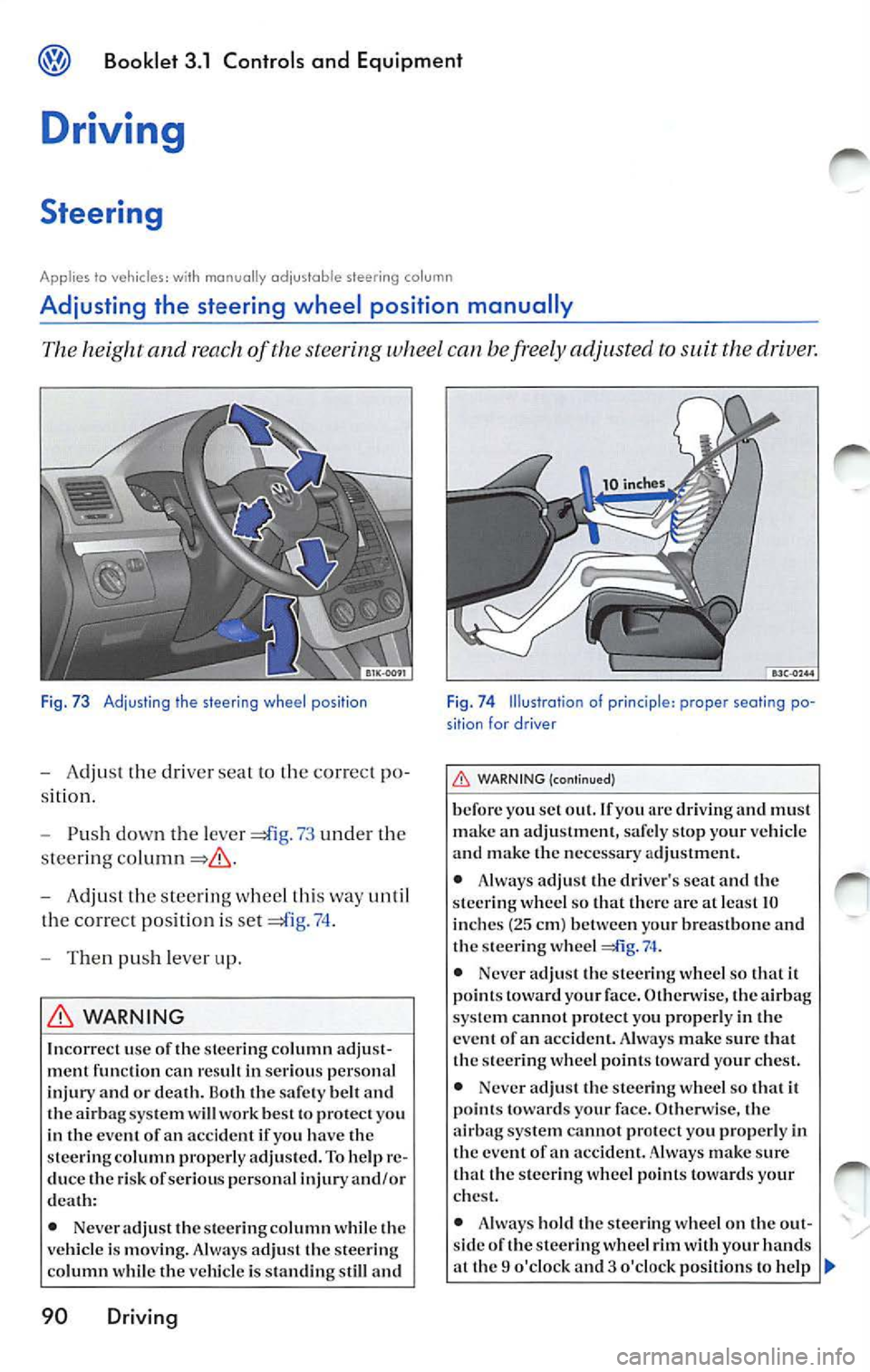
Fi g. 73 Adjusting the stee ring wheel position
- Adj ust the d river sea t to th e cor rect po
s it ion.
- Push dow n the leve r
73 und er th e
s tee rin g
- Adju st th e s teerin g w hee l thi s way until
the corre ct po siti on is se t
74 .
- Then push le ver up .
WARNING
Incorrect use of the steer ing co lumn adjust
ment function can in seriou s per sonal
in ju ry and or death. the sa fety bell and sys tem w ill work best to protec t yo u
in the event of an accident if yo u have the
s teering column properly adjusted. To help re
duce
ri sk of seriou s perso nal injury and /or
death:
• Neve r adjust
steering column whil e vehicle i s moving. Always ad just steering
co lumn whil e the vehicle is standing still and
90 Driving
Fig. 74 Illustratio n of prin ciple: proper seating po
sition for d river
WARN ING (continu ed)
b efore you se t out . If yo u are driving and must
ma ke an adju stment, safely slop your vehicl e
and make
necessary adjustment.
• Always adjust the dri ver 's s cat and the
s teer ing wheel so that there are at leas t 10
in che s (2 5 cm) between your brea stb one and
ste ering whee l
• Neve r adjust the stee ring wheel so Iha! ii points toward your face. Otherw ise, the a irb ag
syste m cann ot prote ct yo u proper ly in
eve nt of an accident. A lway s make sure that steer ing wh eel point s toward your chest .
• Neve r ad just the stee ring whee l so
points towards your face. O then vise, airbag system canno t p ro tect you properl y in eve nt of an accid ent . Always make sure
that the steerin g whe el po int s toward s your
c h es t.
• Alw ays hold
stee ring w heel on out
s id e of steering wheel rim with your hands
a t th e 9 o 'clock 3 o'clock posit ions to help
Page 294 of 477
Booklet 3.1 Controls and Equipment
WARNING (continued)
redu ce the risk of personal inju ry if the
driv er' s ai rbag infl ates.
• Neve r hold the ste er ing wheel at th e 12
o'cloc k po sition or with your hands a t other
positions insid e th e steeri ng whe el rim or on
t he steer ing wheel hub. I-foldin g th e s teerin g
whe el the wro ng way can cau se s eriou s inju-
Safety
WARNING (cont inu ed)
rics to th e han ds, a rms and head the driv er's
a irb ag inflat es.
• After adjus ting th e s teering wheel, always
pus h the stee ring wh eel a dju stment lever back
up as
as it will go. T his en sure s th e po siti on
of the st eering whee l ca nnot be alt ered unin
t e ntionally when the vehicle is moving.
Applies lo vehicles: wi th Electronic S ta biliza tion Progr am (E S P)
Electronic Stabilization Program
ESP helps mak e driving safer in certain situations.
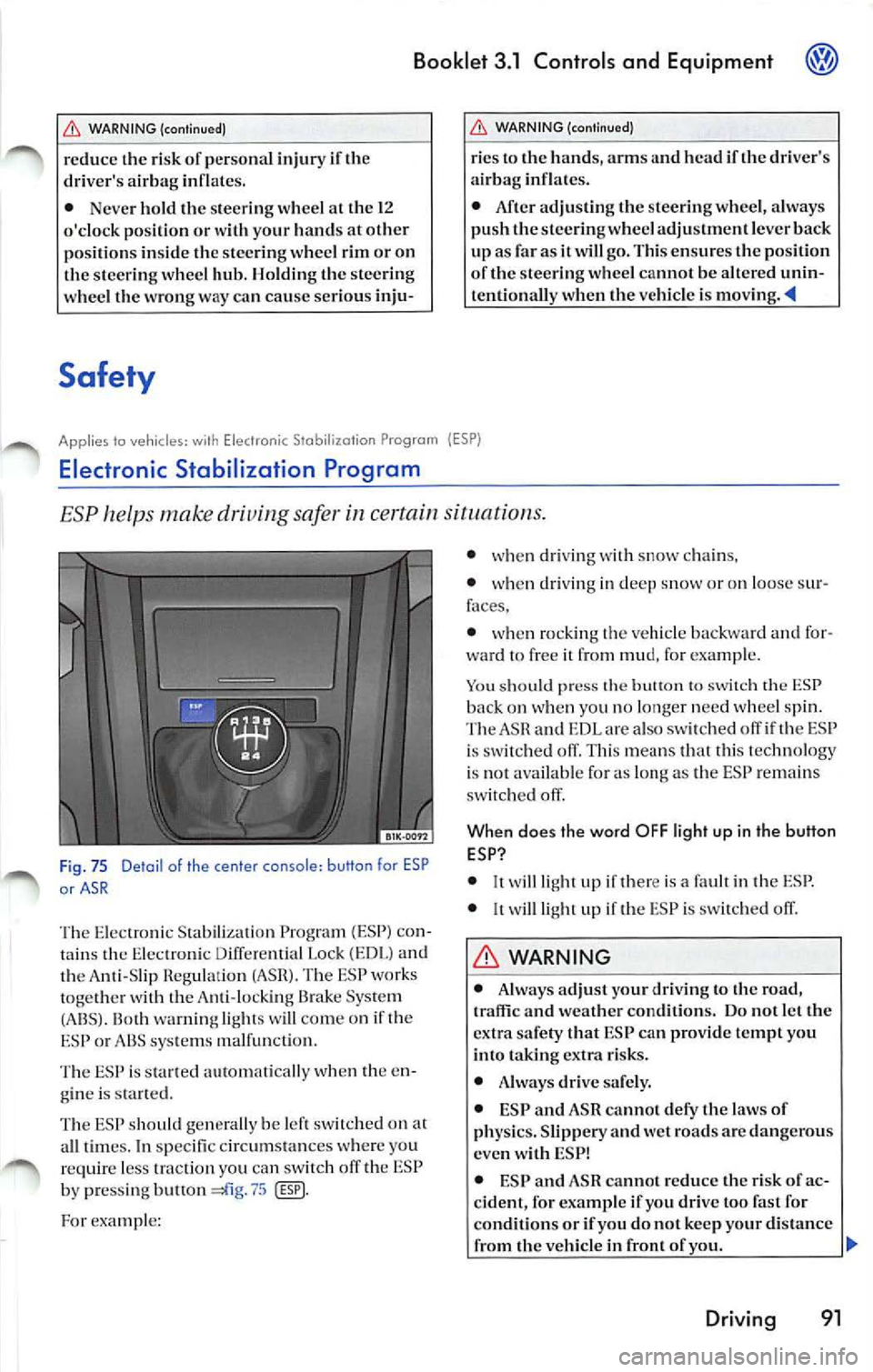
Fi g. 75 D etail of the center console: bu tto n for ES P or ASR
Th e Electro nic Sta biliza tion Program (ESP) co n
tain s th e Ele ctro ni c Diff ere ntial Lock (ED L) and
t h e Anti -Slip Regu la tio n (A SH). Th e ESP works
to ge th er with the Anti -lo ck in g Brake System
( ABS ). Both warnin g lig hts w ill come o n if the
E SP or ABS sys te m s m alfu nct io n .
T he ES P is s ta rt ed a utomat ica lly w hen th e en
g in e is sta rt ed.
The ESP s hou ld ge nerall y be lef t sw itc hed on at
a ll tim es. In sp ecifi c circ um stan ces w here you
r e quir e less tract ion you ca n sw itch off th e ES P
by press ing buu on
75
For example: •
when dri vi ng w ith snow ch ain s,
• when dri vi ng in deep snow or on loo se sur
faces .
• when ro ckin g th e ve hicle backwa rd and for
wa rd to fre e it fro m mu d, for exa mple.
Yo u sh o uld press th e
to swi tc h th e back o n when you no longer need wh ee l spin .
Th e and ED Lare also sw itch ed off if th e ESP
i s sw it c h ed off. This means th at this te chn ology
i s not ava ilab le fo r as lo ng as th e ESP re ma in s
s w itc hed off.
When does the w ord OFF l ight up in the button
ESP?
• will lig ht up if th ere is a fault in the ES P.
• It will li gh t up if the ES P is sw itc hed off.
WARNING
• Always adjust your driv in g to th e road,
t raffic a nd weat her cond itions. Do not l et th e
extra sa fety that ESP can prov ide temp t you
int o tak ing extra risks.
• Always drive safel y.
• ESP and ASR cannot defy the laws of
ph ysics . Slipp ery and wet roads arc dangero us
eve n with ESP!
• ESP and
ca nnot re du ce the risk of ac
cident, for example if you drive too fast for
co nditi ons or if you do not keep your di sta nc e
fro m the vehicle in
of you.
Driving 91
Page 295 of 477
@ Booklet 3.1 Controls and Equipment
WARNING
• Always re memb er th at ve hicl e alterat ion s
or modifi cation s can affe ct the fun cti on of the
ABS, BAS, EDL and ESP syste m s. Examp les o f
the se alterations or modification s include a
different whe el/ tir e co mbination and bra ke or
c h ass is m odifi cation s
3.2 "T ips and
Advi ce", c hapter "Repa irs an d techni cal mod
ifi ca tions."
• Changin g the vehicle su sp ens ion or using
unappro ved tire
I rim combin ation can
c h ange th e wa y th e ABS, BAS, EDL and ESP
sys tem s work and r educe th eir effe cti ve ne ss.
App lies lo vehi cles: with An ti-Slip Regula tion
Anti-Slip Regulation
WARN ING (continued)
• The effec tive ne ss ofESP is also determined
b y th e tir es fitted
3.2 "Ti ps and vice", c hapt er "W hee ls ."
g ine power -even when this is not the bes t thin g
t o do und er th e circu mstan ces .
• After reco nnect ing the v ehicle ba ttery the
ESP warning light in the ins trum ent cluste r w ill
co me on and s ta y o n.
will go o ff afte r you have
d ri ve n abou t 10 feet (3 m eter s) at 10 mph (15 km /h ).
ASR helps make driving safer in certain situation s.
On vehicl es w ith front -whee l dri ve, ASH help s
pr eve nt th e fron t w hee ls from spinnin g when
th e ve hicle is ac ce lerat ed by redu cin g th e e ngine
power dir ecte d to these whe els. T he AS H work s
to ge ther wit h the Anti-L ock B rake Sys tem (ABS).
B o th warn ing ligh ts w ill com e on if th e
or
A BS sys te m s malfun ction.
T he ASH is sta rt ed aut om ati call y wh en th e en
g in e is s tart ed.
T he ASH s hou ld genera lly be lef t sw itch ed on at
all tim es. In specifi c ci rc um sta nces w here yo u
requ ire les s trac tion you ca n sw it c h off th e AS H
b y pr ess ing b utton
91, fig . 75.
For exam ple:
• when dri ving with sno w ch ain s,
• whe n dr iv in g in dee p s now or o n loo se s ur
faces,
• when roc king the ve hicl e ba ckw ar d and for
war d to free it from mud, for examp le.
Yo u sh ould pre ss the butt on
to sw itch th e back on when you no lo nger nee d w hee l s pin .
Th e EDL is al so sw itch ed off if th e ASH is
swi tche d off . Thi s m ea ns that this tec hn ology is
n ot ava ilable for as lo ng as the ASR remains
sw itched off .
92 Driving
When doe s the word OFF light up in the button ASR?
• It will lig ht up if there is a in the
• It will lig h t up if th e AS R is sw itch ed
WARNING
• Alwa ys adju st yo ur dri vin g to the road, and weather conditions. Do not l et the
ex tra safe ty th at ca n provide te mpt you
into t aking extra risk s.
• Alw ays dri ve safel y.
• ASH ca nnot defy th e la ws of ph ysics. S lip
p ery an d we t roads arc dangerou s eve n wi th
• cann ot r edu ce the risk of accident , for
exa mpl e if yo u dri ve too fast for conditions or
if yo u do not k eep your dista n ce from the
hicl e in fr ont of you.
WARNING
• re m em be r that vehicl e alterations
or mod ifica tions can affec t th e fun ction of the
ABS , BAS , EDL and ASR systems. Examp les of
th ese a .Itera tion s or modifi cations include a
Page 297 of 477
Booklet 3.1 Controls and Equipment
&. WARNING (continued)
dows can be opera te d l eading lo serio us per
so nal inju ry.
• Neve r leave ch ildren, disa bled perso ns or
anyone who cann ot help themselves in the ve
hicle. The door s can be lo cke d using the re
mote control key. This could resu lt in people
b ein g trapped in the vehicle in an emerge ncy.
example, depend ing o n the time of year,
peo ple trapped in the vehicle ca n be expose d
t o very high or low tem pera tures.
• Never remove the key from steering lock
w hil e th e vehi cle is mo ving or wh ile it is ro lling
t o a stop . The steer ing w hee l co lumn will loc k
Applies lo vehic les: with on aulomalic lransmission
Safety interlock for ignition key
WARN ING (continued)
up and you w ill not be abl e to steer or contro l
the vehicl e.
your vehicl e (key positio n
Tips
If you ope n the dr iver's door with the ke y still in
th e igniti on l ock, a buzze r w ill so und to r emind
yo u
ta ke the ke y and lock your ve hicle. -4
The ignition key can only be taken of the ignition lock if the selector lever is in
the P position.
-Switch the ign ition.
- Mo ve the selec tor le ver
102 to P
(Pa rk).
Electronic immobilizer
- Remove the key. Thi s locks the selecto r
lever.
-4
The immobilizer helps to prevent use of the vehicle.
The re is a chip in the key that automati call y de
ac tiva tes the imm obilizer w hen you p ut th e key
into the igni tion lock.
T he electronic immobili ze r is automaticall y
tivated w hen you tak e the key out of the ignition
lu ck.
94 Driving
Th e engine can only be s tart ed using a genuin e
and correc tly co ded Volkswagen key.
Tip s
You can on ly start the e ngin e with
co rrec tly ge nuin e Volk swagen k ey. You may have
prob lems starting t he ve hicle if ge nuin e and
c orre ctl y co ded Volkswagen key is no t u sed. -4
Page 300 of 477
Booklet 3.1 Controls and Equipment
Switching off the engine
- Let the vehicle come to a complete stop.
- Turn the ignition key to position
93, 76
WARNING
Never switch off the engine before the vehicle
ha s come to a com plete stop. You can lose co n
of the vehicle, crash and be ser iously in
jured.
Manual transmission
Applies to vehicles: with monuol
WARNING (continued]
• The airbags and safety belt pretensioners will not wo rk when the ignition is switch ed off.
• The brake booster docs not work when the
engine is turned off. A lot more
pedal
pressure will be necessary to stop the vehicle.
• The power steer ing system docs not work
w hen the engine is turned off and you will
ne ed mor e force to stee r the vehicle.
• When the key is removed, lhc steering
whee l co lumn will lock up and you will not be
ab le to steer the veh icle.
engin e could ov erh eat w hen it is
s wi tc h ed off . To r edu ce the ri sk of en gine
dama ge, be sur e
to le t th e engine id le for ab out 2
minut es before yo u sw it c h it off._.
5-speed and 6-speed manual transmissions
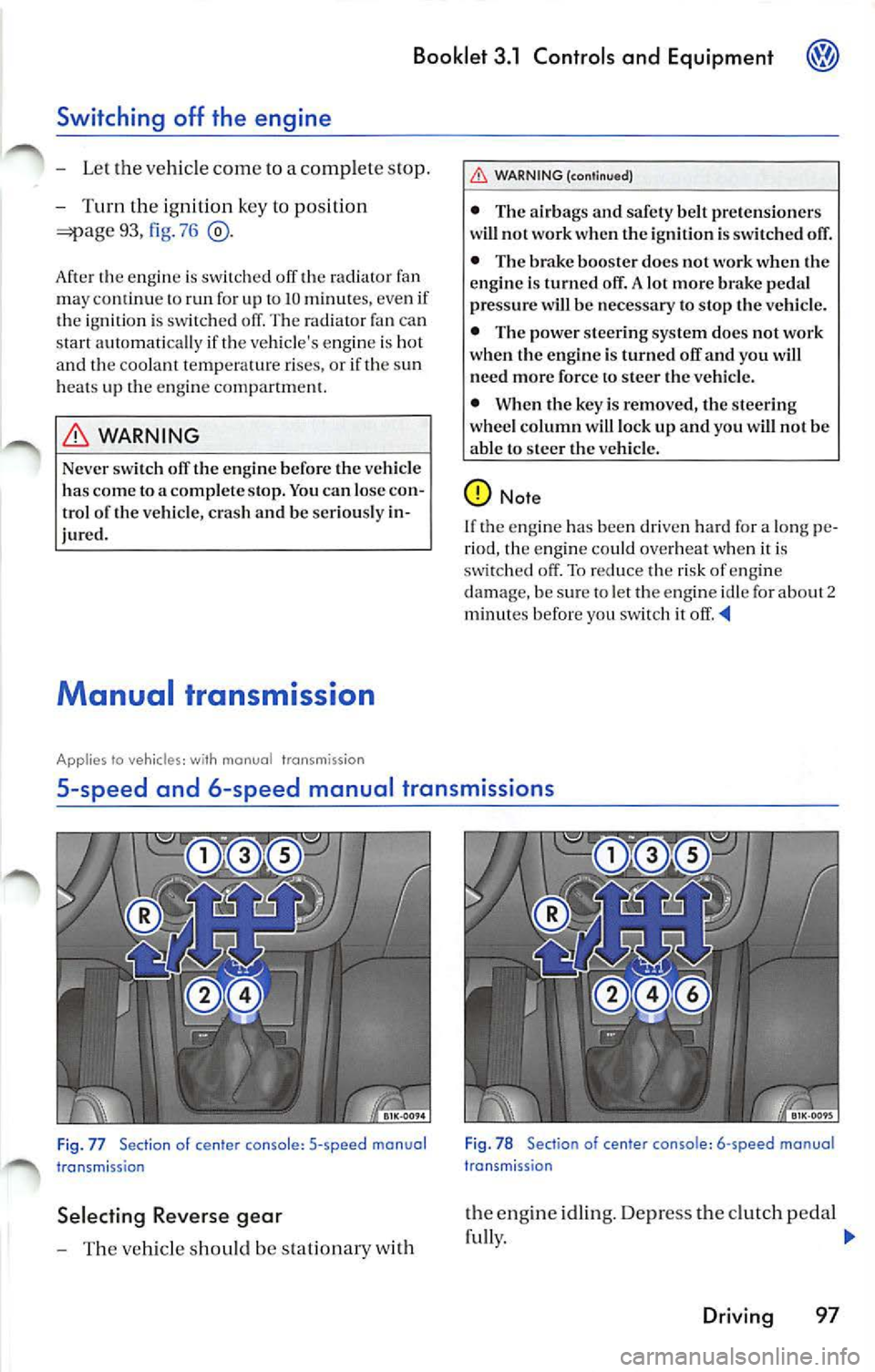
Fig. 77 Section of center console : 5- speed manual
transm ission
Selecting Reverse gear
- The ve hicl e shou ld be stat ionary w ith
Fig. 78 Section of center console : 6 -speed manual
t ransm issio n
the eng in e idli ng. Depr ess the clutch p edal
fully. ._
Driving 97
Page 303 of 477
Booklet 3.1 Controls and Equipment
Stopping on an incline
- You should always hold the veh icle in
posit ion with th e footbrake to sto p it from
"ro lling backward".
- Do not try to stop th e veh ic le from
"ro lling backward" by increasing the revs
w hen a gear is
Moving away on an incline
- With a gear en gaged, rake your foot
from th e brake and depress t he accele r
a tor.
The steepe r the gradient, the lowe r the ge ar you
will need . This increases the brakin g effect of the
e n gin e. For exampl e, yo u should drive clown a
very steep s lo p e in 3rd gear. If the engin e brak e
effect is not suffi cient , th e ve hicle wi ll gain
speed. Th e auto matic transmi ssion
I direct shi ft
ge arbox automaticall y upshift s to prev ent the
e n gine from overr eving. U se the foot b rake to re
duce speed a nd chang e into 3rd gear using "T ip
tronic
Your veh icle has an A utomat ic Shift Lock (ASL )
t h at lo cks the sel ector lever in P or N when th e
ignition is o n. You mu st depr ess th e brake pedal
t o mov e the selec tor le ve r out of P or N. Thi s pre
ven ts the selector le ve r from b ein g unintention
a lly mov ed in to
driv ing pos ition resulting in
unwanted vehicl e movement.
A lway s hold the ve hicle
the foot if you
s top while driv ing up hill to preve nt from
rolling backward.
T he ignition ke y cannot be re m ov ed unl ess the
se lector le ver is in P.
WARNING
Unintended ca n ca use rious persona l inju ry .
• Neve r get out of the driver's seat when the
eng ine is runnin g, espe cially w hen it is in ge ar.
If yo u mu st lea ve yo ur vehicle w ith th e engine
runnin g, alwa ys se t the parki ng brake firml y
and m ove the se lec tor lever to P (Par k).
• When the en gine is runnin g wit h th ese
l ec tor lever in a driving po sition (D (Dr ive), S
(S port ) or R (Revers e) always de press and ho ld
100 Driving
WARN ING (continued)
the brake pedal lo keep the vehicl e from
mo vin g. Power is transmitted to th e wh eels
when a driving position is se lec ted a nd th e ve
hicl e m ay "creep" even a t idle spe ed.
• Neve r depr ess the acce lerato r w hen
mo vin g th e se lec tor leve r.
• Neve r move the selecto r leve r to R (Re
verse) or P (Park) when th e ve hicle i s moving.
WARNING
Neve r sw itch off the e ngi ne be fore the vehicle
ha s co me to a co mplete sto p. Y ou ca n lose co n
trol of the vehicle, crash and be se riou sly in
jured .
• Th e airbags and safe ty belt pr ete n sio ners
w ill not work when the ig niti on is sw itched
• Th e brak e booster does no t wor k w hen th e
e n gin e is turn ed oil A lot m ore brak e peda l
press ure w ill b e necessary to stop th e ve hicl e.
• The power steering system does not work
when t he eng ine is turn ed
and you w ill
ne ed more force to steer the vehicle.
• When th e key is removed, the s teer ing
w hee l co lumn will lock up and you w ill not be
able to stee r th e ve hicl e.
• Never co as t do wn a slo pe with the t rans
mi ssion in Neu tral.
Not e
• If you stop the ve hicl e on gradi ent, d o not
attempt to stop it rollin g by depres sin g th e
a cce le rat or wh en a gear has be en sel ec te d. Th e
a u tomatic tra nsmi ssio n
I direc t sh ift gearb ox
co uld ove rheat an d be damag ed . Pu ll th e
parking brake on fully or depr ess the brak e pedal
t o pr eve nt th e v ehicl e from
• :-lever let th e vehicle roll down a hill with the
s electo r lev er i n N and the engine swi tched off .
Thi s w ill dam age th e a utomati c tran smi ssion
I d ir ec t shift gearb ox.
Tip s
• If th e sele ctor l ev er is un intentiona lly mo ved
int o N whil e dr ivi ng, tak e your foot off the acce l
erato r peda l and wait unt il the eng ine s peed has
dropp ed to id le s peed b efo re se lectin g a drivi ng
po sition.
Page 306 of 477
Booklet 3.1 Controls and Equipment
has bee n se lec te d in ad dition to po siti on D 83 .
If po sit io n N h as been selec te d and you wi sh to
se le ct D , yo u mu st pre ss the foot brake if th e ve
hi cle is stat io nary, or travellin g at under 5 km/h
( approx. 3 mph )
S - standard dri ving posit ion {sport program)
If y ou s ele ct t he sport pro gra m yo u will be
dri ving in a sport y mode . A ll forward gear s
shift and down shift automat ically at high er en
g in e s pee ds dep ending on en gin e load , you r in
di vid ual d rivin g sty le and th e ve hicle sp ee d.
W hile dr iv ing downh ill in S, the engin e docs not
the veh icle. Th e displa y al so sh ow s wh ic h
ge ar ha s be en se lec te d in addit io n t o po siti on S .
WARNING
Neve r switch off the engine before the ve hicle
ha s come lo a complete stop. You can lose co n
trol of the vehicl e, crash and be ser iously in
jured.
• The airb ags a nd safe ty bell pretensioners
w ill n ot work when the igniti on i s swi tched off.
• The br ake boo ster do es no t work when the
eng ine i s turn ed off. A lot mor e brak e pedal
pressure will be necessary to stop th e vehicle.
• The power steer ing system does not work
w hen the engine is turn ed off and you will
n eed more force to steer th e ve hicl e.
Applies to vehicles: with on a utoma tic trans missio n
Kick-down function
WARNI NG (continued)
• When the key is removed, th e steer ing
w hee l co lumn will lo ck up and you will not be
able to stee r th e ve hicle.
• Never coast down a slop e w ith th e trans
mi ssio n in Ne utral.
Tips
• If th e selec to r lev er i s un inte nti onal ly mo ved
int o N wh ile dri ving , take your fo ot off t he acc el
era to r p eda l a n d wa it until th e engi ne spee d has
dropp ed to idl e sp ee d before sele c tin g a dri vin g
po sition .
• If th ere is
fa ult in th e sys te m and th e auto
mati c tra nsmi ssion I dir ect shift gearbox is run
n in g in an emergen cy program if all the displays
of the s elector leve r position s for the au tomat ic
tr ansmi ss ion
I di rec t s hi ft g ea rb ox have light
ba ckg ro un d. The a utoma tic tran smi ssio n I di
r ec t shift gearbo x shou ld be c hec ked b y an au
thori zed Vo lkswage n dea ler as soon as
po ssibl e._.
Th e kick -down permits maximum a ccele ration the se lector lev er
is
D, So r
down, th e tran smi ssion p ermi ts a c
c e le ratio n. The tran smi ssio n aut om atica lly
down shift s, de pending on the road spe ed as we ll
a s th e eng ine sp ee d.
Th e tra nsmi ssion
not up sh ift until the en
g in e reac hes the engin e s pee d for th e
g ear sele ct ed .
WARNING
Accelerating on slippe ry road s can cause lo ss
of ve hicle control and serious per sonal injury.
• Be very careful when u sin g th e kick -do wn
especi all y o n sli ppery sur faces. Rapid
accelera tion may ca use w hee l spin and sk id
d in g.
• Use the kick-down fea tur e o nly w hen
and weather conditions permit
Driving 103
Page 309 of 477

Booklet 3.1 Controls and Equipment
Electronic Parking Assistance
Applies to wit h E le ctro nic Perk ing Assis tance
Description of Electronic Parking Assistance
The Electronic Parking Assistance is a parking aid, which draws to
obstacles.
The electro nic parking a ssistanc e he lps th e
dr iver when parking the ve hicle. Th e driv er is
fo rm ed or warned by audibl e signals that hide is approac hing behind ve·
hide. The clo ser yo ur vehicle approach es
obstacle, quicker aud ible sig nal s w ill
so und. Th e audib le s ig nal will sound continu ·
o usly if lh e obs tacle i s very near.
It uses ultrasonic senso rs in rea r bumpers to
measure distanc e lo obstacle s.
Th e se nso rs ar e
lrans miller s and rece ive rs
o f ult rasoun d waves. The e lec tronic syste m s
uses ultra sou nd waves (i.e. transm iss ion, r e·
fl ec lion from th e obstacle a nd rece ption) to
th e di stance th e vehicle and obstacle .
O nc e yo ur vehicl e is very close lo
obstacle, will no longer be det.ec tccl and you
co uld cau se damage lo vehicl e. Always pay
close attention lo audibl e signals lo help you
park your vehicl e.
Switching on the electronic parking assistance
The parking distan ce warni ng
is
s witched on when reverse gea r is selected
and when i g niti on i s on. An audible sig nal is
g iv en. I f yo u do not h ear th is acoustic sig nal.
parking di stan ce wa rning sy stem is n ot on. Hav e sys tem insp ec ted b y yo ur au rized Vo lk swagen deal er.
106 Driving
Switching off the electronic parking assistanc e
Th e parki ng ass istanc e is
off when th e
r e ver se gear is desele cted.
WARNING
The elec troni c parking cannot re
p lace the driver's assessmelll of situation.
T he dri ver is per sonally respons ible for safe
parking and other maneuver s.
• The sensor s ha ve blind spot s in which ob
s tacles an d people are not registered.
•
p arti cul arly aware o f sm all children or
animals when backing up. The sens ors may
not always be abl e to det ect them.
may not way s be abl e dete ct object s such a s draw bar s, thin rails, fences, po sts e tc .
T hi s co uld resu lt in da mag e lo your car.
• The electroni c pa rking as sis tance work s on ly
al sp eeds of und er about 9 mph (15 km/h ).
• The elec troni c park ing senso rs in th e
bump ers mu st be k epl clea n and free of i ce.
When cleanin g wi th pre ssure hoses and
cleaner s, lhe sensors sh ould b e spra yed on ly
b riefly. A distan ce of a t least 0.3 ft. (0. 1 m ete rs)
betwee n th e se nso rs and I hose
nozz le must b e ob se rved.