2009 SUBARU TRIBECA Heat
[x] Cancel search: HeatPage 380 of 2453

AC(diag)-3
General Description
HVAC SYSTEM (AUTO A/C) (DIAGNOSTICS)
2. General Description
A: CAUTION
1) Never connect the battery in reverse polarity.
•Auto A/C control module may be destroyed in-
stantly.
2) Do not disconnect the battery terminals while the
engine is running.
•A large counter electromotive force will be gener-
ated in the generator, and this voltage may damage
electronic parts such as auto A/C control module
etc.
3) Before disconnecting the connectors of each
sensor and the auto A/C control module, be sure to
turn the ignition switch to OFF.
•Auto A/C control module may be damaged.
4) Every A/C-related part is a precision part. Do not
drop them.
5) Airbag system wiring harness is routed near the
A/C control panel and junction box.
CAUTION:
•For airbag system, yellow-colored wiring har-
ness and connectors are all used. Do not use
the electrical test equipment on these circuits.
•Be careful not to damage the airbag system
wiring harness when servicing the A/C control
panel and junction box.
B: INSPECTION
Before performing the diagnosis, check the follow-
ing items which might affect A/C system problems.
1. BATTERY
1) Measure the battery voltage and specific gravity
of electrolyte.
Standard voltage: 12 V
Specific gravity: 1.260 or more
2) Check the condition of the fuses for A/C system
power supply and other fuses.
3) Check the condition of harness and harness
connector connections.
2. ASPIRATOR HOSE
1) Turn the ignition switch to ON, and press the A/
C switch.
2) Turn the temperature control dial to maximum
hot position.
3) Turn the air flow control dial to “DEF” position.
4) Turn the fan speed control dial to 4th position.
5) Put a strip of paper close to the front side of in-
vehicle sensor suction port (A) located in the driv-
er’s side console side panel, and check that air is
being sucked into the port by seeing the paper
moving towards the port.
NOTE:
Be careful not to let the paper get sucked into the
port.
6) If the paper does not move at all, remove the
driver’s side console side panel
connection of the aspirator hose, in-vehicle sensor
and heater unit, and repair them if necessary.
3. A/C LINE
Check the connection for A/C line (A) and lower
side high-pressure pipe.
AC-01323
AC-01324
(A)
Page 381 of 2453

AC(diag)-4
General Description
HVAC SYSTEM (AUTO A/C) (DIAGNOSTICS)
4. CONTROL SWITCHES
Start the engine and warm-up completely.
1) Inspection using switches
2) Compressor operation inspection
3) Inspection of illumination control
No. Point to check Switch operation Judgment standard
1OFF switch Press the OFF switch.
Setting temperature display goes out.
•Blower fan: OFF
•Inlet opening: FRESH
•Compressor: OFF
2
AU TO sw it c h, d r iver ’s
side temperature con-
trol dial and passen-
ger’s side temperature
control dial
1) Press the AUTO switch.
2) Turn the temperature control dial to the left
fully, and set to 18°C (65°F) (maximum cool posi-
tion).
AU TO di sp l ay i l lu mi n at e s.
•Outlet air temperature: COOL
•Blower fan: HI (AUTO)
•Outlet opening: FACE
•Inlet opening: AUTO
•Compressor: AUTO
3) Turn the temperature control dial to the right
slowly, and change the setting from 18°C (64°F)
(maximum cool position) to 32°C (85°F).
•Outlet air temperature: COOL → HOT
•Blower fan: AUTO
•Outlet opening: FACE → B/L → FOOTHEAT
•Inlet opening: AUTO
•Compressor: AUTO
4) Turn the temperature control dial to the right
fully, and set to 32°C (85°F) (maximum hot posi-
tion).
•Outlet air temperature: HOT
•Blower fan: HI (AUTO)
•Outlet opening: HEAT
•Inlet opening: FRESH (AUTO)
•Compressor: AUTO
3Defroster switch Press the defroster switch.
Defroster switch indicator illuminates.
•Outlet air temperature: AUTO
•Blower fan: AUTO
•Outlet opening: DEF
•Inlet opening: FRESH
•Compressor: ON
4FRESH/RECIRC
switchPress the FRESH/RECIRC switch.
Inlet opening switches RECIRC → FRESH or
FRESH → RECIRC each time pressing the
switch.
5MODE switch Press the MODE switch.Outlet opening switches FACE → B / L → HEAT
→ D/H each time pressing the switch.
6FAN switch Turn the FAN switch.
Blower fan switches OFF → LO → M1 → M2
→ M3 → M4 → HI each time turning the
switch and it switches in reverse order when
turned backward.
No. Point to check Switch operation Judgment standard
1Compressor1) Turn the A/C switch to ON.
2) Set the FAN switch between LO and HI.Compressor: ON
No. Point to check Switch operation Judgment standard
1Illumination Turn the lighting switch to ON. Illumination comes on.
Page 385 of 2453

AC(diag)-8
Auto A/C Control Module I/O Signal
HVAC SYSTEM (AUTO A/C) (DIAGNOSTICS)
4. Auto A/C Control Module I/O Signal
A: ELECTRICAL SPECIFICATION
Te r m i n a l N o . D e s c r i p t i o n M e a s u r i n g c o n d i t i o n S p e c i f i c a t i o n
A1 Battery power supply Ignition switch: OFF Battery voltage
A2 ACC power supply Ignition switch: ACC Battery voltage
A3Mode door actuator position sig-
nal
Mode door: FACE position 4 V
Mode door: DEF position 1 V
A4Passenger’s side air mix door
actuator position signal
Air mix door: Maximum cool position 4 V
Air mix door: Maximum hot position 1 V
A5 In-vehicle sensor Ignition switch: ON Less than 5 V
A6 Sunload sensor Ignition switch: ON, With Sunload (No sunload: 0.8 V) 3 V
A7Driver’s seat heater temperature
sensorIgnition switch: ON Less than 5 V
A8 Sensor power supply Ignition switch: ON 5 V
A9 Ignition power supply Ignition switch: ON Battery voltage
A10 A/C cut signalIgnition switch: ON Battery voltage
When pressure SW is operating 0 V
A12Driver’s side air mix door actuator
position signal
Air mix door: Maximum cool position 4 V
Air mix door: Maximum hot position 1 V
A13 Evaporator sensor Ignition switch: ON Less than 5 V
A14Passenger’s seat heater tempera-
ture sensorIgnition switch: ON Less than 5 V
A15 Sensor ground Continuity to chassis ground 0 Ω
A16 Ground Continuity to chassis ground 0 Ω
B1 CAN communication (HI side) Ignition switch: ON Pulse signal *1
B2Blower motor voltage feedback
signal
Blower level: Manual Lo 7.6 V
Blower level: Manual M3 3.7 V
Blower level: Manual Hi Less than 1 V
B3Blower motor power MOS gate
control signalIgnition switch : ON, Blower switch : ON1 V — battery
voltage
B6 Magnet clutch signalTe m p e r a t u r e s e t t i n g : M a x i m u m C O O L , M O D E : M a n u a l
DEF, A/C: ONBattery voltage
AC-01334
10
20 19 18 17 16 15 14
13 12 11987654 321
1016 15 14 13 12 119
87654 321
B: B283
A: B282
232122242526
Page 386 of 2453

AC(diag)-9
Auto A/C Control Module I/O Signal
HVAC SYSTEM (AUTO A/C) (DIAGNOSTICS)
*1: Unable to measure the voltage for digital signal.
*2: Voltage immediately after switching FACE ⇔ DEF or maximum COOL ⇔ maximum HOT (when the damper door is operat-
ing.) for mode door and air mix door
*3: Voltage immediately after the operation for the seat heater (Always measure the voltage immediately after turning the seat
heater to ON because once reached to the target value, it switches to ON/OFF action.)
B: WIRING DIAGRAM
1. AIR CONDITIONER AUTO A/C MODEL
B7Mode door actuator power supply
(FACE)
When switching mode door from DEF → FACE
Battery voltage
— 2.5 V or more
*2
When switching mode door from FACE → DEF Less than 1 V *2
B8
Passenger’s side air mix door
actuator power supply (COOL
side)
When switching air mix door from HOT → COOL
Battery voltage
— 2.5 V or more
*2
When switching air mix door from COOL → HOT Less than 1 V *2
B9Driver’s side air mix door actuator
power supply (COOL side)
When switching air mix door from HOT → COOL
Battery voltage
— 2.5 V or more
*2
When switching air mix door from COOL → HOT Less than 1 V *2
B10 Inlet opening motor (FRESH side)FRESH Less than 1 V
RECIRC Battery voltage
B11 Driver’s seat heater Driver’s seat heater: ON (3 stages) Less than 1 V *3
B13 Passenger’s seat heater Passenger’s seat heater: ON (3 stages) Less than 1 V *3
B14 CAN communication (Lo side) Ignition switch: ON Pulse signal *1
B16 Blower motor relayBlower motor: Stopped Battery voltage
Blower motor: Operated Less than 1 V
B18Panel communication (transmitter
side)Ignition switch: ON Pulse signal *1
B19Panel communication (receiver
side)Ignition switch: ON Pulse signal *1
B20 Mode door (DEF) side
Mode: DEF ⇒ FACE Less than 1 V
Mode: FACE ⇒ DEFBattery voltage
— 2.5 V or more
B21 Passenger’s side air mix door
Air mix: Maximum HOT ⇒ maximum COOL Less than 1 V
Air mix: Maximum COOL ⇒ maximum HOTBattery voltage
— 2.5 V or more
B22 Driver’s side air mix door
Air mix: Maximum HOT ⇒ maximum COOL Less than 1 V
Air mix: Maximum COOL ⇒ maximum HOTBattery voltage
— 2.5 V or more
B23Inlet opening motor (RECIRC
side)
RECIRC Less than 1 V
FRESH Battery voltage
B24 Driver’s seat heater ground Continuity to chassis ground 0 Ω
B25 Passenger’s seat heater ground Continuity to chassis ground 0 Ω
Te r m i n a l N o . D e s c r i p t i o n M e a s u r i n g c o n d i t i o n S p e c i f i c a t i o n
Page 389 of 2453

AC(diag)-12
Diagnostic Chart for Self-diagnosis
HVAC SYSTEM (AUTO A/C) (DIAGNOSTICS)
2. SWITCH CHECK TABLE
Switch Display screen Switch Display screen
A/C switch (6) FAN switch (+) (4)
AU TO sw i t ch ( 1 ) FA N sw it ch ( –) (3 )
Air flow control switch (9)Driver’s side temperature con-
trol dial
Right rotation (11) Left rotation
(12)
FRESH/RECIRC (13)Passenger’s side temperature
control dial
Right rotation (5) Left rotation
(10)
Defroster switch (7) OFF switch (2)
Rear defogger switch (8) Driver’s seat heater switch (14)
Passenger’s seat heater
switch(15)
AC-01333
(7)(8)
(6)(1)
(13)(4)(3)
(9)
(2)
(15)(14)
(12)
(11)
(10)
(5)
Page 391 of 2453

AC(diag)-14
Diagnostic Chart for Self-diagnosis
HVAC SYSTEM (AUTO A/C) (DIAGNOSTICS)
4. SENSOR CHECK TABLE
NOTE:
When the sunload sensor check is performed indoors or in the shade, it could be diagnosed as having an
open circuit. Always check the sunload sensor with the sun shining on it.
*1: “AUTO” display does not blink when past malfunction occurred. Past malfunction means that abnormal signals were contin-
uously input for a certain time in the past.
*2: Present malfunction only is displayed for sunload sensor open circuit.
5. OPERATING MODE TABLE
*Same opening angle for both driver’s and passenger’s side
Display screen (Malfunction at
present) *1Sensor Trouble contents
21/AUTO BlinkIn-vehicle sensorOpen
–21/AUTO BlinkShort
22/AUTO Blink Ambient sensor Sensor trouble or communication malfunction
23/AUTO BlinkEvaporator sensorOpen
–23/AUTO BlinkShort
24/AUTO Blink Engine coolant temperature sensor Sensor trouble or communication malfunction
25 BlinkSunload sensorOpen *2
–25/AUTO BlinkShort
26/AUTO BlinkDriver's side air mix door actuator
potentiometer
COOL
27/AUTO BlinkHOT
–26/AUTO BlinkPassenger’s side air mix door actua-
tor potentiometer
COOL
–27/AUTO BlinkHOT
28/AUTO BlinkMode door actuator potentiometerFA C E
29/AUTO BlinkDEF
41/AUTO BlinkSeat heater thermistor (Driver’s
side)
Open
–41/AUTO BlinkShort
42/AUTO BlinkSeat heater thermistor (Passenger’s
side)
Open
–42/AUTO BlinkShort
20 Blink When all conditions are normal
Display screenFRESH/RECIRC
doorMode door Air mix door* Blower fanA/C compressor (Mag-
net clutch)
31 FRESH FACE Maximum cool LO OFF
32 RECIRC FACE Maximum cool LO ON
33 RECIRC FACE Maximum cool M1 ON
34 FRESH B/L 50% M1 ON
35 FRESH HEAT 50% M1 ON
36 FRESH HEAT Maximum hot M3 ON
37 FRESH D/H Maximum hot M3 ON
38 FRESH DEF Maximum hot HI ON
Page 417 of 2453
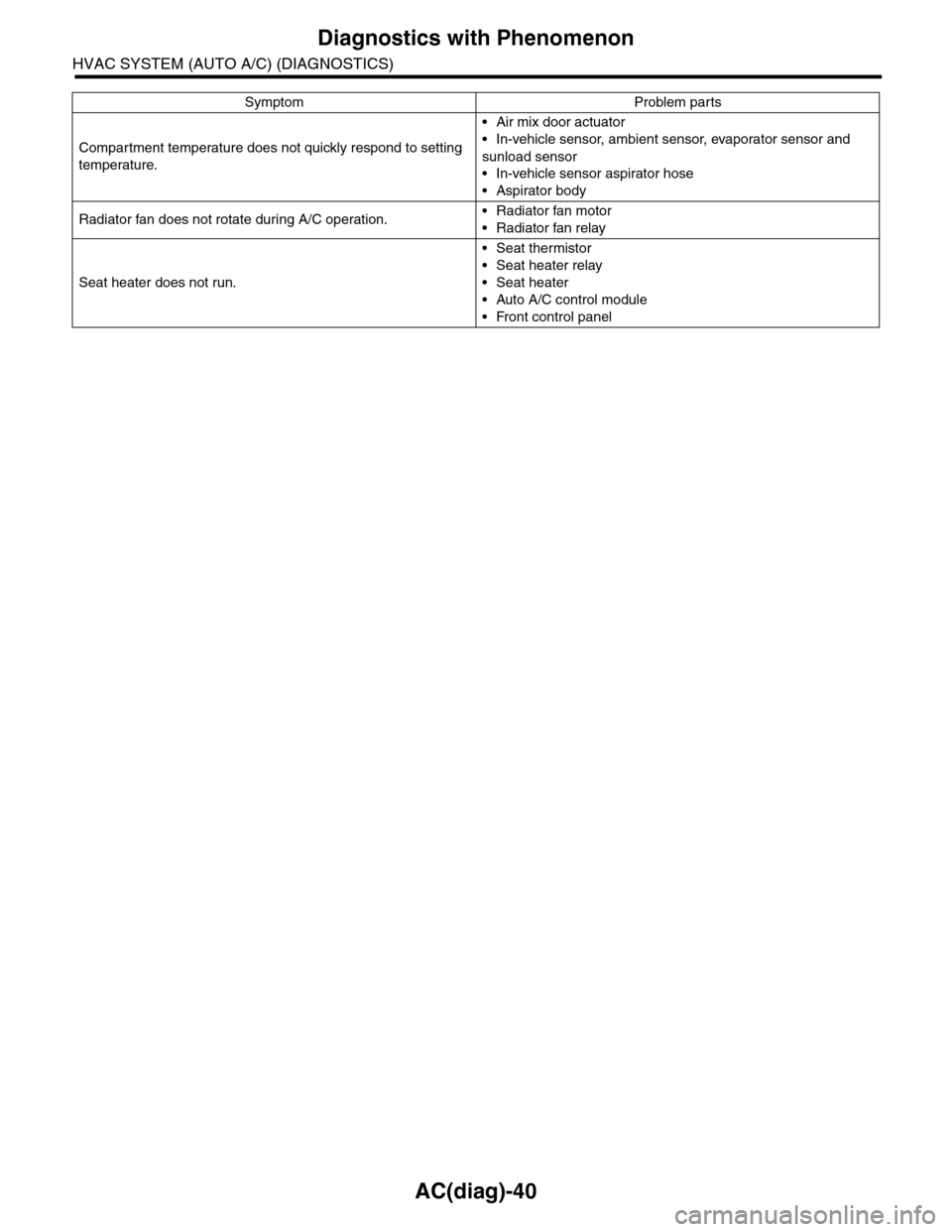
AC(diag)-40
Diagnostics with Phenomenon
HVAC SYSTEM (AUTO A/C) (DIAGNOSTICS)
Compartment temperature does not quickly respond to setting
temperature.
•Air mix door actuator
•In-vehicle sensor, ambient sensor, evaporator sensor and
sunload sensor
•In-vehicle sensor aspirator hose
•Aspirator body
Radiator fan does not rotate during A/C operation.•Radiator fan motor
•Radiator fan relay
Seat heater does not run.
•Seat thermistor
•Seat heater relay
•Seat heater
•Auto A/C control module
•Front control panel
Symptom Problem parts
Page 473 of 2453

LAN(diag)-17
Subaru Select Monitor
LAN SYSTEM (DIAGNOSTICS)
NOTE:
For details concerning operation procedure, refer to the “SUBARU SELECT MONITOR OPERATION MAN-
UAL”.
Number of cylinders 4 cylinders/6 cylinders CAN data input value 6 cylinders
E/G cam shaft specification SOHC/DOHC CAN data input value DOHC
E/G Turbo Turbo/Non-turbo CAN data input value OFF
E/G displacement (2.5 L) 2.5 L/ OFF CAN data input value OFF
E/G displacement (3.0 L) 3.0 L/ OFF CAN data input value 3.0 L
AT / M T i d e n t i f i c a t i o n t e r m i n a l AT m o d e l / M T m o d e l C A N d a t a i n p u t v a l u e AT
E/G cooling fan ON/OFF CAN data input valueNot supported by North American specifica-
tions
Heater cock valve output ON/OFFBody integrated unit output
value
Not supported by North American specifica-
tions
Pow er w i nd ow (U p) O N /O FFBody integrated unit output
value
Not supported by North American specifica-
tions
Pow er w i nd ow (D ow n ) O N /O FFBody integrated unit output
value
Not supported by North American specifica-
tions
Keyless buzzer ON/OFFBody integrated unit output
value
On when keyless answer-back buzzer oper-
ates (when keyless switch connector is
removed)
P/W ECM Failure NG/OK CAN data input valueNot supported by North American specifica-
tions
Keyless Hook SW ON/OFFBody integrated unit input
value
Not supported by North American specifica-
tions
Door lock SW (Open) ON/OFFBody integrated unit input
value
Not supported by North American specifica-
tions
Door lock SW (Close) ON/OFFBody integrated unit input
value
Not supported by North American specifica-
tions
Door Key SW (Open) ON/OFFBody integrated unit input
value
Not supported by North American specifica-
tions
Door Key SW (Close) ON/OFFBody integrated unit input
value
Not supported by North American specifica-
tions
Under hook registration ON/OFFBody integrated unit input
value
Not supported by North American specifica-
tions
Hook registration end ON/OFFBody integrated unit input
value
Not supported by North American specifica-
tions
Unlock request ON/OFFBody integrated unit input
value
Not supported by North American specifica-
tions
Center display failure OK/NG CAN data input valueReception from center display (NAVI moni-
tor and MFD)
NAVI Failure OK/NG CAN data input value Reception from Center Display
IE Bus failure Can not use CAN data input value Reception from Center Display
Auto A/C failure OK/NG C AN data input value Reception from auto A/C module
EBD Warning Light OK/OFF CAN data input valueReception from VDC/ABS and transmission
to combination meter
ABS Warning Light OK/OFF CAN data input valueReception from VDC/ABS and transmission
to combination meter
VDC OFF flag ON/OFF CAN data input valueReception from VDC/ABS and transmission
to combination meter
VDC/ABS OK B OK/NG CAN data input value
Reception from VDC/ABS (When an error is
detected in either of the yaw rate, G sensor,
steering sensor, or pressure sensor)
VDC/ABS condition 0 — 4 CAN data input valueReception from VDC/ABS and transmission
to combination meter
Destination 0 — 16 CAN data input value Reception from combination meter
To u c h S W 0 — 6 4 C A N d a t a i n p u t v a l u e R e c e p t i o n f r o m m o n i t o r ( e x c e p t M F D )
Items to be displayed Unit of measure Description Note