Page 626 of 2453
SE-16
Second-row Seats
SEATS
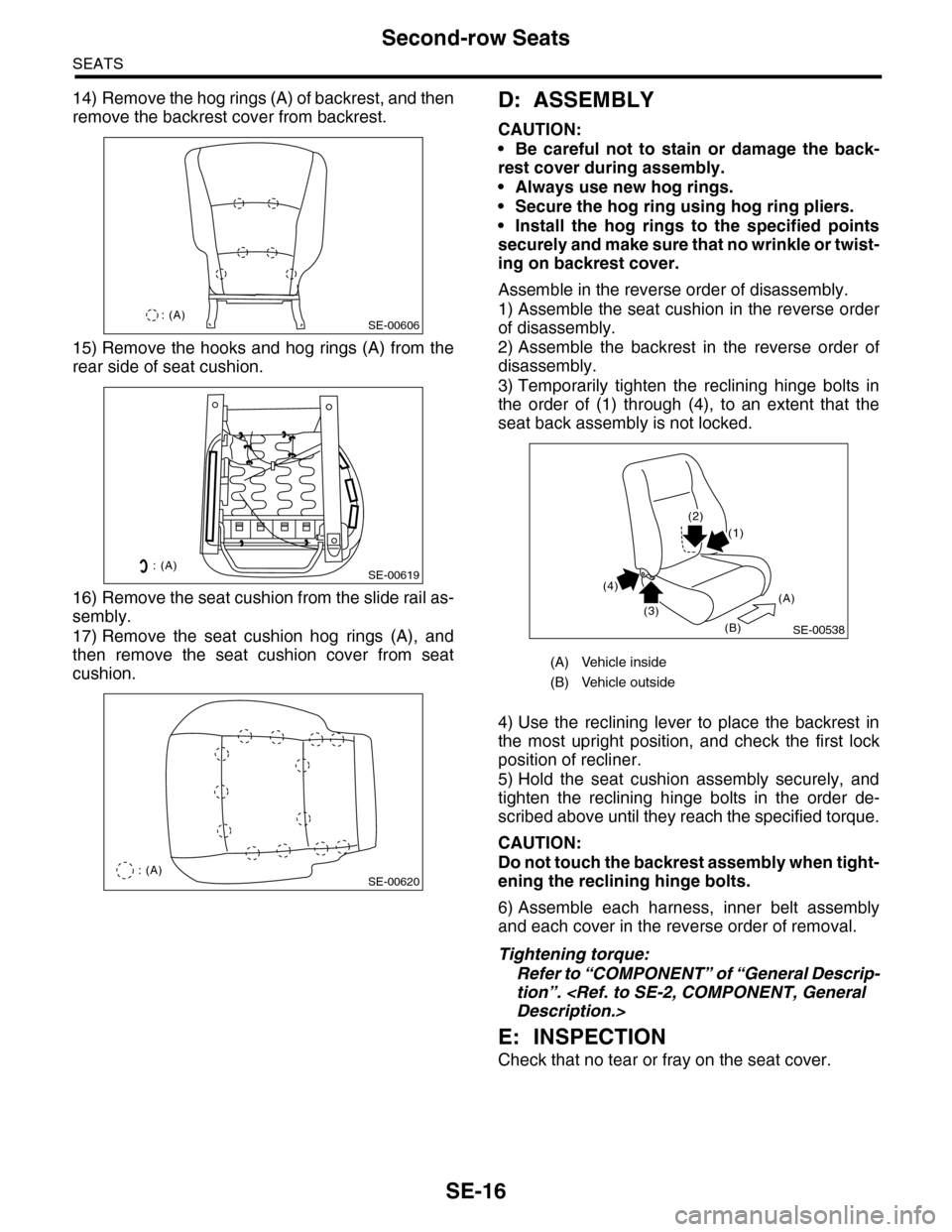
14) Remove the hog rings (A) of backrest, and then
remove the backrest cover from backrest.
15) Remove the hooks and hog rings (A) from the
rear side of seat cushion.
16) Remove the seat cushion from the slide rail as-
sembly.
17) Remove the seat cushion hog rings (A), and
then remove the seat cushion cover from seat
cushion.
D: ASSEMBLY
CAUTION:
•Be careful not to stain or damage the back-
rest cover during assembly.
•Always use new hog rings.
•Secure the hog ring using hog ring pliers.
•Install the hog rings to the specified points
securely and make sure that no wrinkle or twist-
ing on backrest cover.
Assemble in the reverse order of disassembly.
1) Assemble the seat cushion in the reverse order
of disassembly.
2) Assemble the backrest in the reverse order of
disassembly.
3) Temporarily tighten the reclining hinge bolts in
the order of (1) through (4), to an extent that the
seat back assembly is not locked.
4) Use the reclining lever to place the backrest in
the most upright position, and check the first lock
position of recliner.
5) Hold the seat cushion assembly securely, and
tighten the reclining hinge bolts in the order de-
scribed above until they reach the specified torque.
CAUTION:
Do not touch the backrest assembly when tight-
ening the reclining hinge bolts.
6) Assemble each harness, inner belt assembly
and each cover in the reverse order of removal.
Tightening torque:
Refer to “COMPONENT” of “General Descrip-
tion”.
Description.>
E: INSPECTION
Check that no tear or fray on the seat cover.
SE-00606: (A)
SE-00619: (A)
SE-00620: (A)
(A) Vehicle inside
(B) Vehicle outside
(A)
(B)
(2)
(4)
(3)
(1)
SE-00538
Page 627 of 2453
SE-17
Third-row Seats
SEATS
4. Third-row Seats
A: REMOVAL
1) Lift up the front side of the 3rd seat cushion and
then remove the hooks.
2) Lift up the 3rd seat cushion and remove the seat
cushion by pushing it backward to detach the hook.
3) Remove the eight bolts securing the 3rd seat
back.
4) Remove the 3rd seat.
B: INSTALLATION
Install in the reverse order of removal.
Tightening torque:
Refer to “COMPONENT” of “General Descrip-
tion”.
Description.>
C: DISASSEMBLY
1) Remove the 3rd seat.
AL, Third-row Seats.>
2) Remove the headrest.
3) Pull out the seat belt tray.
4) Remove the hog rings (A) on the rear side of
seat cushion.
5) Remove the hog rings (A) on the front side of
seat cushion.
6) Remove the two screws securing the hinge lever
assembly.
7) Disconnect the wire connected to the hinge lever
assembly.
8) Remove the seat back cover.
SE-00621
SE-00622
SE-00623: (A)
SE-00624: (A)
SE-00625
SE-00626
Page 628 of 2453
SE-18
Third-row Seats
SEATS
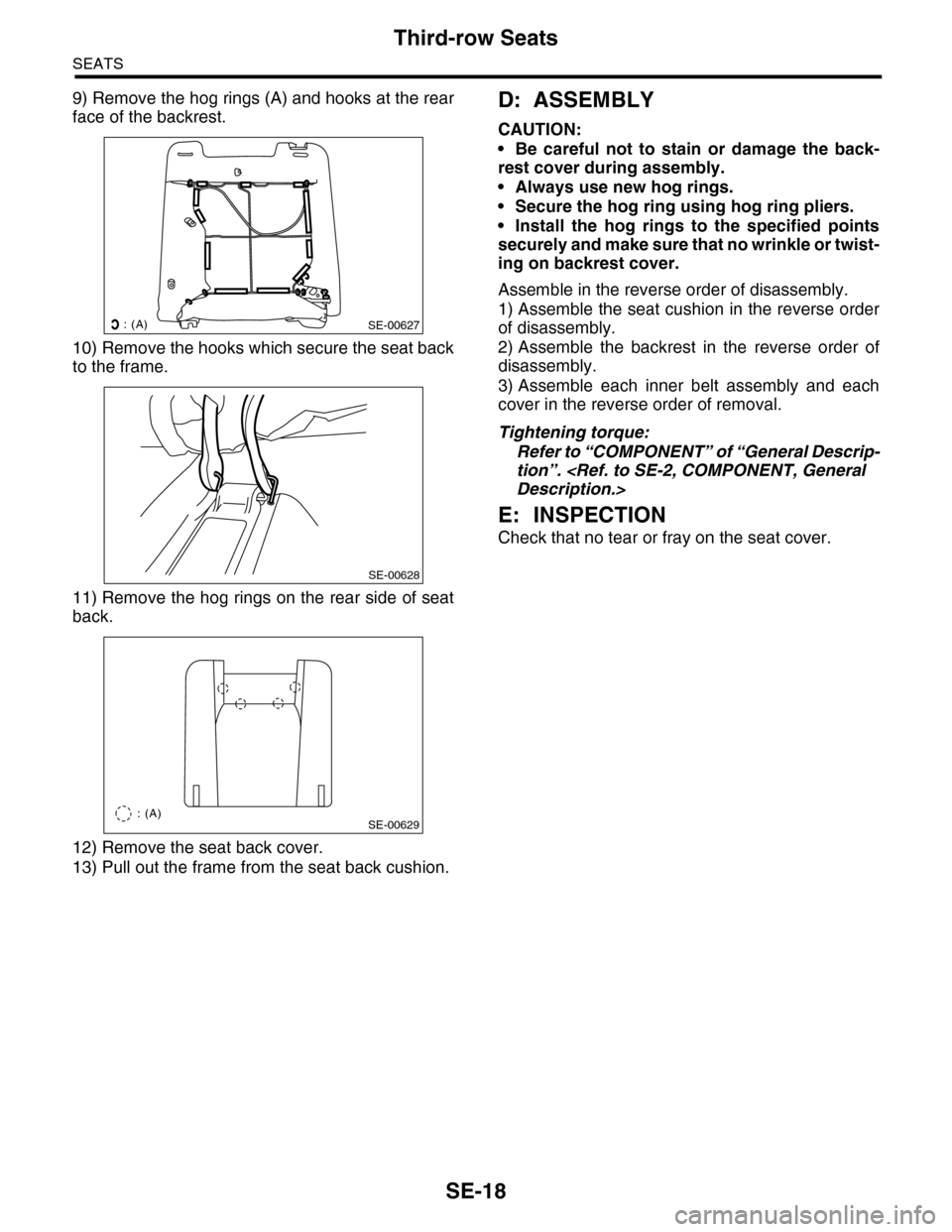
9) Remove the hog rings (A) and hooks at the rear
face of the backrest.
10) Remove the hooks which secure the seat back
to the frame.
11) Remove the hog rings on the rear side of seat
back.
12) Remove the seat back cover.
13) Pull out the frame from the seat back cushion.
D: ASSEMBLY
CAUTION:
•Be careful not to stain or damage the back-
rest cover during assembly.
•Always use new hog rings.
•Secure the hog ring using hog ring pliers.
•Install the hog rings to the specified points
securely and make sure that no wrinkle or twist-
ing on backrest cover.
Assemble in the reverse order of disassembly.
1) Assemble the seat cushion in the reverse order
of disassembly.
2) Assemble the backrest in the reverse order of
disassembly.
3) Assemble each inner belt assembly and each
cover in the reverse order of removal.
Tightening torque:
Refer to “COMPONENT” of “General Descrip-
tion”.
Description.>
E: INSPECTION
Check that no tear or fray on the seat cover.
: (A)SE-00627
SE-00628
SE-00629: (A)
Page 629 of 2453
SE-19
Seat Heater System
SEATS
5. Seat Heater System
A: REMOVAL
1. SEAT HEATER UNIT
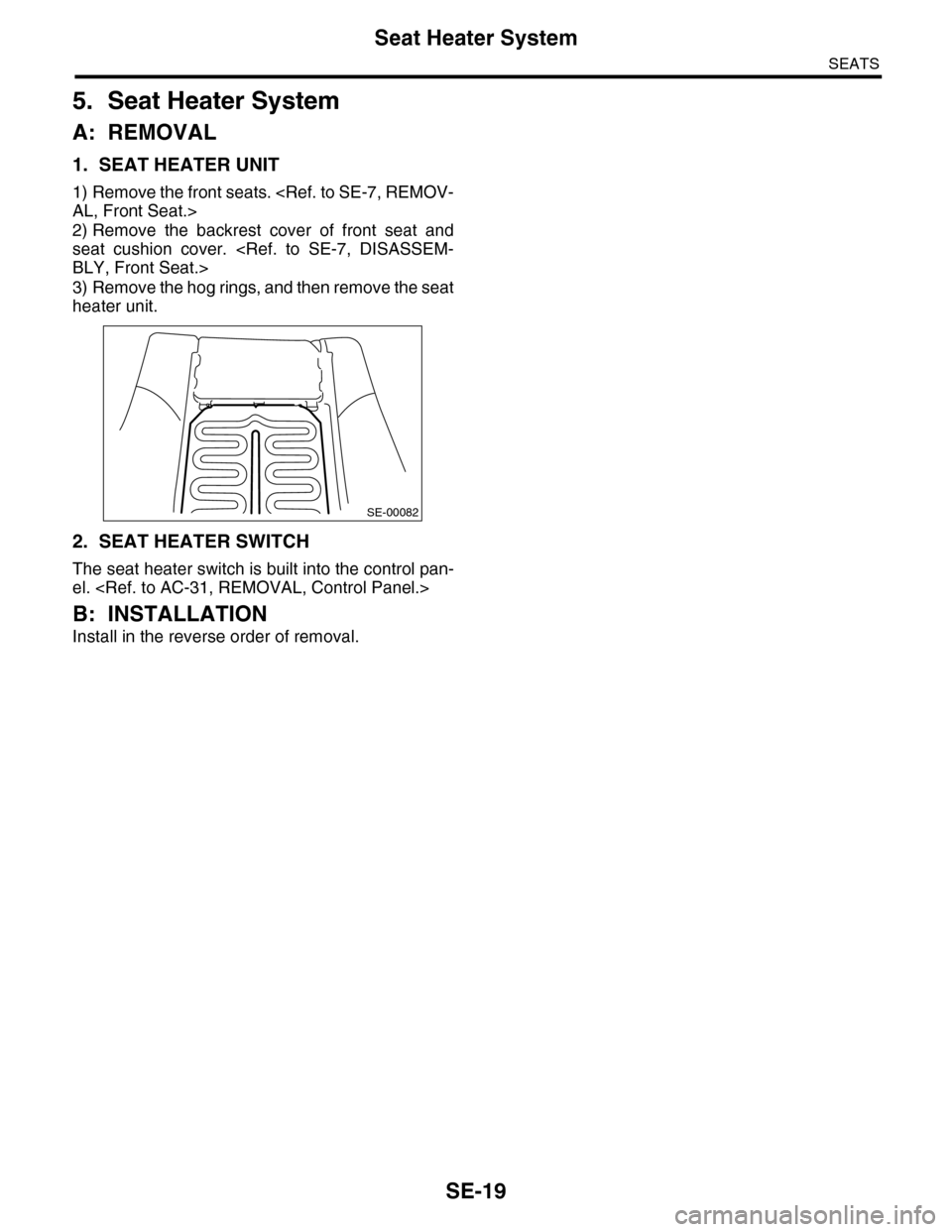
1) Remove the front seats.
AL, Front Seat.>
2) Remove the backrest cover of front seat and
seat cushion cover.
BLY, Front Seat.>
3) Remove the hog rings, and then remove the seat
heater unit.
2. SEAT HEATER SWITCH
The seat heater switch is built into the control pan-
el.
B: INSTALLATION
Install in the reverse order of removal.
SE-00082
Page 674 of 2453
SL-45
Remote Openers
SECURITY AND LOCKS
16.Remote Openers
A: REMOVAL
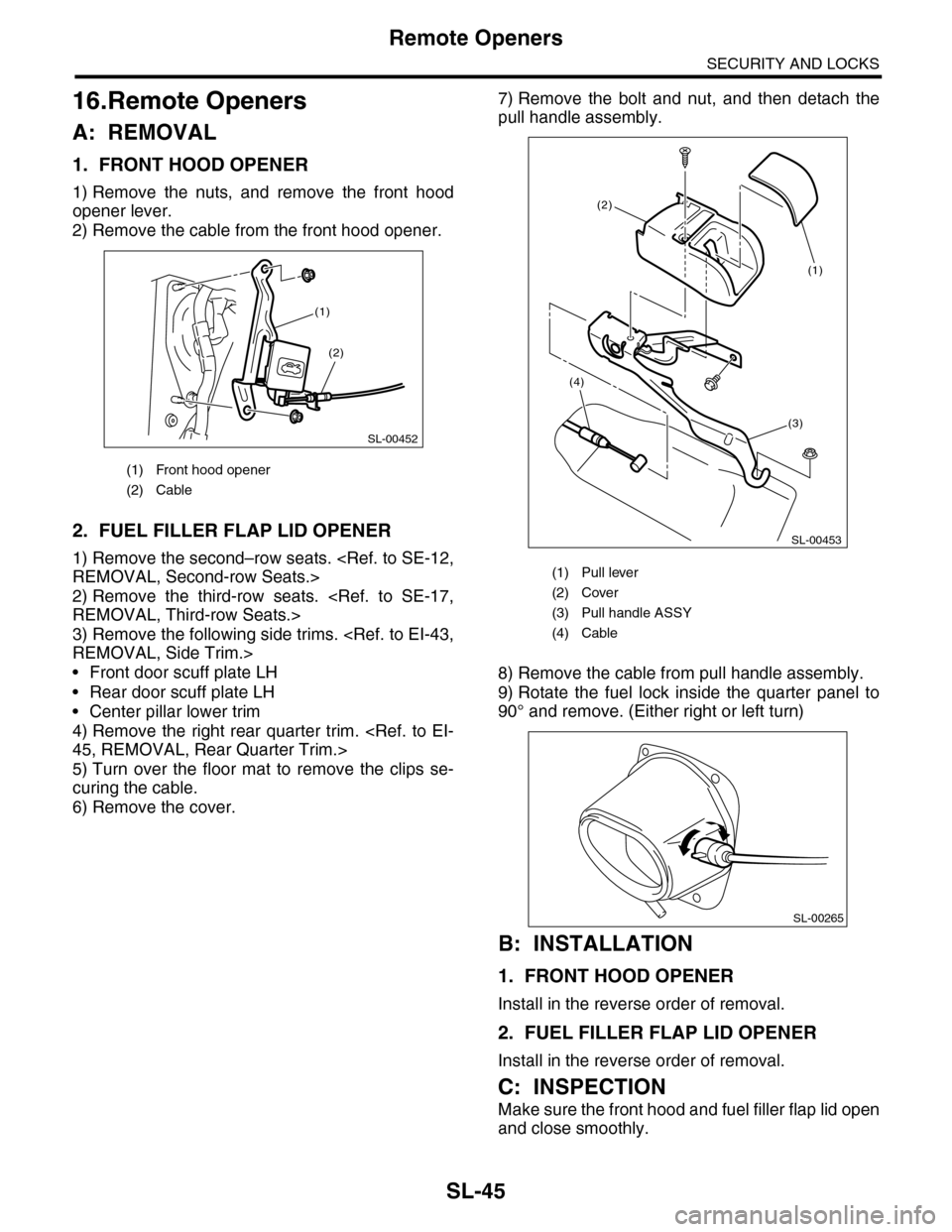
1. FRONT HOOD OPENER
1) Remove the nuts, and remove the front hood
opener lever.
2) Remove the cable from the front hood opener.
2. FUEL FILLER FLAP LID OPENER
1) Remove the second–row seats.
REMOVAL, Second-row Seats.>
2) Remove the third-row seats.
REMOVAL, Third-row Seats.>
3) Remove the following side trims.
REMOVAL, Side Trim.>
•Front door scuff plate LH
•Rear door scuff plate LH
•Center pillar lower trim
4) Remove the right rear quarter trim.
45, REMOVAL, Rear Quarter Trim.>
5) Turn over the floor mat to remove the clips se-
curing the cable.
6) Remove the cover.
7) Remove the bolt and nut, and then detach the
pull handle assembly.
8) Remove the cable from pull handle assembly.
9) Rotate the fuel lock inside the quarter panel to
90° and remove. (Either right or left turn)
B: INSTALLATION
1. FRONT HOOD OPENER
Install in the reverse order of removal.
2. FUEL FILLER FLAP LID OPENER
Install in the reverse order of removal.
C: INSPECTION
Make sure the front hood and fuel filler flap lid open
and close smoothly.
(1) Front hood opener
(2) Cable
SL-00452
(2)
(1)
(1) Pull lever
(2) Cover
(3) Pull handle ASSY
(4) Cable
SL-00453
(3)
(2)
(4)
(1)
SL-00265
Page 876 of 2453
PB-5
Parking Brake Cable
PARKING BRAKE
3. Parking Brake Cable
A: REMOVAL
1. FRONT PARKING BRAKE CABLE
1) Remove the driver’s seat.
2) Remove the console box.
3) Lift the floor mat.
4) Remove the parking brake pedal.
REMOVAL, Parking Brake Pedal.>
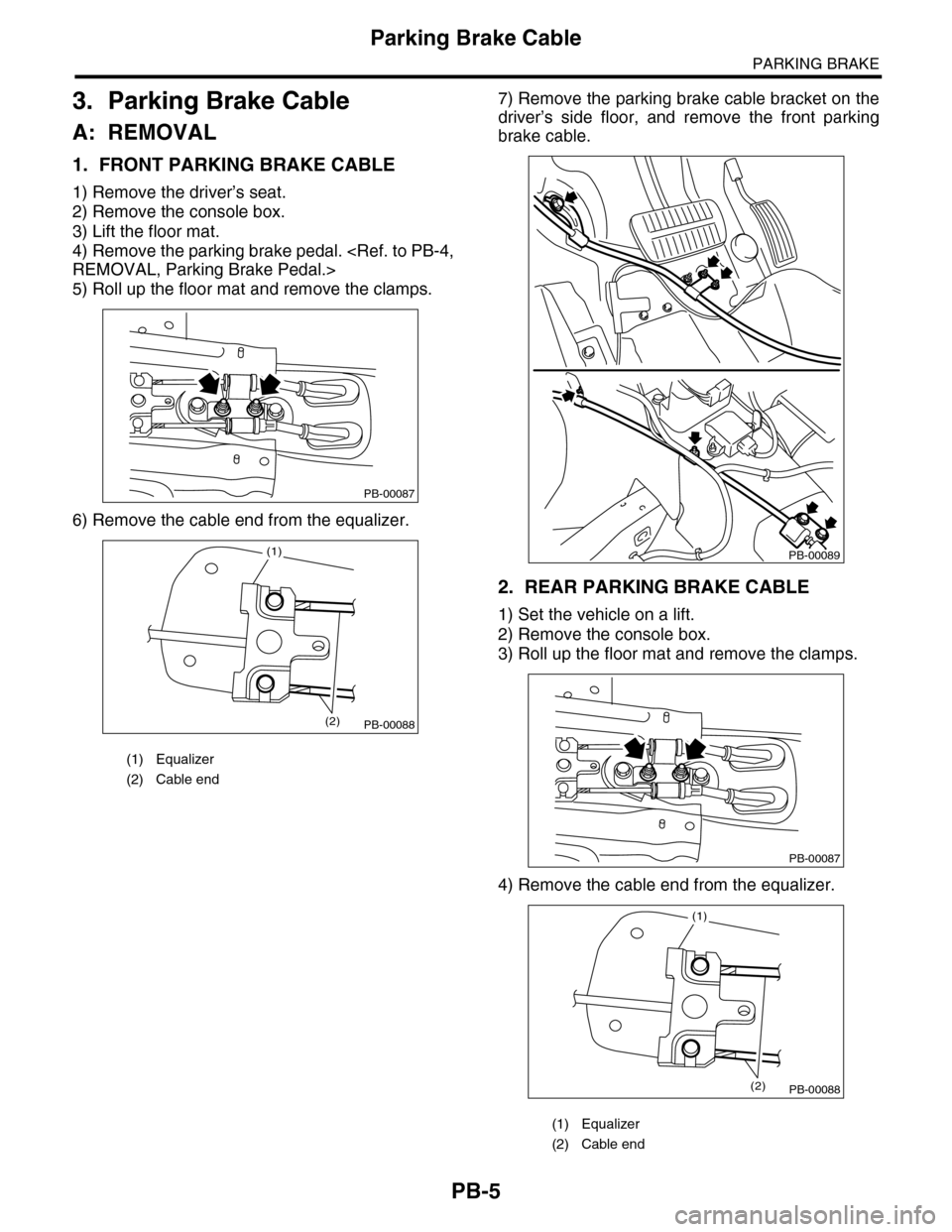
5) Roll up the floor mat and remove the clamps.
6) Remove the cable end from the equalizer.
7) Remove the parking brake cable bracket on the
driver’s side floor, and remove the front parking
brake cable.
2. REAR PARKING BRAKE CABLE
1) Set the vehicle on a lift.
2) Remove the console box.
3) Roll up the floor mat and remove the clamps.
4) Remove the cable end from the equalizer.
(1) Equalizer
(2) Cable end
PB-00087
PB-00088
(1)
(2)
(1) Equalizer
(2) Cable end
PB-00089
PB-00087
PB-00088
(1)
(2)
Page 1113 of 2453
WT-7
Aluminum Wheel
WHEEL AND TIRE SYSTEM
3. Aluminum Wheel
A: REMOVAL
1) Apply the parking brake, and position select le-
ver to “P” or “LOW”.
2) Set the shop jacks or a lift to the specified points,
and support the vehicle with its wheels slightly con-
tacting the floor.
3) Loosen the wheel nuts.
4) Raise the vehicle until its wheels are off the
ground using the jack or a lift.
5) Remove the wheel nuts and wheels.
NOTE:
•When removing the wheels, be careful not to
damage the hub bolts.
•Place the wheels with their outer sides facing up-
ward to prevent wheels from being damaged.
B: INSTALLATION
1) Remove dirt from the mating surface of the
wheel and brake rotor.
2) Attach the wheel to the hub by aligning the wheel
bolt holes with the hub bolts.
3) Temporarily attach the wheel nuts to the hub
bolts. (In the case of aluminum wheels, use SUBA-
RU genuine wheel nuts for aluminum wheels.)
4) Tighten the nuts by hand, making sure the wheel
hub hole is aligned correctly to the guide portion of
hub.
5) Tighten the wheel nuts in a diagonal selection to
the specified torque. Use a wheel nut wrench.
Wheel nut tightening torque:
110 N·m (11.2 kgf-m, 81.1 ft-lb)
CAUTION:
•Tighten the wheel nuts in two or three steps
by gradually increasing the torque on opposing
nuts, until they reach the specified torque.
•Do not push the wrench by foot. Always use
both hands when tightening the nuts.
•Make sure the bolt, nut and the nut seating
surface of the wheel are free from oil.
6) If a wheel is removed for replacement or for re-
pair of a puncture, retighten the wheel nuts to the
specified torque after driving 1,000 km (600 miles).
C: INSPECTION
1) Deformation or damage to the rim may cause air
leakage. Check the rim flange for deformation,
cracks or damage, and repair or replace as neces-
sary.
2) Jack-up the vehicle until wheels clear the floor.
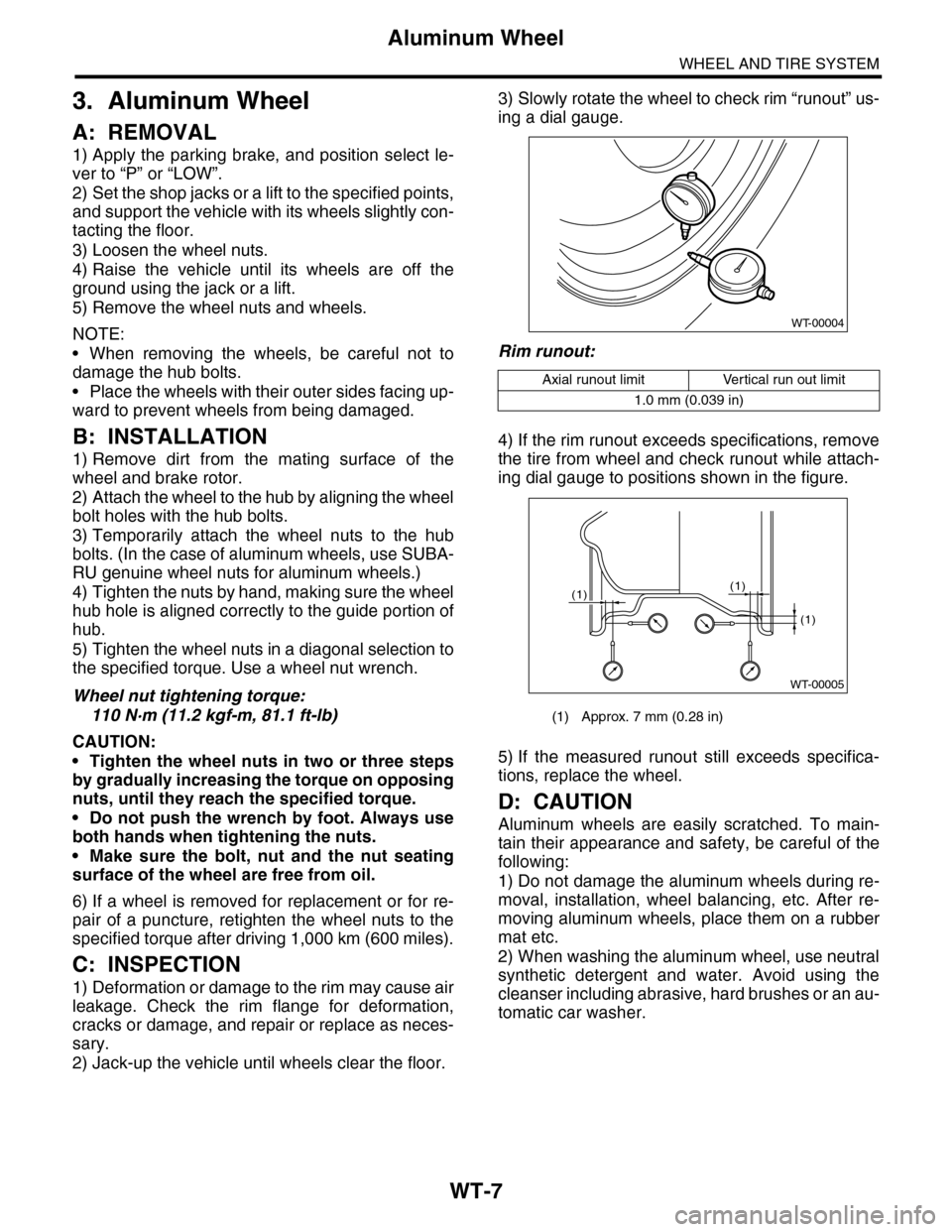
3) Slowly rotate the wheel to check rim “runout” us-
ing a dial gauge.
Rim runout:
4) If the rim runout exceeds specifications, remove
the tire from wheel and check runout while attach-
ing dial gauge to positions shown in the figure.
5) If the measured runout still exceeds specifica-
tions, replace the wheel.
D: CAUTION
Aluminum wheels are easily scratched. To main-
tain their appearance and safety, be careful of the
following:
1) Do not damage the aluminum wheels during re-
moval, installation, wheel balancing, etc. After re-
moving aluminum wheels, place them on a rubber
mat etc.
2) When washing the aluminum wheel, use neutral
synthetic detergent and water. Avoid using the
cleanser including abrasive, hard brushes or an au-
tomatic car washer.
Axial runout limit Vertical run out limit
1.0 mm (0.039 in)
(1) Approx. 7 mm (0.28 in)
WT-00004
WT-00005
(1)
(1)
(1)
Page 1117 of 2453
WT-11
Tire Pressure Monitoring System
WHEEL AND TIRE SYSTEM
6. Tire Pressure Monitoring
System
A: REMOVAL
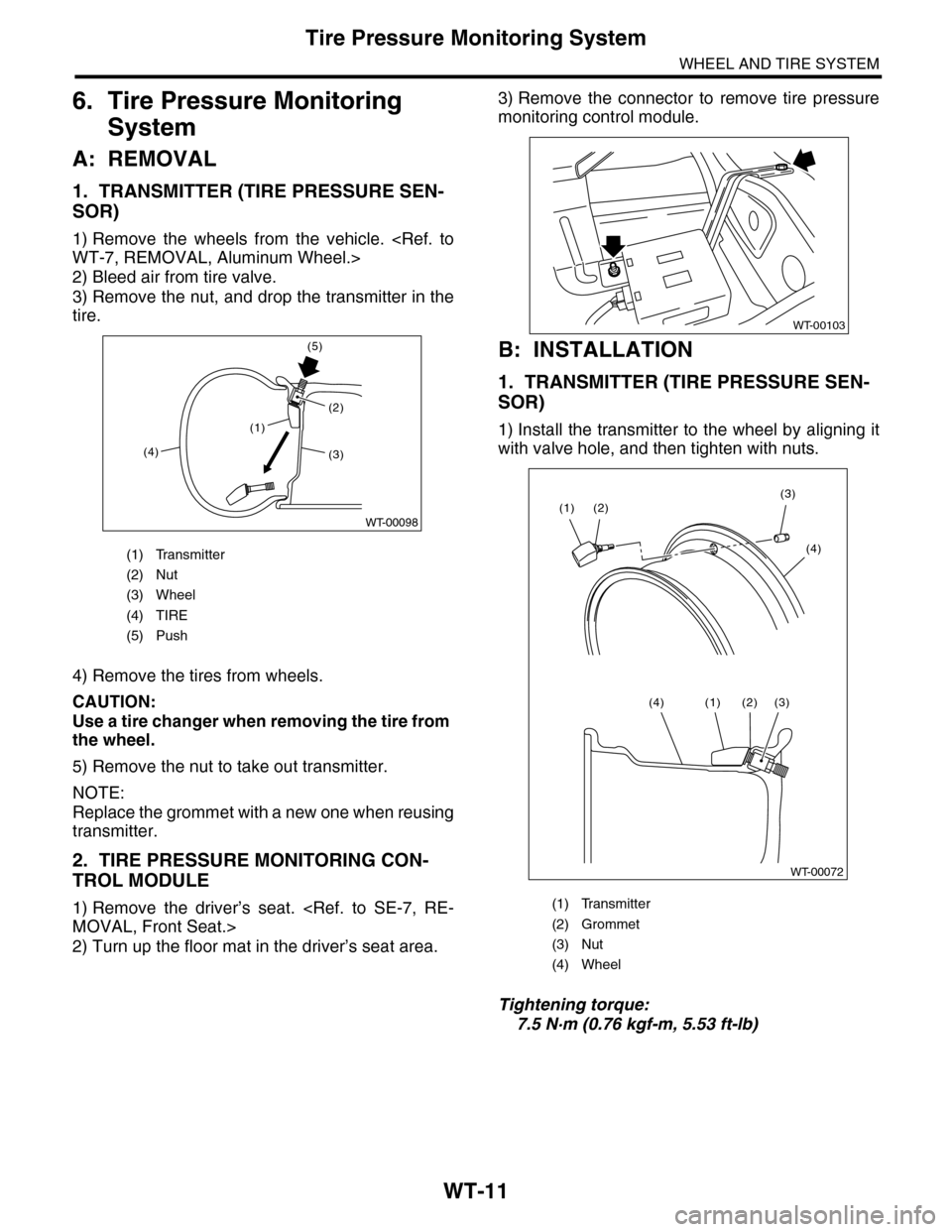
1. TRANSMITTER (TIRE PRESSURE SEN-
SOR)
1) Remove the wheels from the vehicle.
WT-7, REMOVAL, Aluminum Wheel.>
2) Bleed air from tire valve.
3) Remove the nut, and drop the transmitter in the
tire.
4) Remove the tires from wheels.
CAUTION:
Use a tire changer when removing the tire from
the wheel.
5) Remove the nut to take out transmitter.
NOTE:
Replace the grommet with a new one when reusing
transmitter.
2. TIRE PRESSURE MONITORING CON-
TROL MODULE
1) Remove the driver’s seat.
MOVAL, Front Seat.>
2) Turn up the floor mat in the driver’s seat area.
3) Remove the connector to remove tire pressure
monitoring control module.
B: INSTALLATION
1. TRANSMITTER (TIRE PRESSURE SEN-
SOR)
1) Install the transmitter to the wheel by aligning it
with valve hole, and then tighten with nuts.
Tightening torque:
7.5 N·m (0.76 kgf-m, 5.53 ft-lb)
(1) Transmitter
(2) Nut
(3) Wheel
(4) TIRE
(5) Push
(1)
(4)
(5)
(2)
WT-00098
(3)
(1) Transmitter
(2) Grommet
(3) Nut
(4) Wheel
WT-00103
WT-00072
(2)(3)
(4)
(1)
(3)(2)(1)(4)