Page 169 of 228
Vehicle care
169 Fuse assignments in
conjunction with load
compartment
fuse box version A
No. Circuit
1
ABS
2 ABS
3 Interior fan electronic climate
control
4 Interior fan heating and air
conditioning system
5 Radiator fan
6 Radiator fan
7 Central locking system
8 Windscreen washer, rear
window washer
9 Heated rear window, heated
exterior mirror
10 Diagnostics plug
11 Instruments No. Circuit
12
Mobile telephone, digital radio,
infotainment system, display
13 Courtesy light
14 Windscreen wipers
15 Windscreen wipers
16 Horn, ABS, brake light switch,
air conditioning system
17 Diesel fuel filter or air
conditioning system
18 Starter
19 –
20 Horn
21 Engine electronics
22 Engine electronics
23 Headlight range adjustment
24 Fuel pump
25 –
26 Engine electronics
Page 170 of 228

170
Vehicle care
No. Circuit
27
Heating, air conditioning
system, air quality sensor
28 –
29 Power steering
30 Engine electronics
31 Rear window wiper
32 Brake light switch
33 Headlight range adjustment,
light switch, clutch switch,
instrument, driver's door
module
34 Steering column control unit
35 Infotainment system
36 Cigarette lighter, front power
outlet Fuse assignments in
conjunction with load
compartment
fuse box version B
No. Circuit
1
ABS
2 ABS
3 Interior fan electronic climate
control
4 Interior fan heating and air
conditioning system
5 Radiator fan
6 Radiator fan
7 Windscreen washer system
8 Horn
9 Headlamp washer system
10 Emergency unlocking of central
locking system
11 –
12 – No. Circuit
13
Fog light
14 Windscreen wipers
15 Windscreen wipers
16 Control module electronics,
Open&Start system, ABS,
brake light switch
17 Diesel fuel filter heating
18 Starter
19 Transmission electronics
20 Air conditioning system
21 Engine electronics
22 Engine electronics
23 Adaptive Forward Lighting,
headlight range adjustment
24 Fuel pump
25 Transmission electronics
26 Engine electronics
27 Power steering
Page 171 of 228
Vehicle care
171
No. Circuit
28
Transmission electronics
29 Transmission electronics
30 Engine electronics
31 Adaptive Forward Lighting,
headlight range adjustment
32 Brake system, air conditioning
system, clutch switch
33 Adaptive Forward Lighting,
headlight range adjustment,
light switch
34 Steering column control unit
35 Infotainment system
36 Mobile telephone, digital radio,
infotainment system, display Load compartment fuse
box
The fuse box is behind a cover. Press
the locking tabs forward and remove
the cover.
Do not store any objects behind the
cover.
Depending on the equipment, there
are two different fuse boxes.
Fuse box version A
To replace a fuse, remove the
relevant protective cap. No. Circuit
1
Fog light
2 Rear power outlet
3 Load compartment power outlet
4 Reversing lamps
5 Rear power windows
6 Air conditioning system
7 Front power windows
8 Heated exterior mirrors
Page 173 of 228
Vehicle care
173
No. Circuit
29
Cigarette lighter, front power
outlet
30 Rear power outlet
31 –
32 –
33 Open&Start system
34 –
35 Rear power outlet
36 Socket for towing equipment
37 –
38 Central locking system, terminal
30
39 Left seat heating
40 Right seat heating
41 –
42 – No. Circuit
43
–
44 – Vehicle tools
Tools
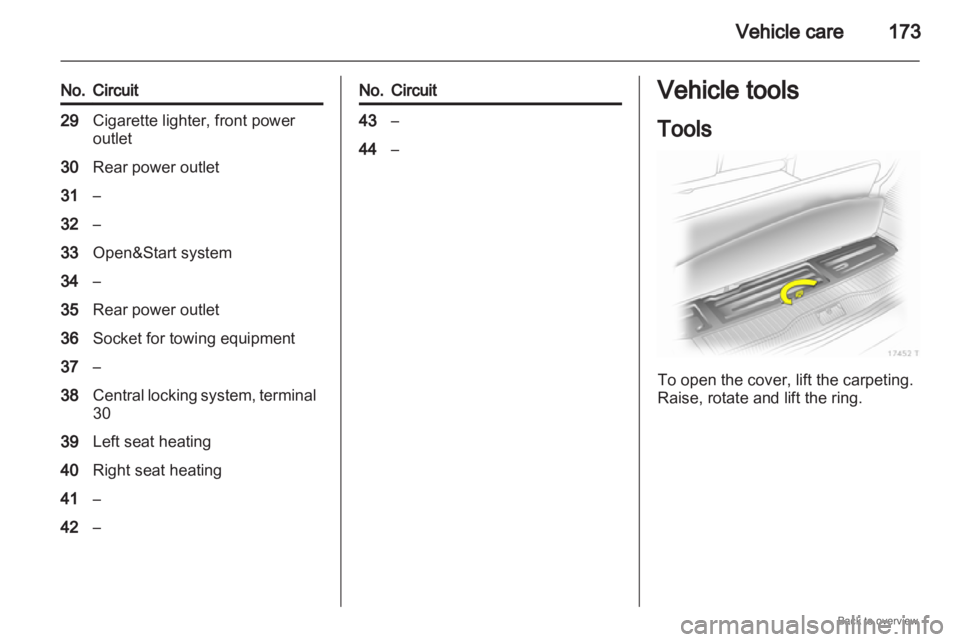
To open the cover, lift the carpeting.
Raise, rotate and lift the ring.
Page 174 of 228

174
Vehicle careThe jack and the vehicle tools are in
a pouch, secured to the stowage
compartment in the floor of the load
compartment with a rubber strap.
To close the lid, insert the lugs on its
front rim into the recesses and lock
into place. Wheels and tyres
Tyre condition, wheel condition
Drive over edges slowly and at right
angles if possible. Driving over sharp
edges can cause tyre and wheel
damage.
Do not trap tyres on the kerb
when parking.
Regularly check the wheels for
damage. Seek the assistance of
a workshop in the event of damage or
unusual wear.
Tyres
Tyres of size 225/45 R 17 are only
permitted if the vehicle is equipped
with electronic stability program.
Winter tyres
Winter tyres improve driving safety at
temperatures below 7 °C.
Tyres of size 225/40 R 18, 225/40 ZR
18 and 235/35 R 19 must not be used
as winter tyres. Winter tyres may only be used on the
Zafira OPC on special alloy wheels
approved by Opel.
Run-flat winter tyres may only be
used on factory approved alloy
wheels.
In accordance with country-specific
regulations, affix the speed sticker in
the driver's field of view.
Run-flat tyres
Run-flat tyres have reinforced, self-
supporting sidewalls, which ensure
that the tyres always have a certain
amount of driveability, even when
there is no pressure.
Run-flat tyres are only permitted on
vehicles with electronic stability
program
and tyre pressure monitoring
system or deflation detection system. Caution
Check tyre pressures regularly
even if run-flat tyres are fitted.
Page 178 of 228

178
Vehicle care
If there is more wear at the front than
the rear, swap round front wheels and
rear wheels.
Tyres age, even if they are not used.
We recommend tyre replacement
every 6 years.
Changing tyre and wheel
size
If tyres of a different size than those
fitted at the factory are used, it may be
necessary to reprogram the
speedometer and make other vehicle
modifications.
After converting to a different tyre
size, have the label with tyre
pressures replaced. 9
Warning Use of unsuitable tyres or wheels
may lead to accidents and will
invalidate the vehicle type
approval. Wheel covers
Wheel covers and tyres that are
factory approved for the respective
vehicle and comply with all of the
relevant wheel and tyre combination
requirements must be used.
If
the wheel covers and tyres used are
not factory approved, the tyres must
not have a beaded edge.
Wheel covers must not impair brake
cooling.
Remove the wheel covers if tyre
chains are to be installed. 9
Warning Use of unsuitable tyres or wheel
covers could lead to sudden
pressure loss and thereby
accidents. Tyre chains
Tyre chains are only permitted on the
front wheels.
Always
use fine mesh chains that add
no more than 10 mm to the tyre tread
and the inboard sides (including chain
lock). 9
Warning Damage may lead to tyre blowout.
Tyre chains are not permitted on tyres
of size 225/40 R 18, 225/40 ZR 18
and 235/35 R 19.
Page 179 of 228
Vehicle care
179
The use of tyre chains is not permitted
on the temporary spare wheel.
Tyre repair kit
Minor damage to the tyre tread or
sidewall
can be repaired with the tyre
repair kit.
Do not remove foreign bodies from
the tyres.
Tyre damage exceeding 4 mm or that
is near the rim cannot be repaired with
the tyre repair kit. 9
Warning Do not drive faster than 80 km/h.
Do not use for a lengthy period.
Steering and handling may be
affected.
If you have a flat tyre:
Apply
the hand brake and engage first
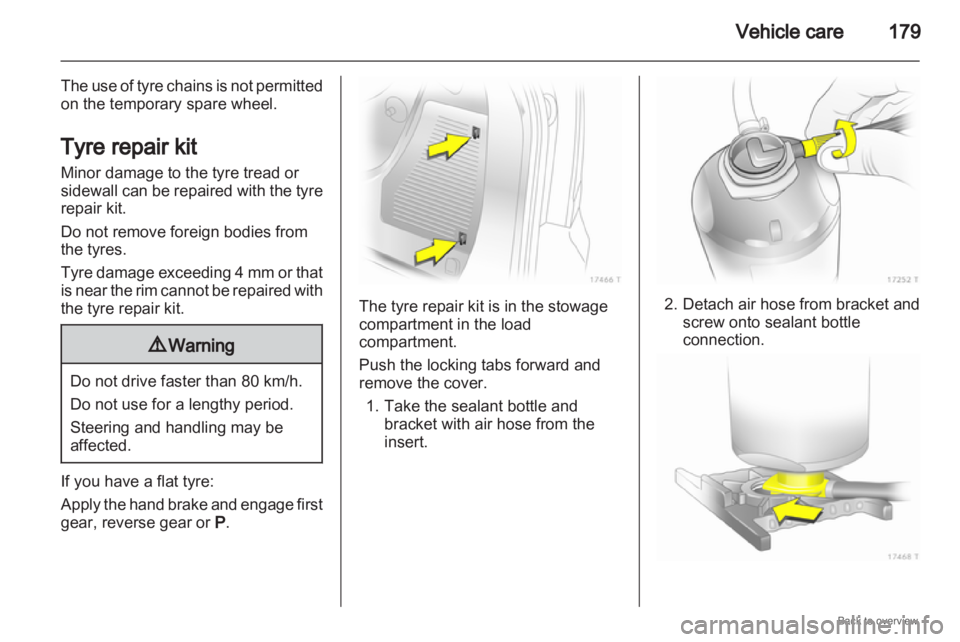
gear, reverse gear or P. The tyre repair kit is in the stowage
compartment in the load
compartment.
Push the locking tabs forward and
remove the cover.
1.
Take the sealant bottle andbracket with air hose from the
insert. 2. Detach air hose from bracket and
screw onto sealant bottle
connection.
Page 185 of 228
Vehicle care
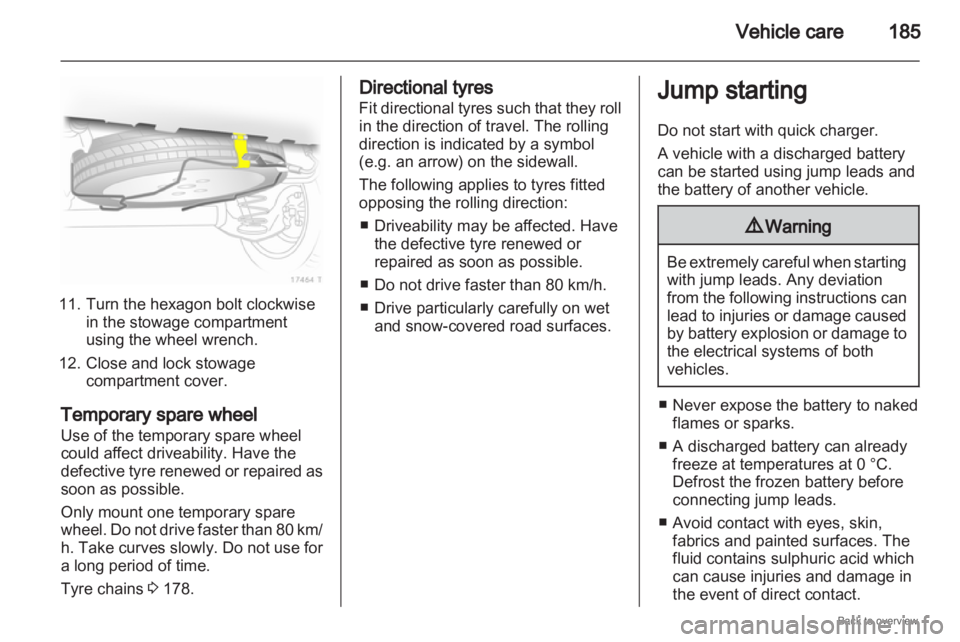
18511. Turn the hexagon bolt clockwise
in the stowage compartment
using the wheel wrench.
12.
Close and lock stowagecompartment cover.
Temporary spare wheel
Use of the temporary spare wheel
could affect driveability. Have the
defective tyre renewed or repaired as
soon as possible.
Only mount one temporary spare
wheel. Do not drive faster than 80 km/
h. Take curves slowly. Do not use for
a long period of time.
Tyre chains 3 178. Directional tyres
Fit
directional tyres such that they roll
in the direction of travel. The rolling
direction is indicated by a symbol
(e.g. an arrow) on the sidewall.
The following applies to tyres fitted
opposing the rolling direction:
■ Driveability may be affected. Have the defective tyre renewed or
repaired as soon as possible.
■ Do not drive faster than 80 km/h.
■ Drive particularly carefully on wet and snow-covered road surfaces. Jump starting
Do not start with quick charger.
A vehicle with a discharged battery
can be started using jump leads and
the battery of another vehicle.
9
Warning Be extremely careful when starting
with jump leads. Any deviation
from
the following instructions can
lead to injuries or damage caused
by battery explosion or damage to
the electrical systems of both
vehicles. ■ Never expose the battery to naked
flames or sparks.
■
A discharged battery can alreadyfreeze at temperatures at 0 °C.
Defrost the frozen battery before
connecting jump leads.
■ Avoid contact with eyes, skin, fabrics and painted surfaces. The
fluid contains sulphuric acid which
can cause injuries and damage in
the event of direct contact.