Page 129 of 228
Driving and operating
129
Overrun cut-off
The fuel supply is automatically cut off
during overrun, i.e. when the vehicle
is driven with a gear engaged but
accelerator is released.
Parking
■ Do not park the vehicle on an easy flammable surface. The high
temperature of the exhaust system
could ignite the surface.
■ Always apply hand brake without pressing release button. Apply as
firmly as possible on downhill or
uphill slopes. Depress the foot
brake at same time to reduce
operating force.
■ Switch off the engine and ignition. Turn the steering wheel until the
steering wheel lock engages.
■ If the vehicle is on a level surface or uphill slope, engage first gear or set
the selector lever to P before
switching off the ignition. On an
uphill slope, turn the front wheels
away from the kerb. If the vehicle is on a downhill slope,
engage reverse gear or set the
selector
lever to P before switching
off the ignition. Turn the front
wheels towards the kerb.
■ Lock the vehicle and activate the anti-theft locking system and the
anti-theft alarm system. Engine exhaust
9
Danger Engine exhaust gases contain
poisonous carbon monoxide,
which is colourless and odourless
and could be fatal if inhaled.
If exhaust gases enter the interior
of the vehicle, open the windows.
Have the cause of the fault
rectified by a workshop.
Avoid driving with an open load
compartment, otherwise exhaust
gases could enter the vehicle.
Diesel particle filter
The
diesel particle filter system filters
harmful soot particles out of the
exhaust gases. The system includes
a self-cleaning function that runs
automatically during driving. The filter
is cleaned by burning off the soot
particles at high temperature. This
process takes place automatically
under set driving conditions and may
take up to 25 minutes. Fuel
Page 132 of 228
132
Driving and operating
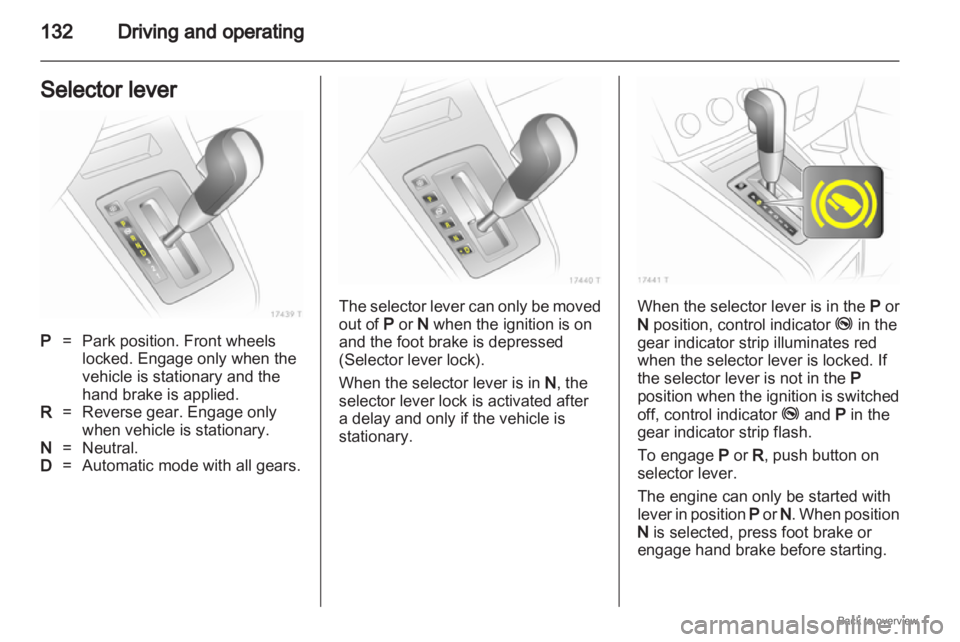
Selector lever P
=Park position. Front wheels
locked. Engage only when the
vehicle is stationary and the
hand brake is applied.
R = Reverse gear. Engage only
when vehicle is stationary.
N = Neutral.
D = Automatic mode with all gears. The selector lever can only be moved
out of P or N
when the ignition is on
and the foot brake is depressed
(Selector lever lock).
When the selector lever is in N, the
selector lever lock is activated after
a delay and only if the vehicle is
stationary. When the selector lever is in the P or
N position, control indicator j in the
gear indicator strip illuminates red
when the selector lever is locked. If
the selector lever is not in the P
position
when the ignition is switched
off, control indicator j and P in the
gear indicator strip flash.
To engage P or R, push button on
selector lever.
The engine can only be started with
lever in position P or N. When position
N is selected, press foot brake or
engage hand brake before starting.
Page 136 of 228
136
Driving and operating4. Pull the loop and move the
selector lever out of P or N. If P or
N is engaged again, the selector
lever will be locked in position
again. Have the cause of the
power supply interruption
remedied by a workshop.
5. Put on ashtray holder or cover and engage.
6. Fasten the metal cover with the screw. Fit the ashtray insert 3 82. Manual transmission
To engage reverse, with the vehicle
stationary wait 3 seconds after
declutching and then pull up the
button on the selector lever and
engage the gear.
If the gear does not engage, set the
lever in neutral, release the clutch
pedal
and depress again; then repeat
gear selection.
Do not grind the clutch unnecessarily.
When operating, depress the clutch
pedal completely. Do not use the
pedal as a foot rest. Manual transmission
automated
The Easytronic transmission permits
manual (manual mode) or automatic
gear shifting (automatic mode), both
with automatic clutch control.
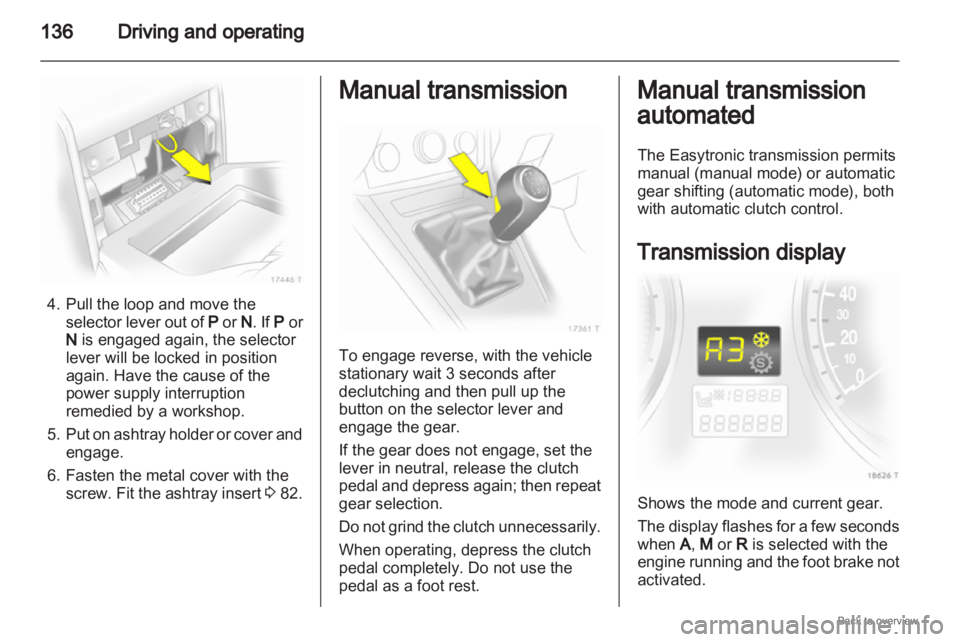
Transmission display
Shows the mode and current gear.
The
display flashes for a few seconds
when A, M or R is selected with the
engine running and the foot brake not
activated.
Page 140 of 228
140
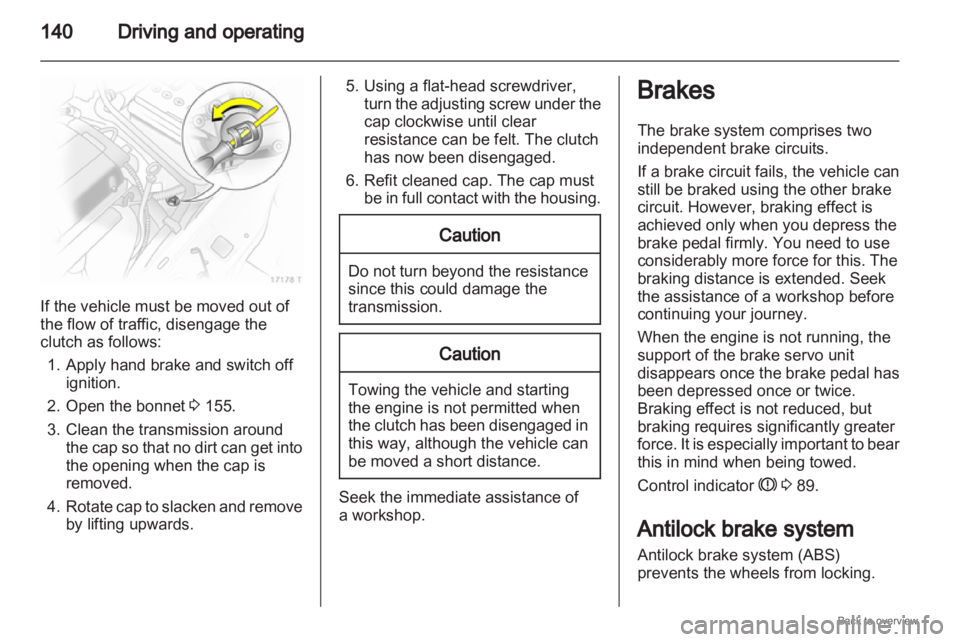
Driving and operatingIf the vehicle must be moved out of
the flow of traffic, disengage the
clutch as follows:
1.
Apply hand brake and switch offignition.
2. Open the bonnet 3 155.
3. Clean the transmission around the cap so that no dirt can get into
the opening when the cap is
removed.
4. Rotate cap to slacken and remove by lifting upwards. 5. Using a flat-head screwdriver,
turn
the adjusting screw under the
cap clockwise until clear
resistance can be felt. The clutch
has now been disengaged.
6. Refit cleaned cap. The cap must be in full contact with the housing. Caution
Do not turn beyond the resistance
since this could damage the
transmission.
Caution
Towing the vehicle and starting
the engine is not permitted when
the
clutch has been disengaged in
this way, although the vehicle can
be moved a short distance. Seek the immediate assistance of
a workshop. Brakes
The brake system comprises two
independent brake circuits.
If a brake circuit fails, the vehicle can
still be braked using the other brake
circuit. However, braking effect is
achieved only when you depress the
brake pedal firmly. You need to use
considerably more force for this. The
braking distance is extended. Seek
the assistance of a workshop before
continuing your journey.
When the engine is not running, the
support of the brake servo unit
disappears
once the brake pedal has
been depressed once or twice.
Braking effect is not reduced, but
braking requires significantly greater
force. It is especially important to bear
this in mind when being towed.
Control indicator R 3 89.
Antilock brake system
Antilock brake system (ABS)
prevents the wheels from locking.
Page 141 of 228
Driving and operating
141
ABS starts to regulate brake pressure
as soon as a wheel shows a tendency
to lock. The vehicle remains
steerable, even during hard braking.
ABS control is made apparent though
a pulse in the brake pedal and the
noise of the regulation process.
For optimum braking, keep the brake
pedal fully depressed throughout the
braking process, despite the fact that
the pedal is pulsating. Do not reduce
the pressure on the pedal.
Control indicator u 3 89.
Adaptive brake lamp
During full braking, all three brake
lamps flash for the duration of ABS
control. Fault
9
Warning If there is a fault in the ABS, the
wheels may be liable to lock due
to braking that is heavier than
normal. The advantages of ABS
are no longer available. During
hard braking, the vehicle can no
longer be steered and may
swerve.
Have the cause of the fault remedied
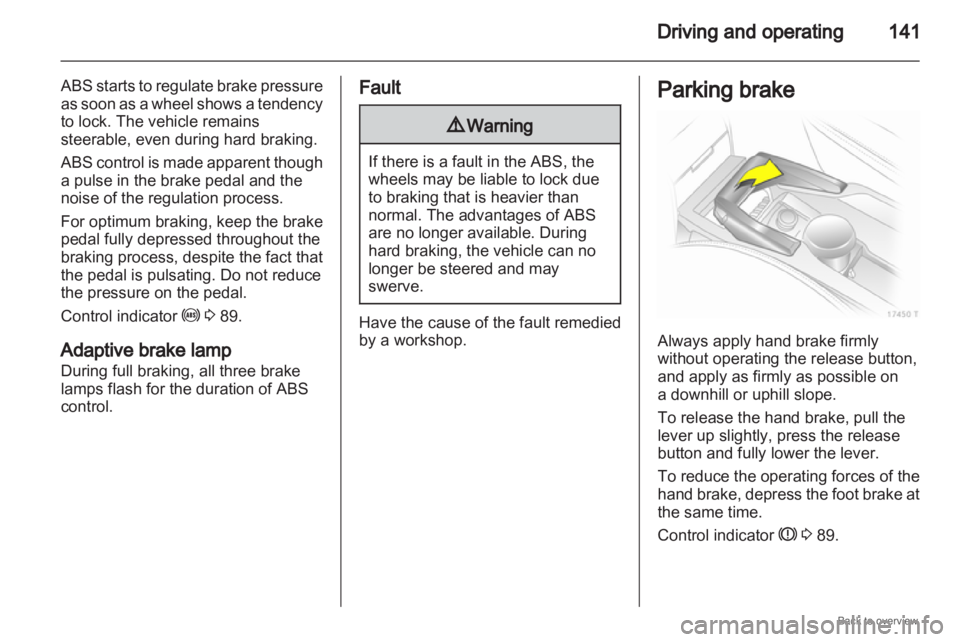
by a workshop. Parking brake
Always apply hand brake firmly
without operating the release button,
and apply as firmly as possible on
a downhill or uphill slope.
To release the hand brake, pull the
lever up slightly, press the release
button and fully lower the lever.
To
reduce the operating forces of the
hand brake, depress the foot brake at
the same time.
Control indicator R 3 89.
Page 143 of 228
Driving and operating
143
Hold the SPORT button depressed
for about 4 seconds. Control indicator
v illuminates. ESPoff also appears in
the service display. 9
Warning Do not deactivate ESP®
Plus
if
a
run-flat tyre 3 has lost pressure.ESP®
Plus
is reactivated by pressing
the SPORT
button. ESPon appears in
the service display. ESP® Plus
is also
reactivated the next time the ignition
is switched on.
Sport mode 3 143.
Interactive driving system
Interactive driving system (IDS Plus
)
combines the electronic stability
program (ESP® Plus
) with the antilock
brake system (ABS) and continuous
damping control (CDC) to improve
driving dynamics and vehicle safety. Sport mode
Suspension and steering become
more direct and provide better
contact with the road surface. The
engine reacts more quickly to
accelerator pedal movements.
Automatic
gear changing is also more
responsive.
Control indicator IDSPlus
3 91.
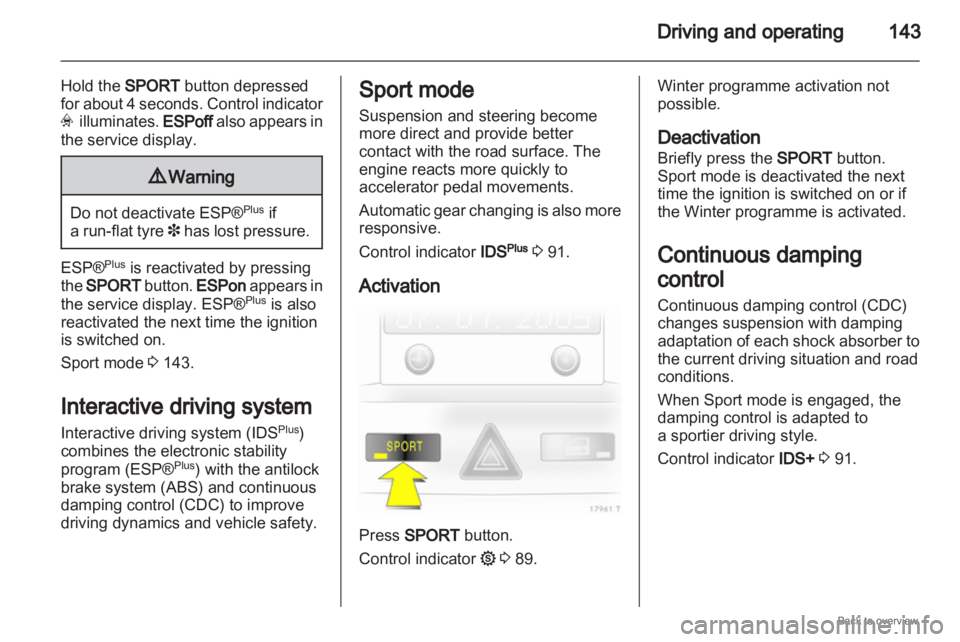
Activation Press SPORT button.
Control indicator
1 3 89. Winter programme activation not
possible.
Deactivation
Briefly press the SPORT button.
Sport mode is deactivated the next
time the ignition is switched on or if
the Winter programme is activated.
Continuous damping
control
Continuous damping control (CDC)
changes suspension with damping
adaptation
of each shock absorber to
the current driving situation and road
conditions.
When Sport mode is engaged, the
damping control is adapted to
a sportier driving style.
Control indicator IDS+ 3 91.
Page 147 of 228

Driving and operating
147
Do not use marine diesel oils, heating
oils or entirely or partially plant-based
diesel fuels, such as rape seed oil or
bio diesel, Aquazole and similar
diesel-water emulsions. Diesel fuels
must not be diluted with fuels for
petrol engines.
The flow and filterability of diesel fuel
are temperature-dependent. When
temperatures are low, refuel with
diesel fuel with guaranteed winter
properties.
Fuel for natural gas
operation
Use natural gas with a methane
content of approx. 78 - 99 %. L-gas
(low) has approx. 78 - 87 % and H-gas
(high) has approx. 87 - 99 %. Biogas
with the same methane content can
also be used if it has been chemically
prepared and desulphurised.
Liquid gas or LPG must not be used. Refuelling
9
Danger Before refuelling, switch off engine
and any external heaters with
combustion chambers (identified
by
sticker on fuel filler flap). Switch
off any mobile phones.
Follow the operating and safety
instructions of the filling station
when refuelling. 9
Danger Fuel is flammable and explosive.
No smoking. No naked flames or
sparks.
If you can smell fuel in your
vehicle, have the cause of this
remedied immediately by
a workshop.
Fuel filler flap is located at right rear
side of vehicle.
The
fuel filler flap can only be opened
if the vehicle is unlocked.
Page 151 of 228
Driving and operating
151
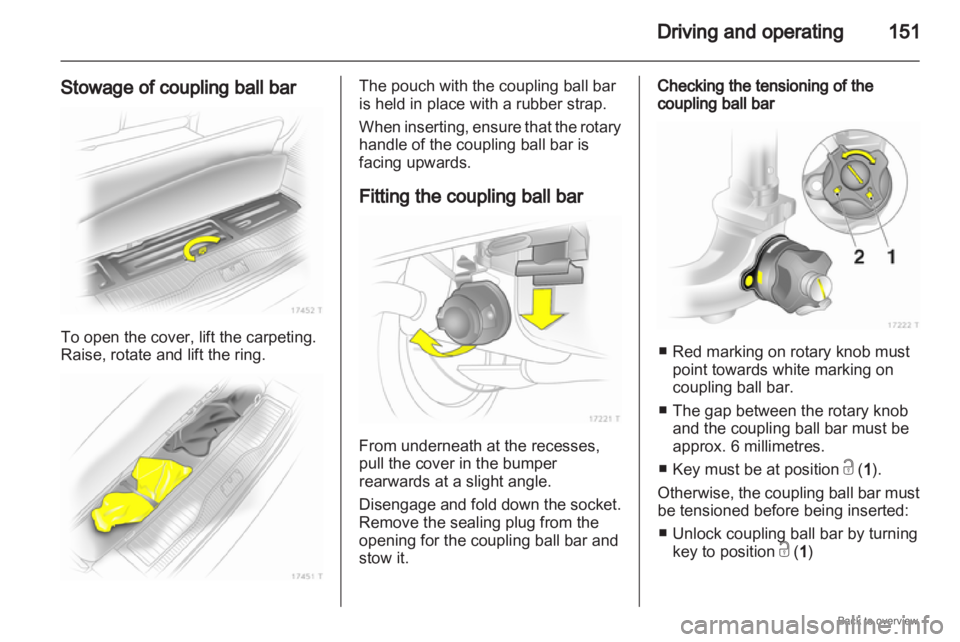
Stowage of coupling ball bar To open the cover, lift the carpeting.
Raise, rotate and lift the ring. The pouch with the coupling ball bar
is held in place with a rubber strap.
When
inserting, ensure that the rotary
handle of the coupling ball bar is
facing upwards.
Fitting the coupling ball bar From underneath at the recesses,
pull the cover in the bumper
rearwards at a slight angle.
Disengage
and fold down the socket.
Remove the sealing plug from the
opening for the coupling ball bar and
stow it. Checking the tensioning of the
coupling ball bar
■ Red marking on rotary knob must
point towards white marking on
coupling ball bar.
■
The gap between the rotary knoband the coupling ball bar must be
approx. 6 millimetres.
■ Key must be at position c (1 ).
Otherwise, the coupling ball bar must
be tensioned before being inserted: ■ Unlock coupling ball bar by turning key to position c (1 )