2009 OPEL ZAFIRA lock
[x] Cancel search: lockPage 186 of 228
186
Vehicle care
■ Wear eye protection and protective
clothing when handling a battery.
■ Use a booster battery with the same voltage (12 volts). Its capacity
(Ah) must not be much less than
that of the discharged battery.
■ Use jump leads with insulated terminals and a cross section of at
least 16 mm 2
(25 mm 2
for diesel
engines).
■ Do not disconnect the discharged battery from the vehicle.
■ Switch off all unnecessary electrical consumers.
■ Do not lean over the battery during jump starting.
■ Do not allow the terminals of one lead to touch those of the other
lead.
■ The vehicles must not come into contact with each other during the
jump starting process.
■ Apply the handbrake, transmission in neutral, automatic transmission
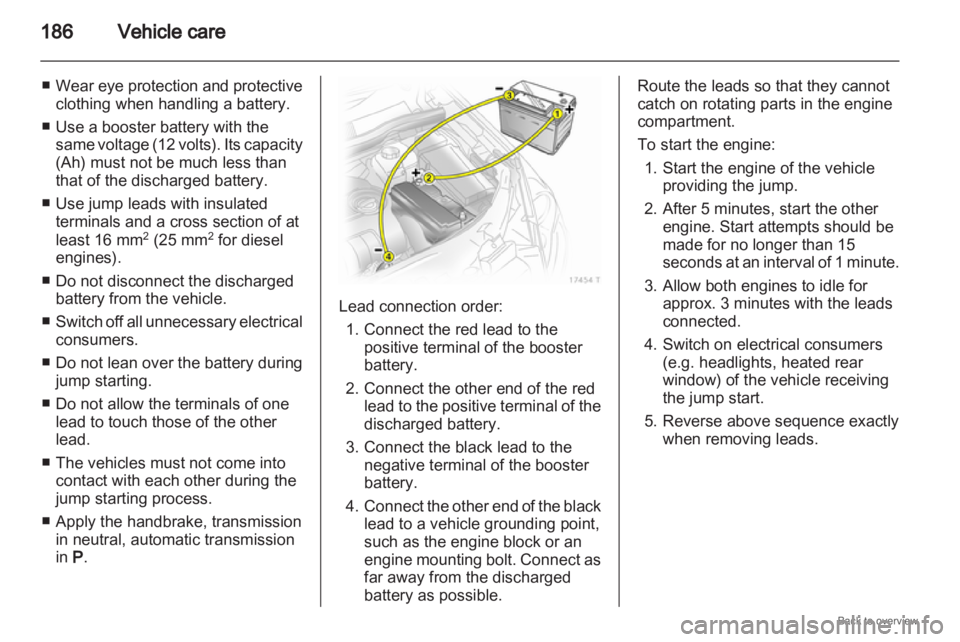
in P. Lead connection order:
1.
Connect the red lead to thepositive terminal of the booster
battery.
2. Connect the other end of the red lead to the positive terminal of the
discharged battery.
3. Connect the black lead to the negative terminal of the booster
battery.
4. Connect the other end of the black lead to a vehicle grounding point,
such as the engine block or an
engine mounting bolt. Connect as
far away from the discharged
battery as possible. Route the leads so that they cannot
catch on rotating parts in the engine
compartment.
To start the engine:
1.
Start the engine of the vehicleproviding the jump.
2. After 5 minutes, start the other engine. Start attempts should be
made for no longer than 15
seconds at an interval of 1 minute.
3. Allow both engines to idle for approx. 3 minutes with the leads
connected.
4. Switch on electrical consumers (e.g. headlights, heated rear
window) of the vehicle receiving
the jump start.
5. Reverse above sequence exactly when removing leads.
Page 187 of 228
Vehicle care
187
Towing
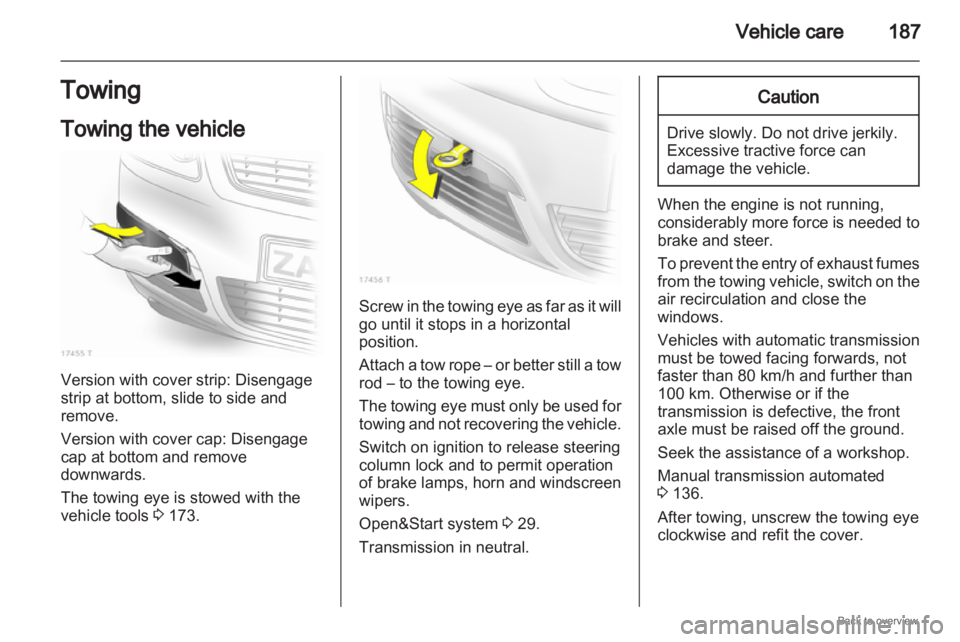
Towing the vehicle Version with cover strip: Disengage
strip at bottom, slide to side and
remove.
Version with cover cap: Disengage
cap at bottom and remove
downwards.
The towing eye is stowed with the
vehicle tools
3 173. Screw in the towing eye as far as it will
go until it stops in a horizontal
position.
Attach
a tow rope – or better still a tow
rod – to the towing eye.
The towing eye must only be used for
towing and not recovering the vehicle.
Switch on ignition to release steering
column lock and to permit operation
of brake lamps, horn and windscreen
wipers.
Open&Start system 3 29.
Transmission in neutral. Caution
Drive slowly. Do not drive jerkily.
Excessive tractive force can
damage the vehicle.
When the engine is not running,
considerably
more force is needed to
brake and steer.
To prevent the entry of exhaust fumes
from the towing vehicle, switch on the
air recirculation and close the
windows.
Vehicles with automatic transmission
must be towed facing forwards, not
faster than 80 km/h and further than
100 km. Otherwise or if the
transmission is defective, the front
axle must be raised off the ground.
Seek the assistance of a workshop.
Manual transmission automated
3 136.
After towing, unscrew the towing eye
clockwise and refit the cover.
Page 188 of 228
188
Vehicle care
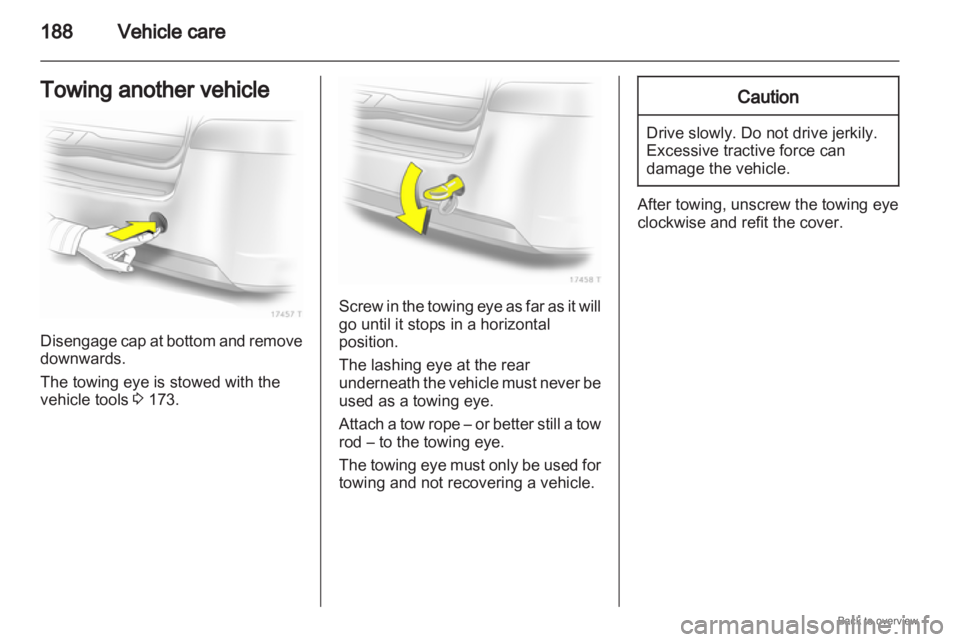
Towing another vehicle Disengage cap at bottom and remove
downwards.
The towing eye is stowed with the
vehicle tools
3 173. Screw in the towing eye as far as it will
go until it stops in a horizontal
position.
The lashing eye at the rear
underneath
the vehicle must never be
used as a towing eye.
Attach a tow rope – or better still a tow
rod – to the towing eye.
The towing eye must only be used for
towing and not recovering a vehicle. Caution
Drive slowly. Do not drive jerkily.
Excessive tractive force can
damage the vehicle.
After towing, unscrew the towing eye
clockwise and refit the cover.
Page 189 of 228
Vehicle care
189
Appearance care
Exterior care
Locks
The
locks are lubricated at the factory
using a high quality lock cylinder
grease. Use de-icing agent only when
absolutely necessary, as this has
a degreasing effect and impairs lock
function. After using de-icing agent,
have the locks regreased by
a workshop.
Washing
The paintwork of your vehicle is
exposed to environmental influences.
Wash and wax your vehicle regularly.
When using automatic car washes,
select a programme that includes
waxing.
Bird droppings, dead insects, resin,
pollen and the like should be cleaned
off immediately, as they contain
aggressive constituents which can
cause paint damage. If using a car wash, comply with the
car
wash manufacturer's instructions.
The windscreen wipers and rear
window wiper must be switched off.
Remove antenna and external
accessories such as roof racks etc.
If you wash your vehicle by hand,
make sure that the insides of the
wheel housings are also thoroughly
rinsed out.
Clean edges and folds on opened
doors and the bonnet as well as the
areas they cover.
Thoroughly rinse and leather-off the
vehicle. Rinse leather frequently. Use
separate leathers for painted and
glass surfaces: remnants of wax on
the windows will impair vision.
Do not use hard objects to remove
spots of tar. Use tar removal spray on
painted surfaces.
Exterior lights
Headlamp and other lamp covers are
made of plastic. Do not use any
abrasive or caustic agents, do not use
an ice scraper, and do not clean them
dry. Polishing and waxing
Wax the vehicle regularly (at the
latest when water no longer beads).
Otherwise, the paintwork will dry out.
Polishing
is necessary only if the paint
has become dull or if solid deposits
have become attached to it.
Paintwork polish with silicone forms
a protective film, making waxing
unnecessary.
Plastic body parts must not be treated
with wax or polishing agents.
Windows and windscreen wiper
blades
Use a soft lint-free cloth or chamois
leather together with window cleaner
and insect remover.
When cleaning the rear window,
make sure the heating element inside
the window is not damaged.
For mechanical removal of ice, use
a sharp-edged ice scraper. Press the
scraper firmly against the glass so
that no dirt can get under it and
scratch the glass.
Page 190 of 228
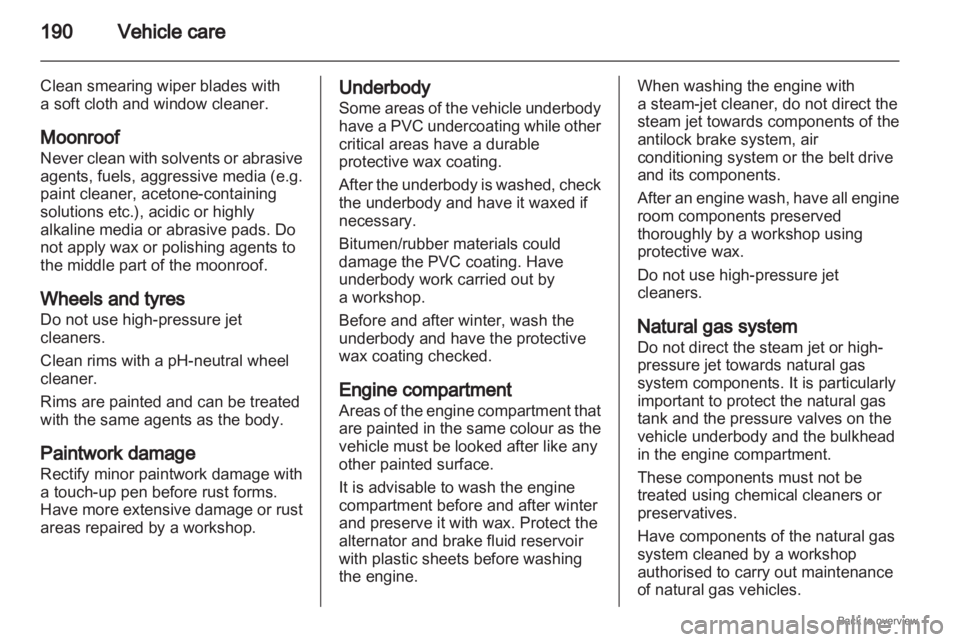
190
Vehicle care
Clean smearing wiper blades with
a soft cloth and window cleaner.
Moonroof
Never
clean with solvents or abrasive
agents, fuels, aggressive media (e.g.
paint cleaner, acetone-containing
solutions etc.), acidic or highly
alkaline media or abrasive pads. Do
not apply wax or polishing agents to
the middle part of the moonroof.
Wheels and tyres
Do not use high-pressure jet
cleaners.
Clean rims with a pH-neutral wheel
cleaner.
Rims are painted and can be treated
with the same agents as the body.
Paintwork damage
Rectify minor paintwork damage with
a touch-up pen before rust forms.
Have more extensive damage or rust
areas repaired by a workshop. Underbody
Some
areas of the vehicle underbody
have a PVC undercoating while other
critical areas have a durable
protective wax coating.
After the underbody is washed, check
the underbody and have it waxed if
necessary.
Bitumen/rubber materials could
damage the PVC coating. Have
underbody work carried out by
a workshop.
Before and after winter, wash the
underbody and have the protective
wax coating checked.
Engine compartment
Areas of the engine compartment that
are painted in the same colour as the
vehicle must be looked after like any
other painted surface.
It is advisable to wash the engine
compartment before and after winter
and preserve it with wax. Protect the
alternator and brake fluid reservoir
with plastic sheets before washing
the engine. When washing the engine with
a steam-jet cleaner, do not direct the
steam jet towards components of the
antilock brake system, air
conditioning system or the belt drive
and its components.
After
an engine wash, have all engine
room components preserved
thoroughly by a workshop using
protective wax.
Do not use high-pressure jet
cleaners.
Natural gas system
Do not direct the steam jet or high-
pressure jet towards natural gas
system components. It is particularly
important to protect the natural gas
tank and the pressure valves on the
vehicle underbody and the bulkhead
in the engine compartment.
These components must not be
treated using chemical cleaners or
preservatives.
Have components of the natural gas
system cleaned by a workshop
authorised to carry out maintenance
of natural gas vehicles.
Page 194 of 228
194
Service and maintenance
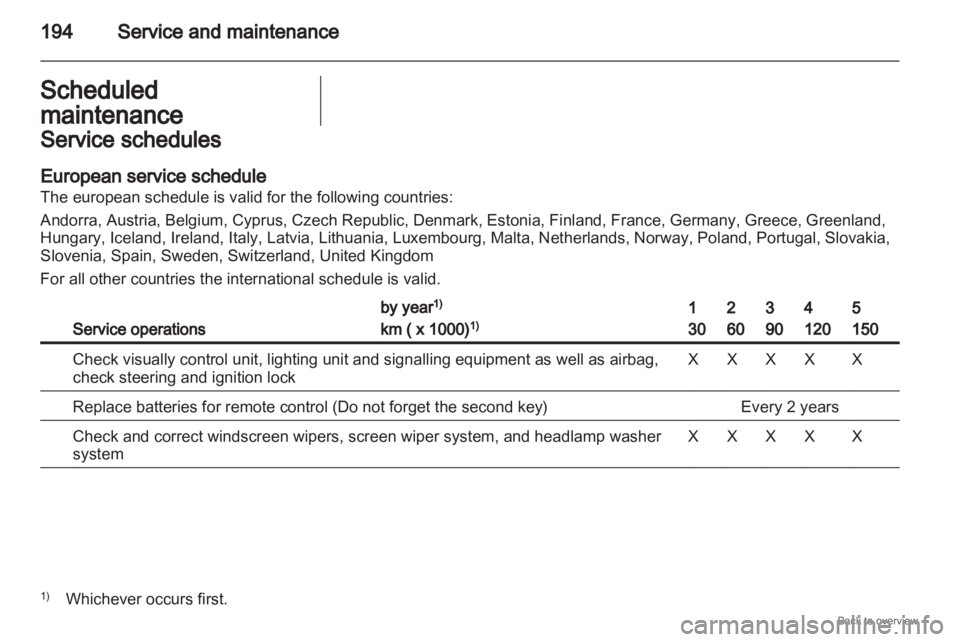
Scheduled
maintenance Service schedules
European service schedule
The european schedule is valid for the following countries:
Andorra, Austria, Belgium, Cyprus, Czech Republic, Denmark, Estonia, Finland, France, Germany, Greece, Greenland,
Hungary, Iceland, Ireland, Italy, Latvia, Lithuania, Luxembourg, Malta, Netherlands, Norway, Poland, Portugal, Slovakia,
Slovenia, Spain, Sweden, Switzerland, United Kingdom
For all other countries the international schedule is valid.
Service operations by year
1)
km ( x 1000) 1) 1
30 2
60 3
90 4
120 5
150
Check visually control unit, lighting unit and signalling equipment as well as airbag,
check steering and ignition lock X X X X X
Replace batteries for remote control (Do not forget the second key) Every 2 years
Check and correct windscreen wipers, screen wiper system, and headlamp washer
system X X X X X
1)
Whichever occurs first.
Page 198 of 228

198
Service and maintenanceService operations by year
1)
km ( x 1000) 1) 1
30 2
60 3
90 4
120 5
150
Undo wheel fastening (take care if tyre pressure monitoring system is present) and
tighten to torque: 110 Nm.
The wheel bolt taper should be greased or oiled lightly during assembly.
Check tyre condition. Check/correct tyre pressure (including spare wheel)
With tyre repair system - check completeness and expiry date of kit. Replace sealant
bottle every 4 years. X X
+
Annual service check if annual mileage exceeds 20 000 km
Visually inspect first-aid kit, (presence in designated stowage compartment,
completeness and expiry date), lashing eyes and warning triangle Every 2 years
Check/correct headlamp adjustment (including auxiliary headlamps) X X
Grease door hinges, door stop, lock cylinder, striker plate, bonnet lock, tailgate hinges,
wipe door stop check strap clean before greasing X X
Test drive, final inspection (check steering and ignition locks, instruments and indicator
lamps,
entire brake system, steering, air conditioning, engine, body and running gear),
reset service interval display with TECH 2) X X X X X
+: Additional operations.
o: Under extreme operating conditions and if required by country-specific conditions, the intervals are reduced.
Page 199 of 228
Service and maintenance
199
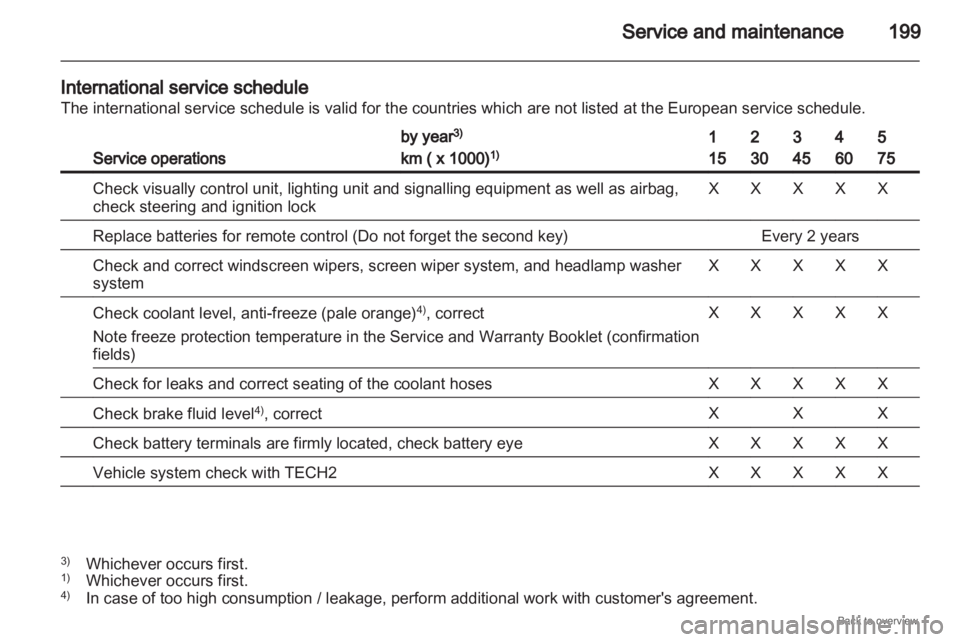
International service schedule
The international service schedule is valid for the countries which are not listed at the European service schedule. Service operations by year
3)
km ( x 1000) 1) 1
15 2
30 3
45 4
60 5
75
Check visually control unit, lighting unit and signalling equipment as well as airbag,
check steering and ignition lock X X X X X
Replace batteries for remote control (Do not forget the second key) Every 2 years
Check and correct windscreen wipers, screen wiper system, and headlamp washer
system X X X X X
Check coolant level, anti-freeze (pale orange)
4)
, correct
Note freeze protection temperature in the Service and Warranty Booklet (confirmation
fields) X X X X X
Check for leaks and correct seating of the coolant hoses X X X X X
Check brake fluid level
4)
, correct X X X
Check battery terminals are firmly located, check battery eye X X X X X
Vehicle system check with TECH2 X X X X X
3)
Whichever occurs first.
1) Whichever occurs first.
4) In case of too high consumption / leakage, perform additional work with customer's agreement.