Page 137 of 228
Driving and operating
137
If the Winter programme is activated,
T is illuminated.
Starting the engine
Depress the foot brake when starting
the engine. If the foot brake is not
depressed, j illuminates in the
instrument, "N" flashes in the
transmission display and the engine
cannot be started.
Starting is not possible if all brake
lights fail.
When
the foot brake is depressed, the
transmission automatically shifts to
N upon start. There may be a slight
delay. Selector lever
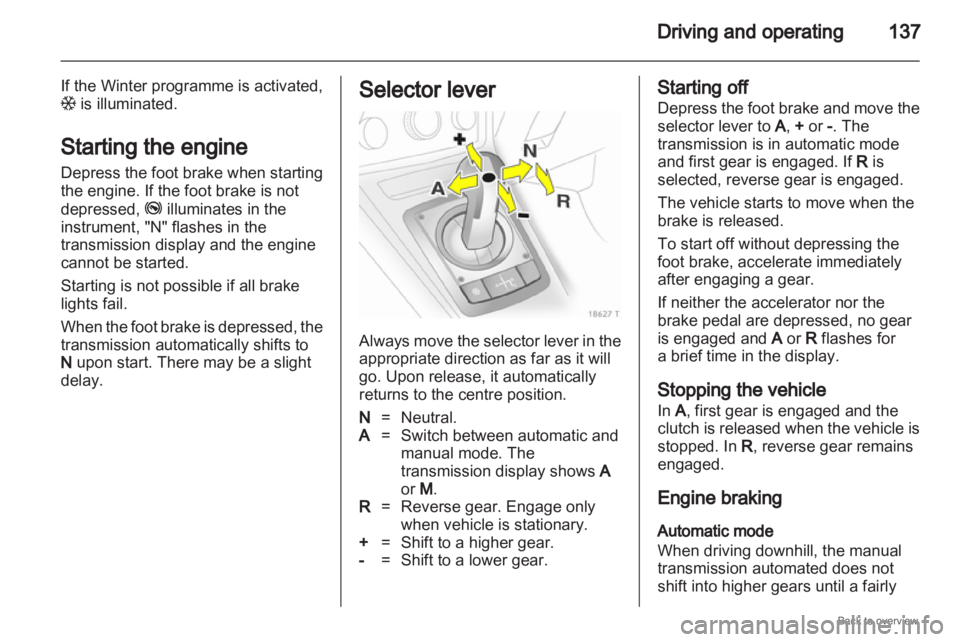
Always move the selector lever in the
appropriate direction as far as it will
go. Upon release, it automatically
returns to the centre position.
N
= Neutral.
A = Switch between automatic and
manual mode. The
transmission display shows A
or M.
R = Reverse gear. Engage only
when vehicle is stationary.
+ = Shift to a higher gear.
- = Shift to a lower gear. Starting off
Depress
the foot brake and move the
selector lever to A, + or -. The
transmission is in automatic mode
and first gear is engaged. If R is
selected, reverse gear is engaged.
The vehicle starts to move when the
brake is released.
To start off without depressing the
foot brake, accelerate immediately
after engaging a gear.
If neither the accelerator nor the
brake pedal are depressed, no gear
is engaged and A or R flashes for
a brief time in the display.
Stopping the vehicle
In A, first gear is engaged and the
clutch is released when the vehicle is
stopped. In R , reverse gear remains
engaged.
Engine braking
Automatic mode
When driving downhill, the manual
transmission automated does not
shift into higher gears until a fairly
Page 160 of 228
160
Vehicle care
Wiper blade on the rear window Lift wiper arm. Disengage wiper blade
as shown in illustration and remove. Bulb replacement
Switch off the ignition and switch off
the
relevant switch or close the doors.
Only hold a new bulb at the base! Do
not touch the bulb glass with bare
hands.
Use only the same bulb type for
replacement. The bulbs of the front outer lamps are
replaced through openings in the
front wheel housing: turn wheels in
the way that gains access, release
catch and remove cover. To replace bulbs on the right side of
the engine compartment, detach the
air hose from the air filter. On the left
side, detach the plug to the fuse box.
Halogen headlights
Headlamps have separate systems
for
high beam 1 (inner bulbs) and low
beam 2 (outer bulbs).
Low beam 1. Replace bulbs through the opening in the wheel housing.
Page 162 of 228
162
Vehicle care
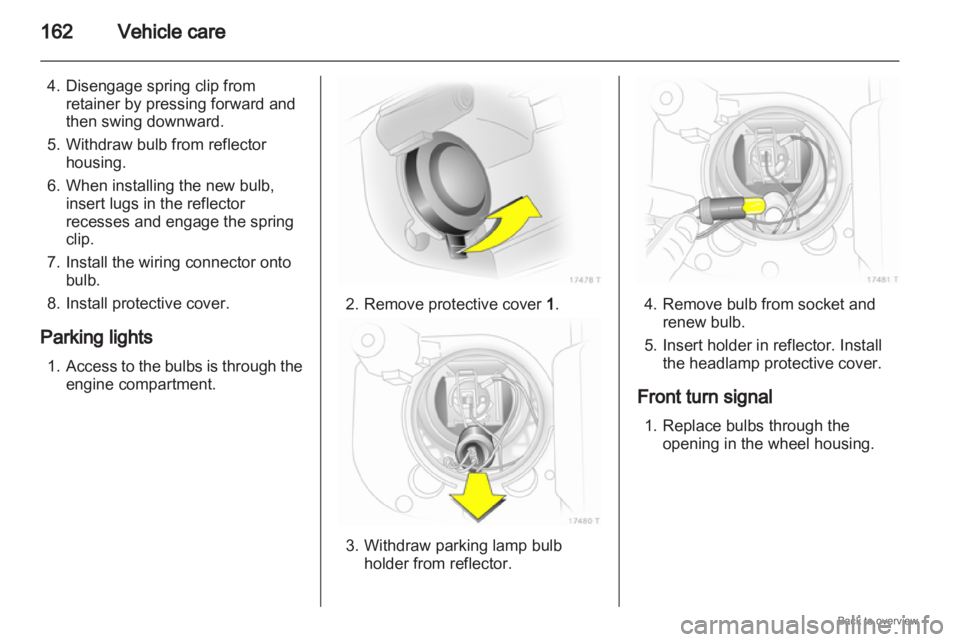
4. Disengage spring clip from retainer by pressing forward and
then swing downward.
5.
Withdraw bulb from reflectorhousing.
6. When installing the new bulb, insert lugs in the reflector
recesses and engage the spring
clip.
7. Install the wiring connector onto bulb.
8. Install protective cover.
Parking lights 1. Access to the bulbs is through the engine compartment. 2. Remove protective cover
1. 3. Withdraw parking lamp bulb
holder from reflector. 4. Remove bulb from socket and
renew bulb.
5.
Insert holder in reflector. Installthe headlamp protective cover.
Front turn signal 1. Replace bulbs through the opening in the wheel housing.
Page 163 of 228
Vehicle care
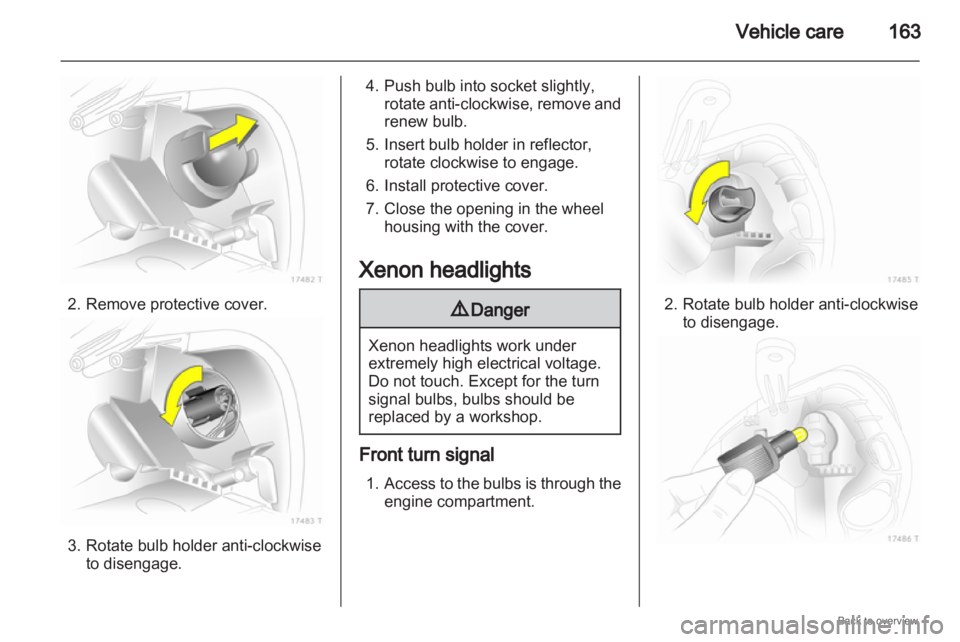
1632. Remove protective cover.
3. Rotate bulb holder anti-clockwise
to disengage. 4. Push bulb into socket slightly,
rotate anti-clockwise, remove and
renew bulb.
5. Insert bulb holder in reflector, rotate clockwise to engage.
6. Install protective cover.
7. Close the opening in the wheel housing with the cover.
Xenon headlights 9
Danger Xenon headlights work under
extremely high electrical voltage.
Do not touch. Except for the turn
signal bulbs, bulbs should be
replaced by a workshop.
Front turn signal
1. Access
to the bulbs is through the
engine compartment. 2. Rotate bulb holder anti-clockwise
to disengage.
Page 164 of 228
164
Vehicle care
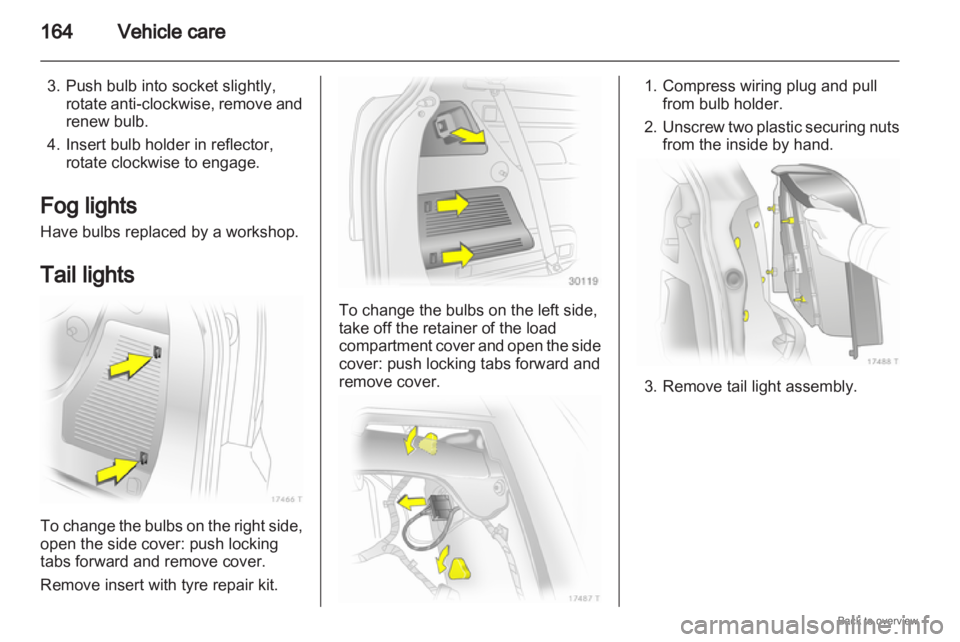
3. Push bulb into socket slightly, rotate anti-clockwise, remove and
renew bulb.
4. Insert bulb holder in reflector, rotate clockwise to engage.
Fog lights
Have bulbs replaced by a workshop.
Tail lights To change the bulbs on the right side,
open the side cover: push locking
tabs forward and remove cover.
Remove insert with tyre repair kit. To change the bulbs on the left side,
take off the retainer of the load
compartment
cover and open the side
cover: push locking tabs forward and
remove cover. 1. Compress wiring plug and pull
from bulb holder.
2. Unscrew
two plastic securing nuts
from the inside by hand. 3. Remove tail light assembly.
Page 165 of 228
Vehicle care
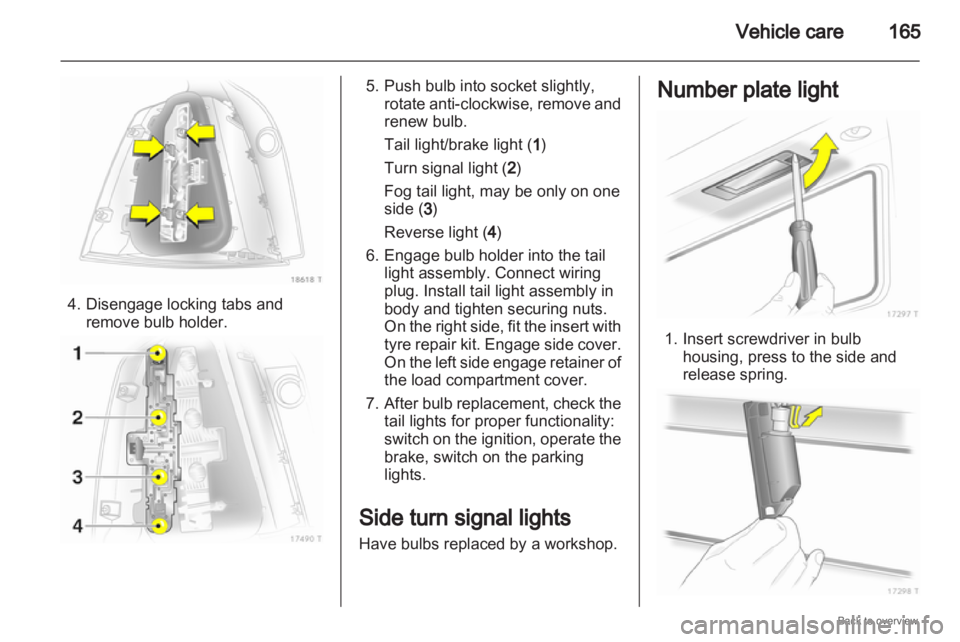
1654. Disengage locking tabs and
remove bulb holder. 5. Push bulb into socket slightly,
rotate anti-clockwise, remove and
renew bulb.
Tail light/brake light ( 1)
Turn signal light ( 2)
Fog tail light, may be only on one
side (3 )
Reverse light ( 4)
6. Engage bulb holder into the tail light assembly. Connect wiring
plug. Install tail light assembly in
body and tighten securing nuts.
On the right side, fit the insert with
tyre repair kit. Engage side cover.
On the left side engage retainer of
the load compartment cover.
7. After bulb replacement, check the tail lights for proper functionality:
switch on the ignition, operate the
brake, switch on the parking
lights.
Side turn signal lights
Have bulbs replaced by a workshop. Number plate light
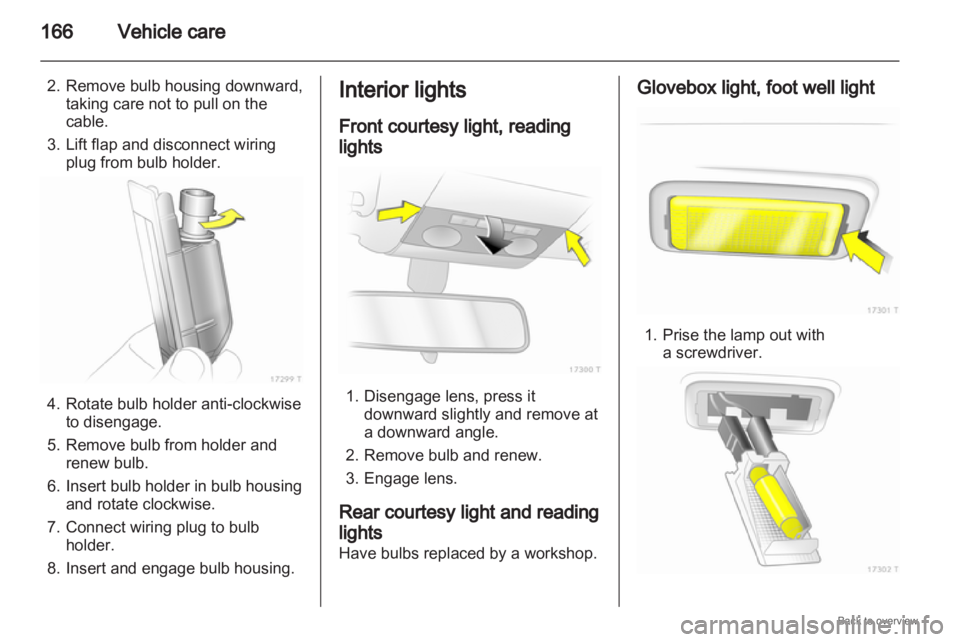
1. Insert screwdriver in bulb
housing, press to the side and
release spring.
Page 166 of 228
166
Vehicle care
2. Remove bulb housing downward, taking care not to pull on the
cable.
3.
Lift flap and disconnect wiringplug from bulb holder. 4. Rotate bulb holder anti-clockwise
to disengage.
5.
Remove bulb from holder andrenew bulb.
6. Insert bulb holder in bulb housing and rotate clockwise.
7. Connect wiring plug to bulb holder.
8. Insert and engage bulb housing. Interior lights
Front courtesy light, reading
lights
1. Disengage lens, press it
downward slightly and remove at
a downward angle.
2.
Remove bulb and renew.
3. Engage lens.
Rear courtesy light and reading
lights
Have bulbs replaced by a workshop. Glovebox light, foot well light
1. Prise the lamp out with
a screwdriver.
Page 186 of 228
186
Vehicle care
■ Wear eye protection and protective
clothing when handling a battery.
■ Use a booster battery with the same voltage (12 volts). Its capacity
(Ah) must not be much less than
that of the discharged battery.
■ Use jump leads with insulated terminals and a cross section of at
least 16 mm 2
(25 mm 2
for diesel
engines).
■ Do not disconnect the discharged battery from the vehicle.
■ Switch off all unnecessary electrical consumers.
■ Do not lean over the battery during jump starting.
■ Do not allow the terminals of one lead to touch those of the other
lead.
■ The vehicles must not come into contact with each other during the
jump starting process.
■ Apply the handbrake, transmission in neutral, automatic transmission
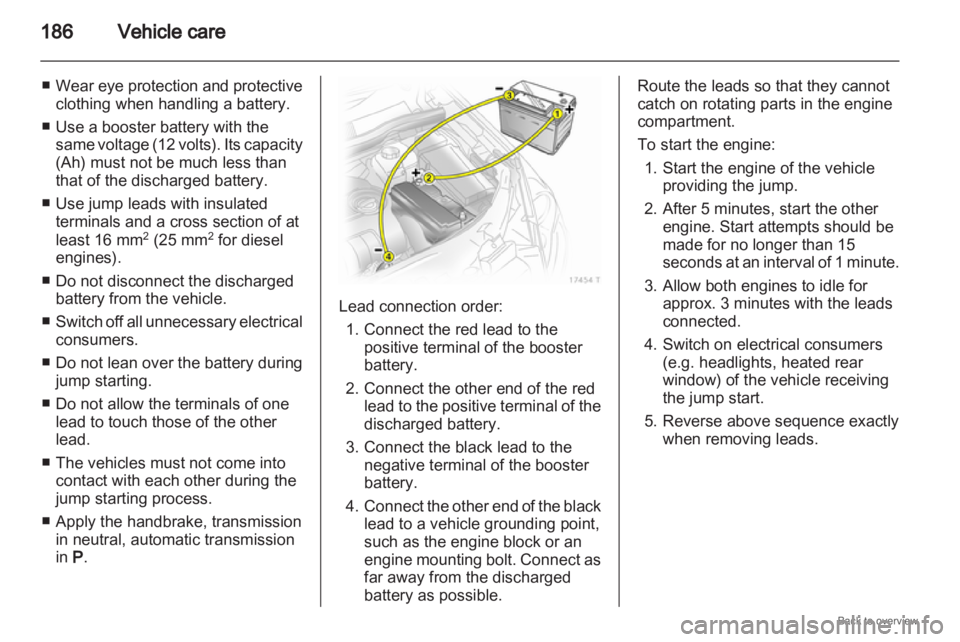
in P. Lead connection order:
1.
Connect the red lead to thepositive terminal of the booster
battery.
2. Connect the other end of the red lead to the positive terminal of the
discharged battery.
3. Connect the black lead to the negative terminal of the booster
battery.
4. Connect the other end of the black lead to a vehicle grounding point,
such as the engine block or an
engine mounting bolt. Connect as
far away from the discharged
battery as possible. Route the leads so that they cannot
catch on rotating parts in the engine
compartment.
To start the engine:
1.
Start the engine of the vehicleproviding the jump.
2. After 5 minutes, start the other engine. Start attempts should be
made for no longer than 15
seconds at an interval of 1 minute.
3. Allow both engines to idle for approx. 3 minutes with the leads
connected.
4. Switch on electrical consumers (e.g. headlights, heated rear
window) of the vehicle receiving
the jump start.
5. Reverse above sequence exactly when removing leads.