2009 OPEL ANTARA lock
[x] Cancel search: lockPage 166 of 234

Driving and operation166
Inserting the coupling ball barInsert the coupling ball bar into the
coupling housing and push firmly
downwards until the coupling ball bar
audibly engages.
If it does not engage, repeat fitting
procedure.
Do not swing the coupling ball bar to the
left or right, or upwards and downwards, to
avoid disrupting correct fitting. Lock coupling ball bar by turning the
supplied key in the lock cylinder of the
coupling ball bar.
Remove key.Important
Check that the coupling ball bar is correctly
attached:
z
Green marking must be visible on lever.
z Coupling ball bar must be seated firmly
in coupling housing.
Coupling ball bar must be locked and key
must be removed.
Eye for breakaway stopping cable 3
In the case of caravans/trailers with
brakes 3, attach the breakaway stopping
cable to the eye - not the coupling ball bar.
9 Warning
Towing a caravan/trailer is only
permitted with a properly attached
coupling ball bar. If the coupling ball bar
cannot be properly attached, consult a
workshop.
Page 167 of 234

Driving and operation167
Dismounting the coupling ball bar
Unlock coupling ball bar and remove key.
Push lever to the left, towards the coupling
ball bar and turn it downwards. Pull
coupling ball bar out of coupling housing.
Remove any rust or dirt from area around
the coupling housing and coupling ball bar
connection before inserting sealing plug in
the hole.
Place the coupling ball bar in the bag
supplied, fasten it wi th the strap and stow
it below the floor cover in the luggage
compartment.
Do not use steam-jet cleaners or other
high-pressure cleaners to clean the
coupling ball bar.
Towing
Caravan/trailer loads1)
The permissible caravan/trailer loads are
vehicle-dependent and engine-dependent
maximum values which must not be
exceeded.
The actual caravan/trailer load is the
difference between the actual gross weight
of the caravan/trailer and the actual
coupling socket load with the caravan/
trailer coupled.
When the caravan/trailer load is being
checked, therefore, on ly the caravan/trailer
wheels - and not the jockey wheel - must be
standing on the weighing apparatus.
The permissible caravan/trailer loads for
your vehicle are given in the vehicle papers.
Unless otherwise stated , they are valid for
gradients up to max. 12%.
The permissible caravan/trailer load should
be fully utilized only by drivers who are
adequately experienced in towing large
caravans/trailers.
The permitted caravan/trailer load applies
up to the specified incline and up to an
altitude of 1000 metres above sea level. Since engine power decreases as altitude
increases because of the air becoming
thinner, therefore reducing climbing ability,
it may not be possible for permissible trailer
loads to be fully utilized in mountainous
territory.
The permitted towing weight decreases by
10% for every 1000 metres of additional
altitude.
The towing weight does not have to be
reduced when driving on roads with slight
inclines (less than 8%, e.g. on motorways).
The actual caravan/trailer load plus the
actual Gross Vehicle Weight must not
exceed the maximum permitted towing
weight. For example, if the permitted Gross
Vehicle Weight is utilised, the caravan/
trailer load must only
be used until the
maximum permitted towing weight is
reached.
The maximum permitted towing weight is
shown on the vehicle id entification plate -
see page 215.
1)Observe national regulations.
Page 170 of 234

Driving and operation170
Block the wheels of both the caravan/trailer
and the vehicle when parking and always
apply the hand brake firmly. If possible, do
not park on slopes. Parking on inclines
If parking on an incline is unavoidable,
depress the foot brake, have someone
place wheel blocks under the caravan/
trailer wheels and release the foot brake
until the blocks have absorbed the load.
Depress foot brake again, apply
hand brake, engage first gear on uphill
gradients or reverse gear on downhill
gradients (automatic transmission 3 in P)
and finally, release foot brake. Starting on inclines
Depress the foot brake and hold it down,
start the engine, shift into gear and release
the hand brake.
Release foot brake and drive slowly until
the caravan/trailer is clear of the wheel
blocks. Stop the vehicle and have someone
pick up the blocks. If possible, the engine
speed should not drop during this
procedure.
For vehicles with automatic transmission
3
in automatic mode, apply sufficient
throttle.
Before starting-off under extreme
conditions (e.g. high combination weight,
mountainous terrain with steep inclines),
switch off all unnecessary electrical loads
(e.g. heated rear window, air conditioning
system, heated front seats 3).
9 Warning
Have someone provide assistance when
removing blocks. Always remove blocks
from wheels while standing to one side.
Do not remove blocks while standing
behind the caravan/trailer; risk of injury
and damage to both the vehicle and
caravan/trailer.
Page 171 of 234

Self-help, vehicle care171
Self-help, vehicle care
Diesel fuel system, bleeding
Never let the fuel tank run dry. If control
indicator Y illuminates, refuel as soon as
possible.
It is possible to restart the engine if the tank
has been run dry. A delayed start can be
expected. Switch on the ignition three times
for approx. 15 seconds. Then try to start
the engine for no more than 40 seconds. If
the engine will not start, wait at least
10 seconds before trying again. If the
engine will still not start, consult a
workshop.
Bonnet
To open the bonnet, pull release lever /
located on the left-hand side below the
instrument panel.
The bonnet will then be unlocked and will
partially open. Return release lever to its
original position.
Do not pull release lever while the vehicle is
moving.
Diesel fuel system, bleeding .............. 171
Bonnet ................................................. 171
Starting ................................................ 172
Starting the engine with jump leads
3 172
Towing ................................................. 174
Jack and vehicle tools ........................ 176
Warning triangle ¨ 3 ,
First aid kit +3................................ 177
Temporary spare wheel ..................... 177
Wheel changing .................................. 178
Electrical system ................................. 181
Fuses and the most important circuits they protect ...................................... 182
Bulb replacement ............................... 185
Opel genuine parts and accessories . 191
A note on safety ................................. 191
Checking and topping up fluids ........ 191
Windscreen wipers .............................. 198
Windscreen washer system ................ 199
Battery ................................................. 200
Protection of electr onic components 201
Vehicle storage ................................... 201
Vehicle care......................................... 201
9 Warning
Disregard of the instructions may lead to
injuries or endanger life. Vehicle
passengers must be informed
accordingly.
Page 172 of 234

Self-help, vehicle care172
To open completely, locate the safety
catch, found slightly left of centre on the
underside of the bonnet, push the catch
upwards and lift the bonnet gently. The
bonnet is held open automatically.
When the bonnet is opened, leaves, dirt or
snow on the bonnet can slide down and
obstruct the air intake. Remove any leaves,
dirt or snow. Air intake - see page 114.
Never drive with bonnet open.
To close bonnet, lower it gradually,
allowing it to drop from a height of approx.
30 cm.
Check that the bonnet is locked in position
before driving, by pulling at its front edge.
If it is not engaged, repeat closing
procedure.
Starting
Do not start with quick charger
This prevents damage to electronic
components.
Do not start by pushing or towing
Because your vehicle is fitted with a
catalytic converter, it must not be started
by pushing or towing - see page 133.
The vehicle can only be started using jump
leads - see following pages.
Starting the engine with jump
leads 3
A vehicle with a discha rged battery can be
started using jump leads and the battery of
another vehicle.
Start attempts should be made at intervals
of 1 minute and should not last longer than
15 seconds.
9 Warning
If the vehicle battery requires charging
whilst still in the vehicle, ensure there is
adequate ventilation in and around the
battery compartment, to prevent risk of
explosion.
9 Warning
This must be done with extreme care. Any
deviation from the following instructions
could lead to personal injury or damage
resulting from battery explosion, as well
as to damage to the electrical systems in
both vehicles.
Page 173 of 234
Self-help, vehicle care173
zNever expose the battery to naked
flames or sparks.
z A discharged battery can freeze at
temperatures of 0
°C. Defrost the battery
in a warm room before connecting the
jump leads.
z Do not allow battery fluid to contact
eyes, skin, fabrics or painted surfaces.
The fluid contains sulphuric acid which
can cause injuries and damage in the
event of direct contact.
z Wear eye protection and protective
clothing when handling a battery. z
Use auxiliary battery with same voltage
(12 volts). Its capacity (Ah) must not be
considerably less than that of the
discharged battery. Voltage and
capacity information can be found on
the batteries.
z Use jump leads with insulated terminals
and a width of at least 16 mm
2 (25 mm2
for diesel engines).
z Do not disconnect the discharged
battery from the vehicle.
z Switch off all unnecessary electrical
consumers. Infotainment system may be
damaged if switched on while jump
starting.
z Do not lean over the battery during jump
starting procedure.
z Do not allow the terminals of one lead to
touch those of the other lead.
z The vehicles should not touch while jump
starting.
z Apply hand brake.
z Manual transmissi on in neutral,
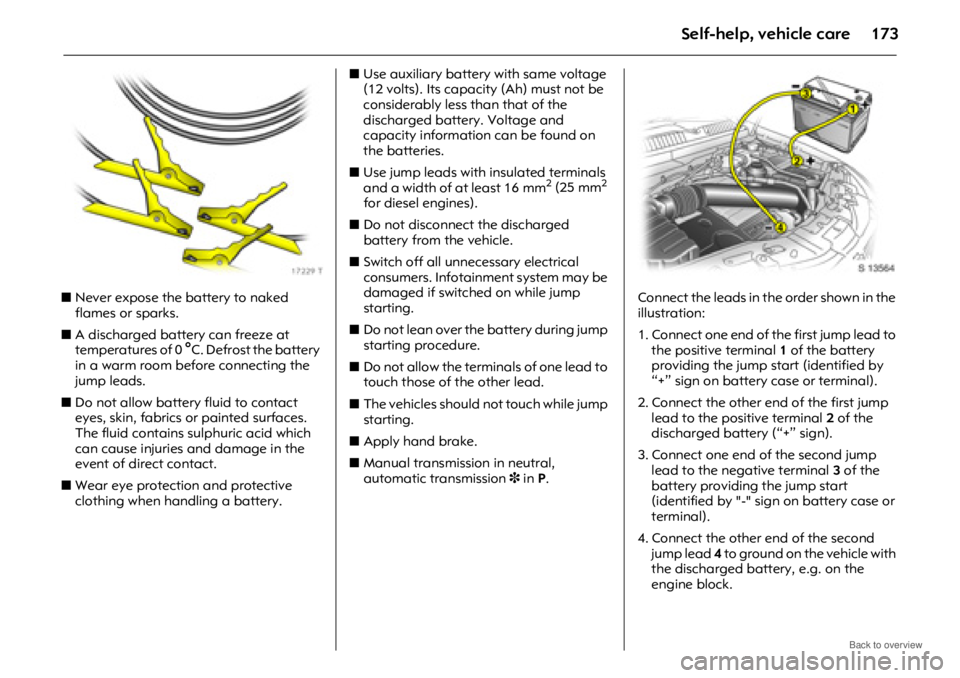
automatic transmission 3 in P. Connect the leads in th
e order shown in the
illustration:
1. Connect one end of the first jump lead to the positive terminal 1 of the battery
providing the jump start (identified by
“+” sign on battery case or terminal).
2. Connect the other end of the first jump lead to the positive terminal 2 of the
discharged battery (“+” sign).
3. Connect one end of the second jump lead to the negative terminal 3 of the
battery providing the jump start
(identified by "-" sign on battery case or
terminal).
4. Connect the other end of the second jump lead 4 to ground on the vehicle with
the discharged battery, e.g. on the
engine block.
Page 174 of 234

Self-help, vehicle care174
zDo not connect leads to negative
terminal of discharged battery.
z The last connection point should be as
far away from the discharged battery as
possible.
z Route leads so they cannot catch on
rotating parts in engine compartment.
z Start the engine of the vehicle providing
the jump start.
z After 5 minutes, start the other engine.
Start attempts shou ld be made at
intervals of 1 minute and should not last
longer than 15 seconds.
z After starting, allow both engines to idle
for approx. 3 minutes with leads
connected.
z In order to avoid excess voltage in the
electrical system, before removing a
lead, switch on an electrical consumer
(e.g. lamps, heated rear window) in the
vehicle receiving the jump start.
z Operate discharged vehicle for approx.
20 minutes to allow for recharging.
z Reverse above sequence exactly when
removing leads.
Towing
Towing the vehicle
Attach a tow rope 3 - or better still a tow
rod 3 - to the front towing eye (located
under the front bumper). Do not tow the
vehicle from the rear.
The front towing eye must only be used for
towing and not recovering the vehicle. Place gearshift lever in neutral. Switch on
the ignition to release the steering column
lock and to permit operation of the brake
lamps and windscreen wipers.
Drive off slowly and avoid jerky
movements. Impermissible tractive forces
could damage
the vehicles.
9 Warning
Care must be taken to ensure that the
leads do not inadvertently contact metal
surfaces within the compartment area.
9 Warning
Never lift vehicle using the towing eye.
9 Warning
More brake pedal pressure is necessary
when braking since the brake servo unit is
operative only when engine is running.
Considerably greater steering force is
necessary since this unit is operative only
when the engine is running.
Page 176 of 234

Self-help, vehicle care176
Screw the rear towing eye attachment anti-
clockwise until it is firmly in place.
Drive off slowly and avoid jerky
movements. Impermissible tractive forces
could damage the vehicles.
To prevent damage, do not take up slack
in the tow rope too quickly.
After towing, unscrew the rear towing eye
attachment clockwise to remove, and
reinstall the cover.
Jack and vehicle tools
The jack and vehicle tools have been
specially developed for your vehicle and
must only be used on that vehicle. Only use
jack for changing wheels.
The jack and vehicle tools are located in
the luggage compartment below the floor
cover. To remove the jack and vehicle tools, open
the tailgate. Push both levers on the floor
cover towards the handle and pull up the
floor cover by the handle.
Hang the hook to the upper part of the
tailgate opening (see page 63, Fig.
S 13419).
Remove wing bolt from the jack by rotating
it anti-clockwise and remove the jack and
wheel wrench bag.
Remove straps holding the bag containing
the wheel wrench. Remove wheel wrench
from the bag.
9 Warning
Never lift vehicle using the towing eye.
9 Warning
In a sudden stop or a collision, loose items
can be thrown around inside the vehicle,
causing personal injury and damage to
the interior.
Secure the jack and vehicle tools away
properly under the floor cover in the
luggage compartment.