2009 MERCEDES-BENZ GL SUV check engine
[x] Cancel search: check enginePage 194 of 309
R
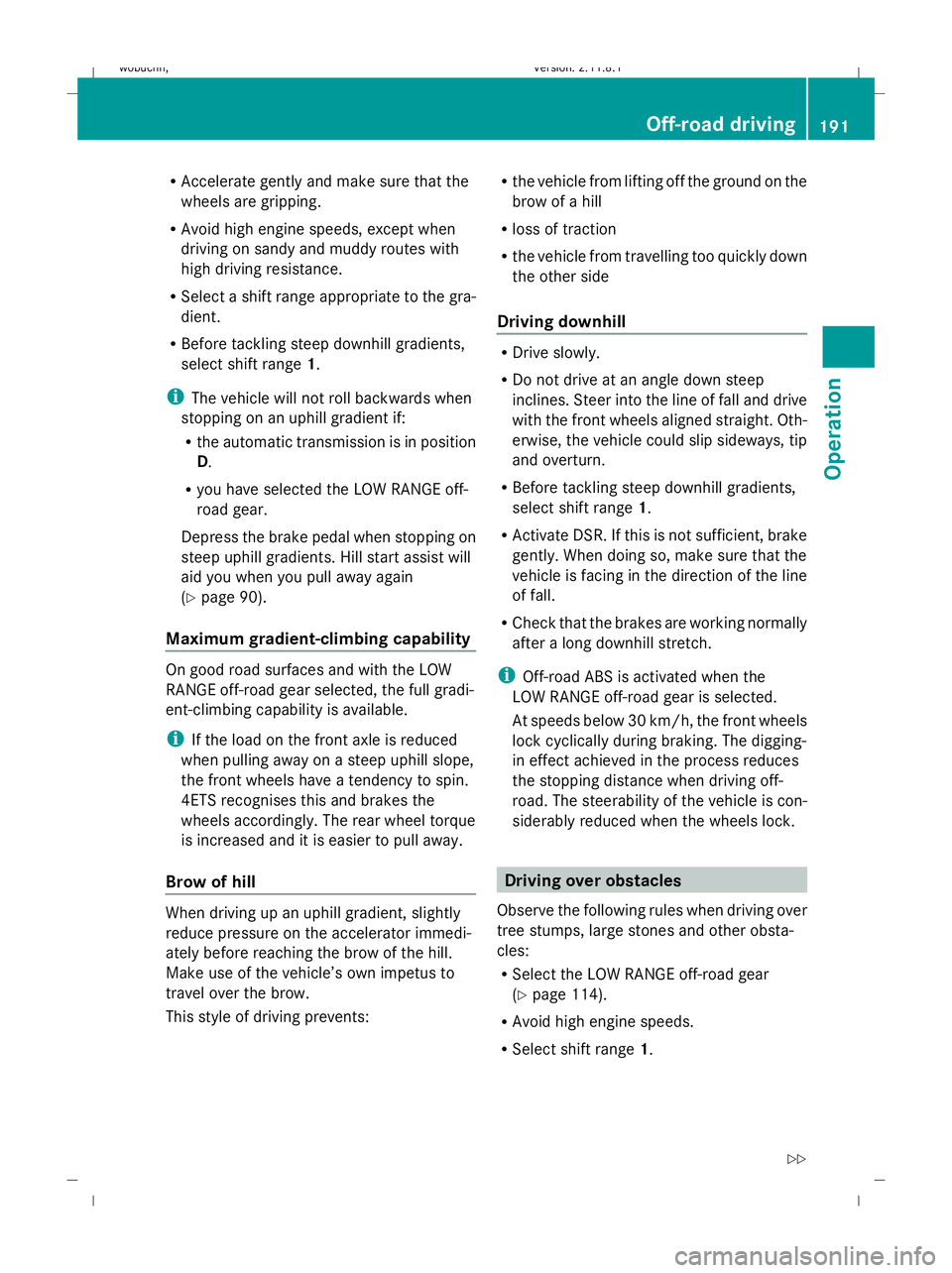
Accelerate gently and make sure that the
wheels are gripping.
R Avoid high engine speeds, except when
driving on sandy and muddy routes with
high driving resistance.
R Select a shift range appropriate to the gra-
dient.
R Before tackling steep downhill gradients,
select shift range 1.
i The vehicle will not roll backwards when
stopping on an uphill gradient if:
R the automatic transmission is in position
D.
R you have selected the LOW RANGE off-
road gear.
Depress the brake pedal when stopping on
steep uphill gradients. Hill start assist will
aid you when you pull away again
(Y page 90).
Maximum gradient-climbing capability On good road surfaces and with the LOW
RANGE off-road gear selected, the full gradi-
ent-climbing capability is available.
i
If the load on the front axle is reduced
when pulling away on a steep uphill slope,
the front wheels have a tendency to spin.
4ETS recognises this and brakes the
wheels accordingly. The rear wheel torque
is increased and it is easier to pull away.
Brow of hill When driving up an uphill gradient, slightly
reduce pressure on the accelerator immedi-
ately before reaching the brow of the hill.
Make use of the vehicle’s own impetus to
travel over the brow.
This style of driving prevents: R
the vehicle from lifting off the ground on the
brow of a hill
R loss of traction
R the vehicle from travelling too quickly down
the other side
Driving downhill R
Drive slowly.
R Do not drive at an angle down steep
inclines. Steer into the line of fall and drive
with the front wheels aligned straight. Oth-
erwise, the vehicle could slip sideways, tip
and overturn.
R Before tackling steep downhill gradients,
select shift range 1.
R Activate DSR. If this is not sufficient, brake
gently. When doing so, make sure that the
vehicle is facing in the direction of the line
of fall.
R Check that the brakes are working normally
after a long downhill stretch.
i Off-road ABS is activated when the
LOW RANGE off-road gear is selected.
At speeds below 30 km/h, the front wheels
lock cyclically during braking. The digging-
in effect achieved in the process reduces
the stopping distance when driving off-
road. The steerability of the vehicle is con-
siderably reduced when the wheels lock. Driving over obstacles
Observe the following rules when driving over
tree stumps, large stones and other obsta-
cles:
R Select the LOW RANGE off-road gear
(Y page 114).
R Avoid high engine speeds.
R Select shift range 1. Off-road driving
191Operation
X164_AKB; 2; 3, en-GB
wobuchh,V ersion: 2.11.8.1
2009-03-31T14:14:58+02:00 - Seite 191 Z
Dateiname: 6515431202_buchblock.pdf; erzeugt am 01. Apr 2009 00:17:49; WK
Page 196 of 309

R
Drive quickly to overcome the rolling resist-
ance. The vehicle could otherwise dig itself
into the sand.
R Drive in the tracks of other vehicles, if pos-
sible. Make sure that the ruts are not too
deep, that the sand is firm enough and that
your vehicle has sufficient ground clear-
ance. Ruts
Observe the following rules when driving
along ruts in off-road terrain or on roads with
loose gravel:
! Check that the ruts are not too deep and
that your vehicle has sufficient clearance.
Otherwise, your vehicle could be damaged
or bottom out and get stuck.
R Select the LOW RANGE off-road gear
(Y page 114).
R Select a higher vehicle level.
R Avoid high engine speeds.
R Select shift range 1.
R Drive slowly.
R Where ruts are too deep, drive with the
wheels on one side on the middle section
of turf if possible. Driving abroad
Points to remember
An extensive Mercedes-Benz Service network
is also available in other countries. The
Service Hotline's current telephone numbers
for use when you are abroad are to be found
in the "Service24h" chapter of the Service
Booklet.
Only low-octane fuel is available in certain
countries.
You can find further information about fuel
grades on (Y page 172). Symmetrical dipped beam
If your journey takes you to countries where
vehicles are driven on sides of the road oppo-
site to the country in which the vehicle is reg-
istered, your headlamps must be switched to
symmetrical dipped beam. Oncoming traffic
will be dazzled less.
X Have the headlamps switched over at a
qualified specialist workshop, e. g. a
Mercedes-Benz Service Centre. G
Risk of accident
Remember to set the headlamps back to
asymmetrical dipped beam when you return
to driving on the same side of the road as that
of the country in which your vehicle was reg-
istered. You may otherwise dazzle the oncom-
ing traffic and could cause an accident. Trailer towing*
Folding out the ball coupling
Before you can tow a trailer with your vehicle,
you must fit the ball coupling.
The telescopic lever is under the boot/lug-
gage compartment mat on the left-hand side. G
Risk of accident
Make sure that the ball coupling is fully
engaged both when it is folded in and when it
is folded out. The indicator lamp is not lit.
Do not pull the telescopic lever if a trailer is
attached. The trailer could otherwise come
loose. Trailer towing*
193Operation
* optional
X164_AKB; 2; 3, en-GB
wobuchh
,V ersion: 2.11.8.1
2009-03-31T14:14:58+02:00 - Seite 193 Z
Dateiname: 6515431202_buchblock.pdf; erzeugt am 01. Apr 2009 00:17:50; WK
Page 200 of 309

You will find the values approved by the man-
ufacturer on the vehicle identification plates
and those for the towing vehicle in the "Tech-
nical data" section.
You will find installation dimensions and loads
in the "Technical data" section
(Y page 297).
The maximum drawbar load of the trailer
drawbar on the ball coupling is 140 kg. How-
ever, the actual noseweight must not exceed
the value given on the trailer coupling or
trailer identification plates. The lowest weight
applies.
! Use a noseweight as close as possible to
the maximum permissible noseweight. Do
not use a noseweight of less than 50 kg,
otherwise the trailer may come loose.
Bear in mind that the payload and the rear
axle load are reduced by the actual nose-
weight.
When towing a trailer, where possible set the
tyre pressures for the permissible gross
weight which you find in the table on the
inside of your vehicle's fuel filler flap (higher
values).
Driving tips i
Observe the notes on ESP ®
trailer stabi-
lisation (Y page 51).
In Germany, the maximum permissible speed
for vehicle/trailer combinations depends on
the type of trailer and is either 80 km/h or
100 km/h. Before beginning the journey,
check the trailer's documents to see what the
maximum permitted speed is. G
Risk of accident
Always observe the maximum speed permit-
ted in Germany for vehicle/trailer combina-
tions, even in countries where higher speeds
are permitted. This lowers the risk of an acci-
dent. When towing a trailer, your vehicle's handling
characteristics will be different in comparison
to when driving without a trailer.
The vehicle/trailer combination:
R is heavier
R is restricted in its acceleration and gradi-
ent-climbing capability
R has an increased braking distance
R is affected more by strong crosswinds
R demands more sensitive steering
R consumes more fuel
On long and steep downhill gradients, you
must select shift range 1,2or 3in good time.
i This also applies if you have activated
cruise control, Distronic* or Speedtronic.
This will use the braking effect of the engine,
so less braking will be required to maintain
the speed. This relieves the load on the brake
system and prevents the brakes from over-
heating and wearing too quickly. If you need
additional braking, depress the brake pedal
repeatedly rather than continuously. G
Risk of accident
Never depress the brake pedal continuously
while the vehicle is in motion, e.g. never cause
the brakes to rub by applying constant slight
pedal pressure. This causes the brake system
to overheat, increases the braking distance
and can lead to the brakes failing completely.
Driving tips
R Maintain a greater distance from the vehi-
cle in front than when driving without a
trailer.
R Avoid braking abruptly. If possible, brake
gently at first to allow the trailer to run on.
Then, increase the braking force rapidly.
R The values given for gradient-climbing
capabilities from a standstill refer to sea
level. When driving in mountainous areas,
note that the power output of the engine,
and consequently the vehicle's gradient- Trailer towing*
197Operation
* optional
X164_AKB; 2; 3, en-GB
wobuchh
,V ersion: 2.11.8.1
2009-03-31T14:14:58+02:00 - Seite 197 Z
Dateiname: 6515431202_buchblock.pdf; erzeugt am 01. Apr 2009 00:17:52; WK
Page 216 of 309
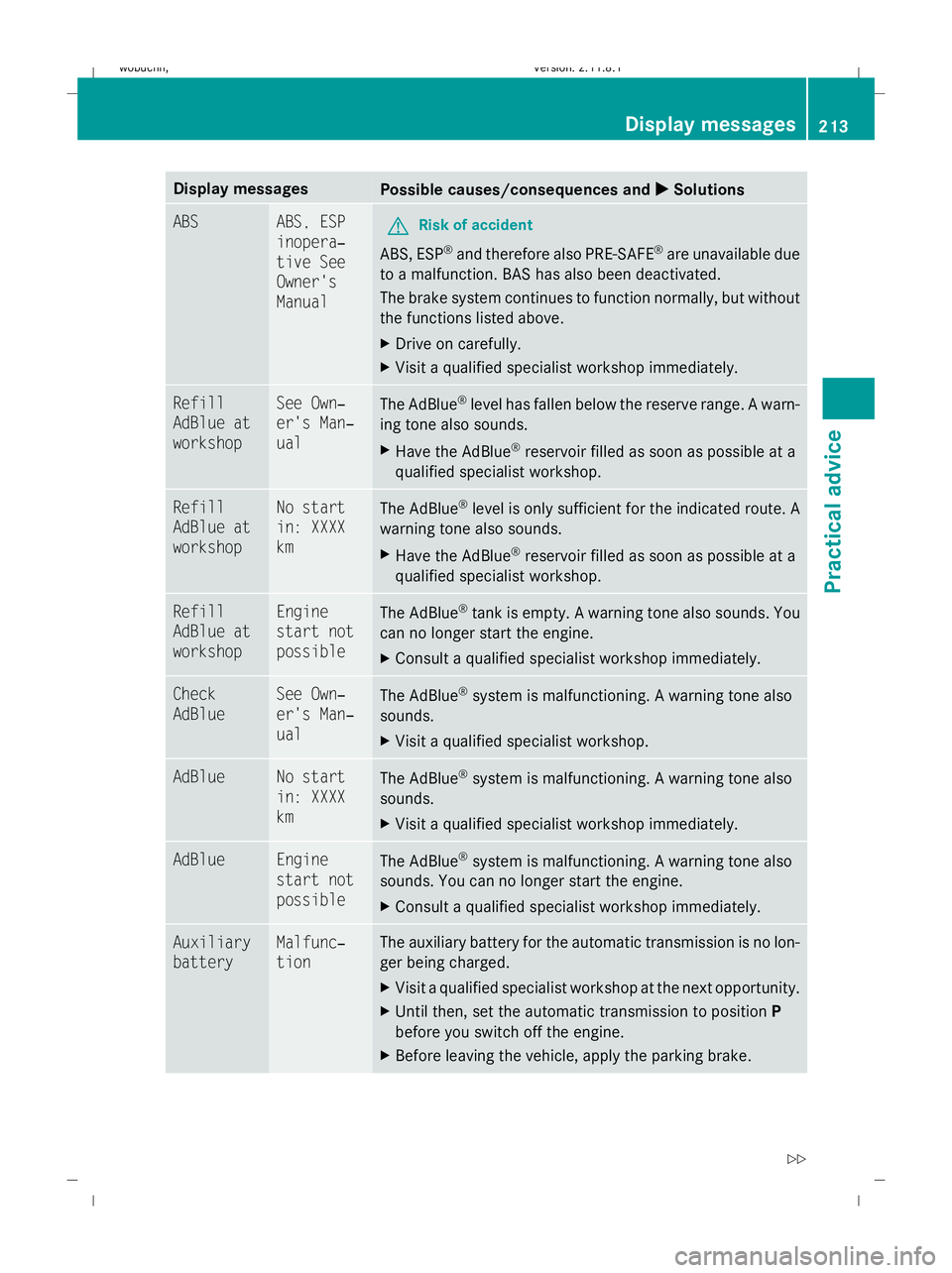
Display messages
Possible causes/consequences and
X
X Solutions ABS ABS, ESP
inopera‐
tive See
Owner's
Manual
G
Risk of accident
ABS, ESP ®
and therefore also PRE-SAFE ®
are unavailable due
to a malfunction. BAS has also been deactivated.
The brake system continues to function normally, but without
the functions listed above.
X Drive on carefully.
X Visit a qualified specialist workshop immediately. Refill
AdBlue at
workshop See Own‐
er's Man‐
ual
The AdBlue
®
level has fallen below the reserve range. A warn-
ing tone also sounds.
X Have the AdBlue ®
reservoir filled as soon as possible at a
qualified specialist workshop. Refill
AdBlue at
workshop No start
in: XXXX
km
The AdBlue
®
level is only sufficient for the indicated route. A
warning tone also sounds.
X Have the AdBlue ®
reservoir filled as soon as possible at a
qualified specialist workshop. Refill
AdBlue at
workshop Engine
start not
possible
The AdBlue
®
tank is empty. A warning tone also sounds. You
can no longer start the engine.
X Consult a qualified specialist workshop immediately. Check
AdBlue See Own‐
er's Man‐
ual
The AdBlue
®
system is malfunctioning. A warning tone also
sounds.
X Visit a qualified specialist workshop. AdBlue No start
in: XXXX
km
The AdBlue
®
system is malfunctioning. A warning tone also
sounds.
X Visit a qualified specialist workshop immediately. AdBlue Engine
start not
possible
The AdBlue
®
system is malfunctioning. A warning tone also
sounds. You can no longer start the engine.
X Consult a qualified specialist workshop immediately. Auxiliary
battery Malfunc‐
tion The auxiliary battery for the automatic transmission is no lon-
ger being charged.
X
Visit a qualified specialist workshop at the next opportunity.
X Until then, set the automatic transmission to position P
before you switch off the engine.
X Before leaving the vehicle, apply the parking brake. Display
messages
213Practical advice
X164_AKB; 2; 3, en-GB
wobuchh,V ersion: 2.11.8.1
2009-03-31T14:14:58+02:00 - Seite 213 Z
Dateiname: 6515431202_buchblock.pdf; erzeugt am 01. Apr 2009 00:17:58; WK
Page 217 of 309
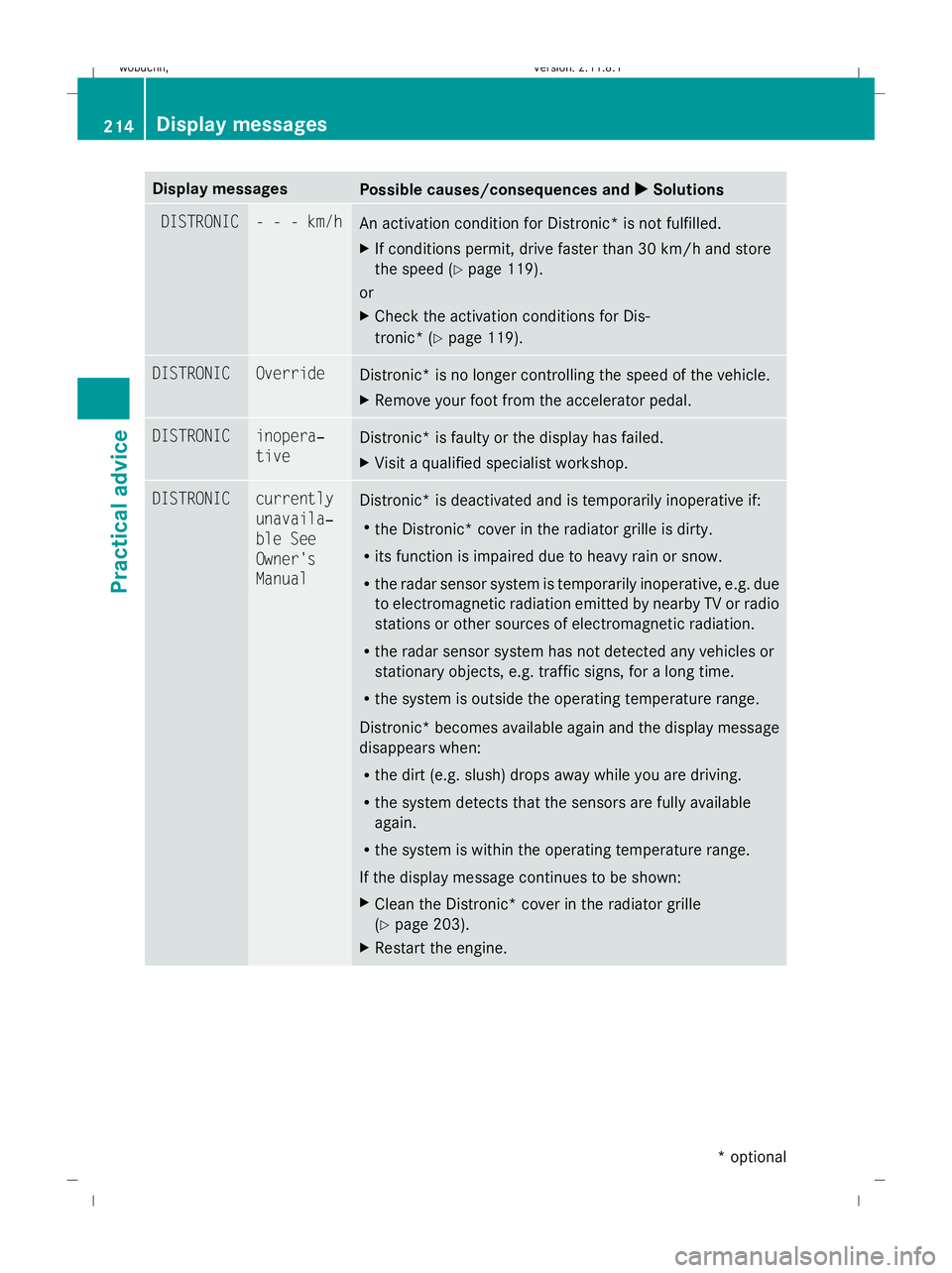
Display messages
Possible causes/consequences and
X
X Solutions DISTRONIC - - - km/h
An activation condition for Distronic* is not fulfilled.
X
If conditions permit, drive faster than 30 km/h and store
the speed (Y page 119).
or
X Check the activation conditions for Dis-
tronic* (Y page 119). DISTRONIC Override
Distronic* is no longer controlling the speed of the vehicle.
X
Remove your foot from the accelerator pedal. DISTRONIC inopera‐
tive
Distronic* is faulty or the display has failed.
X
Visit a qualified specialist workshop. DISTRONIC currently
unavaila‐
ble See
Owner's
Manual
Distronic* is deactivated and is temporarily inoperative if:
R
the Distronic* cover in the radiator grille is dirty.
R its function is impaired due to heavy rain or snow.
R the radar sensor system is temporarily inoperative, e.g. due
to electromagnetic radiation emitted by nearby TV or radio
stations or other sources of electromagnetic radiation.
R the radar sensor system has not detected any vehicles or
stationary objects, e.g. traffic signs, for a long time.
R the system is outside the operating temperature range.
Distronic* becomes available again and the display message
disappears when:
R the dirt (e.g. slush) drops away while you are driving.
R the system detects that the sensors are fully available
again.
R the system is within the operating temperature range.
If the display message continues to be shown:
X Clean the Distronic* cover in the radiator grille
(Y page 203).
X Restart the engine. 214
Display
messagesPractical advice
* optional
X164_AKB; 2; 3, en-GB
wobuchh
,V ersion: 2.11.8.1
2009-03-31T14:14:58+02:00 - Seite 214
Dateiname: 6515431202_buchblock.pdf; erzeugt am 01. Apr 2009 00:17:59; WK
Page 220 of 309

Display messages
Possible causes/consequences and
X
X Solutions P To start
the
engine,
shift to
either P
or N You have attempted to start the engine with the transmission
in position
Ror D.
X Shift the automatic transmission to Por N. Depress
brake to
shift out
of position P
X
Depress the brake pedal. PRE-SAFE inopera‐
tive See
Owner's
Manual
G
Risk of injury
Important functions of PRE-SAFE ®
have failed. All other occu-
pant safety systems, e.g. airbags, remain available.
X Visit a qualified specialist workshop. Tyre pres‐
sure moni‐
tor inopera‐
tive
The tyre pressure monitor* is malfunctioning.
X
Have the tyre pressure monitor* and wheels checked at a
qualified specialist workshop. Tyre pres‐
sure moni‐
tor inopera‐
tive No
wheel sen‐
sors The fitted wheels do not have suitable tyre pressure sensors.
The tyre pressure monitor* is deactivated.
X
Fit wheels with suitable tyre pressure sensors.
The tyre pressure monitor* is activated automatically after
driving for a few minutes. Tyre pres‐
sure moni‐
tor Wheel sen‐
sor miss‐
ing
The tyre pressure monitor* is not receiving signals from one
or more wheels because:
R
a wheel without a suitable tyre pressure sensor has been
fitted, e.g. the emergency wheel*.
R the battery on one of the wheel electronics unit is dis-
charged.
R a wheel electronics unit has malfunctioned.
A line is displayed in the multi-function display for the affected
tyre instead of the tyre pressure value.
X Have the tyre pressure monitor* and wheels checked at a
qualified specialist workshop.
If wheels with suitable tyre pressure sensors are fitted, the
tyre pressures appear in the multi-function display after
driving for a few minutes. Display
messages
217Practical advice
* optional
X164_AKB; 2; 3, en-GB
wobuchh
,V ersion: 2.11.8.1
2009-03-31T14:14:58+02:00 - Seite 217 Z
Dateiname: 6515431202_buchblock.pdf; erzeugt am 01. Apr 2009 00:17:59; WK
Page 223 of 309
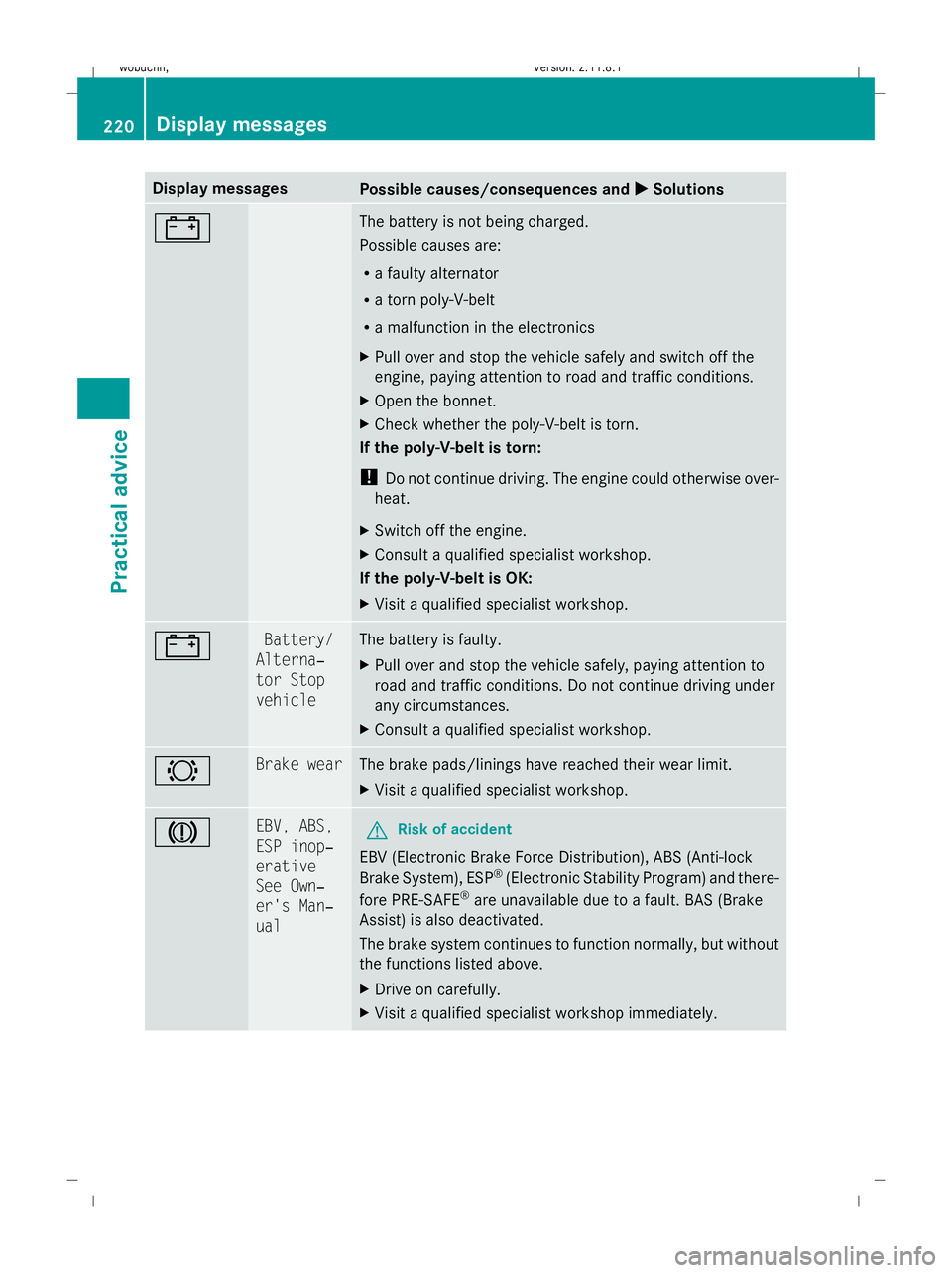
Display messages
Possible causes/consequences and
X
X Solutions # The battery is not being charged.
Possible causes are:
R
a faulty alternator
R a torn poly-V-belt
R a malfunction in the electronics
X Pull over and stop the vehicle safely and switch off the
engine, paying attention to road and traffic conditions.
X Open the bonnet.
X Check whether the poly-V-belt is torn.
If the poly-V-belt is torn:
! Do not continue driving. The engine could otherwise over-
heat.
X Switch off the engine.
X Consult a qualified specialist workshop.
If the poly-V-belt is OK:
X Visit a qualified specialist workshop. # Battery/
Alterna‐
tor Stop
vehicle The battery is faulty.
X
Pull over and stop the vehicle safely, paying attention to
road and traffic conditions. Do not continue driving under
any circumstances.
X Consult a qualified specialist workshop. # Brake wear The brake pads/linings have reached their wear limit.
X
Visit a qualified specialist workshop. J EBV, ABS,
ESP inop‐
erative
See Own‐
er's Man‐
ual
G
Risk of accident
EBV (Electronic Brake Force Distribution), ABS (Anti-lock
Brake System), ESP ®
(Electronic Stability Program) and there-
fore PRE-SAFE ®
are unavailable due to a fault. BAS (Brake
Assist) is also deactivated.
The brake system continues to function normally, but without
the functions listed above.
X Drive on carefully.
X Visit a qualified specialist workshop immediately. 220
Display
messagesPractical advice
X164_AKB; 2; 3, en-GB
wobuchh,V ersion: 2.11.8.1
2009-03-31T14:14:58+02:00 - Seite 220
Dateiname: 6515431202_buchblock.pdf; erzeugt am 01. Apr 2009 00:17:59; WK
Page 226 of 309
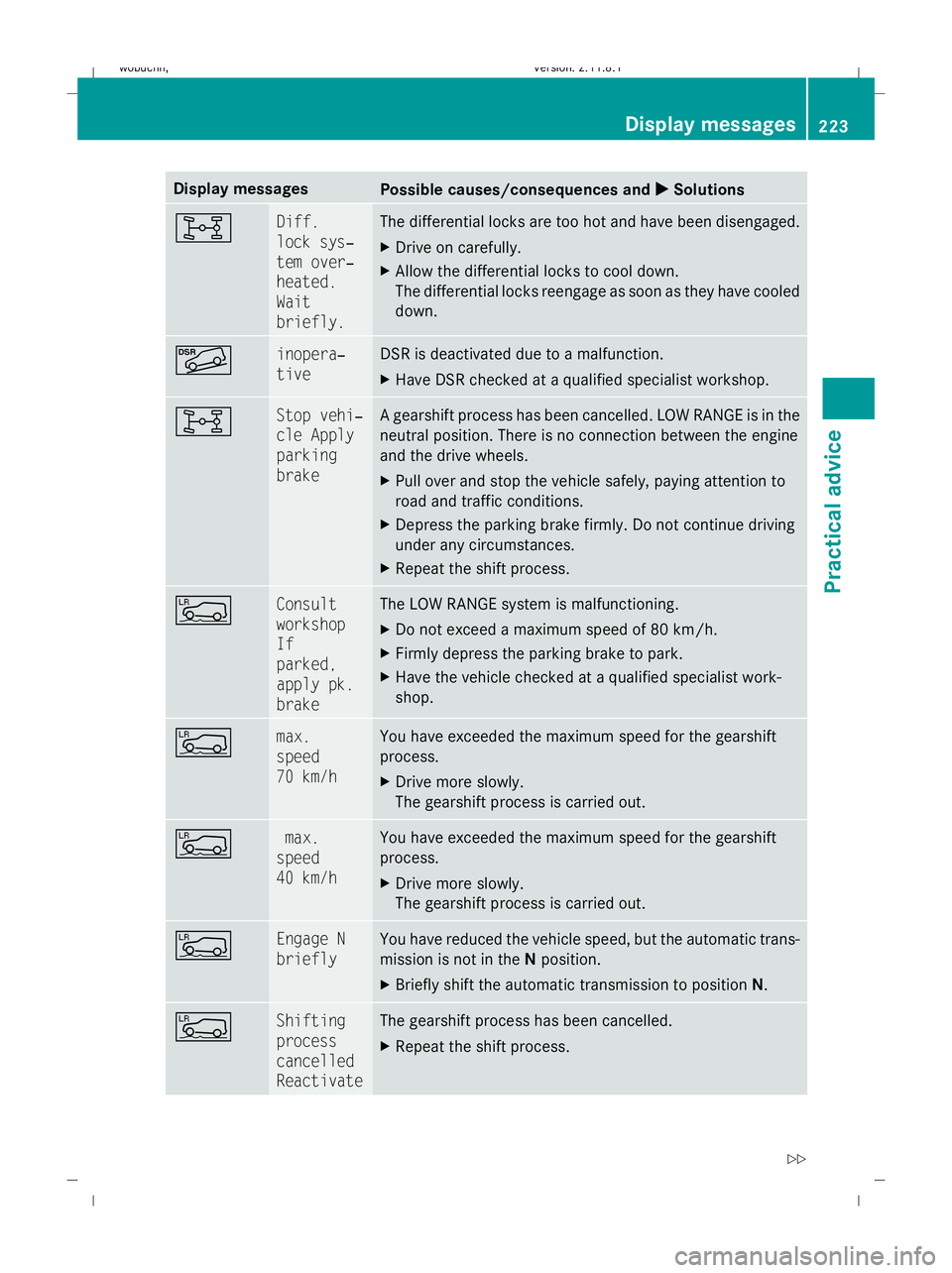
Display messages
Possible causes/consequences and
X
X Solutions 8 Diff.
lock sys‐
tem over‐
heated.
Wait
briefly. The differential locks are too hot and have been disengaged.
X
Drive on carefully.
X Allow the differential locks to cool down.
The differential locks reengage as soon as they have cooled
down. Ã inopera‐
tive DSR is deactivated due to a malfunction.
X
Have DSR checked at a qualified specialist workshop. 8 Stop vehi‐
cle Apply
parking
brake A gearshift process has been cancelled. LOW RANGE is in the
neutral position. There is no connection between the engine
and the drive wheels.
X
Pull over and stop the vehicle safely, paying attention to
road and traffic conditions.
X Depress the parking brake firmly. Do not continue driving
under any circumstances.
X Repeat the shift process. Å Consult
workshop
If
parked,
apply pk.
brake The LOW RANGE system is malfunctioning.
X
Do not exceed a maximum speed of 80 km/h.
X Firmly depress the parking brake to park.
X Have the vehicle checked at a qualified specialist work-
shop. Å max.
speed
70 km/h You have exceeded the maximum speed for the gearshift
process.
X
Drive more slowly.
The gearshift process is carried out. Å max.
speed
40 km/h You have exceeded the maximum speed for the gearshift
process.
X
Drive more slowly.
The gearshift process is carried out. Å Engage N
briefly You have reduced the vehicle speed, but the automatic trans-
mission is not in the
Nposition.
X Briefly shift the automatic transmission to position N.Å Shifting
process
cancelled
Reactivate The gearshift process has been cancelled.
X
Repeat the shift process. Display
messages
223Practical advice
X164_AKB; 2; 3, en-GB
wobuchh,V ersion: 2.11.8.1
2009-03-31T14:14:58+02:00 - Seite 223 Z
Dateiname: 6515431202_buchblock.pdf; erzeugt am 01. Apr 2009 00:18:00; WK