Page 385 of 534

WARNING! (Continued)
•NEVER run the engine in a closed area, such as a
garage, and NEVER sit in a parked vehicle with
the engine running for an extended period. If the
vehicle is stopped in an open area with the engine
running for more than a short period, adjust the
ventilation system to force fresh, outside air into
the vehicle.
•Guard against carbon monoxide with proper
maintenance. Have the exhaust system inspected
every time the vehicle is raised. Have any abnor-
mal conditions repaired promptly. Until repaired,
drive with all side windows fully open.
•Keep the liftgate closed when driving your vehicle
to prevent carbon monoxide and other poisonous
exhaust gases from entering the vehicle.
FLEXIBLE FUEL — 3.3L ENGINES ONLY
E-85 General Information
The information in this section is for Flexible Fuel Ve-
hicles (FFV) only. These vehicles can be identified by the
unique fuel filler door label that states:Ethanol (E-85) or
Unleaded Gasoline Only.This section only covers those
subjects that are unique to these vehicles. Please refer to
the other sections of this manual for information on
features that are common between Flexible Fuel and
gasoline only powered vehicles.
STARTING AND OPERATING 383
5
ProCarManuals.com
Page 387 of 534
WARNING!
Ethanol vapors are extremely flammable and could
cause serious personal injury. Never have any smok-
ing materials lit in or near the vehicle when remov-
ing the fuel filler tube cap (gas cap) or filling the
tank. Do not use E-85 as a cleaning agent and never
use it near an open flame.
Fuel Requirements
If your vehicle is E-85 compatible, it will operate on
unleaded gasoline with an octane rating of 87, or E-85
fuel, or any mixture of these two fuels.
For best results, a refueling pattern that avoids alternat-
ing between E-85 and unleaded gasoline is recom-
mended.
When you do switch fuel types, it is recommended that:
•you do not add less than 5 gal (19 L) when refueling
•you drive the vehicle immediately after refueling for at
least 5 miles (8 km)
Observing these precautions will avoid possible hard
starting and/or significant deterioration in drivability
during warm up.
NOTE:The characteristics of E-85 fuel require season-
ally adjusted fuel (ASTM D5798) for optimum engine
performance. With non-seasonally adjusted E-85 fuel,
you may experience hard starting and rough idle follow-
ing start-up, even if the above recommendations are
followed, especially when the ambient temperature is
below 32°F (0°C).
Starting
The characteristics of E-85 fuel make it unsuitable for use
when ambient temperatures fall below 0°F (-18°C). In the
range of 0°F (-18°C) to 32°F (0°C), you may experience an
STARTING AND OPERATING 385
5
ProCarManuals.com
Page 388 of 534
increase in the time it takes for your engine to start and a
deterioration in drivability (sags and/or hesitations) un-
til the engine is fully warmed up.
NOTE:Use of the engine block heater (if equipped) is
beneficial for E-85 startability when the ambient tempera-
ture is less than 32°F (0°C).
Selection Of Engine Oil For Flexible Fuel Vehicles
(FFV) E-85 and Gasoline Vehicles
FFV vehicles operated on E85 require specially formu-
lated engine oils. These special requirements are included
in MOPAR�engine oils, and in equivalent oils meeting
Chrysler Specification MS-6395. The manufacturer only
recommends engine oils that are API Certified and meet
the requirements of Material Standard MS-6395. MS-6395
contains additional requirements, developed during ex-
tensive fleet testing, to provide additional protection to
Chrysler LLC engines. Use MOPAR�or an equivalent oil
meeting the specification MS-6395.
Cruising Range
Because E-85 fuel contains less energy per gallon than
gasoline, you will experience an increase in fuel con-
sumption. You can expect your MPG and your driving
range to decrease by about 30% compared to gasoline
operation.
Replacement Parts
Many components in your Flexible Fuel Vehicle (FFV) are
designed to be compatible with ethanol. Always be sure
that your vehicle is serviced with correct ethanol com-
patible parts.
CAUTION!
Replacing fuel system components with non-ethanol
compatible components can damage your vehicle.
386 STARTING AND OPERATING
ProCarManuals.com
Page 390 of 534
WARNING!
•Never have any smoking materials lit in or near
the vehicle when the gas cap is removed or the
tank filled.
•Never add fuel when the engine is running. This is
in violation of most state and federal fire regula-
tions and will cause the malfunction indicator
light to turn on.
NOTE:
•Tighten the fuel filler cap until you hear a “clicking”
sound. This is an indication that the fuel filler cap is
properly tightened.
•If the gas cap is not tightened properly, the Malfunc-
tion Indicator Light may come on. Be sure the gas cap
is tightened every time the vehicle is refueled.
WARNING!
A fire may result if gasoline is pumped into a
portable container that is inside of a vehicle. You
could be burned. Always place gas containers on the
ground while filling.
Loose Fuel Filler Cap Message
If thegASCAPmessage is displayed in the instrument
cluster, this signifies a leak or change in the evaporative
system is detected. Sometimes this is the result of a
loosely fitting (or possibly damaged) filler cap. Tighten
the fuel filler cap properly and press the odometer reset
button to turn thegASCAPmessage off.
Make sure that the fuel filler cap is tightened each time
the vehicle is refueled.
388 STARTING AND OPERATING
ProCarManuals.com
Page 400 of 534
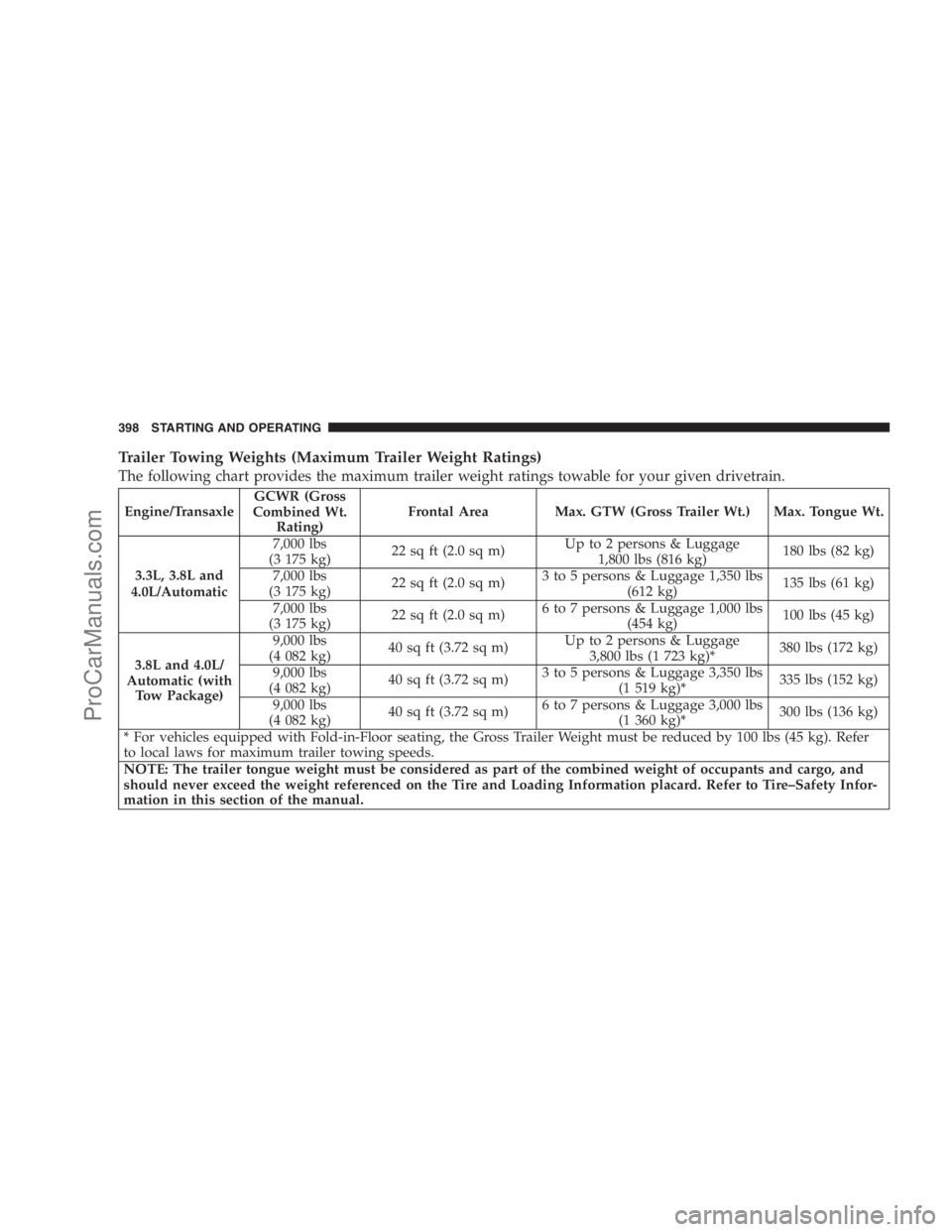
Trailer Towing Weights (Maximum Trailer Weight Ratings)
The following chart provides the maximum trailer weight ratings towable for your given drivetrain.
Engine/TransaxleGCWR (Gross
Combined Wt.
Rating)Frontal Area Max. GTW (Gross Trailer Wt.) Max. Tongue Wt.
3.3L, 3.8L and
4.0L/Automatic7,000 lbs
(3 175 kg)22 sq ft (2.0 sq m)Up to 2 persons & Luggage
1,800 lbs (816 kg)180 lbs (82 kg)
7,000 lbs
(3 175 kg)22 sq ft (2.0 sq m)3 to 5 persons & Luggage 1,350 lbs
(612 kg)135 lbs (61 kg)
7,000 lbs
(3 175 kg)22 sq ft (2.0 sq m)6 to 7 persons & Luggage 1,000 lbs
(454 kg)100 lbs (45 kg)
3.8L and 4.0L/
Automatic (with
Tow Package)9,000 lbs
(4 082 kg)40 sq ft (3.72 sq m)Up to 2 persons & Luggage
3,800 lbs (1 723 kg)*380 lbs (172 kg)
9,000 lbs
(4 082 kg)40 sq ft (3.72 sq m)3 to 5 persons & Luggage 3,350 lbs
(1 519 kg)*335 lbs (152 kg)
9,000 lbs
(4 082 kg)40 sq ft (3.72 sq m)6 to 7 persons & Luggage 3,000 lbs
(1 360 kg)*300 lbs (136 kg)
* For vehicles equipped with Fold-in-Floor seating, the Gross Trailer Weight must be reduced by 100 lbs (45 kg). Refer
to local laws for maximum trailer towing speeds.
NOTE: The trailer tongue weight must be considered as part of the combined weight of occupants and cargo, and
should never exceed the weight referenced on the Tire and Loading Information placard. Refer to Tire–Safety Infor-
mation in this section of the manual.
398 STARTING AND OPERATING
ProCarManuals.com
Page 403 of 534
WARNING! (Continued)
Make certain that the load is secured in the trailer
and will not shift during travel. When trailering
cargo that is not fully secured, dynamic load shifts
can occur that may be difficult for the driver to
control. You could lose control of your vehicle and
have an accident.
•When hauling cargo or towing a trailer, do not over-
load your vehicle or trailer. Overloading can cause a
loss of control, poor performance or damage to brakes,
axle, engine, transaxle, steering, suspension, chassis
structure or tires.
•Safety chains must always be used between your
vehicle and trailer. Always connect the chains to the
frame or hook retainers of the vehicle hitch. Cross the
chains under the trailer tongue and allow enough
slack for turning corners.
•Vehicles with trailers should not be parked on a grade.
When parking, apply the parking brake on the tow
vehicle. Put the tow vehicle automatic transmission in
PARK. Always, block or�chock�the trailer wheels.
•GCWR must not be exceeded.
•Total weight must be distributed between the tow
vehicle and the trailer such that the following four
ratings are not exceeded:
1. GVWR
2. GTW
3. GAWR
4. Trailer tongue weight rating for that trailer hitch.
(This requirement may limit the ability to always
achieve the 10% to 15% range of trailer tongue weight
as a percentage of total trailer weight.)
STARTING AND OPERATING 401
5
ProCarManuals.com
Page 407 of 534
Towing Tips
Before setting out on a trip, practice turning, stopping
and backing the trailer in an area away from heavy
traffic.
Towing Tips — Automatic Transaxle
The DRIVE gear can be selected when towing. However,
if frequent shifting occurs while in DRIVE, move the gear
selector lever into third gear (with four-speed transaxle)
or fifth gear (with six-speed transaxle).
NOTE:Moving the gear selector lever into third gear
(with four-speed transaxle) or fifth gear (with six-speed
transaxle) while operating the vehicle under heavy oper-
ating conditions will improve performance and extend
transaxle life by reducing excessive shifting and heat
build up. This action will also provide better engine
braking.
Seven-Pin Connector
1 — Battery 5 — Ground
2 — Backup Lamps 6 — Left Stop/Turn
3 — Right Stop/Turn 7 — Running Lamps
4 — Electric BrakesSTARTING AND OPERATING 405
5
ProCarManuals.com
Page 408 of 534

The automatic transaxle fluid and filter should be
changed if you REGULARLY tow a trailer for more than
45 minutes of continuous operation. Refer to the “Main-
tenance Schedule” in Section 8 of this manual for trans-
axle fluid change intervals.
NOTE:
•Check the automatic transaxle fluid level before tow-
ing.
•The six-speed automatic transaxle is sealed and re-
quires an authorized dealer to check the transaxle
fluid.
Towing Tips — Electronic Speed Control (If
Equipped)
•
Do not use in hilly terrain or with heavy loads.
•When using the speed control, if you experience speed
drops greater than 10 mph (16 km/h), disengage until
you can get back to cruising speed.
•Use speed control in flat terrain and with light loads to
maximize fuel efficiency.
Towing Tips — Cooling System
To reduce potential for engine and transaxle overheating,
take the following actions:
•City Driving
When stopped for short periods of time, put transaxle
gear selector lever in NEUTRAL but do not increase
engine idle speed.
•Highway Driving
Reduce speed.
•Air Conditioning
Turn off temporarily.
406 STARTING AND OPERATING
ProCarManuals.com
