Page 454 of 534
CAUTION!
•Mixing of engine coolant (antifreeze) other than
specified Hybrid Organic Additive Technology
(HOAT) engine coolant (antifreeze), may result in
engine damage and may decrease corrosion pro-
tection. If a non-HOAT engine coolant (antifreeze)
is introduced into the cooling system in an emer-
gency, it should be replaced with the specified
engine coolant (antifreeze) as soon as possible.
•Do not use water alone or alcohol based engine
coolant (antifreeze) products. Do not use addi-
tional rust inhibitors or anti-rust products, as they
may not be compatible with the radiator engine
coolant (antifreeze) and may plug the radiator.
(Continued)
CAUTION! (Continued)
•This vehicle has not been designed for use with
Propylene Glycol based engine coolant (anti-
freeze). Use of Propylene Glycol based engine
coolant (antifreeze) is not recommended.
Adding Coolant
Your vehicle has been built with an improved engine
coolant (antifreeze) that allows extended maintenance
intervals. This engine coolant (antifreeze) can be used up
to five years or 102,000 miles (170 000 km) before
replacement. To prevent reducing this extended mainte-
nance period, it is important that you use the same
engine coolant (antifreeze) throughout the life of your
vehicle. Please review these recommendations for using
Hybrid Organic Additive Technology (HOAT) engine
coolant (antifreeze).
452 MAINTAINING YOUR VEHICLE
ProCarManuals.com
Page 455 of 534
When adding engine coolant (antifreeze), a minimum
solution of 50% recommended MOPAR�Antifreeze/
Coolant Five Year/100,000 Mile Formula HOAT (Hybrid
Organic Additive Technology), or equivalent, in water
should be used. Use higher concentrations (not to exceed
70%) if temperatures below�34°F (�37°C ) are antici-
pated.
Use only high purity water such as distilled or deionized
water when mixing the water/engine coolant (antifreeze)
solution. The use of lower quality water will reduce the
amount of corrosion protection in the engine cooling
system.
Please note that it is the owner’s responsibility to main-
tain the proper level of protection against freezing ac-
cording to the temperatures occurring in the area where
the vehicle is operated.NOTE:Mixing engine coolant (antifreeze) types will
decrease the life of the engine coolant (antifreeze) and
will require more frequent coolant changes.
Cooling System Pressure Cap
The cap must be fully tightened to prevent the loss of
engine coolant (antifreeze), and to ensure that engine
coolant (antifreeze) will return to the radiator from the
coolant recovery bottle.
The cap should be inspected and cleaned if there is any
accumulation of foreign material on the sealing surfaces.
MAINTAINING YOUR VEHICLE 453
7
ProCarManuals.com
Page 456 of 534
WARNING!
•The warning words “DO NOT OPEN HOT” on
the cooling system pressure cap are a safety pre-
caution. Never add engine coolant (antifreeze)
when the engine is overheated. Do not loosen or
remove the cap to cool an overheated engine. Heat
causes pressure to build up in the cooling system.
To prevent scalding or injury, do not remove the
pressure cap while the system is hot or under
pressure.
•Do not use a pressure cap other than the one
specified for your vehicle. Personal injury or en-
gine damage may result.
Disposal of Used Coolant
Used ethylene glycol-based engine coolant (antifreeze) is
a regulated substance requiring proper disposal. Check
with your local authorities to determine the disposalrules for your community. To prevent ingestion by ani-
mals or children do not store ethylene glycol-based
engine coolant (antifreeze) in open containers or allow it
to remain in puddles on the ground. If ingested by a
child, contact a physician immediately. Clean up any
ground spills immediately.
Coolant Level
The coolant bottle provides a quick visual method for
determining that the coolant level is adequate. With the
engine cold, the level of the engine coolant (antifreeze) in
the coolant recovery bottle should be between the ranges
indicated on the bottle.
The radiator normally remains completely full, so there is
no need to remove the radiator cap unless checking for
engine coolant (antifreeze) freeze point or replacing en-
gine coolant (antifreeze). Advise your service attendant
454 MAINTAINING YOUR VEHICLE
ProCarManuals.com
Page 457 of 534
of this. As long as the engine operating temperature is
satisfactory, the coolant bottle need only be checked once
a month.
When additional engine coolant (antifreeze) is needed to
maintain the proper level, it should be added to the
coolant bottle. Do not overfill.
Points to Remember
NOTE:When the vehicle is stopped after a few miles (a
few kilometers) of operation, you may observe vapor
coming from the front of the engine compartment. This is
normally a result of moisture from rain, snow, or high
humidity accumulating on the radiator and being vapor-
ized when the thermostat opens, allowing hot engine
coolant (antifreeze) to enter the radiator.
If an examination of your engine compartment shows no
evidence of radiator or hose leaks, the vehicle may be
safely driven. The vapor will soon dissipate.
•Do not overfill the coolant recovery bottle.
•Check engine coolant (antifreeze) freeze point in the
radiator and in the coolant recovery bottle. If engine
coolant (antifreeze) needs to be added, contents of the
coolant recovery bottle must also be protected against
freezing.
•If frequent engine coolant (antifreeze) additions are
required, or if the level in the coolant recovery bottle
does not drop when the engine cools, the cooling
system should be pressure tested for leaks.
•Maintain engine coolant (antifreeze) concentration at
50% HOAT engine coolant (antifreeze) (minimum)
and distilled water for proper corrosion protection of
your engine, which contains aluminum components.
•Make sure that the radiator and coolant recovery
bottle overflow hoses are not kinked or obstructed.
MAINTAINING YOUR VEHICLE 455
7
ProCarManuals.com
Page 459 of 534
Add enough fluid to bring the level up to the require-
ments described on the brake fluid reservoir. With disc
brakes, fluid level can be expected to fall as the brake
pads wear. However, low fluid level may be caused by a
leak and a checkup may be needed.
Use only manufacturer’s recommended brake fluid. Re-
fer to “Fluids, Lubricants, and Genuine Parts” in this
section for the correct fluid type.
WARNING!
•Overfilling the brake fluid reservoir can result in
spilling brake fluid on hot engine parts and the
brake fluid catching fire.
(Continued)
WARNING! (Continued)
•Use of a brake fluid that has a lower initial boiling
point than the recommended MOPAR�DOT 3
product or a brake fluid that is unidentified as to
FMVSS specification may result in sudden brake
failure during hard prolonged braking. You could
have an accident.
Use only brake fluid that has been in a tightly closed
container to avoid contamination from foreign matter or
moisture.
CAUTION!
Do not allow petroleum based fluid to contaminate
the brake fluid — all brake seal components could be
damaged, causing partial or complete brake failure.
MAINTAINING YOUR VEHICLE 457
7
ProCarManuals.com
Page 461 of 534
Fluid Level Check — 3.8L and 4.0L Engines with
Six-Speed Automatic Transaxle — If Equipped
The six-speed automatic transaxle is a sealed unit and has
no dipstick. See your authorized dealer to have the
transaxle fluid checked or serviced.
Fluid Level Check — 3.3L Engine with Four-Speed
Automatic Transaxle — If Equipped
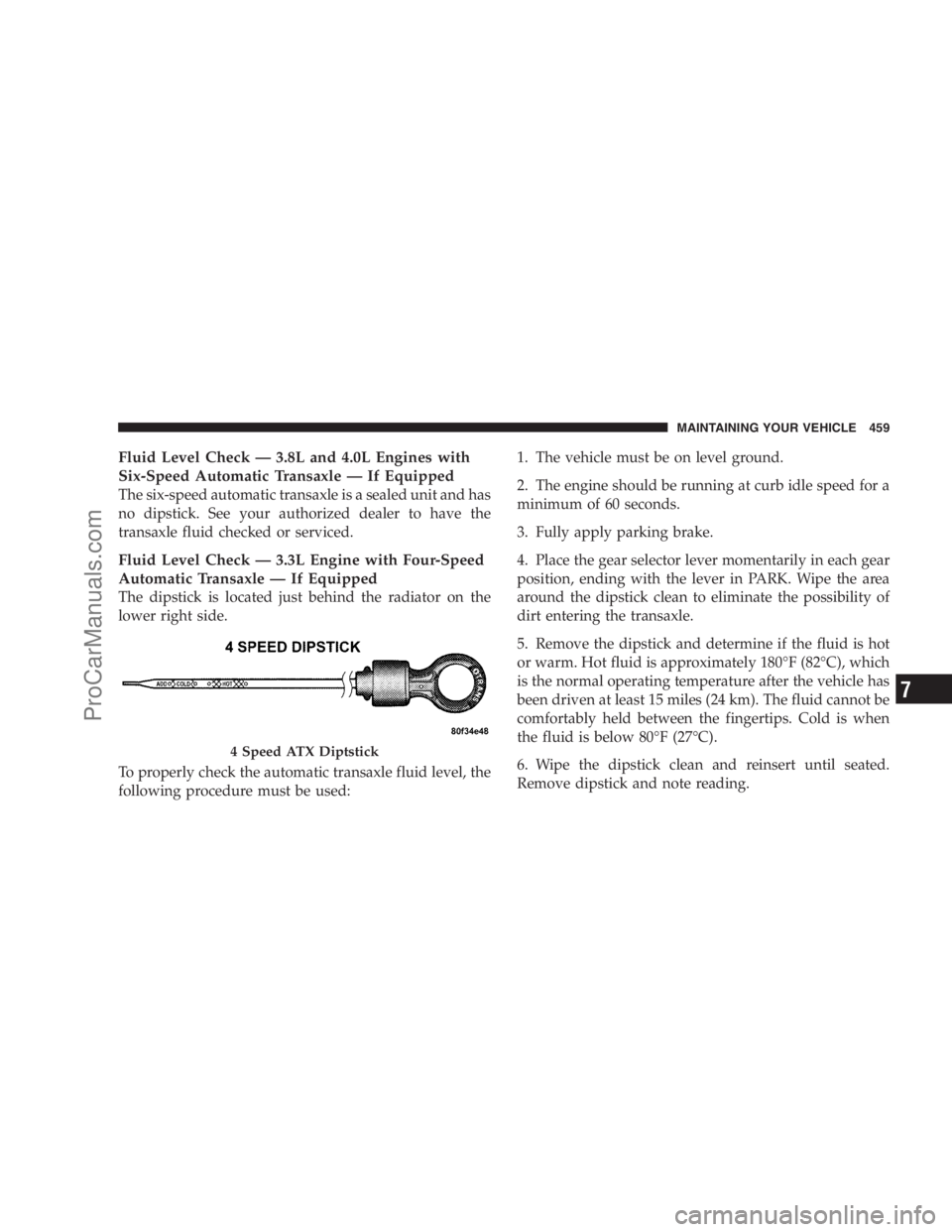
The dipstick is located just behind the radiator on the
lower right side.
To properly check the automatic transaxle fluid level, the
following procedure must be used:1. The vehicle must be on level ground.
2. The engine should be running at curb idle speed for a
minimum of 60 seconds.
3. Fully apply parking brake.
4. Place the gear selector lever momentarily in each gear
position, ending with the lever in PARK. Wipe the area
around the dipstick clean to eliminate the possibility of
dirt entering the transaxle.
5. Remove the dipstick and determine if the fluid is hot
or warm. Hot fluid is approximately 180°F (82°C), which
is the normal operating temperature after the vehicle has
been driven at least 15 miles (24 km). The fluid cannot be
comfortably held between the fingertips. Cold is when
the fluid is below 80°F (27°C).
6. Wipe the dipstick clean and reinsert until seated.
Remove dipstick and note reading.
4 Speed ATX Diptstick
MAINTAINING YOUR VEHICLE 459
7
ProCarManuals.com
Page 462 of 534
a. If the fluid is hot, the reading should be in the
crosshatched area marked “HOT” (between the upper
two holes in the dipstick).
b. If the fluid is cold, the fluid level should be between
the lower two holes in the area marked “COLD”.
If the fluid level indicates that it is low, add sufficient
fluid to bring it to the proper level.
CAUTION!
Do not overfill. Dirt and water in the transaxle can
cause serious damage. To prevent dirt and water from
entering the transaxle after checking or replenishing
fluid, make certain that the dipstick cap is reseated
properly.
Fluid and Filter Changes
Refer to the “Maintenance Schedule” in Section 8 for the
proper maintenance intervals.If the transaxle is disassembled for any reason, the fluid
and filter should be changed.
Special Additives
Automatic Transmission Fluid (ATF) is an engineered
product and its performance may be impaired by supple-
mental additives. Therefore, do not add any fluid addi-
tives to the transaxle. The only exception to this policy is
the use of special dyes to aid in detecting fluid leaks. In
addition, avoid using transaxle sealers as they may
adversely affect seals.
Appearance Care and Protection from Corrosion
Protection of Body and Paint from Corrosion
Vehicle body care requirements vary according to geo-
graphic locations and usage. Chemicals that make roads
passable in snow and ice, and those that are sprayed on
trees and road surfaces during other seasons, are highly
corrosive to the metal in your vehicle. Outside parking,
which exposes your vehicle to airborne contaminants,
460 MAINTAINING YOUR VEHICLE
ProCarManuals.com
Page 469 of 534
Installation
Place the liner into the cupholder drawer and press the
liner into place so that the retention tabs seat into the
corresponding openings in the drawer.
FUSES
Totally Integrated Power Module (TIPM)
The Totally Integrated Power Module (TIPM) is located
in the engine compartment near the battery. Refer to the
applicable “Engine Compartment” illustration in this
section. This center contains cartridge fuses and mini-
fuses. A label that identifies each component may be
printed or embossed on the inside of the cover.
CAUTION!
•When installing the Totally Integrated Power
Module cover, it is important to ensure the cover is
properly positioned and fully latched. Failure to
do so may allow water to get into the Integrated
Power Module, and possibly result in a electrical
system failure.
•When replacing a blown fuse, it is important to
use only a fuse having the correct amperage rating.
The use of a fuse with a rating other than indicated
may result in a dangerous electrical system over-
load. If a properly rated fuse continues to blow, it
indicates a problem in the circuit that must be
corrected.
MAINTAINING YOUR VEHICLE 467
7
ProCarManuals.com