2009 CHERY TIGGO air condition
[x] Cancel search: air conditionPage 1 of 1903

Downloaded from www.Manualslib.com manuals search engine 2009
CHERY
Tiggo
Service Manual
FOREWORD
This manual contains on-vehicle service
and diagnosis procedures for the Chery Tiggo.
A thorough familiarization with this manual
is important for proper repair and
maintenance. It should always be kept in a
handy place for quick and easy reference.
The contents of this manual, including
drawings and specifications, are the latest
available at the time of printing. As
modifications affecting repair or
maintenance occur, relevant information
supplementary to this volume will be made
available at Chery dealers. This manual
should be kept up-to-date.
Chery Automobile Company, Ltd. reserves the
right to alter the specifications and
contents of this manual without obligation
or advance notice.
All rights reserved. No part of this book
may be reproduced or used in any form or
by any means, electronic or mechanical—
including photocopying and recording and the
use of any kind of information storage and
retrieval system—without permission in
writing.
NOTE:
This Tiggo service manual only applies to the fol-
lowing engines and transaxles:
• 1.6L with M/T
• 1.8L with M/T
• 2.0L with A/T
• 2.4L with A/T
Chery Automobile Company, Ltd.Wuhu, Anhui Province, CHINA
CONTENTS
Title Section
GENERAL INFORMATION01
ENGINE02
ELECTRONIC ENGINE CONTROLS03
FUEL DELIVERY04
STARTING & CHARGING05
COOLING06
EXHAUST07
TRANSAXLE & TRANSFER CASE08
DRIVELINE & AXLE09
SUSPENSION10
STEERING11
BRAKES12
HEATING & AIR CONDITIONING13
RESTRAINTS14
BODY & ACCESSORIES15
WIRING16
ALPHABETICAL INDEXAI
© 2009 Chery Automobile Co., Ltd.
PRINTED NOVEMBER, 2009
Page 17 of 1903

Downloaded from www.Manualslib.com manuals search engine DIAGNOSING ELECTRICAL FAILURES
Performing Efficient Electrical Circuit Diagnosis and Troubleshooting
STEPDESCRIPTION
Step 1 Obtain detailed information about the conditions and the environment when the electrical
incident occurred.
Step 2 Operate the affected system, road test the vehicle if necessary.
Verify the parameter of the incident.
If the problem cannot be duplicated, refer to “Electrical Failure Simulation Tests”.
Step 3 Gather the proper diagnostic material including the following:
•
Electrical Power Supply Routing Diagram
• System Operation Descriptions
• Applicable Service Manual Sections
• Check for any Service Bulletins
Identify where to begin diagnosis based upon your knowledge of the system operation
and the customer comments.
Step 4 Inspect the system for mechanical binding, loose connectors or wiring damage.
Determine which circuits and components are involved and diagnose using the Electrical
Power Supply Routing Diagram and Harness Layouts.
Step 5 Repair the circuit or replace the component as necessary.
Step 6 Operate the system in all modes. Verify the system functions properly under all conditions.
Confirm you have not inadvertently created an additional new incident during your
diagnosis or repair steps.
Electrical Circuit Simulation Tests
Often the symptom is not present when the vehicle is brought in for service. If possible, re-create the conditions
present at the time of the incident. Doing so may help avoid a No Trouble Found Diagnosis. The following illustrates
tests to simulate the conditions/environment under which the owner experiences an electrical incident.
The tests are broken into the seven following topics:
•
Vehicle Vibration Test
• Heat Sensitive Test
• Freezing Test
• Water Intrusion Test
• Electrical Load Test
• Cold or Hot Start Up Test
• Voltage Drop Test
NOTE :
Always get a thorough description of the incident from the customer. It is important for simulating the conditions of
the problem.
Vehicle Vibration Test
The problem may occur or become worse while driving on a rough road or when the engine is vibrating (idle with A/C
on). In such a case, check for a vibration related condition. Refer to the following vehicle areas:
Connectors & Harness
• Determine which connectors and wiring harness would affect the electrical system you are inspecting. Gently
shake each connector and harness while monitoring the system for the incident you are trying to duplicate. This
test may indicate a loose or poor electrical connection.
NOTE :
Connectors can be exposed to moisture. It is possible for a thin film of corrosion to form on the connector terminals.
A visual inspection may not reveal this without disconnecting the connector. If the problem occurs intermittently, per-
haps the problem is caused by corrosion. It is a good idea to disconnect, inspect and clean the terminals on related
connectors in the system.
01–16Chery Automobile Co., Ltd.
Page 18 of 1903

Downloaded from www.Manualslib.com manuals search engine Sensors & Relays
•Gently apply a slight vibration to sensors and relays in the system you are inspecting. This test may indicate a
loose or poorly mounted sensor or relay.
Engine Compartment
• There are several reasons a vehicle or engine vibration could cause an electrical complaint. Some of the things
to check for are:
Connectors not fully seated.
Wiring harness not long enough and is being stressed due to engine vibrations or rocking.
Wires laying across brackets or moving components.
Loose, dirty or corroded ground wires.
Wires routed too close to hot components.
• To inspect components under the hood, start by verifying the integrity of the ground connections (See Ground
Inspection described later). First, verify that the system is properly grounded. Then check for any loose connec-
tions by gently shaking the wiring or components as previously explained. Using the wiring diagrams, inspect
the wiring for continuity.
Behind The Instrument Panel
• An improperly routed or improperly clamped harness can become pinched during accessory installation. Vehicle
vibration can aggravate a harness which is routed along a bracket or near a mounting screw.
• An unclamped or loose harness can cause wiring to be pinched by seat components (such as slide guides)
during vehicle vibration. If the wiring runs under seating areas, inspect wire routing for possible damage or
pinching.
Heat Sensitivity Test
The customer’s concern may occur during hot weather or after the vehicle has sat for a short time. In such cases you
will want to check for a heat sensitive condition.
To determine if an electrical component is heat sensitive, heat the component with a heat gun or equivalent.
CAUTION:
Do not heat components above 60°C (140°F).
If the incident occurs while heat testing the component, replace or properly insulate the component as needed.
Freezing Test
The customer may indicate the incident goes away after the vehicle warms up (winter time). The cause could be
related to water freezing somewhere in the wiring/electrical system. There are two methods to check for this:
•The first method is to arrange for the owner to leave the vehicle overnight. Make sure it will get cold enough to
duplicate the complaint. Leave the vehicle parked outside overnight. In the morning, do a quick and thorough
diagnosis of those electrical components which could be affected.
• The second method is to put the suspect component into a freezer long enough for any water to freeze. Rein-
stall the part into the vehicle and check for a reoccurrence of the incident. If it occurs, repair or replace the
component as needed.
Water Intrusion Test
The incident may occur only during high humidity or in rainy/snowy weather. In such cases the incident could be
caused by water intrusion on an electrical part. This can be simulated by soaking the car or running it through a car
wash.
Electrical Load Test
The incident may be electrical load sensitive. Perform diagnosis with all accessories (including A/C, rear window
defogger, radio, fog lamps) turned on.
Cold or Hot Starting Test
On some occasions an electrical incident may occur only when the vehicle is started cold, or it may occur when the
vehicle is restarted hot shortly after being turned off. In these cases you may have to keep the vehicle overnight to
make a proper diagnosis.
DIAGNOSING ELECTRICAL FAILURES
01
01–17Chery Automobile Co., Ltd.
Page 27 of 1903

Downloaded from www.Manualslib.com manuals search engine SERVICE MANUAL CHAPTERCOMPONENT / VEHICLE SYSTEM
08 - Transaxle & Transfer Case •
Transaxle Control Module (TCM)
• Automatic Transaxle Shifter Selector
• Automatic Transaxle Assembly
• Manual Transaxle Assembly
• Winter Mode Switch
• EPDE Solenoid Valve
• Backup Lamp Switch
• Integrated Torque Management (ITM) Control Module
09 - Driveline & Axle •None
10 - Suspension •None
11 - Steering •Power Steering Switch
12 - Brakes •
Antilock Brake System (ABS) Module
• Wheel Speed Sensors
• Brake Switch
• Parking Brake Switch
• Brake Fluid Level Switch
13 - Heating & Air Conditioning •
Manual Temperature Control System
• Blower Motor
• A/C Compressor
• Refrigerant Pressure Switch
14 - Restraints •
Restraints Control Module
• Seat Belt Buckle Switch
• Front Crash Sensors
• Driver Airbag
• Passenger Airbag
HOW TO LOCATE ELECTRICAL SCHEMATICS IN THE SERVICE MANUAL
01–26Chery Automobile Co., Ltd.
Page 42 of 1903

Downloaded from www.Manualslib.com manuals search engine DIAGNOSIS & TESTING
Engine Performance Diagnostics
CONDITIONPOSSIBLE CAUSE CORRECTION
Engine Does Not Start 1. Weak battery.
2. Corroded or loose battery
connections.
3. Faulty starter.
4. Faulty coil(s) or control unit.
5. Incorrect spark plug gap.
6. Contamination in fuel system.
7. Faulty fuel pump.
8. Incorrect timing.1. Test battery. Charge or replace if
necessary.
2. Clean and tighten battery
connections. Apply a coat of light
mineral grease to terminals.
3. Test starting system. Check for
codes. (Refer to Appropriate
Diagnostic Information)
4. Test and replace if needed. (Refer
to Appropriate Diagnostic
Information)
5. Set gap.
6. Clean system and replace fuel
filter.
7. Test fuel pump and replace as
needed. (Refer to Appropriate
Diagnostic Information)
8. Check for a skipped timing belt.
Engine Stalls Or Idles Rough 1. Idle speed too low.
2. Incorrect fuel mixture.
3. Intake manifold leakage.
4. Faulty ignition coil(s).1. Test minimum air flow. (Refer to
Appropriate Diagnostic Information)
2. (Refer to Appropriate Diagnostic
Information)
3. Inspect intake manifold, manifold
gasket, and vacuum hoses.
4. Test and replace if necessary.
(Refer to Appropriate Diagnostic
Information)
Engine Loss Of Power 1. Dirty or incorrectly gapped spark
plugs.
2. Contamination in fuel system.
3. Faulty fuel pump.
4. Incorrect valve timing.
5. Leaking cylinder head gasket.
6. Low compression.
7. Burned, warped, excessive
clearance, or pitted valves.
8. Plugged or restricted exhaust
system.
9. Faulty ignition coil(s).
10. Burned spark plugs.1. Clean spark plugs and set gap.
2. Clean system and replace fuel
filter.
3. Test and replace if necessary.
(Refer to Appropriate Diagnostic
Information)
4. Correct valve timing.
5. Replace cylinder head gasket.
6. Test compression of each
cylinder.
7. Replace valves.
8. Perform exhaust restriction test.
Install new parts.
9. Test and replace if necessary.
(Refer to Appropriate Diagnostic
Information)
10. Replace spark plugs.
DIAGNOSIS & TESTING
02
02–13Chery Automobile Co., Ltd.
Page 43 of 1903
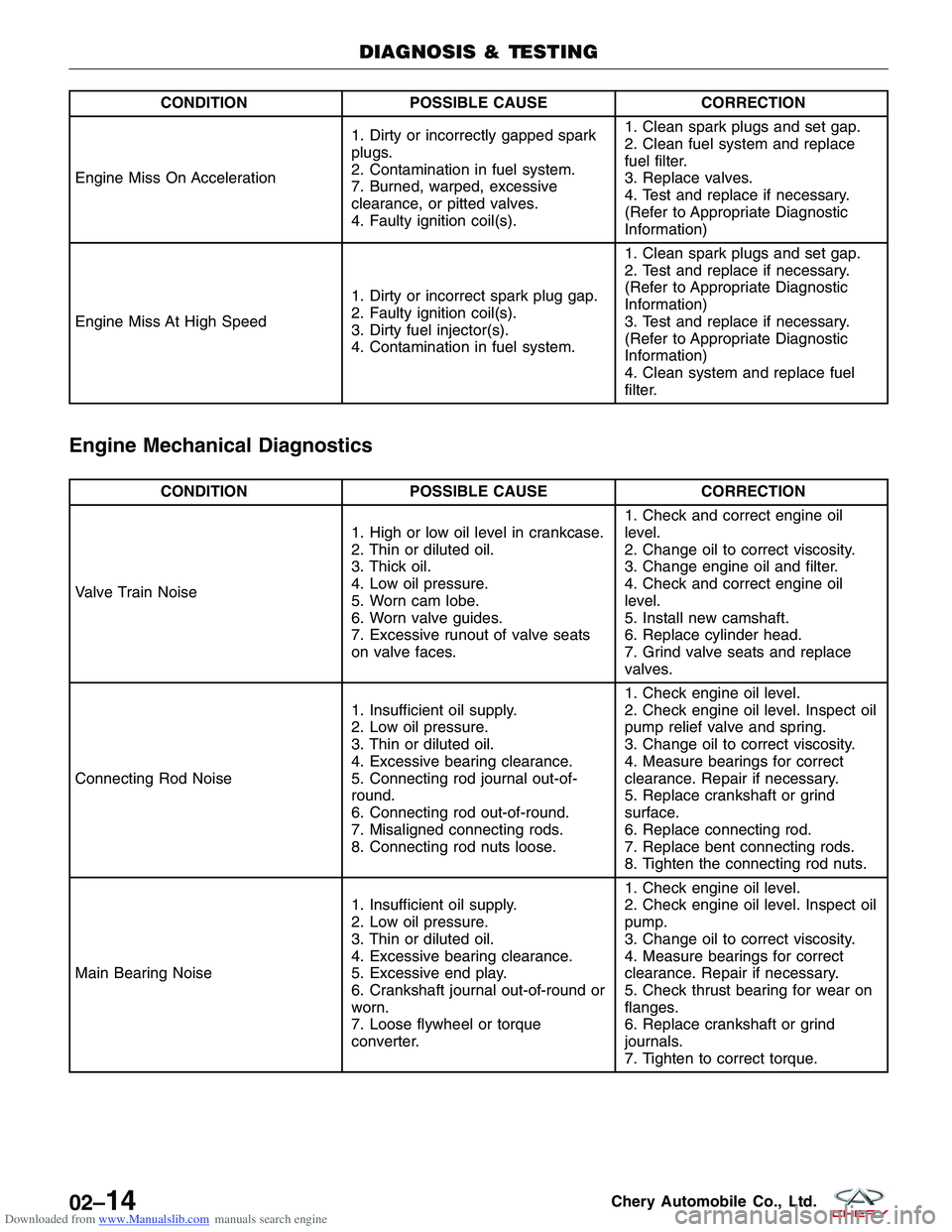
Downloaded from www.Manualslib.com manuals search engine CONDITIONPOSSIBLE CAUSE CORRECTION
Engine Miss On Acceleration 1. Dirty or incorrectly gapped spark
plugs.
2. Contamination in fuel system.
7. Burned, warped, excessive
clearance, or pitted valves.
4. Faulty ignition coil(s).1. Clean spark plugs and set gap.
2. Clean fuel system and replace
fuel filter.
3. Replace valves.
4. Test and replace if necessary.
(Refer to Appropriate Diagnostic
Information)
Engine Miss At High Speed 1. Dirty or incorrect spark plug gap.
2. Faulty ignition coil(s).
3. Dirty fuel injector(s).
4. Contamination in fuel system.1. Clean spark plugs and set gap.
2. Test and replace if necessary.
(Refer to Appropriate Diagnostic
Information)
3. Test and replace if necessary.
(Refer to Appropriate Diagnostic
Information)
4. Clean system and replace fuel
filter.
Engine Mechanical Diagnostics
CONDITION
POSSIBLE CAUSE CORRECTION
Valve Train Noise 1. High or low oil level in crankcase.
2. Thin or diluted oil.
3. Thick oil.
4. Low oil pressure.
5. Worn cam lobe.
6. Worn valve guides.
7. Excessive runout of valve seats
on valve faces.1. Check and correct engine oil
level.
2. Change oil to correct viscosity.
3. Change engine oil and filter.
4. Check and correct engine oil
level.
5. Install new camshaft.
6. Replace cylinder head.
7. Grind valve seats and replace
valves.
Connecting Rod Noise 1. Insufficient oil supply.
2. Low oil pressure.
3. Thin or diluted oil.
4. Excessive bearing clearance.
5. Connecting rod journal out-of-
round.
6. Connecting rod out-of-round.
7. Misaligned connecting rods.
8. Connecting rod nuts loose.1. Check engine oil level.
2. Check engine oil level. Inspect oil
pump relief valve and spring.
3. Change oil to correct viscosity.
4. Measure bearings for correct
clearance. Repair if necessary.
5. Replace crankshaft or grind
surface.
6. Replace connecting rod.
7. Replace bent connecting rods.
8. Tighten the connecting rod nuts.
Main Bearing Noise 1. Insufficient oil supply.
2. Low oil pressure.
3. Thin or diluted oil.
4. Excessive bearing clearance.
5. Excessive end play.
6. Crankshaft journal out-of-round or
worn.
7. Loose flywheel or torque
converter.1. Check engine oil level.
2. Check engine oil level. Inspect oil
pump.
3. Change oil to correct viscosity.
4. Measure bearings for correct
clearance. Repair if necessary.
5. Check thrust bearing for wear on
flanges.
6. Replace crankshaft or grind
journals.
7. Tighten to correct torque.
DIAGNOSIS & TESTING
02–14Chery Automobile Co., Ltd.
Page 44 of 1903
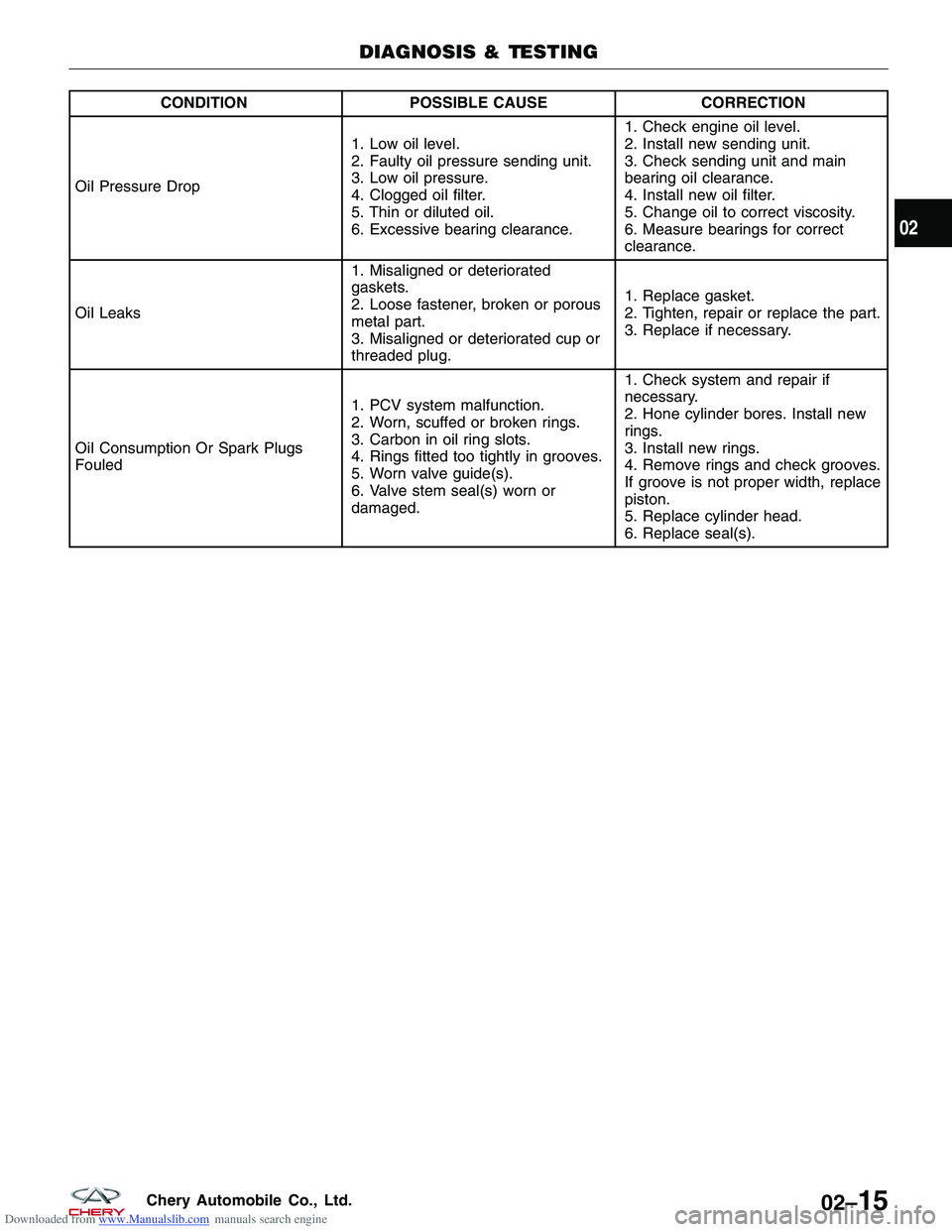
Downloaded from www.Manualslib.com manuals search engine CONDITIONPOSSIBLE CAUSE CORRECTION
Oil Pressure Drop 1. Low oil level.
2. Faulty oil pressure sending unit.
3. Low oil pressure.
4. Clogged oil filter.
5. Thin or diluted oil.
6. Excessive bearing clearance.1. Check engine oil level.
2. Install new sending unit.
3. Check sending unit and main
bearing oil clearance.
4. Install new oil filter.
5. Change oil to correct viscosity.
6. Measure bearings for correct
clearance.
Oil Leaks 1. Misaligned or deteriorated
gaskets.
2. Loose fastener, broken or porous
metal part.
3. Misaligned or deteriorated cup or
threaded plug.1. Replace gasket.
2. Tighten, repair or replace the part.
3. Replace if necessary.
Oil Consumption Or Spark Plugs
Fouled 1. PCV system malfunction.
2. Worn, scuffed or broken rings.
3. Carbon in oil ring slots.
4. Rings fitted too tightly in grooves.
5. Worn valve guide(s).
6. Valve stem seal(s) worn or
damaged.1. Check system and repair if
necessary.
2. Hone cylinder bores. Install new
rings.
3. Install new rings.
4. Remove rings and check grooves.
If groove is not proper width, replace
piston.
5. Replace cylinder head.
6. Replace seal(s).
DIAGNOSIS & TESTING
02
02–15Chery Automobile Co., Ltd.
Page 60 of 1903

Downloaded from www.Manualslib.com manuals search engine Removal & Installation - Rear Mount
NOTE :
The following special tools are required to perform the
repair procedure:
•Engine Hoist
1. Disconnect the negative battery cable.
2. Support the engine with the engine hoist.
3. Remove the engine rear mount retaining bolts (2) and remove the engine rear mount bracket bolts
(1).
(Tighten: Engine rear mount bolts to 60 N·m)
4. Installation is in the reverse order of removal.
Engine Assembly
Removal & Installation
NOTE :
The following special tools are required to perform the repair procedure:
• CH-20001 - Right Engine Mount Bolt Remover
• Engine Hoist
NOTE :
The engine is removed with the transaxle as an assembly. 1. Remove the vehicle hood.
2. Remove the negative battery cable from the engine.
3. Remove the engine cover.
4. Remove the battery, battery hold downs, and battery tray (See Battery Removal & Installation in Section 05 Starting & Charging).
5. Discharge air conditioning system (See A/C System Evacuation and Recharge in Section 13 Heating & Air Con- ditioning).
6. Drain the cooling system (See Cooling System Draining and Filling in Section 06 Cooling).
WARNING!
Always allow the engine to cool before opening the cooling system. Do not loosen the coolant pressure relief
cap when the engine is operating or the cooling system is hot. The cooling system is under pressure; steam and
hot liquid can come out forcefully when the cap is loosened slightly. Failure to follow these instructions may
result in serious personal injury.
ON-VEHICLE SERVICE
LTSM020188
02
02–31Chery Automobile Co., Ltd.