2009 AUDI S6 height
[x] Cancel search: heightPage 215 of 398

Safety belts -----------------=------
• With the front seats, the height adjustment of the seat can also
be used to adjust the position of the safety belts. •
Improperly worn safety belts
Incorrectly positioned safety belts can cause severe inju
ries.
Wearing safety belts improperly can cause serious injury or
death. Safety belts can only work when they are correctly positioned on the body. Improper seating posit ions reduce
the effectiveness of safety belts and w ill even increase the
risk of injury and death by moving the safety belt to critical
areas of the body . Improper seating positions also increase
the r isk of serious injury and death when an airbag deploys
and strikes an occupant who is not in the correct seating position. A driver is responsible for the safety of all vehicle
occupants and especially for children. Therefore:
-Never permit anyone to assume an incorrect sitting posi
tion in the vehicle while traveling~& .
& WARNING
Improperly worn safety belts increase the risk of serious personal
injury and death whenever a vehicle is being used.
• Always make sure that all vehicle occupants are correctly
restrained and stay in a correct seating position whenever the
vehicle is being used.
• Always read and heed all WARNINGS and other important infor
mation ::::;,
page 208. •
Controls and equip
ment Safety first Vehicle operation
Safety be
lt pretensioners
How safety belt pretensioners work
In front, side and rear -end collisions above a particular
severity, safety belts are tensioned automatically.
The safety belts are equipped with safety belt pretensioners . The
system is activated by sensors in front, side and rear -end collisions
of great severity . This tightens the belt and takes up belt slack::::;,
6
in "Service and disposal of safety belt pretensioner" on page 214.
Taking up the slack helps to reduce forward occupant movement
during a collision.
0 Note
Never let the belt remain over a rear seat back that has been folded
forward.
[ i] Tips
The safety belt pretensioner can only be activated once.
• In minor frontal, side and rear -end collisions, in a rollover and in
accidents involving very little impact force, the safety belt preten
sioner are not activated .
• When the safety belt pretensioners are activated, a fine dust is
released. This is normal and is not caused by a fire in the vehicle.
• The relevant safety requirements must be observed when the
vehicle or components of the system are scrapped . A qualified deal
ership is familiar with these regulations and will be pleased to pass
on the information to you.
• Be sure to observe all safety, environmental and other regula
tions if the vehicle or individual parts of the system, particularly the
safety belt or airbag, are to be disposed . We recommend you have
your authorized Audi dealer perform this service for you. •
Vehicle care Do-it-yourself service Technical data
Page 320 of 398
-~_T_ ir_e_ s_ a_ n_d _ w_ h_ e_e _l_s _________________________________________________ _
& WARNING (continued)
crashes and serious personal injuries . Have worn or damaged tires
replaced immediately.
• Tires age even if they are not being used and can fail suddenly,
especially at high speeds. Tires that are more than 6 years old can
only be used in an emergency and then with special care and at
low speed.
Glossary of tire and loading terminology
Accessory weight
means the combined weight (in excess of those standard items
which may be replaced) of automatic transmission, power steering,
power brakes, power windows, power seats, radio, and heater, to
the extent that these items are available as factory-installed equip
ment (whether installed or not).
Aspect ratio means the ratio of the height to the width of the tire in percent.
Numb ers of 55 or lower indicate a low sidewall for improved
steering response and better overall handling on dry pavement.
Bead
means the part of the tire that is made of steel wires, wrapped or reinforced by ply cords and that is shaped to fit the rim.
Bead separation means a breakdown of the bond between components in the bead.
Cord
means the strands forming the plies in the tire.
& WARNING (continued)
• Never mount used tires on your vehicle if you are not sure of
their "previous history." Old used tires may have been damaged
even though the damage cannot be seen that can lead to sudden
tire failure and loss of vehicle control.
• If you notice unusual vibration or if the vehicle pulls to one side
when driving, always stop as soon as it is safe to do so and check
the wheels and tires for damage . •
Cold tire inflation pressure
means the tire pressure recommended by the vehicle manufacturer
for a tire of a designated size that has not been driven for more than
a couple of miles (kilometers) at low speeds in the three hour period
before the tire pressure is measured or adjusted .
Curb weight means the weight of a motor vehicle with standard equipment
including the maximum capacity of fuel, oil, and coolant, air condi
tioning and additional weight of optional equipment.
Extra load tire
means a tire designed to operate at higher loads and at higher infla
tion pressures than the corresponding standard tire . Extra load tires
my be identified as "XL",
"xi", "EXTRA LOAD", or "RF" on the side
wall.
Gross Axle Weight Rating ("GAWR")
means the load-carrying capacity of a single axle system, measured
at the tire -ground interfaces .
Gross Vehicle Weight Rating ("GVWR"l
means the maximum total loaded weight of the vehicle.
Page 331 of 398
__________________________________________________ T_ ir_e _ s_ a_ n _ d_ w_ h_ e_ e_ls _ ____. 11111
New tires and replacing tires and wheels
New tires and wheels have to be broken in.
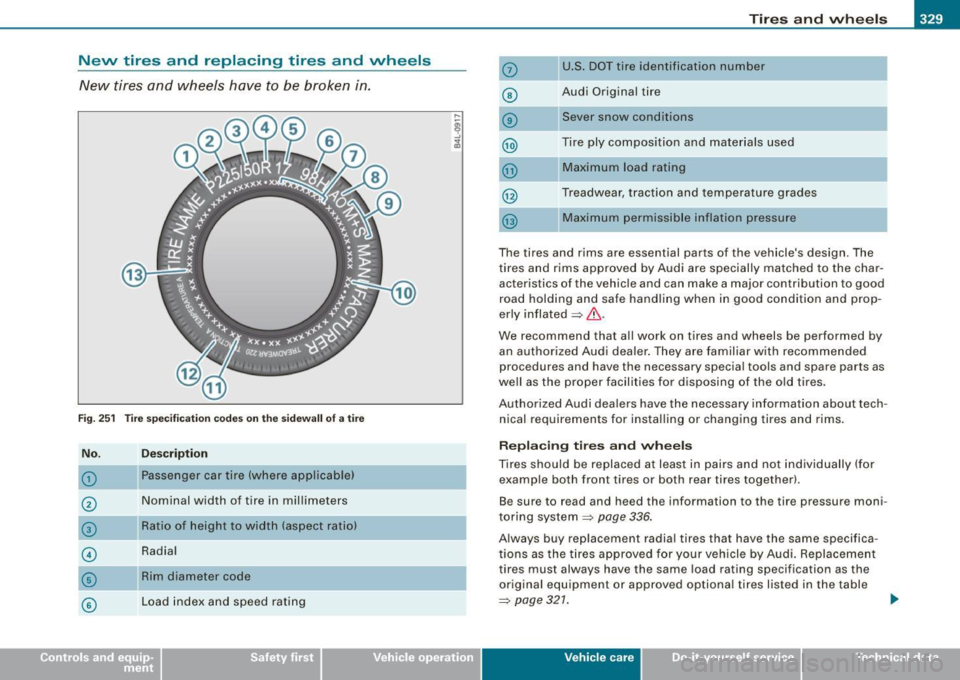
Fig. 251 Tire specification codes on the sidewall of a tire
No.
G)
@
©
©
©
©
Description
Passenger car tire (where applicable)
Nominal width of tire in millimeters
Ratio of height to width (aspect ratio)
Radial
Rim diameter code
Load index and speed rating
0
©
U.S. DOT tire identificat ion number
Audi Original tire
Sever snow condit ions
Tire ply composition and materials used
@ Maximum load rating
@ Treadwear, traction and temperature grades
@ Maximum permissible inflation pressure
The tires and rims are essential parts of the vehicle's design . The
tires and rims approved by Audi are specially matched to the char
acteristics of the vehicle and can make a major contribution to good
road holding and safe handling when in good condition and prop
erly inflated
=> & .
We recommend that all work on tires and wheels be performed by
an authorized Audi dealer. They are familiar with recommended
procedures and have the necessary special tools and spare parts as
well as the proper facilities for disposing of the old tires.
Authorized Audi dealers have the necessary information about tech
nical requirements for installing or changing tires and rims.
Replacing tires and wheels
Tires should be replaced at least in pairs and not individually (for
example both front tires or both rear tires together).
Be sure to read and heed the information to the tire pressure moni
toring system
=> page 336.
Always buy replacement radial tires that have the same specifica
tions as the tires approved for your vehicle by Audi. Replacement
tires must always have the same load rating specification as the
original equipment or approved optional tires listed in the table
=> page 327. ~
Vehic le care I I irechnical data
Page 332 of 398
-~_T_ ir_e_ s_ a_ n_d _ w_ h_ e_e _l_s _________________________________________________ _
Audi-approved specification tires are specially matched to your
vehicle and its load limits, and can contribute to the important road
holding, driving characteristics, and safety of the vehicle . The table
( =>
page 321) lists specifications of the tires approved for the Audi
models covered by your Owner's Literature.
The tire pressure label located on driver's side 8 -pillar (=>
page 321,
fig. 248) lists the specifications of the original equipment tires
installed on your vehicle at the time it was manufactured.
Federa l law requires tire manufacturers to place standardized infor
mation on the sidewall of al l tires=>
page 329, fig. 251. This informa
tion identifies and describes the fundamental characteristics, the
quality grade of the tire and also provides a t ire identification
number for safety standard certification and in case of a recall.
Tire specifications
Knowledge of tire specifications makes it easier to choose the
correct tires. Radial tires have the tire specifications marked on the
sidewa ll, for example:
P245 / 45 R 17 99 H XL
This contains the following information :
P Indicates the tire is for passenger cars (where applicable)
245 Nominal tire width in mm of the tire from sidewall edge to side-
wall edge. In general, the larger the number, the wider the tire
45 Height/width ratio in percent (aspect ratio)
R Tire construction: Radial
17 Rim diameter code (in inches)
99 Load rating code
H Speed rating letter code
XL (or "xi", "EXTRA LOAD", or "RF") indicates that the tire is a"Rein
forced" or an "Extra Load" tire
M+S (or "M/S"l Indicates that the tire has some mud and snow capa
bility
The tires could a lso have the information of direction of rotation
=>
page 317. Tire
manufacturing date
The manufacturing date is also indicated on the tire sidewall
(possibly only on the
inner side of the wheell:
"DO T ... 2208 ... " means, for example, that the tire was produced in
the 22nd week of 2008.
Speed rating (letter code)
The speed rating letter code on the wheels indicates the maximum
permissible road speeds=>
& in "Winter tires" on page 333.
P up to 93 mph ( 150 km/h)
Q up to 99 mph (158 km/h)
R upto 106mph(170km/hl
S upto110mph(180km/hl
T upto118mph(190km/hl
U up to 124 mph (200 km/h)
H up to 130 mph (210 km/h)
V up to 149 mph (240 km/h)31
Z over 149 mph (240 km/h)31
W up to 168 mph (270 km/h)3
l
Y up to 186 mph (298 km/h)31
Your vehicle is normally factory equipped with tires, which possess
excellent driving characteristics and give your Audi optimum
driving comfort. An electronic speed limiter:::>
page 27will normal ly
prevent your vehic le from going faster than the tire speed rating
=> & .
U.S. DOT Tire Identification Number (TIN) and tire
manufacture date
This is the tire's "serial number". It begins with the letters "DOT"
and indicates that the tire meets all federa l standards. The next two
numbers or letters indicate the plant where it was manufactured,
and the last four numbers represent the week and year of manufac-
~
31 For tires with a maximum speed capability over 149 mph (240 km/h), t ire
manufac turers sometimes use the letters "ZR."
Page 337 of 398
Tires and wheels -_______________________ ..::...:..:..-=::.......:.:..;::..:....____;___
•
Wheel bolts
Wheel bolts must always be tightened to the correct
torque.
The design of wheel bolts is matched to the factory installed rims. If
different rims are fitted, the correct wheel bolts with the right length
and correctly shaped bolt heads must be used. This ensures that
wheels are fitted securely and that the brake system functions
correctly.
In certain circumstances, you may not use wheel bolts from a
different vehicle - even if it is the same model~
page 374.
& WARNING
Improperly tightened or maintained wheel bolts can become loose
causing loss of control, a collision and serious personal injury.
• Always keep the wheel bolts and the threads in the wheel hubs
clean so the wheel bolts can turn easily and be properly tightened.
• Never grease or oil the wheel bolts and the threads in the wheel
hubs. They can become loose while driving if greased or oiled,
even if tightened to the specified torque.
• Only use wheel bolts that belong to the rim being installed.
• Never use different wheels bolts on your vehicle.
• Always maintain the correct tightening torque for the wheel
bolts to reduce the risk of a wheel loss.
If the tightening torque of
the wheel bolts is too low, they can loosen and come out when the
vehicle is moving. If the tightening torque is too high, the wheel bolts and threads can be damaged and the wheel can become
loose.
0 Note
The specified torque for the wheel bolts is 90 ft lb (120 Nm) with a
tolerance of ± 7,4 ft lb(± 10 Nm). Torque wheel bolts diagonally.
After changing a wheel, the torque must be checked as soon as possible with a torque wrench
-preferably by an authorized Audi
dealer or qualified workshop. •
Low aspect ratio tires
Your Audi is factory-equipped with low aspect ratio tires. These tires
have been thoroughly tested and been selected specifically for your
model for their superb performance, road feel and handling under
a variety of driving conditions. Ask your authorized Audi dealer for
more details.
The low aspect ratio of these tires is indicated by a numeral of 55 or
less in the tire's size designation. The numeral represents the ratio
of the tire's sidewall height in relation to its tread width expressed
in percentage. Conventional tires have a height/width ratio of 60 or
more.
The performance of low-aspect-ratio tires is particularly sensitive to improper inflation pressure. It is therefore important that low
aspect ratio tires are inflated to the specified pressure and that the
inflation pressure is regularly checked and maintained. Tire pres
sures should be checked at least once a month and always before a
long trip~
page 323, "Checking tire pressure" .
What you can do to avoid tire and rim damage Low aspect ratio tires can be damaged more easily by impact with
potholes, curbs, gullies or ridges on the road, particularly if the tire
is underinflated.
In order to minimize the occurrence of impact damage to the tires
of your vehicle, we recommend that you observe the following
precautions:
• Always maintain recommended inflation pressures . Check your
tire pressure every 2,000 miles (3,000 km) and add air if necessary.
• Drive carefully on roads with potholes, deep gullies or ridges.
The impact from driving through or over such obstacles can
damage your tires. Impact with a curb may also cause damage to
your tires. ..,
Vehicle care
I t •
Page 371 of 398

_____________________________________________________ D_a_ t_ a __ lllll
Data
Ap plies to veh icles: wit h 3.0 lit er 6 -c ylinde r en gine
300 hp, 3 .0 liter, 6-cylinder engine
En gin e da ta
Maximum output SAE net
Maximum torque SAE net
No. of cylinders
Displacement
Stroke
Bore
Compression ratio
Fu el
Dim ension s (app rox.)
Length
Width (with outside mirrors fo lded)
Height (unloaded)
T urning circle diameter (curb to curb)
Ca pac ities (a pprox.)
F u el t ank
-Total capacity
- Reserve (of total capacity)
Wind shi eld and he adli ght * was her fluid container
E ngine oil
with filter change
Controls and equip
ment Safety first
hp@rpm
lb
-ft@ rpm
CID (c m
3
)
in (mm)
in (mm)
300@ 5100 -6800
310@ 2500 -5100
6 cylinder
183 (2995)
3.50 (89.0)
3 .33 (84 .5)
10.5 : 1
Premium unleaded (91 AKI) Recommended for maximum engine performance . Fur
ther details =>
page 295, "Gasoline"
in (mm)
in (mm)
in (mm)
ft (ml
194.4 (4938)
73 .0 (1855)
57.4 (1459)
39.0 (11.9)
gal Oiters)
gal (liters)
quarts (liters)
quarts (liters) 21 .1 (80 .0)
1.8-2.4 (7 -9)
5 .1 (4 .8)
6.9 (6.5)
•
Vehicle operation Vehicle care Do-it-yourself service Tec hn ica l da ta
Page 372 of 398

___ D_ a_t _a ________________________________________________________ _
Applies to vehi cles : wit h 3.2 l iter 6-c ylinder e ngine
255 hp , 3 .2 liter, 6-cylinder engine
Engine data
Max imum output SAE net
Maximum torque SAE net
No . of cy lin ders
D isp laceme nt
Stroke
Bo re
Co mpress ion rati o
Fuel
Dimensions (appro x.)
Leng th
Width (wit h ou ts ide mirrors folded)
Height (un loaded)
T urning c ircle diameter (curb to c urb)
Capacities {approx .)
Fuel tank
-Total capacity
- Rese rve (of total capacity)
Windshield and headlight* washer fluid container
Engine oil
with filter cha n ge h
p@ rpm
lb-ft@ rpm
CID (cm
3 )
in (mm)
in (m m) 255 @6500
243@ 3250
6 cyl inde r
191 (3123)
3 .65 (9 2.8)
3 .33 (84 .5)
1 2 .5: 1
Premium unleaded {91 AKll Recommended for maximum engine performance . Fur
t her deta ils =:>
page 295, "Gasoli ne"
i n (m m)
in (m m)
in (mm)
ft (ml 1
9 4.4 (4 938)
73.0 (1855)
57.4 ( 1459)
39 .0 (1 1.9)
gal (l iters)
g al (li ters)
qua rts (l iters)
q ua rts (l ite rs) 2
1. 1 (80.0)
1 .8 -2 .4 { 7-9)
5.1 ( 4.8)
6 .9 (6 .5)
•
Page 373 of 398

Data -________________ RPI
App lies to vehicles : wit h 4.2 lite r 8- cy lind er e ng in e
350 hp , a-cylinder engine
Engine data
Maximum ou tpu t SAE net
M aximum torque SAE net
No . of c ylind ers
Displaceme nt
Stroke
Bore
C om press ion ratio
F uel
Dimensions ( approx .)
L eng th
Width (w ith outside mirro rs fo lded)
Height (unloaded)
Tu rning circle d ia m eter (c urb to cu rb)
Capacities (approx .>
Fuel tank
- Tot al capaci ty
- Reserve (of total capacity)
Windshield and headlight* washer fluid container Engine oil wit h filter ch ange
Controls and equip ment Safety first h
p@rpm
l b -ft@ rpm
C ID (cm
3
)
in (mm)
in (m m) 35
0@ 6800
3 25@3500
8 c ylinde r
25 4 (4 163)
3.65 (92 .8)
3 .33 (8 4.5)
1 2 .5 : 1
Premium unleaded 191 AKO Recommended for maximum engine performance . Fur
t her details =>
pa ge 295, "Gasoli ne"
in ( mm)
i n (mm)
in (mm)
ft (m l 1
9 4.4 (4 938)
73. 0 (1855)
5 7 .4 (1459)
39.0 (11 .9)
ga l (liter s)
gal (liters)
qua rts (liters)
qua rts (liters) 2
1.1 (80 .0)
1 .8 -2. 4 (7-9)
5.1 ( 4.8)
9.0 (8.5)
•
Vehicle operation Vehicle care Do-it-yourself service Tec hn ica l da ta