Page 300 of 409
9-4
In case of emergency
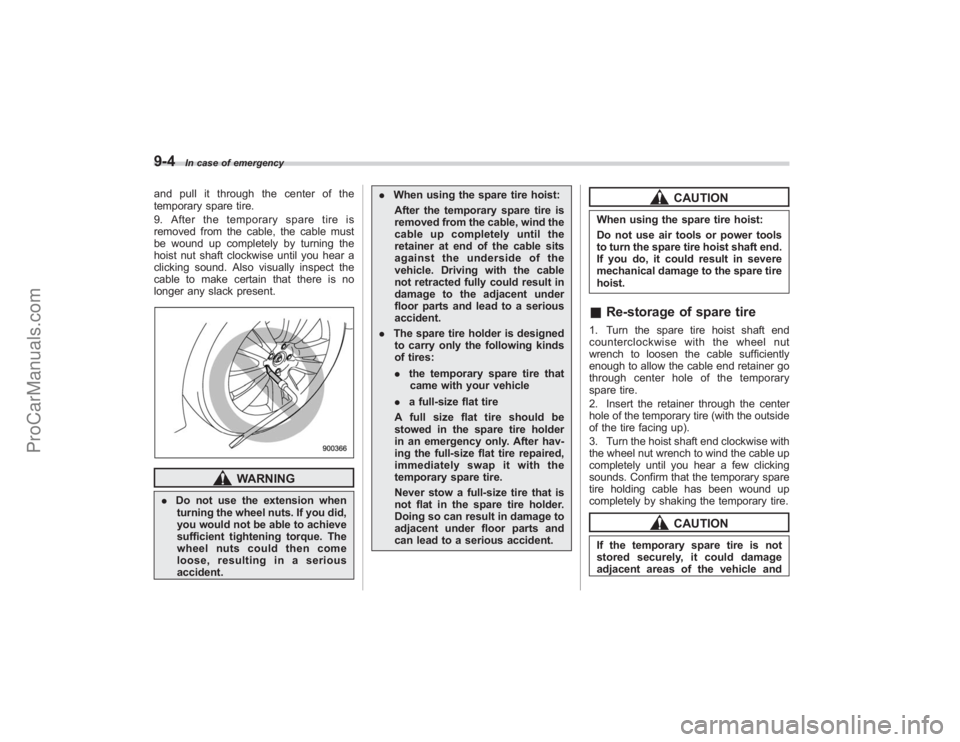
and pull it through the center of the
temporary spare tire.
9. After the temporary spare tire is
removed from the cable, the cable must
be wound up completely by turning the
hoist nut shaft clockwise until you hear a
clicking sound. Also visually inspect the
cable to make certain that there is no
longer any slack present.
WARNING
.Do not use the extension when
turning the wheel nuts. If you did,
you would not be able to achieve
sufficient tightening torque. The
wheel nuts could then come
loose, resulting in a serious
accident. .
When using the spare tire hoist:
After the temporary spare tire is
removed from the cable, wind the
cable up completely until the
retainer at end of the cable sits
against the underside of the
vehicle. Driving with the cable
not retracted fully could result in
damage to the adjacent under
floor parts and lead to a serious
accident.
. The spare tire holder is designed
to carry only the following kinds
of tires:
. the temporary spare tire that
came with your vehicle
. a full-size flat tire
A full size flat tire should be
stowed in the spare tire holder
in an emergency only. After hav-
ing the full-size flat tire repaired,
immediatelyswapitwiththe
temporary spare tire.
Never stow a full-size tire that is
not flat in the spare tire holder.
Doing so can result in damage to
adjacent under floor parts and
can lead to a serious accident.
CAUTION
When using the spare tire hoist:
Do not use air tools or power tools
to turn the spare tire hoist shaft end.
If you do, it could result in severe
mechanical damage to the spare tire
hoist.& Re-storage of spare tire1. Turn the spare tire hoist shaft end
counterclockwise with the wheel nut
wrench to loosen the cable sufficiently
enough to allow the cable end retainer go
through center hole of the temporary
spare tire.
2. Insert the retainer through the center
hole of the temporary tire (with the outside
of the tire facing up).
3. Turn the hoist shaft end clockwise with
the wheel nut wrench to wind the cable up
completely until you hear a few clicking
sounds. Confirm that the temporary spare
tire holding cable has been wound up
completely by shaking the temporary tire.
CAUTION
If the temporary spare tire is not
stored securely, it could damage
adjacent areas of the vehicle and
ProCarManuals.com
Page 305 of 409
WARNING
Do not use oil or grease on the
wheel studs or nuts when the spare
tire is installed. This could cause the
nuts to become loose and lead to an
accident.
15. Turn the jack handle counterclockwise
to lower the vehicle.
CAUTION
There are 2 types of wheel nut
wrenches that apply to different
lengths.
For an aluminum wheel vehicle, the
11.2-inch (285 mm) wheel nut
wrench is equipped as a mainte-
nance tool. And for a chrome plated
wheel vehicle, the 13.2-inch (335
mm) wheel nut wrench is equipped
as well. Confirm the equipped wheel
nut wrench type when you replace a
tire. If the wheel nut wrench is the
different type, it cannot be tightened
to the specified torque.
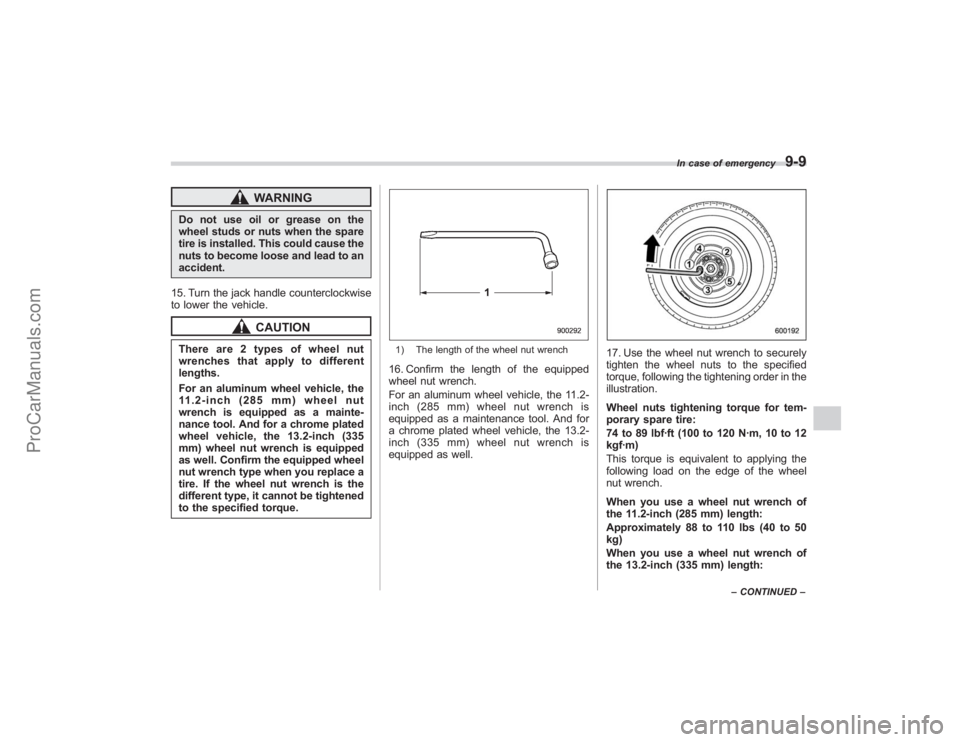
1) The length of the wheel nut wrench16. Confirm the length of the equipped
wheel nut wrench.
For an aluminum wheel vehicle, the 11.2-
inch (285 mm) wheel nut wrench is
equipped as a maintenance tool. And for
a chrome plated wheel vehicle, the 13.2-
inch (335 mm) wheel nut wrench is
equipped as well.
17. Use the wheel nut wrench to securely
tighten the wheel nuts to the specified
torque, following the tightening order in the
illustration.
Wheel nuts tightening torque for tem-
porary spare tire:
74 to 89 lbf·ft (100 to 120 N·m, 10 to 12
kgf·m)
This torque is equivalent to applying the
following load on the edge of the wheel
nut wrench.
When you use a wheel nut wrench of
the 11.2-inch (285 mm) length:
Approximately 88 to 110 lbs (40 to 50
kg)
When you use a wheel nut wrench of
the 13.2-inch (335 mm) length:
In case of emergency
9-9
– CONTINUED –
ProCarManuals.com
Page 310 of 409

9-14
In case of emergency
5. Start the engine of the vehicle with the
booster battery and run it at moderate
speed. Then start the engine of the vehicle
that has the discharged battery.
6. When finished, carefully disconnect
the cables in exactly the reverse order.
Engine overheating
WARNING
Never attempt to remove the radia-
tor cap until the engine has been
shut off and has fully cooled down.
When the engine is hot, the coolant
is under pressure. Removing the
cap while the engine is still hot
could release a spray of boiling hot
coolant, which could burn you very
seriously.
If the engine overheats, safely pull off the
road and stop the vehicle in a safe place.& If steam is coming from the
engine compartmentTurn off the engine and get everyone
away from the vehicle until it cools down.&If no steam is coming from
the engine compartment1. Keep the engine running at idling
speed.
2. Open the hood to ventilate the engine
compartment.
Confirm that the cooling fan is turning. If
the fan is not turning, immediately turn off the engine and contact your authorized
dealer for repair.
3. After the engine coolant temperature
has dropped, turn off the engine.
If the temperature gauge stays at the
overheated zone, turn off the engine.
4. After the engine has fully cooled down,
check the coolant level in the reserve
tank.
If the coolant level is below the
“LOW ”
mark, add coolant up to the “FULL”mark.
5. If there is no coolant in the reserve
tank, add coolant to the reserve tank.
Then remove the radiator cap and fill the
radiator with coolant.
If you remove the radiator cap from a hot
radiator, first wrap a thick cloth around the
radiator cap, then turn the cap counter-
clockwise slowly without pressing down
until it stops. Release the pressure from
the radiator. After the pressure has been
fully released, remove the cap by pressing
down and turning it.
ProCarManuals.com
Page 330 of 409
11-8
Maintenance and service
.Be careful not to spill engine oil
when adding it. If oil touches the
exhaust pipe, it may cause a bad
smell, smoke, and/or a fire. If
engine oil gets on the exhaust
pipe, be sure to wipe it off.
If you check the oil level just after stopping
the engine, wait a few minutes for the oil to
drain back into the oil pan before checking
the level.
To prevent overfilling the engine oil, do not
add any additional oil above the upper
level when the engine is cold.& Changing the oil and oil filterChange the oil and oil filter according to
the maintenance schedule in the “War-
ranty and Maintenance Booklet ”.
The engine oil and oil filter must be
changed more frequently than listed in
the maintenance schedule when driving
on dusty roads, when short trips are
frequently made, or when driving in
extremely cold whether.
1. Warm up the engine by letting the
engine idle for approximately 10 minutes
to ease draining the engine oil.
2. Park the vehicle on a level surface and
stop the engine.
3. Remove the oil filler cap.
4. Drain out the engine oil by removing
the drain plug while the engine is still
warm. The used oil should be drained into
an appropriate container and disposed of
properly.
WARNING
Be careful not to burn yourself with
hot engine oil.
5. Wipe the seating surface of the drain
plug with a clean cloth and tighten it
securely with a new sealing washer after
the oil has completely drained out.
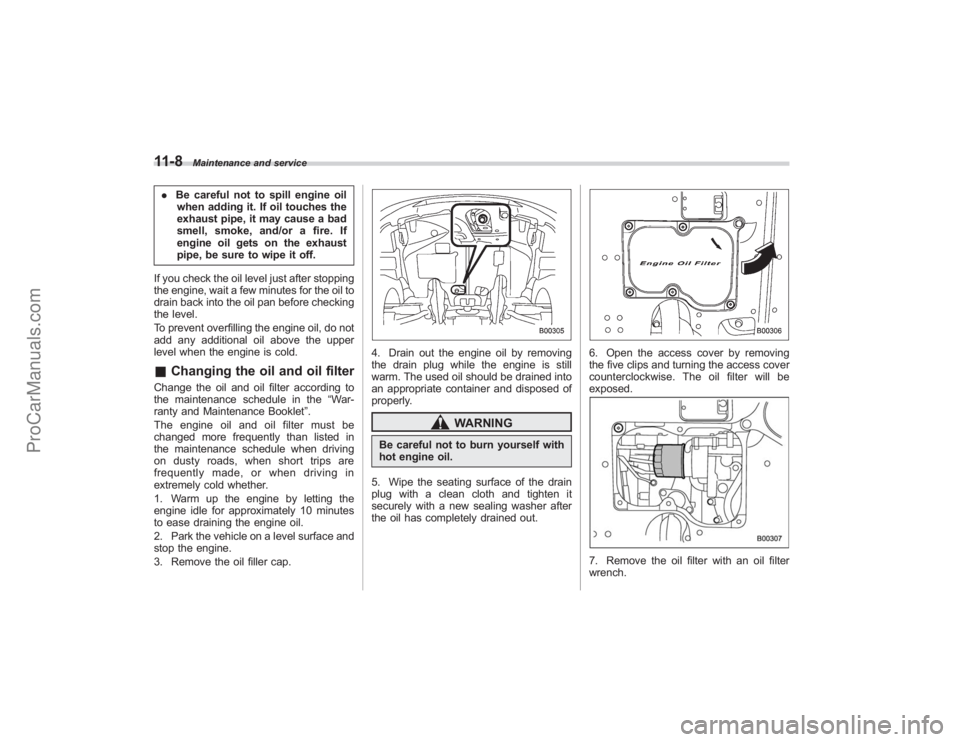
6. Open the access cover by removing
the five clips and turning the access cover
counterclockwise. The oil filter will be
exposed.7. Remove the oil filter with an oil filter
wrench.
ProCarManuals.com
Page 357 of 409
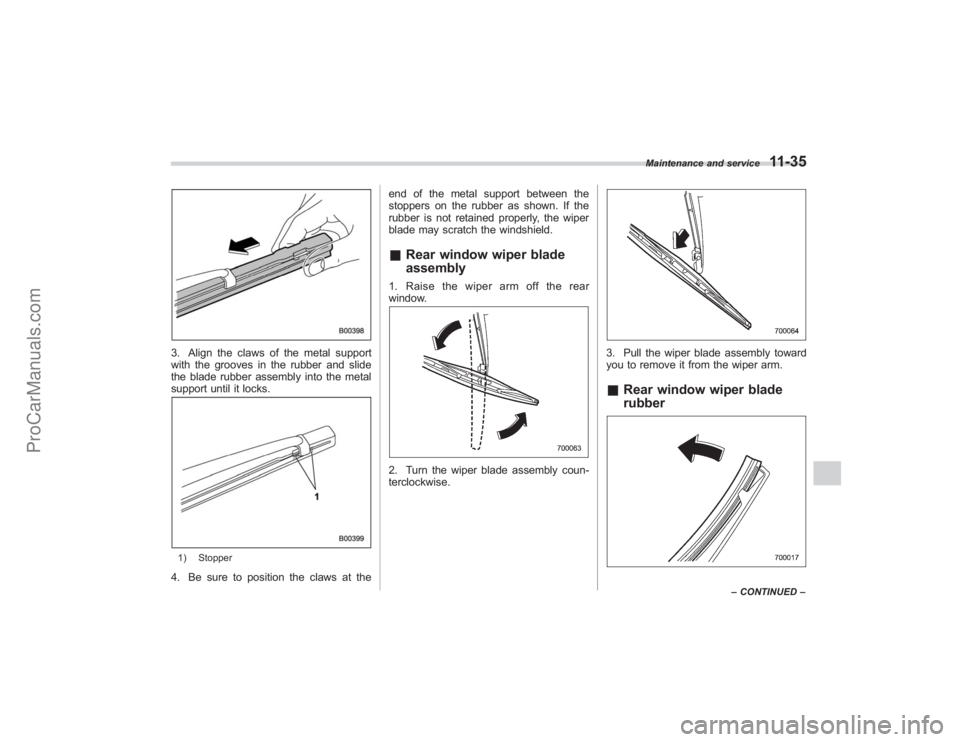
3. Align the claws of the metal support
with the grooves in the rubber and slide
the blade rubber assembly into the metal
support until it locks.1) Stopper4. Be sure to position the claws at theend of the metal support between the
stoppers on the rubber as shown. If the
rubber is not retained properly, the wiper
blade may scratch the windshield.
&
Rear window wiper blade
assembly1. Raise the wiper arm off the rear
window.2. Turn the wiper blade assembly coun-
terclockwise.
3. Pull the wiper blade assembly toward
you to remove it from the wiper arm.&Rear window wiper blade
rubber
Maintenance and service
11-35
–CONTINUED –
ProCarManuals.com
Page 366 of 409
11-44
Maintenance and service
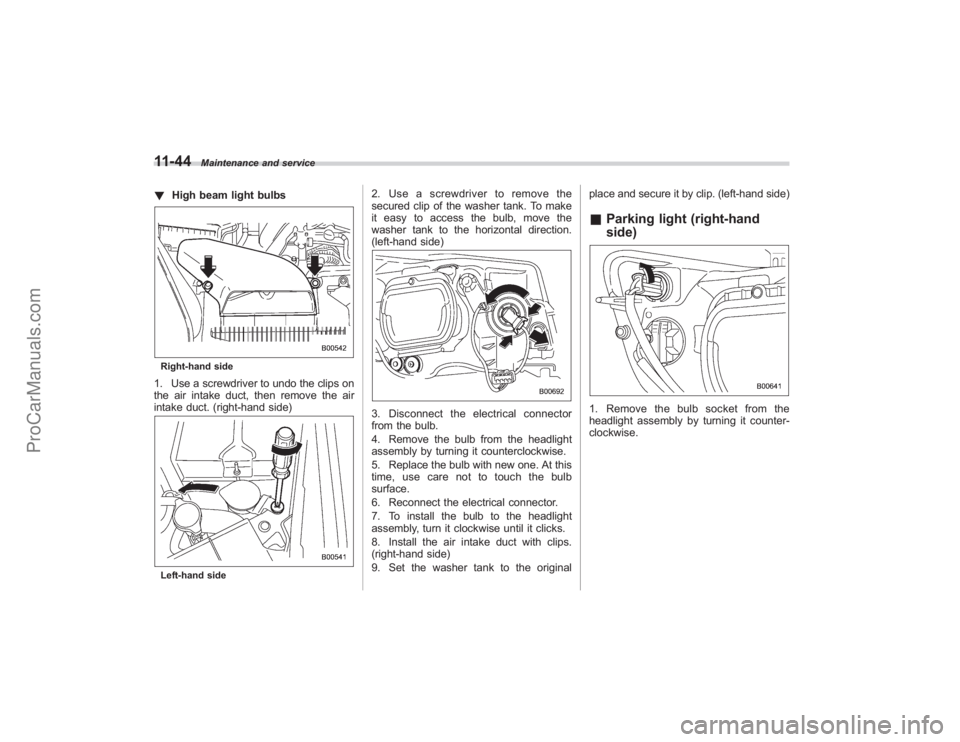
!High beam light bulbsRight-hand side1. Use a screwdriver to undo the clips on
the air intake duct, then remove the air
intake duct. (right-hand side)Left-hand side
2. Use a screwdriver to remove the
secured clip of the washer tank. To make
it easy to access the bulb, move the
washer tank to the horizontal direction.
(left-hand side)3. Disconnect the electrical connector
from the bulb.
4. Remove the bulb from the headlight
assembly by turning it counterclockwise.
5. Replace the bulb with new one. At this
time, use care not to touch the bulb
surface.
6. Reconnect the electrical connector.
7. To install the bulb to the headlight
assembly, turn it clockwise until it clicks.
8. Install the air intake duct with clips.
(right-hand side)
9. Set the washer tank to the original place and secure it by clip. (left-hand side)
&
Parking light (right-hand
side)1. Remove the bulb socket from the
headlight assembly by turning it counter-
clockwise.
ProCarManuals.com
Page 367 of 409
2. Pull the bulb out of the socket. Install a
new bulb.
3. Set the bulb socket into the headlight
assembly and turn it clockwise until it
locks.NOTEContact your SUBARU dealer for the
bulb replacement of the left-hand side.
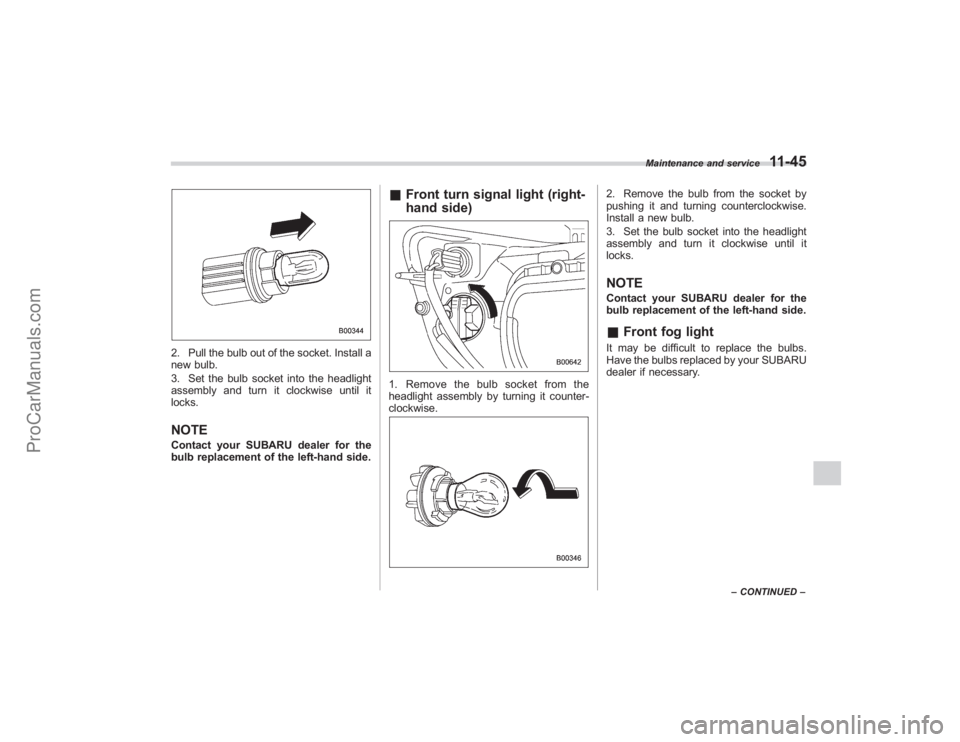
&Front turn signal light (right-
hand side)1. Remove the bulb socket from the
headlight assembly by turning it counter-
clockwise.
2. Remove the bulb from the socket by
pushing it and turning counterclockwise.
Install a new bulb.
3. Set the bulb socket into the headlight
assembly and turn it clockwise until it
locks.NOTEContact your SUBARU dealer for the
bulb replacement of the left-hand side.&Front fog lightIt may be difficult to replace the bulbs.
Have the bulbs replaced by your SUBARU
dealer if necessary.
Maintenance and service
11-45
–CONTINUED –
ProCarManuals.com
Page 368 of 409
11-46
Maintenance and service
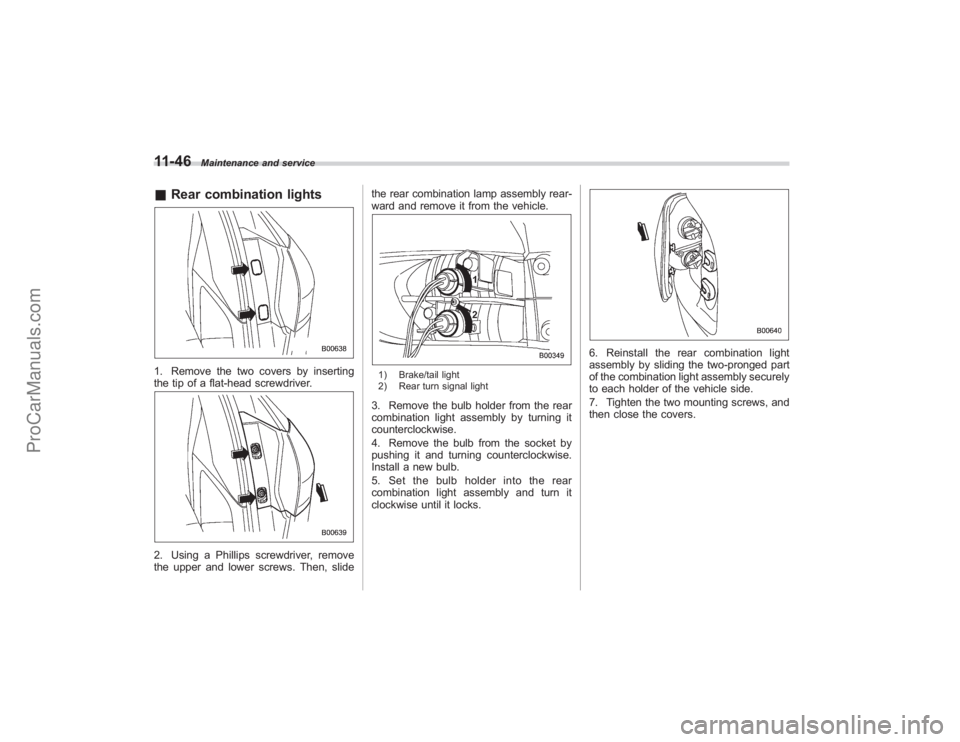
&Rear combination lights1. Remove the two covers by inserting
the tip of a flat-head screwdriver.2. Using a Phillips screwdriver, remove
the upper and lower screws. Then, slide the rear combination lamp assembly rear-
ward and remove it from the vehicle.
1) Brake/tail light
2) Rear turn signal light3. Remove the bulb holder from the rear
combination light assembly by turning it
counterclockwise.
4. Remove the bulb from the socket by
pushing it and turning counterclockwise.
Install a new bulb.
5. Set the bulb holder into the rear
combination light assembly and turn it
clockwise until it locks.
6. Reinstall the rear combination light
assembly by sliding the two-pronged part
of the combination light assembly securely
to each holder of the vehicle side.
7. Tighten the two mounting screws, and
then close the covers.
ProCarManuals.com