2008 NISSAN TEANA cvt
[x] Cancel search: cvtPage 42 of 5121

ADP-36
< FUNCTION DIAGNOSIS >
DIAGNOSIS SYSTEM (DRIVER SEAT CONTROL UNIT)
ACTIVE TEST
CAUTION:
When driving vehicle never perform active test.
WORK SUPPORT
SLIDE PULSE — –×Value (32768) when battery connections are standard. If it
moves backward, the value increases. If it moves forward,
the value decreases
RECLN PULSE — –×Value (32768) when battery connections are standard. If it
moves backward, the value increases. If it moves forward,
the value decreases
LIFT FR PULSE — –×Value (32768) when battery connections are standard. If it
moves DOWN, the value increases. If it moves UP, the val-
ue decreases
LIFT RR PULSE — –×Value (32768) when battery connections are standard. If it
moves DOWN, the value increases. If it moves UP, the val-
ue decreases
VEHICLE SPEED —××Display the vehicle speed signal received from combination
meter by numerical value [km/h]
P RANG SW CAN “ON/OFF”××ON/OFF status judged from the P range switch signal
R RANGE (CAN) “ON/OFF”××ON/OFF status judged from the R range switch signal
DOOR SW–FL “ON/OFF”××ON/OFF status judged from the door switch (front driver
side) signal
DOOR SW–FR “ON/OFF”××ON/OFF status judged from the door switch (front passen-
ger side) signal
IGN ON SW “ON/OFF”××ON/OFF status judged from the ignition switch signal
ACC ON SW “ON/OFF”××ON/OFF status judged from the ACC switch signal
KEY ON SW “ON/OFF”××ON/OFF status judged from the key on switch signal
KEYLESS ID —××Key ID status judged from the key ID signal
KYLS DR UNLK “ON/OFF”××ON/OFF status judged from the driver side door unlock ac-
tuator output switch signal
VHCL SPEED (ABS) “ON/OFF”××ON/OFF status judged from vehicle speed signal
HANDLE “RHD/LHD”××RHD/LHD status judged from handle position signal
TRANSMISSION“AT or CVT/
MT”××AT or CVT/MT status judged from transmission
STEERING STATUS“LOCK/UN-
LOCK”××LOCK/UNLOCK status judged from steering lock unit Monitor Item UnitMain
SignalsSelection
From
MenuContents
Test item Description
SEAT SLIDE Activates/deactivates the sliding motor
SEAT RECLINING Activates/deactivates the reclining motor
SEAT LIFTER FR Activates/deactivates the lifting motor (front)
SEAT LIFTER RR Activates/deactivates the lifting motor (rear)
MEMORY SW INDCTR Turns ON/OFF the memory indicator
Work item Content Item
SEAT SLIDE VOLUME SETThe amount of seat sliding for entry/exit assist can be selected
from 3 items.40 mm
80 mm
150 mm
Page 119 of 5121

DRIVER SEAT CONTROL UNIT
ADP-113
< ECU DIAGNOSIS >
C
D
E
F
G
H
I
K
L
MA
B
ADP
N
O
P
*: The value at the position attained when the battery is connected is regarded as 32768.
TERMINAL LAYOUT
PHYSICAL VALUES
LIFT RR PULSE Seat lifter (rear)Up
The numeral value decreases
*
Down
The numeral value increases *
Other than above
No change to numeral value*
STEERING STATUS Steering lock unitLOCK LOCK
unlock UNLOCK
VEHICLE SPEED The condition of vehicle speed is displayed km/h
P RANG SW CAN Selector leverP position ON
Other than above OFF
R RANGE (CAN) Selector leverR position ON
Other than above OFF
DOOR SW-FL Driver doorOpen ON
Close OFF
DOOR SW-FR Passenger doorOpen ON
Close OFF
IGN ON SW Ignition switchON position ON
Other than above OFF
ACC ON SW Ignition switchACC or ON position ON
Other than above OFF
KEY ON SW Intelligent KeyInserted is key slot ON
Inserted is not key slot OFF
KEYLESS ID UNLOCK button of Intelligent Key is pressed 1,2,3,4or5
KYLS DR UNLKIntelligent Key or driver
side door request switchON ON
OFF OFF
VHCL SPEED (ABS) Can signal from ABSReceived ON
Not received OFF
HANDLE The BCM for handle position is displayedLHD
RHD
TRANSMISSIONTransmission type is dis-
played CVT Monitor Item Condition Value/Status
JMJIA2011ZZ
Page 843 of 5121

BCS-26
< FUNCTION DIAGNOSIS >
DIAGNOSIS SYSTEM (BCM)
SELF-DIAG RESULT
Refer to BCS-74, "DTCIndex".
DATA MONITOR
INSIDE ANT DIAGNOSIS This function allows inside key antenna self-diagnosis.
HORN WITH KEYLESS LOCKHorn reminder function mode by Intelligent Key button can be changed to operate (ON) or not op-
erate (OFF) in this mode. Monitor item Description
Monitor Item Condition
REQ SW -DR Indicates [ON/OFF] condition of door request switch (driver side).
REQ SW -AS Indicates [ON/OFF] condition of door request switch (passenger side).
REQ SW -BD/TR Indicates [ON/OFF] condition of trunk lid opener request switch.
PUSH SW Indicates [ON/OFF] condition of push-button ignition switch.
IGN RLY2 -F/B Indicates [ON/OFF] condition of ignition relay 2.
CLUCH SWNOTE:
This item is displayed, but cannot be monitored.
BRAKE SW 1 Indicates [ON/OFF] condition of brake switch.
DETE/CANCL SW Indicates [ON/OFF] condition of the P position.
SFT PN/N SW Indicates [ON/OFF] condition of the P or N position.
S/L -LOCK Indicates [ON/OFF] condition of steering lock unit (LOCK).
S/L -UNLOCK Indicates [ON/OFF] condition of steering lock unit (UNLOCK).
S/L RELAY -F/B Indicates [ON/OFF] condition of steering lock relay.
UNLK SEN -DR Indicates [ON/OFF] condition of driver door UNLOCK status.
PUSH SW -IPDM Indicates [ON/OFF] condition of push-button ignition switch.
IGN RLY1 -F/B Indicates [ON/OFF] condition of ignition relay 1.
DETE SW -IPDM Indicates [ON/OFF] condition of the P position.
SFT PN -IPDM Indicates [ON/OFF] condition of the P or N position.
SFT P -MET Indicates [ON/OFF] condition of the P position.
SFT N -MET Indicates [ON/OFF] condition of the N position.
ENGINE STATE Indicates [STOP/STALL/CRANK/RUN] condition of engine states.
S/L LOCK-IPDM Indicates [ON/OFF] condition of steering lock unit (LOCK).
S/L UNLK-IPDM Indicates [ON/OFF] condition of steering lock unit (UNLOCK).
S/L RELAY-REQ Indicates [ON/OFF] condition of steering lock relay.
VEH SPEED 1 Displays the vehicle speed signal received from combination meter by numerical value [Km/h].
VEH SPEED 2 Displays the vehicle speed signal received from ABS, VDC or CVT by numerical value [Km/h].
DOOR STAT-DR Indicates [LOCK/READY/UNLK] condition of driver side door status.
DOOR STAT-AS Indicates [LOCK/READY/UNLK] condition of passenger side door status.
ID OK FLAG Indicates [SET/RESET] condition of key ID.
PRMT ENG STRT Indicates [SET/RESET] condition of engine start possibility.
PRMT RKE STRTNOTE:
This item is displayed, but cannot be monitored.
KEY SW -SLOT Indicates [ON/OFF] condition of key slot.
TRNK/HAT MNTR Indicates [ON/OFF] condition of trunk lid.
RKE-LOCK Indicates [ON/OFF] condition of LOCK signal from Intelligent Key.
RKE-UNLOCK Indicates [ON/OFF] condition of UNLOCK signal from Intelligent Key.
RKE-TR/BD Indicates [ON/OFF] condition of TRUNK OPEN signal from Intelligent Key.
Page 1012 of 5121
![NISSAN TEANA 2008 Service Manual TCS
BRC-71
< FUNCTION DIAGNOSIS >[VDC/TCS/ABS]
C
D
E
G
H
I
J
K
L
MA
B
BRC
N
O
P
TCS
System DiagramINFOID:0000000003767312
System DescriptionINFOID:0000000003766890
Traction Control System is a funct](/manual-img/5/57391/w960_57391-1011.png "NISSAN TEANA 2008 Service Manual TCS
BRC-71
< FUNCTION DIAGNOSIS >[VDC/TCS/ABS]
C
D
E
G
H
I
J
K
L
MA
B
BRC
N
O
P
TCS
System DiagramINFOID:0000000003767312
System DescriptionINFOID:0000000003766890
Traction Control System is a funct")
TCS
BRC-71
< FUNCTION DIAGNOSIS >[VDC/TCS/ABS]
C
D
E
G
H
I
J
K
L
MA
B
BRC
N
O
P
TCS
System DiagramINFOID:0000000003767312
System DescriptionINFOID:0000000003766890
Traction Control System is a function that electronically controls engine torque, brake fluid pressure and
CVT shift position to ensure the optimum slippage ratio at drive wheels by computing wheel speed signals
from 4 wheel sensors. When ABS actuator and electric unit (control unit) detects a spin at drive wheels (rear
wheels), it compares wheel speed signals from all 4 wheels. At this time, LH and RH rear brake fluid pres-
sure are controlled, while fuel being cut to engine and throttle valve being closed to reduce engine torque by
the control unit. Further more, throttle position is continuously controlled to ensure the optimum engine
torque at all times.
During TCS operation, TCS informs driver of system operation by flashing SLIP indicator lamp.
Electrical system diagnosis by CONSULT-III is available.
JSFIA0259GB
Page 1136 of 5121
RADIATOR
CO-13
< ON-VEHICLE REPAIR >
C
D
E
F
G
H
I
J
K
L
MA
CO
N
P O
ON-VEHICLE REPAIR
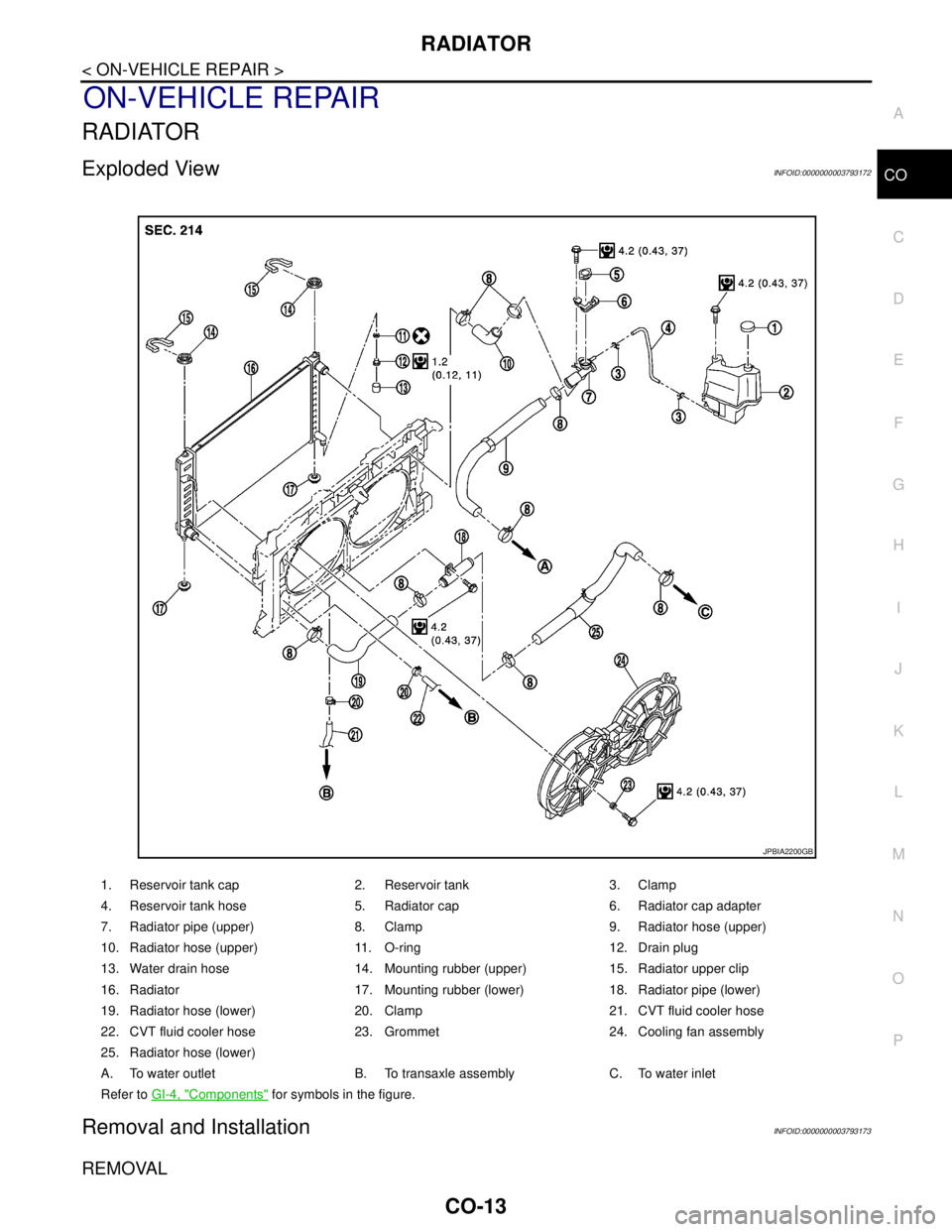
RADIATOR
Exploded ViewINFOID:0000000003793172
Removal and InstallationINFOID:0000000003793173
REMOVAL
1. Reservoir tank cap 2. Reservoir tank 3. Clamp
4. Reservoir tank hose 5. Radiator cap 6. Radiator cap adapter
7. Radiator pipe (upper) 8. Clamp 9. Radiator hose (upper)
10. Radiator hose (upper) 11. O-ring 12. Drain plug
13. Water drain hose 14. Mounting rubber (upper) 15. Radiator upper clip
16. Radiator 17. Mounting rubber (lower) 18. Radiator pipe (lower)
19. Radiator hose (lower) 20. Clamp 21. CVT fluid cooler hose
22. CVT fluid cooler hose 23. Grommet 24. Cooling fan assembly
25. Radiator hose (lower)
A. To water outlet B. To transaxle assembly C. To water inlet
Refer to GI-4, "
Components" for symbols in the figure.
JPBIA2200GB
Page 1137 of 5121
CO-14
< ON-VEHICLE REPAIR >
RADIATOR
WARNING:
Never remove radiator cap when engine is hot. Serious burns could occur from high-pressure engine
coolant escaping from radiator. Wrap a thick cloth around the cap. Slowly turn it a quarter of a turn to
release built-up pressure. Carefully remove radiator cap by turning it all the way.
1. Remove the following parts:
Engine under cover.
Air duct (inlet): Refer to EM-26, "
Exploded View".
Horn: Refer to HRN-6, "
Exploded View".
Hood lock: Refer to DLK-220, "
Exploded View".
2. Drain engine coolant from radiator. Refer to CO-8, "
Draining".
CAUTION:
Perform this step when the engine is cold.
Never spill engine coolant on drive belt.
3. Disconnect reservoir tank hose from radiator pipe (upper).
4. Disconnect CVT fluid cooler hoses from radiator.
Install blind plug to avoid leakage of CVT fluid.
5. Disconnect Low-pressure flexible hose from lower pressure pipe, and then move it to aside. Refer to HA-
38, "Exploded View".
6. Remove radiator cap adapter and radiator hoses (upper) and radiator pipe (upper) assembly.
CAUTION:
Be careful not to allow engine coolant to contact drive belt.
7. Disconnect radiator hose (lower) from radiator.
8. Remove condenser. Refer to HA-46, "
Exploded View".
CAUTION:
Be careful not to damage condenser core.
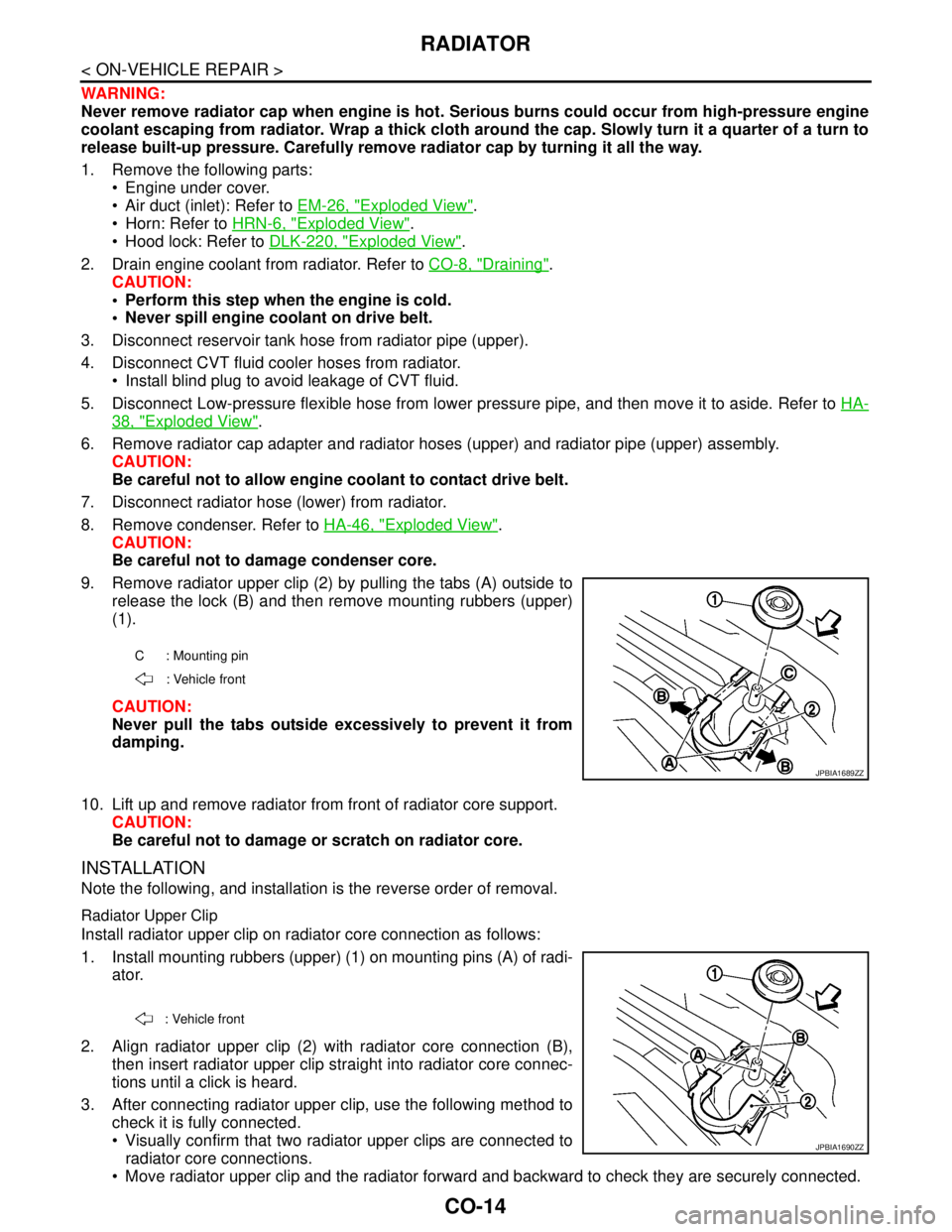
9. Remove radiator upper clip (2) by pulling the tabs (A) outside to
release the lock (B) and then remove mounting rubbers (upper)
(1).
CAUTION:
Never pull the tabs outside excessively to prevent it from
damping.
10. Lift up and remove radiator from front of radiator core support.
CAUTION:
Be careful not to damage or scratch on radiator core.
INSTALLATION
Note the following, and installation is the reverse order of removal.
Radiator Upper Clip
Install radiator upper clip on radiator core connection as follows:
1. Install mounting rubbers (upper) (1) on mounting pins (A) of radi-
ator.
2. Align radiator upper clip (2) with radiator core connection (B),
then insert radiator upper clip straight into radiator core connec-
tions until a click is heard.
3. After connecting radiator upper clip, use the following method to
check it is fully connected.
Visually confirm that two radiator upper clips are connected to
radiator core connections.
Move radiator upper clip and the radiator forward and backward to check they are securely connected.
C : Mounting pin
: Vehicle front
JPBIA1689ZZ
: Vehicle front
JPBIA1690ZZ
Page 1138 of 5121

RADIATOR
CO-15
< ON-VEHICLE REPAIR >
C
D
E
F
G
H
I
J
K
L
MA
CO
N
P O
InspectionINFOID:0000000003793174
INSPECTION AFTER INSTALLATION
Check for leakage of engine coolant using the radiator cap tester adapter (commercial service tool) and the
radiator cap tester (commercial service tool). Refer to CO-8, "
Inspection".
Start and warm up the engine. Visually check that there is no leakage of engine coolant and CVT fluid.
Page 1149 of 5121
CO-26
< ON-VEHICLE REPAIR >
WATER OUTLET AND WATER PIPING
5. Remove CVT fluid charging pipe and CVT fluid level gauge. Refer to TM-332, "Exploded View" (VQ25DE)
or TM-168, "
Exploded View" (VQ35DE).
6. Move CVT control cable aside. Refer to TM-319, "
Exploded View" (VQ25DE) or TM-157, "Exploded View"
(VQ35DE).
7. Remove vacuum pipe (front) mounting bolt from water outlet. Refer to EM-67, "
Exploded View".
8. Remove radiator hose (upper) from water outlet.
9. Remove water hoses and heater hoses.
10. Disconnect harness connectors, and move harness to aside.
11. Remove engine coolant temperature sensor as necessary.
CAUTION:
Be careful not to damage engine coolant temperature sensor.
12. Remove water outlet, heater pipe, water bypass pipe and water connector.
INSTALLATION
Note the following, and install in the reverse order of removal.
Securely insert each hose, and install clamp at a position where it does not interfere with the pipe bulge.
When inserting water bypass pipe and heater pipe into water connector, apply neutral detergent to O-ring.
InspectionINFOID:0000000003793187
INSPECTION AFTER INSTALLATION
Check for leakage of engine coolant using the radiator cap tester adapter (commercial service tool) and the
radiator cap tester (commercial service tool). Refer to CO-8, "
Inspection".
Start and warm up the engine. Visually check that there is no leakage of engine coolant.