Page 1083 of 5121
![NISSAN TEANA 2008 Service Manual BRC-142
< SYMPTOM DIAGNOSIS >[VDC/TCS/ABS]
EXCESSIVE ABS FUNCTION OPERATION FREQUENCY
SYMPTOM DIAGNOSIS
EXCESSIVE ABS FUNCTION OPERATION FREQUENCY
Diagnosis ProcedureINFOID:0000000003767023
1.CHECK ST](/manual-img/5/57391/w960_57391-1082.png "NISSAN TEANA 2008 Service Manual BRC-142
< SYMPTOM DIAGNOSIS >[VDC/TCS/ABS]
EXCESSIVE ABS FUNCTION OPERATION FREQUENCY
SYMPTOM DIAGNOSIS
EXCESSIVE ABS FUNCTION OPERATION FREQUENCY
Diagnosis ProcedureINFOID:0000000003767023
1.CHECK ST")
BRC-142
< SYMPTOM DIAGNOSIS >[VDC/TCS/ABS]
EXCESSIVE ABS FUNCTION OPERATION FREQUENCY
SYMPTOM DIAGNOSIS
EXCESSIVE ABS FUNCTION OPERATION FREQUENCY
Diagnosis ProcedureINFOID:0000000003767023
1.CHECK START
Check front and rear brake force distribution using a brake tester. Refer to BR-45, "
General Specifications".
Is the inspection result normal?
YES >> GO TO 2.
NO >> Check brake system.
2.CHECK FRONT AND REAR AXLE
Make sure that there is no excessive play in the front and rear axles.
Front: Refer to FA X - 6 , "
Inspection".
Rear: Refer to RAX-3, "
Inspection".
Is the inspection result normal?
YES >> GO TO 3.
NO >> Repair or replace malfunctioning components.
3.CHECK WHEEL SENSOR AND SENSOR ROTOR
Check the following.
Wheel sensor installation for damage.
Sensor rotor installation for damage.
Wheel sensor connector connection.
Wheel sensor harness inspection.
Is the inspection result normal?
YES >> GO TO 4.
NO >> Replace wheel sensor or sensor rotor.
Repair harness.
4.CHECK ABS WARNING LAMP DISPLAY
Make sure that the ABS warning lamp is turned off after the ignition switch is turned ON or when driving.
Is the ABS warning lamp illuminated?
YES >> Perform self-diagnosis.
NO >> Normal
Page 1085 of 5121
BRC-144
< SYMPTOM DIAGNOSIS >[VDC/TCS/ABS]
THE BRAKING DISTANCE IS LONG
THE BRAKING DISTANCE IS LONG
Diagnosis ProcedureINFOID:0000000003767025
CAUTION:
The stopping distance on slippery road surfaces might be longer when the ABS is operating than
when the ABS is not operating.
1.CHECK FUNCTION
Turn the ignition switch OFF and disconnect ABS actuator and electric unit (control unit) connector to deacti-
vate ABS. In this condition, check stopping distance. After inspection, connect connector.
Is the inspection result normal?
YES >> Normal
NO >> Check brake system.
Page 1086 of 5121
ABS FUNCTION DOES NOT OPERATE
BRC-145
< SYMPTOM DIAGNOSIS >[VDC/TCS/ABS]
C
D
E
G
H
I
J
K
L
MA
B
BRC
N
O
P
ABS FUNCTION DOES NOT OPERATE
Diagnosis ProcedureINFOID:0000000003767026
CAUTION:
ABS does not operate when speed is 10 km/h (6 MPH) or lower.
1.CHECK ABS WARNING LAMP DISPLAY
Make sure that the ABS warning lamp turns OFF after ignition switch is turned ON or when driving.
Is the inspection result normal?
YES >> Normal
NO >> Perform self-diagnosis.
Page 1088 of 5121
![NISSAN TEANA 2008 Service Manual VEHICLE JERKS DURING VDC/TCS/ABS CONTROL
BRC-147
< SYMPTOM DIAGNOSIS >[VDC/TCS/ABS]
C
D
E
G
H
I
J
K
L
MA
B
BRC
N
O
P
VEHICLE JERKS DURING VDC/TCS/ABS CONTROL
Diagnosis ProcedureINFOID:0000000003767028](/manual-img/5/57391/w960_57391-1087.png "NISSAN TEANA 2008 Service Manual VEHICLE JERKS DURING VDC/TCS/ABS CONTROL
BRC-147
< SYMPTOM DIAGNOSIS >[VDC/TCS/ABS]
C
D
E
G
H
I
J
K
L
MA
B
BRC
N
O
P
VEHICLE JERKS DURING VDC/TCS/ABS CONTROL
Diagnosis ProcedureINFOID:0000000003767028")
VEHICLE JERKS DURING VDC/TCS/ABS CONTROL
BRC-147
< SYMPTOM DIAGNOSIS >[VDC/TCS/ABS]
C
D
E
G
H
I
J
K
L
MA
B
BRC
N
O
P
VEHICLE JERKS DURING VDC/TCS/ABS CONTROL
Diagnosis ProcedureINFOID:0000000003767028
1.SYMPTOM CHECK
Check if the vehicle jerks during VDC/TCS/ABS control.
Is the inspection result normal?
YES >> Normal.
NO >> GO TO 2.
2.CHECK SELF-DIAGNOSIS RESULTS
Perform self-diagnosis of ABS actuator and electric unit (control unit).
Are self-diagnosis results indicated?
YES >> Check corresponding items, make repairs, and perform ABS actuator and electric unit (control
unit) self-diagnosis.
NO >> GO TO 3.
3.CHECK CONNECTOR
Turn the ignition switch OFF and disconnect ABS actuator and electric unit (control unit) connector and
check terminal for deformation, disconnection, looseness, etc.
Securely connect connectors and perform ABS actuator and electric unit (control unit) self-diagnosis.
Are self-diagnosis results indicated?
YES >> If poor contact, damage, open or short circuit of connector terminal is found, repair or replace.
NO >> GO TO 4.
4.CHECK ECM AND A/T SELF-DIAGNOSIS RESULTS
Perform ECM self-diagnosis and TCM self-diagnosis.
Are self-diagnosis results indicated?
YES >> Check the corresponding items.
NO >> Replace ABS actuator and electric unit (control unit).
Page 1090 of 5121
![NISSAN TEANA 2008 Service Manual PRECAUTIONS
BRC-149
< PRECAUTION >[VDC/TCS/ABS]
C
D
E
G
H
I
J
K
L
MA
B
BRC
N
O
P
PRECAUTION
PRECAUTIONS
Precaution for Supplemental Restraint System (SRS) "AIR BAG" and "SEAT BELT
PRE-TENSIONER"
INFO](/manual-img/5/57391/w960_57391-1089.png "NISSAN TEANA 2008 Service Manual PRECAUTIONS
BRC-149
< PRECAUTION >[VDC/TCS/ABS]
C
D
E
G
H
I
J
K
L
MA
B
BRC
N
O
P
PRECAUTION
PRECAUTIONS
Precaution for Supplemental Restraint System (SRS) \"AIR BAG\" and \"SEAT BELT
PRE-TENSIONER\"
INFO")
PRECAUTIONS
BRC-149
< PRECAUTION >[VDC/TCS/ABS]
C
D
E
G
H
I
J
K
L
MA
B
BRC
N
O
P
PRECAUTION
PRECAUTIONS
Precaution for Supplemental Restraint System (SRS) "AIR BAG" and "SEAT BELT
PRE-TENSIONER"
INFOID:0000000003893849
The Supplemental Restraint System such as “AIR BAG” and “SEAT BELT PRE-TENSIONER”, used along
with a front seat belt, helps to reduce the risk or severity of injury to the driver and front passenger for certain
types of collision. Information necessary to service the system safely is included in the “SRS AIRBAG” and
“SEAT BELT” of this Service Manual.
WARNING:
To avoid rendering the SRS inoperative, which could increase the risk of personal injury or death in
the event of a collision which would result in air bag inflation, all maintenance must be performed by
an authorized NISSAN/INFINITI dealer.
Improper maintenance, including incorrect removal and installation of the SRS, can lead to personal
injury caused by unintentional activation of the system. For removal of Spiral Cable and Air Bag
Module, see the “SRS AIRBAG”.
Never use electrical test equipment on any circuit related to the SRS unless instructed to in this Ser-
vice Manual. SRS wiring harnesses can be identified by yellow and/or orange harnesses or harness
connectors.
Precaution for Procedure without Cowl Top CoverINFOID:0000000003928809
When performing the procedure after removing cowl top cover, cover
the lower end of windshield with urethane, etc.
Precaution for Brake SystemINFOID:0000000003767031
WARNING:
Clean brake pads and shoes with a waste cloth, then wipe with a dust collector.
Only use “DOT 3” or “DOT 4” brake fluid. Refer to MA-11, "
Fluids and Lubricants".
Never reuse drained brake fluid.
Never spill or splash brake fluid on painted surfaces. Brake fluid may seriously damage paint. Wipe it off
immediately and wash with water if it gets on a painted surface.
Never use mineral oils such as gasoline or light oil. They may damage rubber parts and cause improper
operation.
Always loosen the brake tube flare nut with a flare nut wrench.
Tighten the brake tube flare nut to the specified torque with a flare
nut torque wrench (A).
Always conform the specified tightening torque when installing the
brake pipes.
Brake system is an important safety part. If a brake fluid leak is
detected, always disassemble the affected part. If a malfunction is
detected, replace part with a new one.
Turn the ignition switch OFF and disconnect the ABS actuator and
electric unit (control unit) connector or the battery negative terminal
before performing the work.
PIIB3706J
JPFIA0061ZZ
Page 1101 of 5121
CHG
DIAGNOSIS AND REPAIR WORKFLOW
CHG-3
< BASIC INSPECTION >
C
D
E
F
G
H
I
J
K
L B A
O
P N
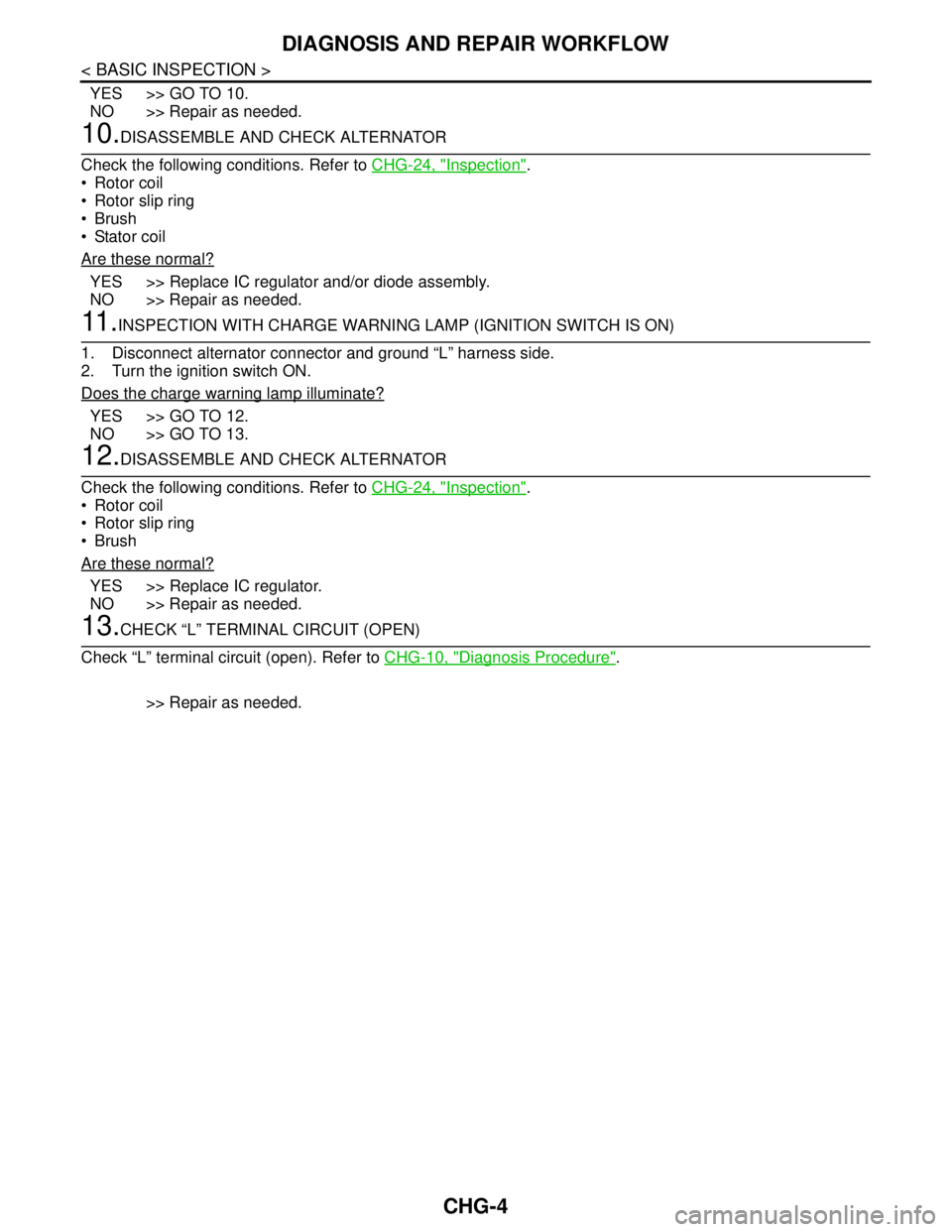
1.PRELIMINARY INSPECTION
Perform the preliminary inspection. Refer to CHG-20, "
Inspection Procedure".
>> GO TO 2.
2.STOP POWER GENERATION VOLTAGE VARIABLE CONTROL SYSTEM
Stop the operation of the power generation voltage variable control in either of the following procedures.
• After selecting “ENGINE” of “SELECT SYSTEM” using CONSULT-III, set the DUTY value of “ALTERNATOR
DUTY” to 0 % by selecting “ALTERNATOR DUTY” of “Active Test”. Continue “Active Test” until the end of
inspection. (When the DUTY value is 0 or 100 %, the normal power generation is performed according to the
characteristic of the IC regulator of the alternator.)
Turn the ignition switch OFF, and disconnect the battery current sensor connector. [However, DTC (P1550 -
P1554) of the engine might remain. After finishing the inspection, connect the battery current sensor connec-
tor and erase the self-diagnostic results history of the engine using CONSULT-III.]
>> GO TO 3.
3.INSPECTION WITH CHARGE WARNING LAMP (IGNITION SWITCH IS ON)
Turn the ignition switch ON.
Does the charge warning lamp illuminate?
YES >> GO TO 4.
NO >> GO TO 11.
4.INSPECTION WITH CHARGE WARNING LAMP (IDLING)
Start the engine and run it at idle.
Does the charge warning lamp turn OFF?
YES >> GO TO 5.
NO >> GO TO 6.
5.INSPECTION WITH CHARGE WARNING LAMP (ENGINE AT 2,500 RPM)
Increase and maintain the engine speed at 2,500 rpm.
Does the charge warning lamp illuminate?
YES >> GO TO 8.
NO >> INSPECTION END
6.“L” TERMINAL CIRCUIT (SHORT) INSPECTION
Check “L” terminal circuit (short). Refer to CHG-12, "
Diagnosis Procedure".
Is the inspection result normal?
YES >> GO TO 7.
NO >> Repair as needed.
7.“S” TERMINAL CIRCUIT INSPECTION
Check “S” terminal circuit. Refer to CHG-13, "
Diagnosis Procedure".
Is the inspection result normal?
YES >> GO TO 8.
NO >> Repair as needed.
8.MEASURE “B” TERMINAL VOLTAGE
Engine start. When keeping engine running at 2,500 rpm, measure “B” terminal voltage.
What voltage does the measurement result show?
Less than 13.0 V>>GO TO 9.
More than 16.0 V>>Replace IC regulator.
9.“B” TERMINAL CIRCUIT INSPECTION
Check “B” terminal circuit. Refer to CHG-9, "
Diagnosis Procedure".
Is the inspection result normal?
Page 1102 of 5121
CHG-4
< BASIC INSPECTION >
DIAGNOSIS AND REPAIR WORKFLOW
YES >> GO TO 10.
NO >> Repair as needed.
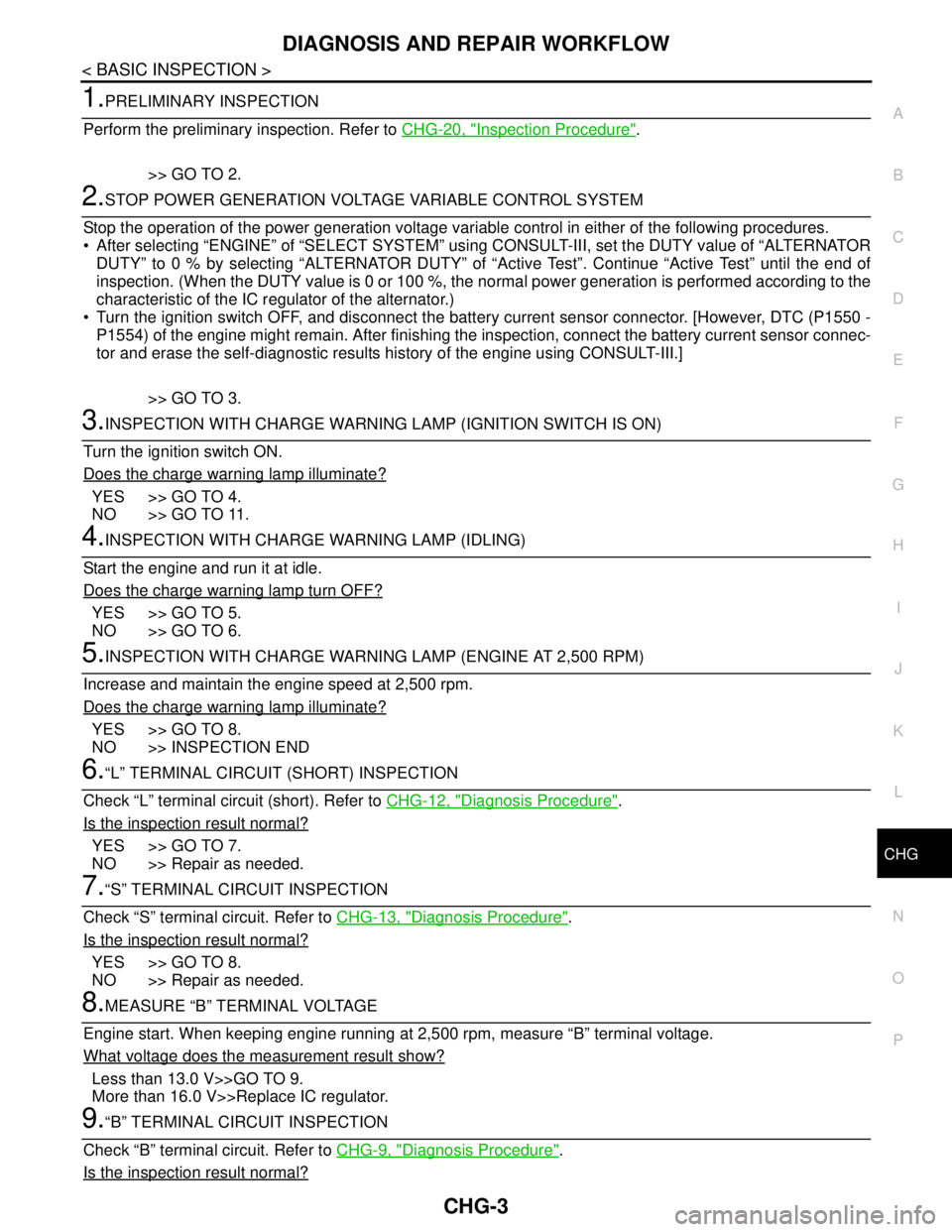
10.DISASSEMBLE AND CHECK ALTERNATOR
Check the following conditions. Refer to CHG-24, "
Inspection".
Rotor coil
Rotor slip ring
Brush
Stator coil
Are these normal?
YES >> Replace IC regulator and/or diode assembly.
NO >> Repair as needed.
11 .INSPECTION WITH CHARGE WARNING LAMP (IGNITION SWITCH IS ON)
1. Disconnect alternator connector and ground “L” harness side.
2. Turn the ignition switch ON.
Does the charge warning lamp illuminate?
YES >> GO TO 12.
NO >> GO TO 13.
12.DISASSEMBLE AND CHECK ALTERNATOR
Check the following conditions. Refer to CHG-24, "
Inspection".
Rotor coil
Rotor slip ring
Brush
Are these normal?
YES >> Replace IC regulator.
NO >> Repair as needed.
13.CHECK “L” TERMINAL CIRCUIT (OPEN)
Check “L” terminal circuit (open). Refer to CHG-10, "
Diagnosis Procedure".
>> Repair as needed.
Page 1107 of 5121
CHG
B TERMINAL CIRCUIT
CHG-9
< COMPONENT DIAGNOSIS >
C
D
E
F
G
H
I
J
K
L B A
O
P N
COMPONENT DIAGNOSIS
B TERMINAL CIRCUIT
DescriptionINFOID:0000000003860521
“B” terminal circuit supplies power to charge the battery and to operate the vehicle’s electrical system.
Diagnosis ProcedureINFOID:0000000003860522
1.CHECK “B” TERMINAL CONNECTION
1. Turn ignition switch OFF.
2. Check if “B” terminal is clean and tight.
Is the inspection result normal?
YES >> GO TO 2.
NO >> Repair “B” terminal connection. Confirm repair by performing complete Starting/Charging system
test. Refer to Technical Service Bulletin.
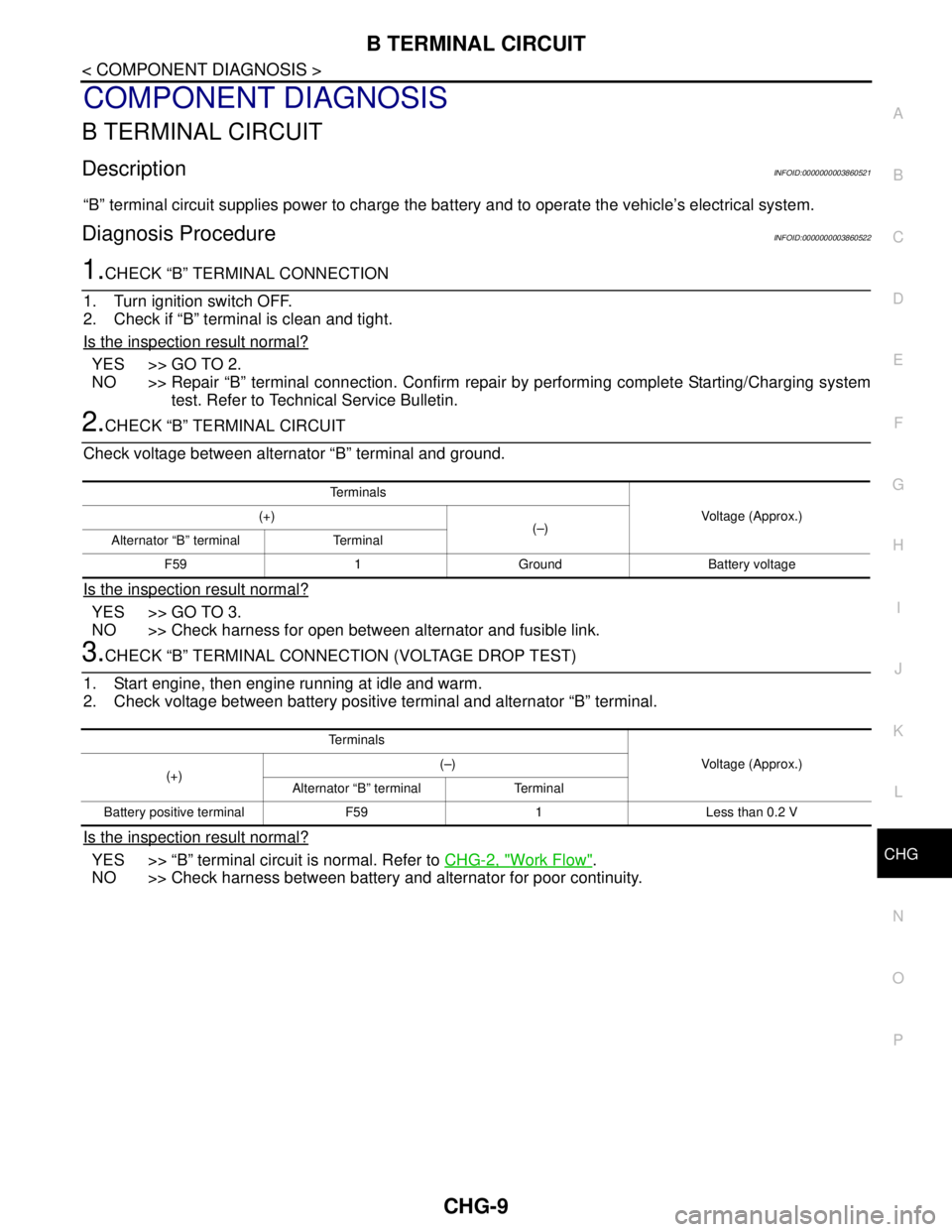
2.CHECK “B” TERMINAL CIRCUIT
Check voltage between alternator “B” terminal and ground.
Is the inspection result normal?
YES >> GO TO 3.
NO >> Check harness for open between alternator and fusible link.
3.CHECK “B” TERMINAL CONNECTION (VOLTAGE DROP TEST)
1. Start engine, then engine running at idle and warm.
2. Check voltage between battery positive terminal and alternator “B” terminal.
Is the inspection result normal?
YES >> “B” terminal circuit is normal. Refer to CHG-2, "Work Flow".
NO >> Check harness between battery and alternator for poor continuity.
Te r m i n a l s
Voltage (Approx.) (+)
(–)
Alternator “B” terminal Terminal
F59 1 Ground Battery voltage
Te r m i n a l s
Voltage (Approx.)
(+)(–)
Alternator “B” terminal Terminal
Battery positive terminal F59 1 Less than 0.2 V
![NISSAN TEANA 2008 Service Manual BRC-144
< SYMPTOM DIAGNOSIS >[VDC/TCS/ABS]
THE BRAKING DISTANCE IS LONG
THE BRAKING DISTANCE IS LONG
Diagnosis ProcedureINFOID:0000000003767025
CAUTION:
The stopping distance on slippery road surfaces](/manual-img/5/57391/w960_57391-1084.png "NISSAN TEANA 2008 Service Manual BRC-144
< SYMPTOM DIAGNOSIS >[VDC/TCS/ABS]
THE BRAKING DISTANCE IS LONG
THE BRAKING DISTANCE IS LONG
Diagnosis ProcedureINFOID:0000000003767025
CAUTION:
The stopping distance on slippery road surfaces")
![NISSAN TEANA 2008 Service Manual ABS FUNCTION DOES NOT OPERATE
BRC-145
< SYMPTOM DIAGNOSIS >[VDC/TCS/ABS]
C
D
E
G
H
I
J
K
L
MA
B
BRC
N
O
P
ABS FUNCTION DOES NOT OPERATE
Diagnosis ProcedureINFOID:0000000003767026
CAUTION:
ABS does not](/manual-img/5/57391/w960_57391-1085.png "NISSAN TEANA 2008 Service Manual ABS FUNCTION DOES NOT OPERATE
BRC-145
< SYMPTOM DIAGNOSIS >[VDC/TCS/ABS]
C
D
E
G
H
I
J
K
L
MA
B
BRC
N
O
P
ABS FUNCTION DOES NOT OPERATE
Diagnosis ProcedureINFOID:0000000003767026
CAUTION:
ABS does not")