2008 MERCEDES-BENZ GLK SUV ECU
[x] Cancel search: ECUPage 179 of 261
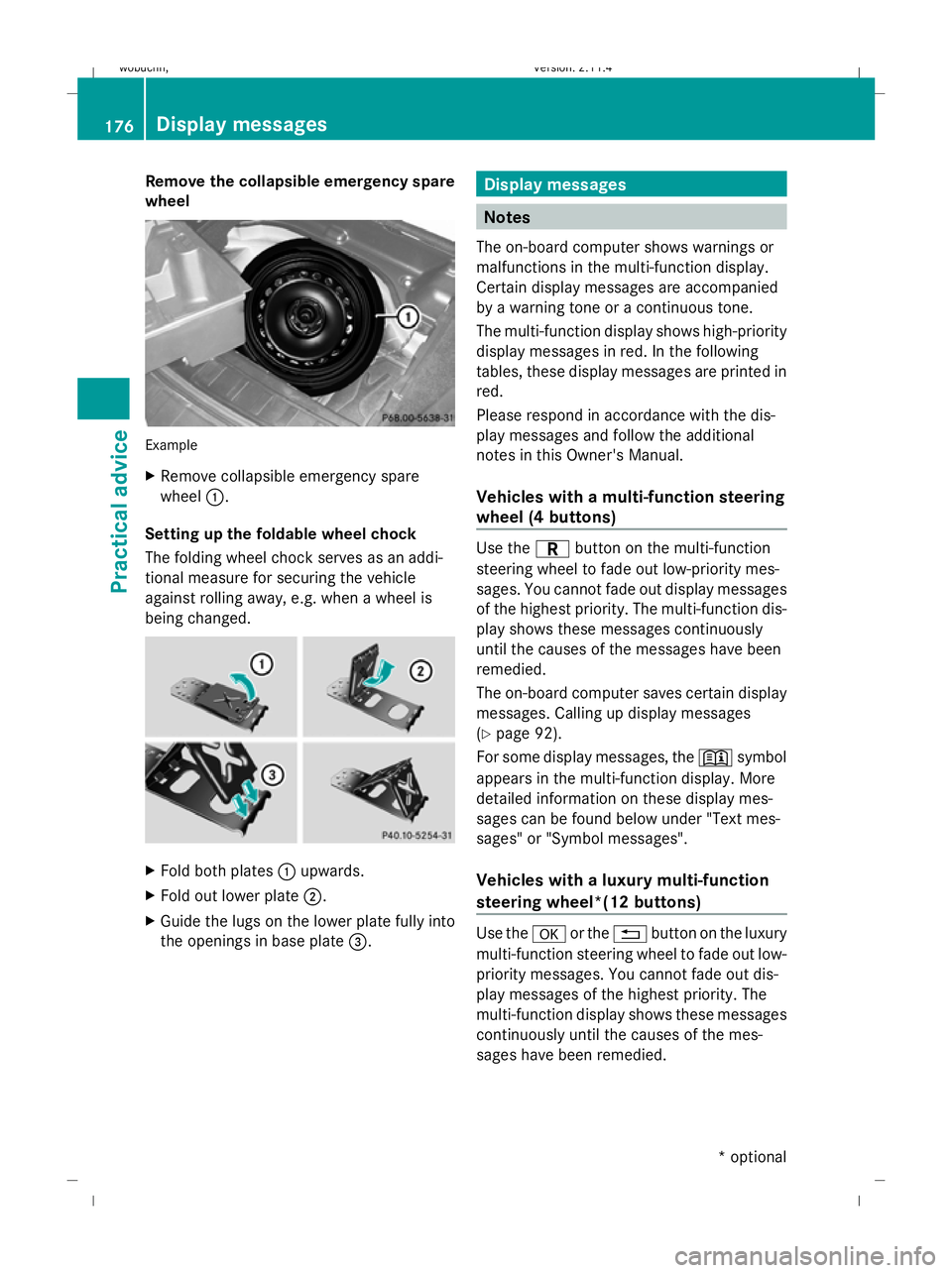
Remove the collapsible emergency spare
wheel Example
X
Remove collapsible emergency spare
wheel :.
Setting up the foldable wheel chock
The folding wheel chock serves as an addi-
tional measure for securing the vehicle
against rolling away, e.g. when a wheel is
being changed. X
Fold both plates :upwards.
X Fold out lower plate ;.
X Guide the lugs on the lower plate fully into
the openings in base plate =. Display messages
Notes
The on-board computer shows warnings or
malfunctions in the multi-function display.
Certain display messages are accompanied
by a warning tone or a continuous tone.
The multi-function display shows high-priority
display messages in red. In the following
tables, these display messages are printed in
red.
Please respond in accordance with the dis-
play messages and follow the additional
notes in this Owner's Manual.
Vehicles with a multi-function steering
wheel (4 buttons) Use the
Cbutton on the multi-function
steering wheel to fade out low-priority mes-
sages. You cannot fade out display messages
of the highest priority. The multi-function dis-
play shows these messages continuously
until the causes of the messages have been
remedied.
The on-board computer saves certain display
messages. Calling up display messages
(Y page 92).
For some display messages, the +symbol
appears in the multi-function display. More
detailed information on these display mes-
sages can be found below under "Text mes-
sages" or "Symbol messages".
Vehicles with a luxury multi-function
steering wheel*(12 buttons) Use the
aor the %button on the luxury
multi-function steering wheel to fade out low-
priority messages. You cannot fade out dis-
play messages of the highest priority. The
multi-function display shows these messages
continuously until the causes of the mes-
sages have been remedied. 176 Display messagesPractical advice
* optional
X204_AKB; 1; 5, en-GB
wobuchh,
Version: 2.11.4 2008-10-15T13:20:56+02:00 - Seite 176Dateiname: 6515_0671_02_buchblock.pdf; preflight
Page 230 of 261
To reduce the tyre pressure:
press yellow
pressure release button Enext to pres-
sure gauge F.
X Drive to the nearest workshop and have the
tyre changed there.
X Have the TIREFIT kit replaced as soon as
possible at a qualified specialist workshop,
e.g. at a Mercedes-Benz Service Centre. G
Risk of accident
Do not exceed the maximum speed of
80 km/h.
The "max. 80 km/h" label must be affixed in
the driver's field of vision.
The vehicle's handling characteristics may be
affected. H
Environmental note
Have the used TIREFIT kit disposed of profes-
sionally, e.g. at a Mercedes-Benz Service
Centre.
X Have the TIREFIT kit replaced every four
years at a qualified specialist workshop,
e.g. a Mercedes-Benz Service Centre. Changing a wheel/fitting the emer-
gency spare wheel* G
Risk of accident
The wheel dimensions and tyre size of the
emergency spare wheel* may differ from
those of the standard wheels.
The handling characteristics of your vehicle
will change if you fit an emergency spare
wheel*. Adapt your style of driving accord-
ingly.
You may only use the emergency spare
wheel* for a short while. Do not exceed the
maximum speed of 80 km/h and do not deac-
tivate ESP ®
.
Never drive the vehicle with more than one
emergency spare wheel* fitted. G
Risk of accident
Have the emergency spare wheel* replaced
as soon as possible at a qualified specialist
workshop which has the necessary specialist
knowledge and tools to carry out the work
required. Mercedes-Benz recommends that
you use a Mercedes-Benz Service Centre for
this purpose. In particular, work relevant to
safety or on safety-related systems must be
carried out at a qualified specialist workshop.
Preparing the vehicle X
Prepare the vehicle as described
(Y page 222).
X If a trailer is coupled, uncouple it.
X Place the wheels in the straight-ahead posi-
tion.
X Take the following from the stowage well
beneath the luggage compartment floor:
R
the collapsible emergency spare wheel*
R the wheel bolts of the collapsible emer-
gency spare wheel*
R the vehicle tool kit
R the jack
X Secure the vehicle to prevent it from rolling
away.
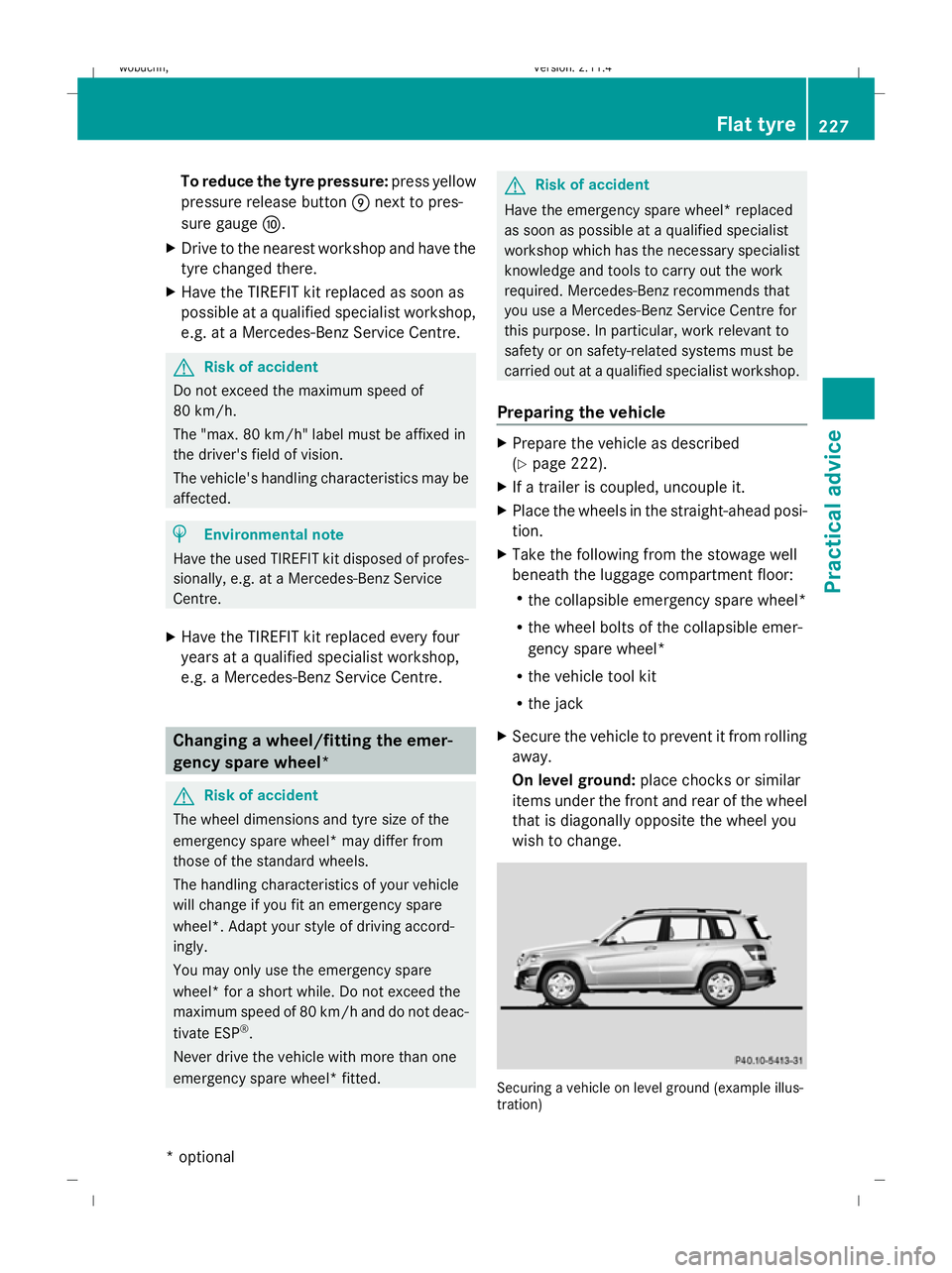
On level ground: place chocks or similar
items under the front and rear of the wheel
that is diagonally opposite the wheel you
wish to change. Securing a vehicle on level ground (example illus-
tration) Flat tyre
227Practical advice
* optional
X204_AKB; 1; 5, en-GB
wobuchh
,V ersion: 2.11.4
2008-10-15T13:20:56+02:00 - Seite 227 ZDateiname: 6515_0671_02_buchblock.pdf; preflight
Page 231 of 261
X
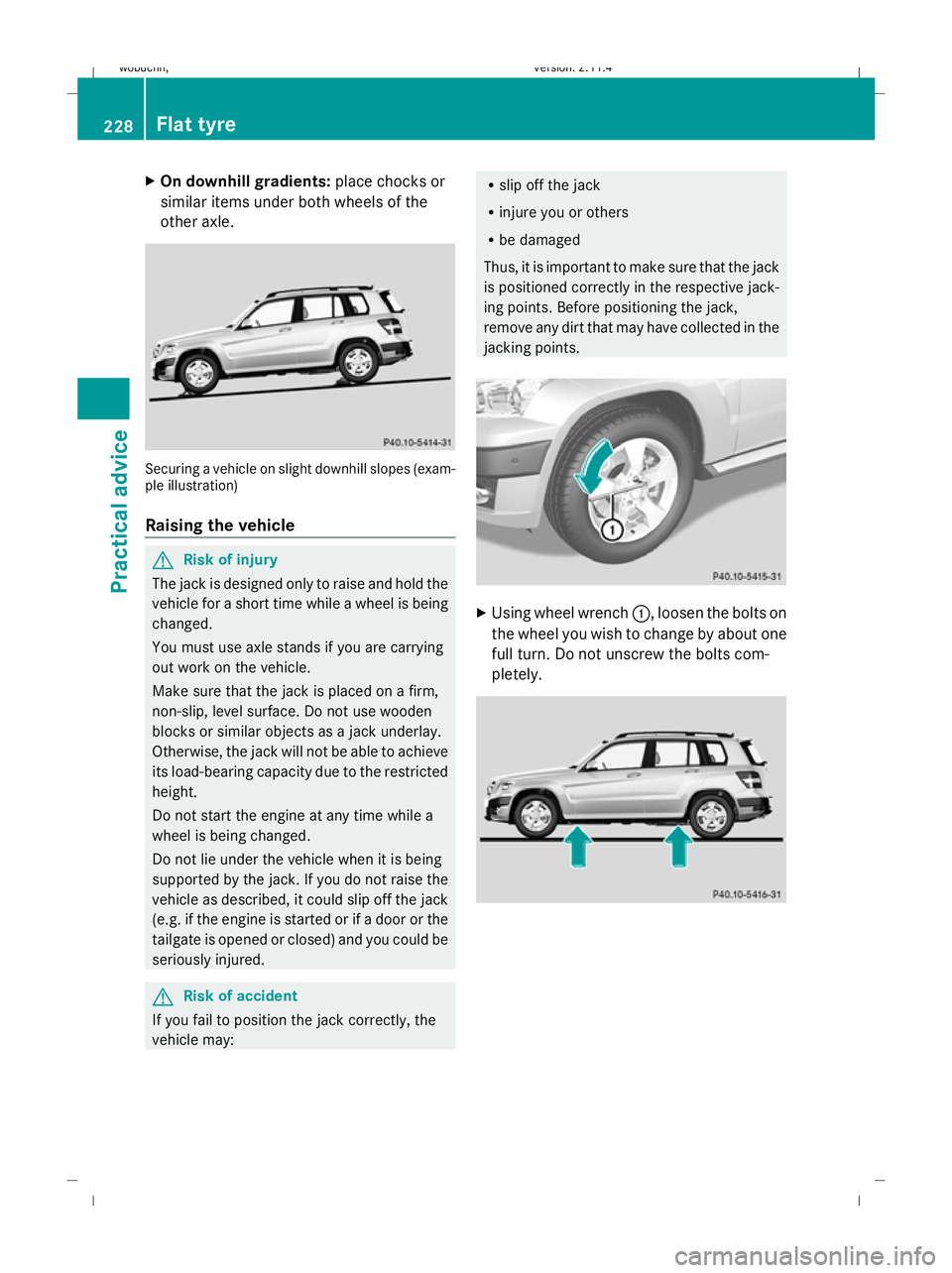
On downhill gradients: place chocks or
similar items under both wheels of the
other axle. Securing a vehicle on slight downhill slopes (exam-
ple illustration)
Raising the vehicle G
Risk of injury
The jack is designed only to raise and hold the
vehicle for a short time while a wheel is being
changed.
You must use axle stands if you are carrying
out work on the vehicle.
Make sure that the jack is placed on a firm,
non-slip, level surface. Do not use wooden
blocks or similar objects as a jack underlay.
Otherwise, the jack will not be able to achieve
its load-bearing capacity due to the restricted
height.
Do not start the engine at any time while a
wheel is being changed.
Do not lie under the vehicle when it is being
supported by the jack. If you do not raise the
vehicle as described, it could slip off the jack
(e.g. if the engine is started or if a door or the
tailgate is opened or closed) and you could be
seriously injured. G
Risk of accident
If you fail to position the jack correctly, the
vehicle may: R
slip off the jack
R injure you or others
R be damaged
Thus, it is important to make sure that the jack
is positioned correctly in the respective jack-
ing points. Before positioning the jack,
remove any dirt that may have collected in the
jacking points. X
Using wheel wrench 1, loosen the bolts on
the wheel you wish to change by about one
full turn. Do not unscrew the bolts com-
pletely. 228 Flat tyrePractical advice
X204_AKB; 1; 5, en-GB
wobuchh,
Version: 2.11.4 2008-10-15T13:20:56+02:00 - Seite 228Dateiname: 6515_0671_02_buchblock.pdf; preflight
Page 237 of 261
Charging and fitting the battery
G
Risk of injury
Only charge the battery in a well-ventilated
area. As the battery is being charged, gases
can escape and generate minor explosions.
This may injure you and other persons or
cause damage to the paintwork or acid cor-
rosion on the vehicle.
You can obtain information about battery
chargers which allow the battery to be
charged when still installed from a qualified
specialist workshop, e.g. a Mercedes-Benz
Service Centre. G
Risk of injury
There is a risk of acid burns during the charg-
ing process due to the gases which escape
from the battery. Do not lean over the battery
during the charging process. G
Risk of injury
Battery acid is caustic. Avoid contact with the
skin, eyes or clothing.
! Only charge the installed battery with a
battery charger which has been tested and
approved by Mercedes-Benz. These battery
chargers allow the battery to be charged
while it is still installed. However, the bat-
tery must always be disconnected first.
! Only use battery chargers with a maxi-
mum charging voltage of 14.8 V.
X Charge the battery. Observe the notes in
the operating instructions for your battery
charger.
X Refit the charged battery.
To do this, follow the steps described in
"Removing the battery" (Y page 233) in
reverse order. Reconnecting the battery
! Always reconnect the battery in the
sequence described below. Never swap the
terminal clamps. You may otherwise dam-
age the vehicle electronics.
X Switch off all electrical consumers (e.g.
radio, blower, etc.).
X Connect the positive terminal clamp and
secure the cover.
X Connect the negative terminal clamp.
X Connect the breather hose. Make sure that
a cell cap is fitted on the side of the battery.
X Close the bonnet.
i If the battery power supply has been inter-
rupted (e.g. if it has been reconnected), you
must carry out the following tasks:
R set the time (Y page 102).
R reset the panorama sliding sun-
roof* (Y page 127)
R reset the function for folding the exterior
mirrors in/out automatically* by folding
the mirrors out once (Y page 68). Jump-starting
If your vehicle's battery is discharged, the
engine can be jump-started from another
vehicle or from an external battery using jump
leads.
Observe the following points:
R jump-starting may only be performed when
the engine and catalytic converter are cold.
R do not start the engine if the battery is fro-
zen. Let the battery thaw first.
R jump-starting may only be performed from
batteries with a nominal voltage of 12 V.
R only use jump leads which have a sufficient
cross-section and insulated terminal
clamps. 234 Jump-startingPractical advice
* optional
X204_AKB; 1; 5, en-GB
wobuchh,
Version: 2.11.4 2008-10-15T13:20:56+02:00 - Seite 234Dateiname: 6515_0671_02_buchblock.pdf; preflight
Page 240 of 261
When towing, observe the legal requirements
in all countries concerned.
!
When towing, pull away slowly and with-
out jerking. If the tractive power is too high,
the vehicles could be damaged.
! Do not use the towing eye for recovery,
as this could damage the vehicle. If in
doubt, recover the vehicle with a crane.
! You may tow the vehicle for a maximum
of 50 km. A towing speed of 50 km/hm ust
not be exceeded.
For towing distances over 50 km, the entire
vehicle needs to be lifted up and transpor-
ted.
! Only secure the tow cable or towing bar
to the towing eyes. You may otherwise
damage the vehicle.
R Tow-starting the vehicle is not permitted.
R The vehicle is equipped with 4MATIC and
must not be towed with the front or rear
axle raised.
R If the engine does not start, try jump-start-
ing it (Y page 234).
R If it is not possible to jump-start the vehicle,
have it towed to the nearest qualified spe-
cialist workshop, e.g. a Mercedes-Benz
Service Centre.
R If the vehicle has suffered transmission
damage, have it carried away on a trans-
porter or trailer.
R The automatic transmission selector lever
must be in the Nposition when towing the
vehicle away.
R If you are towing the vehicle, move the
automatic transmission selector lever to
N and turn the key to position
2 (Y page 61) in the ignition lock.
R Before towing the vehicle, make sure that
the battery is connected and charged. Oth-
erwise: -
you cannot switch on the ignition.
- you cannot move the selector lever to
N.
- you have no support when braking.
i Switch off the automatic locking feature
before the vehicle is towed. Otherwise, you
could be locked out when pushing or tow-
ing the vehicle.
Deactivate tow-away protection* before
the vehicle is towed ( Ypage 55). Fitting the towing eye
Vehicles with a trailer tow hitch: if you
intend to use the vehicle for towing, fit the ball
coupling (Y page 162)and connect the towbar
to it.
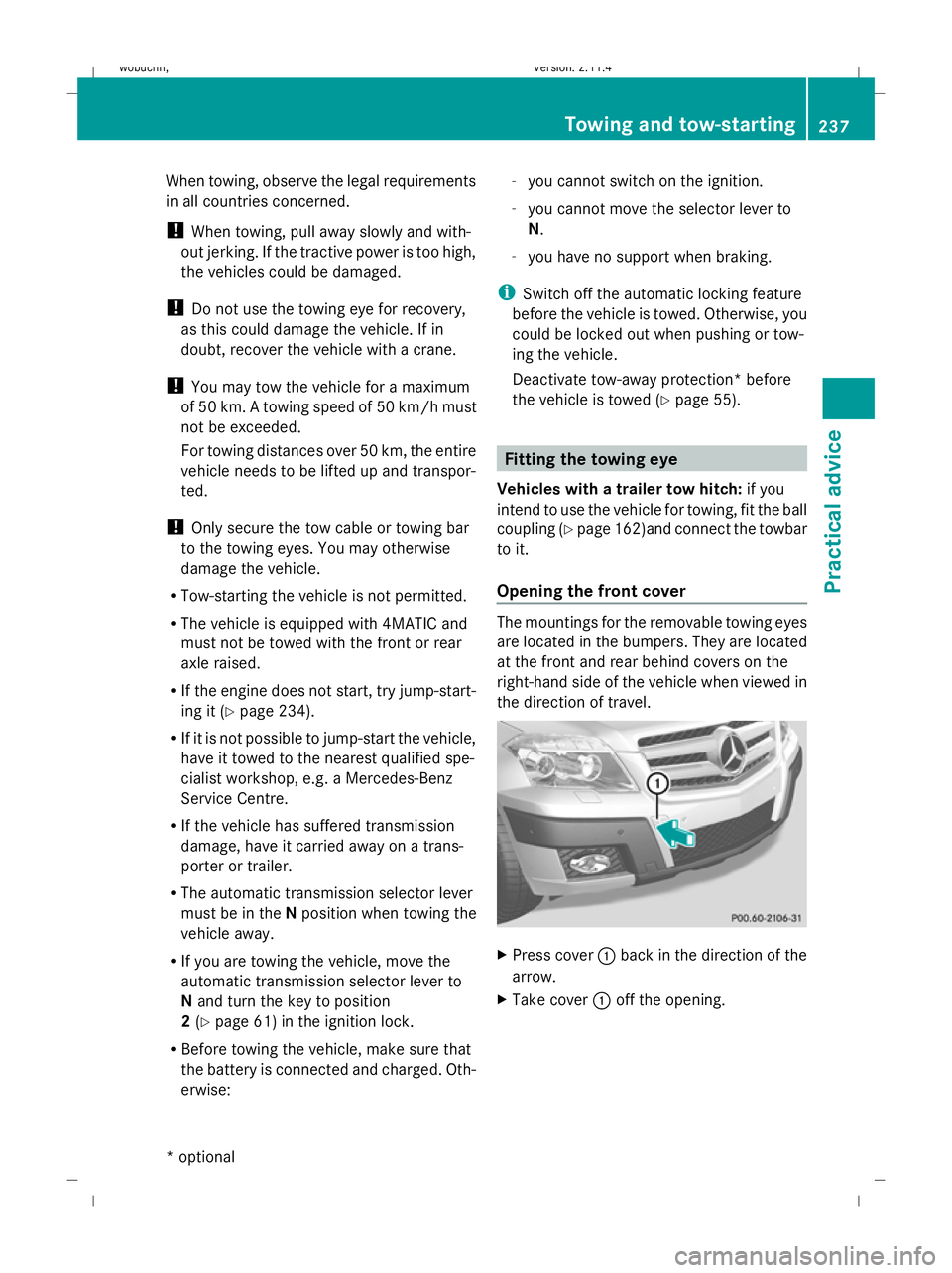
Opening the front cover The mountings for the removable towing eyes
are located in the bumpers. They are located
at the front and rear behind covers on the
right-hand side of the vehicle when viewed in
the direction of travel. X
Press cover :back in the direction of the
arrow.
X Take cover :off the opening. Towing and tow-starting
237Practical advice
* optional
X204_AKB; 1; 5, en-GB
wobuchh,
Version: 2.11.4 2008-10-15T13:20:56+02:00 - Seite 237 ZDateiname: 6515_0671_02_buchblock.pdf; preflight
Page 241 of 261
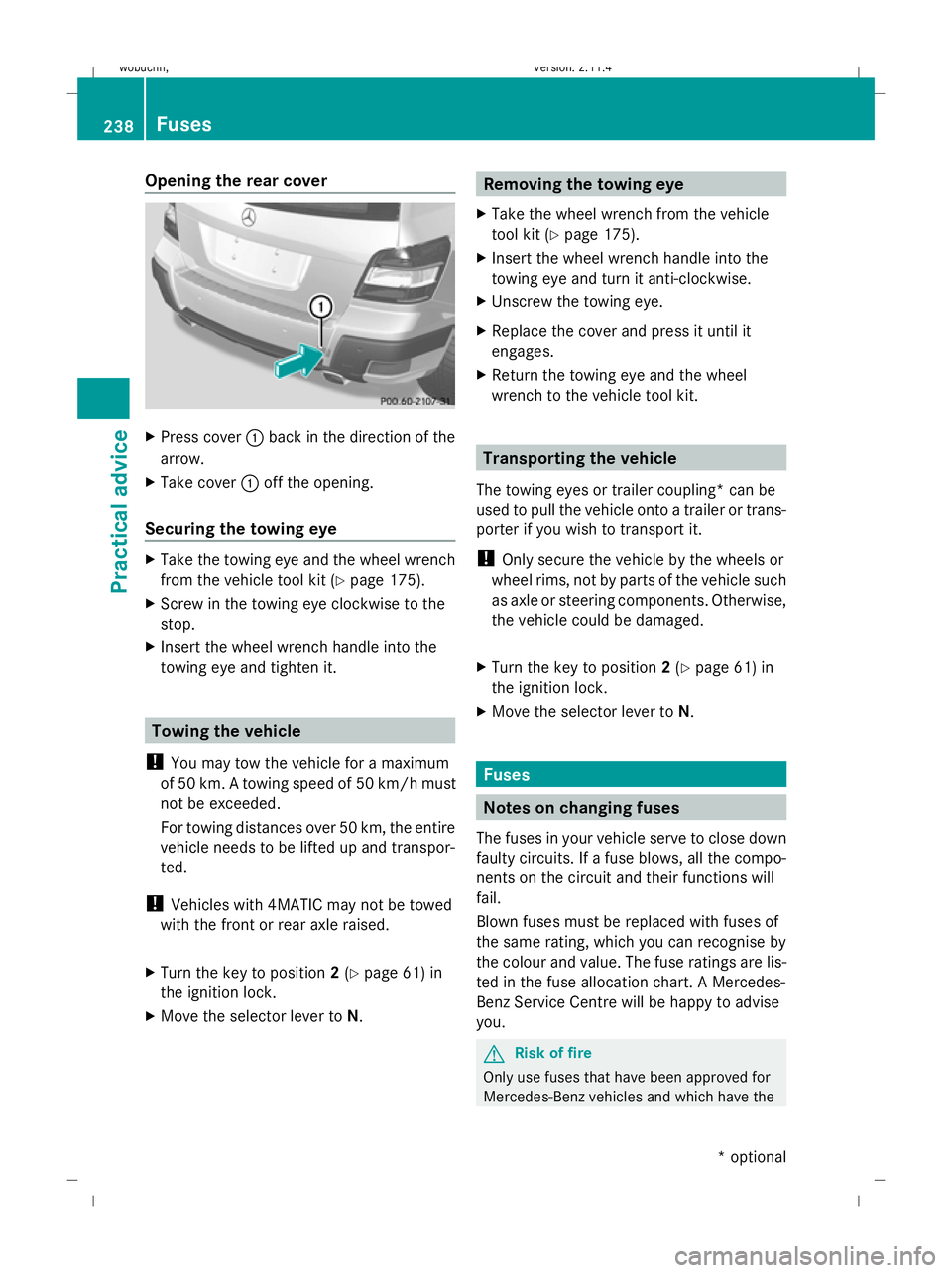
Opening the rear cover
X
Press cover :back in the direction of the
arrow.
X Take cover :off the opening.
Securing the towing eye X
Take the towing eye and the wheel wrench
from the vehicle tool kit (Y page 175).
X Screw in the towing eye clockwise to the
stop.
X Insert the wheel wrench handle into the
towing eye and tighten it. Towing the vehicle
! You may tow the vehicle for a maximum
of 50 km. A towing speed of 50 km/hm ust
not be exceeded.
For towing distances over 50 km, the entire
vehicle needs to be lifted up and transpor-
ted.
! Vehicles with 4MATIC may not be towed
with the front or rear axle raised.
X Turn the key to position 2(Y page 61) in
the ignition lock.
X Move the selector lever to N. Removing the towing eye
X Take the wheel wrench from the vehicle
tool kit (Y page 175).
X Insert the wheel wrench handle into the
towing eye and turn it anti-clockwise.
X Unscrew the towing eye.
X Replace the cover and press it until it
engages.
X Return the towing eye and the wheel
wrench to the vehicle tool kit. Transporting the vehicle
The towing eyes or trailer coupling* can be
used to pull the vehicle onto a trailer or trans-
porter if you wish to transport it.
! Only secure the vehicle by the wheels or
wheel rims, not by parts of the vehicle such
as axle or steering components. Otherwise,
the vehicle could be damaged.
X Turn the key to position 2(Y page 61) in
the ignition lock.
X Move the selector lever to N. Fuses
Notes on changing fuses
The fuses in your vehicle serve to close down
faulty circuits. If a fuse blows, all the compo-
nents on the circuit and their functions will
fail.
Blown fuses must be replaced with fuses of
the same rating, which you can recognise by
the colour and value. The fuse ratings are lis-
ted in the fuse allocation chart. A Mercedes-
Benz Service Centre will be happy to advise
you. G
Risk of fire
Only use fuses that have been approved for
Mercedes-Benz vehicles and which have the 238 FusesPractical advice
* optional
X204_AKB; 1; 5, en-GB
wobuchh,
Version: 2.11.4 2008-10-15T13:20:56+02:00 - Seite 238Dateiname: 6515_0671_02_buchblock.pdf; preflight
Page 243 of 261
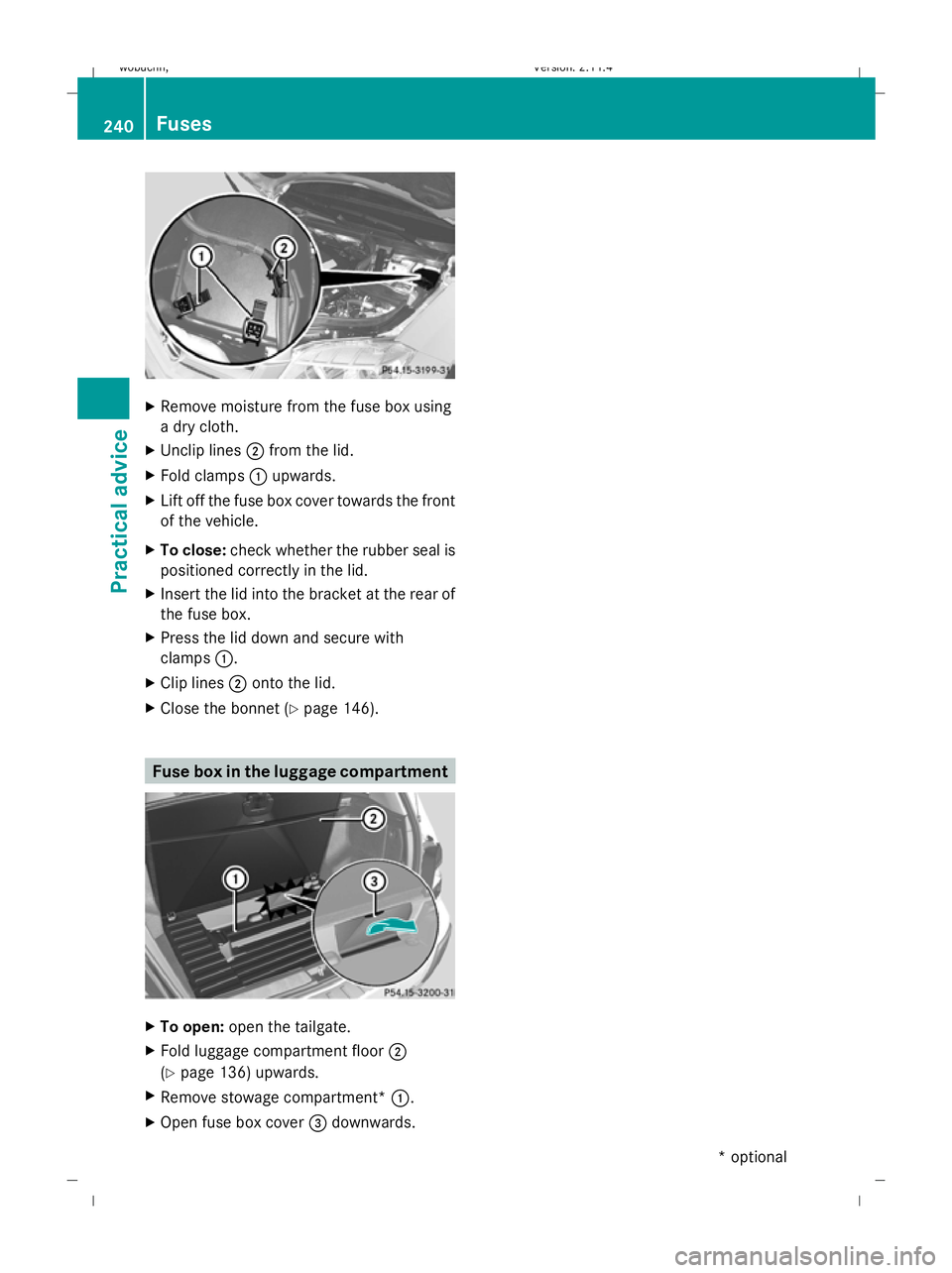
X
Remove moisture from the fuse box using
a dry cloth.
X Unclip lines ;from the lid.
X Fold clamps :upwards.
X Lift off the fuse box cover towards the front
of the vehicle.
X To close: check whether the rubber seal is
positioned correctly in the lid.
X Insert the lid into the bracket at the rear of
the fuse box.
X Press the lid down and secure with
clamps :.
X Clip lines ;onto the lid.
X Close the bonnet (Y page 146). Fuse box in the luggage compartment
X
To open: open the tailgate.
X Fold luggage compartment floor ;
(Y page 136) upwards.
X Remove stowage compartment* :.
X Open fuse box cover =downwards. 240 FusesPractical advice
* optional
X204_AKB; 1; 5, en-GB
wobuchh,
Version: 2.11.4 2008-10-15T13:20:56+02:00 - Seite 240Dateiname: 6515_0671_02_buchblock.pdf; preflight