Page 341 of 413
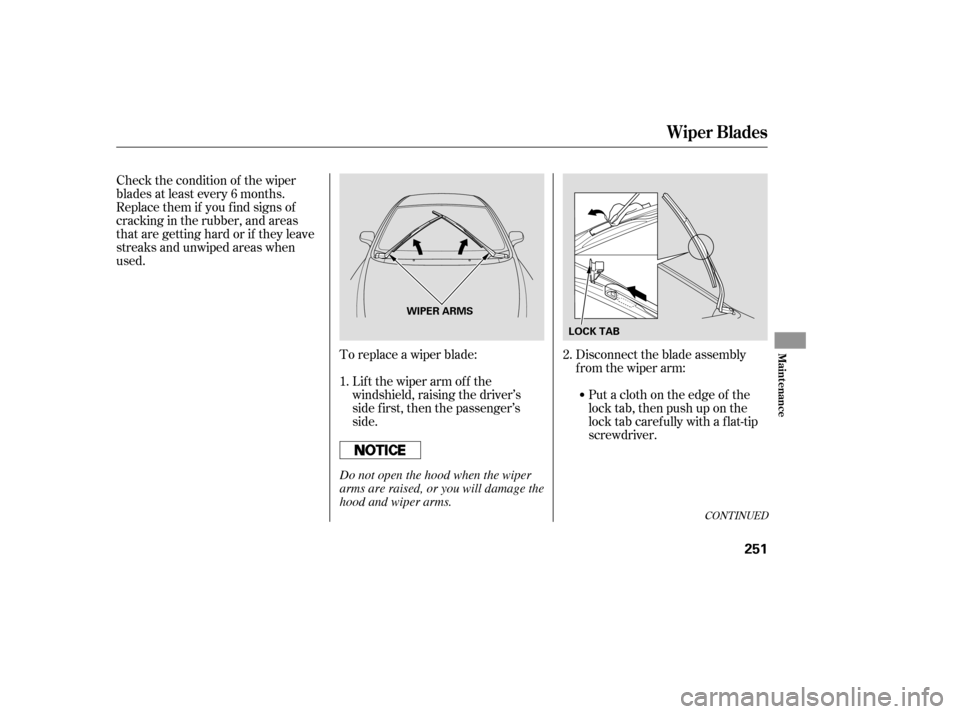
Check the condition of the wiper
blades at least every 6 months.
Replace them if you f ind signs of
cracking in the rubber, and areas
that are getting hard or if they leave
streaks and unwiped areas when
used.To replace a wiper blade:Lift the wiper arm off the
windshield, raising the driver’s
side first, then the passenger’s
side. Disconnect the blade assembly
from the wiper arm:
Put a cloth on the edge of the
lock tab, then push up on the
lock tab carefully with a flat-tip
screwdriver.
2.
1.
CONT INUED
Wiper Blades
Maint enance
251
WIPER ARMS LOCK TAB
Do not open the hood when the wiper
arms are raised, or you will damage the
hood and wiper arms.
�����—�����—�����y���
��
��������y���
�(�#���������y���������y
Page 343 of 413
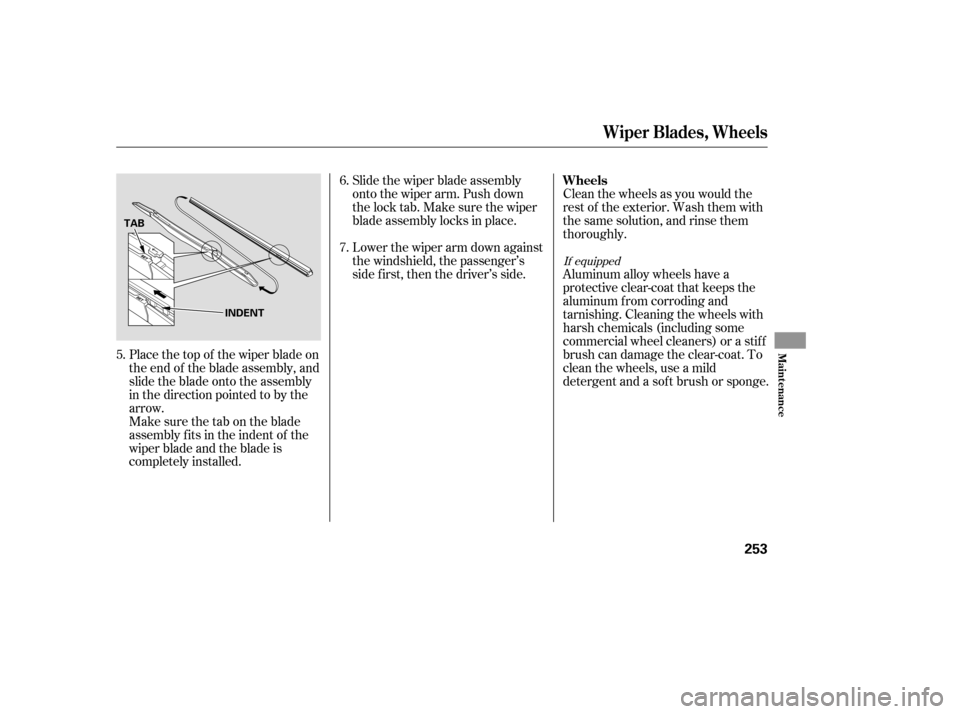
Place the top of the wiper blade on
the end of the blade assembly, and
slide the blade onto the assembly
in the direction pointed to by the
arrow.Slide the wiper blade assembly
onto the wiper arm. Push down
thelocktab.Makesurethewiper
blade assembly locks in place.
Lower the wiper arm down against
the windshield, the passenger’s
side first, then the driver’s side.
Make sure the tab on the blade
assembly fits in the indent of the
wiper blade and the blade is
completely installed. Clean the wheels as you would the
rest of the exterior. Wash them with
thesamesolution,andrinsethem
thoroughly.
Aluminum alloy wheels have a
protective clear-coat that keeps the
aluminum f rom corroding and
tarnishing. Cleaning the wheels with
harsh chemicals (including some
commercial wheel cleaners) or a stif f
brush can damage the clear-coat. To
clean the wheels, use a mild
detergent and a sof t brush or sponge.
5. 6. 7.
If equipped
Wiper Blades, Wheels
Wheels
Maint enance
253
INDENT
TAB
�����—�����—�����y���
��
����
���y���
�(�#���������y���������y
Page 344 of 413
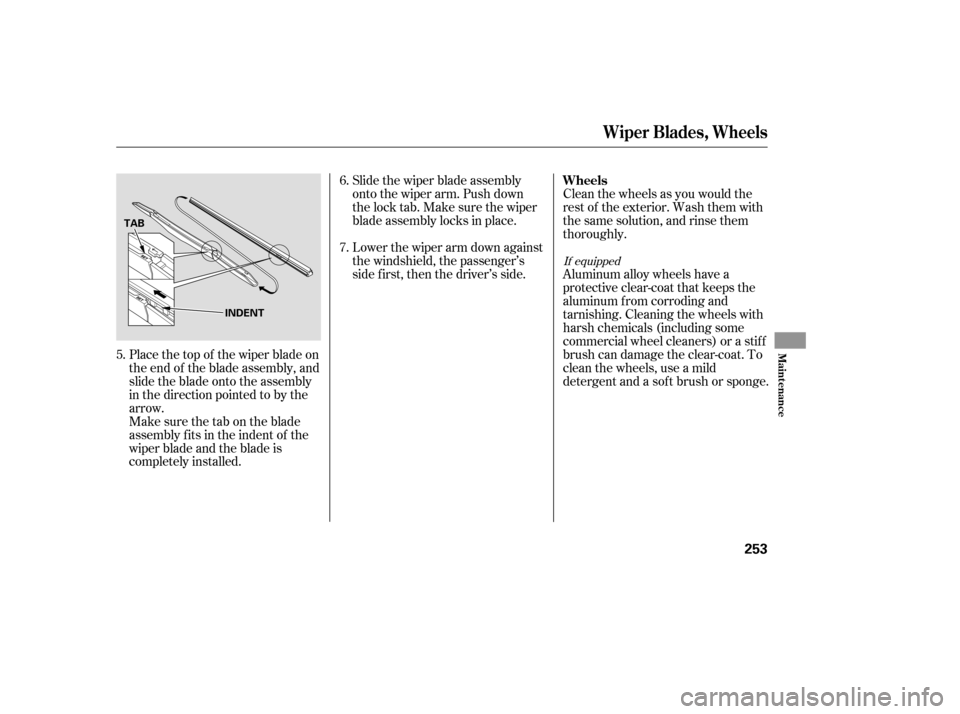
Place the top of the wiper blade on
the end of the blade assembly, and
slide the blade onto the assembly
in the direction pointed to by the
arrow.Slide the wiper blade assembly
onto the wiper arm. Push down
thelocktab.Makesurethewiper
blade assembly locks in place.
Lower the wiper arm down against
the windshield, the passenger’s
side first, then the driver’s side.
Make sure the tab on the blade
assembly fits in the indent of the
wiper blade and the blade is
completely installed. Clean the wheels as you would the
rest of the exterior. Wash them with
thesamesolution,andrinsethem
thoroughly.
Aluminum alloy wheels have a
protective clear-coat that keeps the
aluminum f rom corroding and
tarnishing. Cleaning the wheels with
harsh chemicals (including some
commercial wheel cleaners) or a stif f
brush can damage the clear-coat. To
clean the wheels, use a mild
detergent and a sof t brush or sponge.
5. 6. 7.
If equipped
Wiper Blades, Wheels
Wheels
Maint enance
253
INDENT
TAB
�����—�����—�����y���
��
����
���y���
�(�#���������y���������y
Page 356 of 413

Fill the f uel tank.Block the rear wheels.
If the vehicle is to be stored f or a
longer period, it should be
supported on jackstands so the
tires are of f the ground.
If you need to park your vehicle f or
an extended period (more than 1
month), there are several things you
should do to prepare it f or storage.
Proper preparation helps prevent
deterioration and makes it easier to
get your vehicle back on the road. If
possible, store your vehicle indoors. Leave one window open slightly (if
the vehicle is being stored
indoors).Cover the vehicle with a
‘‘breathable’’ cover, one made
f rom a porous material such as
cotton. Non-porous materials, such
as plastic sheeting, trap moisture,
which can damage the paint.
To minimize sticking, apply a
silicone spray lubricant to all door
and trunk seals. Also, apply a
vehiclebodywaxtothepainted
surfaces that mate with the door
and trunk seals.
Support the f ront wiper blade
arms with a f olded towel or rag so
they do not touch the windshield.
Disconnect the battery. If possible, periodically run the
engine until it reaches f ull
operating temperature (the
cooling f an cycles twice).
Pref erably, do this once a month.
Wash and dry the exterior
completely.
Cleantheinterior.Makesurethe
carpeting, floor mats, etc., are
completely dry.
Leave the parking brake off. Put
the transmission in reverse
(manual) or Park (automatic).
Vehicle Storage
Maint enance
263
�����—�����—�����y���
��
��������y���
�(�#���������y���������y
Page 359 of 413
Turn on the hazard warning lights,
and turn the ignition switch to the
LOCK (0) position. Have all
passengers get out of the vehicle
while you change the tire.
Park the vehicle on f irm, level, and
non-slippery ground. Put the
transmission in Park (automatic)
or reverse (manual). Apply the
parking brake.
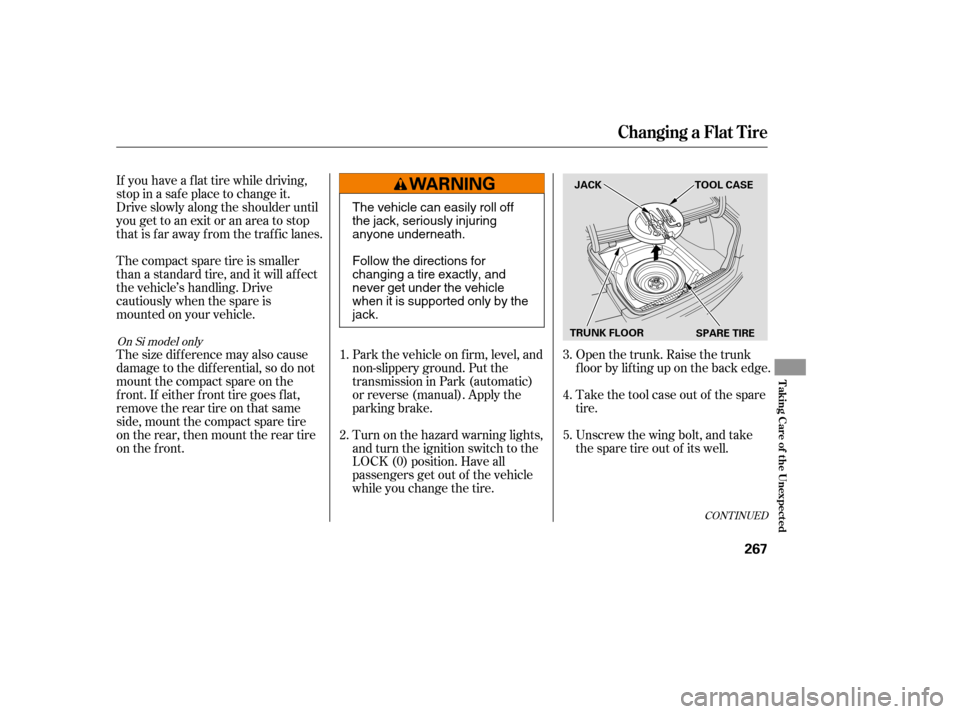
Open the trunk. Raise the trunk
f loor by lif ting up on the back edge.
Take the tool case out of the spare
tire.
Unscrew the wing bolt, and take
the spare tire out of its well.
If you have a f lat tire while driving,
stop in a saf e place to change it.
Drive slowly along the shoulder until
you get to an exit or an area to stop
that is far away from the traffic lanes.
Thecompactsparetireissmaller
than a standard tire, and it will affect
the vehicle’s handling. Drive
cautiously when the spare is
mounted on your vehicle.
Thesizedifferencemayalsocause
damage to the dif f erential, so do not
mount the compact spare on the
f ront. If either f ront tire goes f lat,
removethereartireonthatsame
side, mount the compact spare tire
on the rear, then mount the rear tire
on the f ront.
5.
4.
3.
2.
1.
CONT INUED
On Si model only
Changing a Flat T ire
T aking Care of t he Unexpect ed
267
SPARE TIRE
TRUNK FLOOR JACK TOOL CASE
The vehicle can easily roll off
the jack, seriously injuring
anyone underneath.
Follow the directions for
changing a tire exactly, and
never get under the vehicle
when it is supported only by thejack.
�����—�����—�����y���
��
����
���y���
�(�#���������y���������y
Page 360 of 413
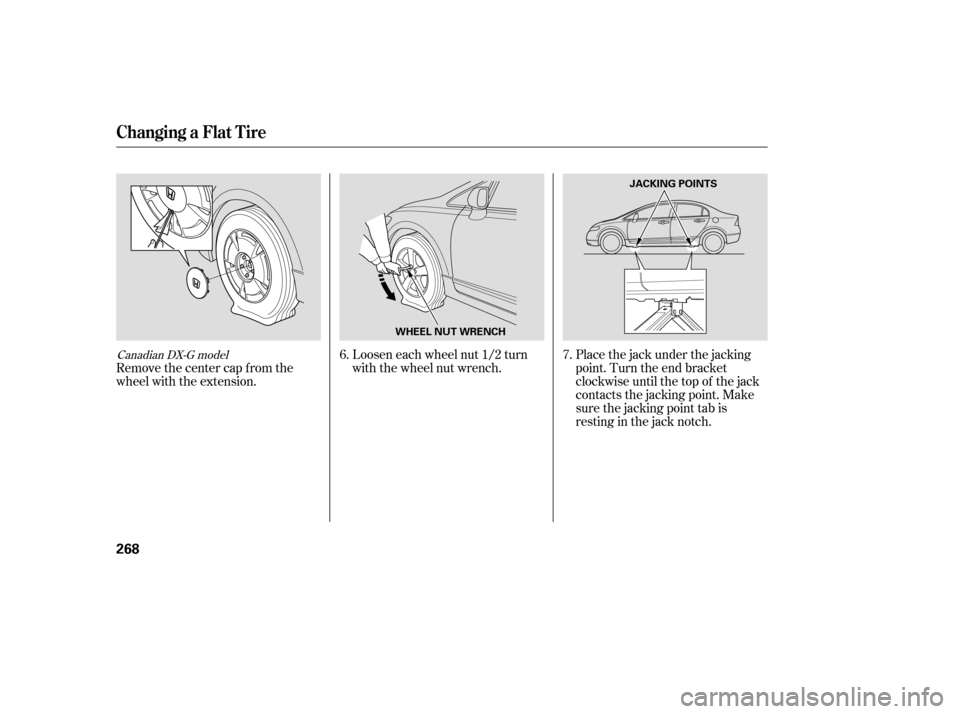
Placethejackunderthejacking
point. Turn the end bracket
clockwise until the top of the jack
contacts the jacking point. Make
sure the jacking point tab is
restinginthejacknotch.
Loosen each wheel nut 1/2 turn
with the wheel nut wrench.
Remove the center cap from the
wheel with the extension. 6.
7.Canadian DX-G model
Changing a Flat T ire
268
JACKING POINTS
WHEEL NUT WRENCH
�����—�����—�����y���
��
��������y���
�(�#���������y���������y
Page 363 of 413

When you turn the ignition switch to
the START (III) position, you do not
hear the normal noise of the engine
trying to start. You may hear a
clicking sound, a series of clicks, or
nothing at all.
Check these things:Check the transmission interlock.
If you have a manual transmission,
the clutch pedal must be pushed
all the way to the f loor or the
starter will not operate. With an
automatic transmission, it must be
in Park or neutral.
Turn the ignition switch to the ON
(II) position. Turn on the
headlights, and check their
brightness. If the headlights are
very dim or do not come on at all,
the battery is discharged. See on page .
Store the jack and tools in the tool
case. Place the tool case in the
center of the f lat tire.
Store the wheel cover or center
cap in the trunk. Make sure it does
not get scratched or damaged.
Lower the trunk f loor, and close
the trunk lid.
Your vehicle’s original tire has a
tire pressure monitoring system
sensor. To replace a tire, ref er to
(see
page ). Diagnosing why the engine won’t
start f alls into two areas, depending
on what you hear when you turn the
ignition switch to the START (III)
position:
You hear nothing, or almost
nothing. The engine’s starter
motor does not operate at all, or
operates very slowly.
You can hear the starter motor
operating normally, or the starter
motor sounds like it is spinning
f aster than normal, but the engine
does not start up and run.
18. 19. 20. 21.
214 273
On U.S. models
CONT INUED
Changing a Flat T ire, If the Engine Won’t Start
Nothing Happens or the Starter
Motor Operates Very Slowly
Jump Starting
Changing a T ire with T PMS If the Engine Won’t Start
T aking Care of t he Unexpect ed
271
Loose items can fly around the
interior in a crash and could
seriously injure the occupants.
Store the wheel, jack, and tools
securely before driving.
�����—�����—�����y���
��
��������y���
�(�#���������y���������y
Page 364 of 413

When you turn the ignition switch to
the START (III) position, you do not
hear the normal noise of the engine
trying to start. You may hear a
clicking sound, a series of clicks, or
nothing at all.
Check these things:Check the transmission interlock.
If you have a manual transmission,
the clutch pedal must be pushed
all the way to the f loor or the
starter will not operate. With an
automatic transmission, it must be
in Park or neutral.
Turn the ignition switch to the ON
(II) position. Turn on the
headlights, and check their
brightness. If the headlights are
very dim or do not come on at all,
the battery is discharged. See on page .
Store the jack and tools in the tool
case. Place the tool case in the
center of the f lat tire.
Store the wheel cover or center
cap in the trunk. Make sure it does
not get scratched or damaged.
Lower the trunk f loor, and close
the trunk lid.
Your vehicle’s original tire has a
tire pressure monitoring system
sensor. To replace a tire, ref er to
(see
page ). Diagnosing why the engine won’t
start f alls into two areas, depending
on what you hear when you turn the
ignition switch to the START (III)
position:
You hear nothing, or almost
nothing. The engine’s starter
motor does not operate at all, or
operates very slowly.
You can hear the starter motor
operating normally, or the starter
motor sounds like it is spinning
f aster than normal, but the engine
does not start up and run.
18. 19. 20. 21.
214 273
On U.S. models
CONT INUED
Changing a Flat T ire, If the Engine Won’t Start
Nothing Happens or the Starter
Motor Operates Very Slowly
Jump Starting
Changing a T ire with T PMS If the Engine Won’t Start
T aking Care of t he Unexpect ed
271
Loose items can fly around the
interior in a crash and could
seriously injure the occupants.
Store the wheel, jack, and tools
securely before driving.
�����—�����—�����y���
��
��������y���
�(�#���������y���������y