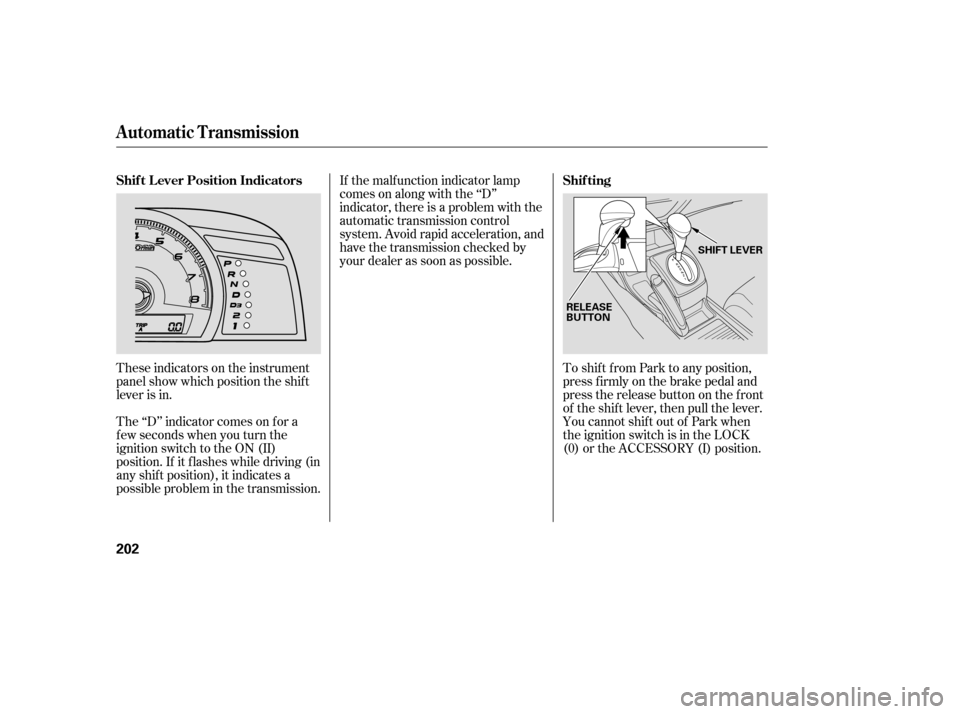
Page 277 of 413
Modif ying your vehicle, or installing
some non-Honda accessories, can
make it unsaf e. Bef ore you make any
modif ications or add any accessories,
be sure to read the f ollowing
inf ormation.
Your dealer has Honda accessories
that allow you to personalize your
vehicle, or improve its perf ormance.
These accessories have been
designed and approved f or your
vehicle, and are covered by warranty.
Although non-Honda accessories
may f it on your vehicle, they may not
meet f actory specif ications, and
could adversely af f ect your vehicle’s
handling and stability.When properly installed, cellular
phones, alarms, two-way radios, and
low-powered audio systems should
not interf ere with your vehicle’s
computer controlled systems, such
as your airbags, anti-lock brakes, and
tire pressure monitoring system (if
equipped).Bef ore installing any accessory:
Make sure the accessory does not
obscure any lights, or interf ere
with proper vehicle operation or
perf ormance.
Be sure electronic accessories do
not overload electrical circuits
(see page ) or interf ere with
the proper operation of your
vehicle.
Bef ore installing any electronic
accessory, have the installer
contact your dealer for assistance.
If possible, have your dealer
inspect the f inal installation.
Do not install accessories on the
side pillars or across the rear
windows. Accessories installed in
theseareasmayinterferewith
proper operation of the side
curtain airbags. 280
A ccessories
A ccessories and Modif icat ions
Bef ore Driving
189
Improper accessories or
modifications can affect your
vehicle’s handling, stability, and
performance, and cause a
crash in which you can be hurt
or killed.
Follow all instructions in this
owner’s manual regarding
accessories and modifications.
�����—�����—�����y���
�����������y���
�(�#���������y���
�����y
Page 278 of 413

�Î
�Î
Removing parts f rom your vehicle,
or replacing components with
non-Honda components could
seriously af f ect your vehicle’s
handling, stability, and reliability.
Some examples are:
Lowering your vehicle with a
non-Honda suspension kit that
signif icantly reduces ground
clearance can allow the
undercarriage to hit speed bumps
or other raised objects, which
could cause the airbags to deploy.
Raising your vehicle with a
non-Honda suspension kit can
af f ect the handling and stability. Larger or smaller wheels and tires
can interf ere with the operation of
your vehicle’s anti-lock brakes and
other systems.
Modif ying your steering wheel or
any other part of your vehicle’s
safety features can make the
systems inef f ective.
If you plan to modif y your vehicle,
consult your dealer. Non-Honda wheels, because they
are a universal design, can cause
excessive stress on suspension
components and will not be
compatible with the tire pressure
monitoring system (TPMS) .
: If equipped
Modif ying Your Vehicle
A ccessories and Modif ications
190
�����—�����—�����y���
�����������y���
�(�#���������y���
�����y
Page 282 of 413

Store or secure all items that could
be thrown around and hurt
someone during a crash.Distribute cargo evenly on the
f loor of the trunk, placing the
heaviest items on the bottom and
as far forward as possible.
If you carry large items that
prevent you f rom closing the trunk
lid, exhaust gas can enter the
passenger area. To avoid the
possibility of
, f ollow the instructions
on page .
If youfolddownthebackseat,tie
down items that could be thrown
about the vehicle during a crash or
sudden stop.
Do not put any items on top of the
trunk panel. They can block your
view and be thrown around the
vehicle during a crash.
Be sure items placed on the f loor
behind the f ront seats cannot roll
underneath and interf ere with the
proper operation of the seats, the
sensors under the seats, or the
driver’s ability to operate the
pedals.
Keep the glove box closed while
driving. If it is open, a passenger
could injure their knees during a
crash or sudden stop. 51
Carrying Items in the Passenger
Compartment
Carrying Cargo in the Trunk
carbon monoxide
poisoning
Carrying Cargo
194
�����—�����—�����y���
�����������y���
�(�#���������y���
�����y
Page 284 of 413
Make sure all windows, mirrors,
and outside lights are clean and
unobstructed. Remove f rost, snow,
or ice.
Check that the hood and trunk are
f ully closed.Check that any items you may be
carrying are stored properly or
f astened down securely.
Check the seat adjustment (see
page ).
Check the adjustment of the
inside and outside mirrors (see
page ).
Check the steering wheel
adjustment (see page ).
Make sure the doors are securely
closed and locked.Fasten your seat belt. Check that
your passengers have f astened
their seat belts (see page ).
Youshoulddothefollowingchecks
and adjustments every day bef ore
you drive your vehicle.
When you start the engine, check
the gauges and indicators in the
instrument panel (see page ).
Visually check the tires. If a tire
looks low, use a gauge to check its
pressure (see page ).
1. 2. 3. 4.
9.
8.
7.
6.
5.
10.
91
75 14
57
254 102
Preparing to Drive
Driving
197
�����—�����—�����y���
�����������y���
�(�#���������y���������y
Page 286 of 413
CONT INUED
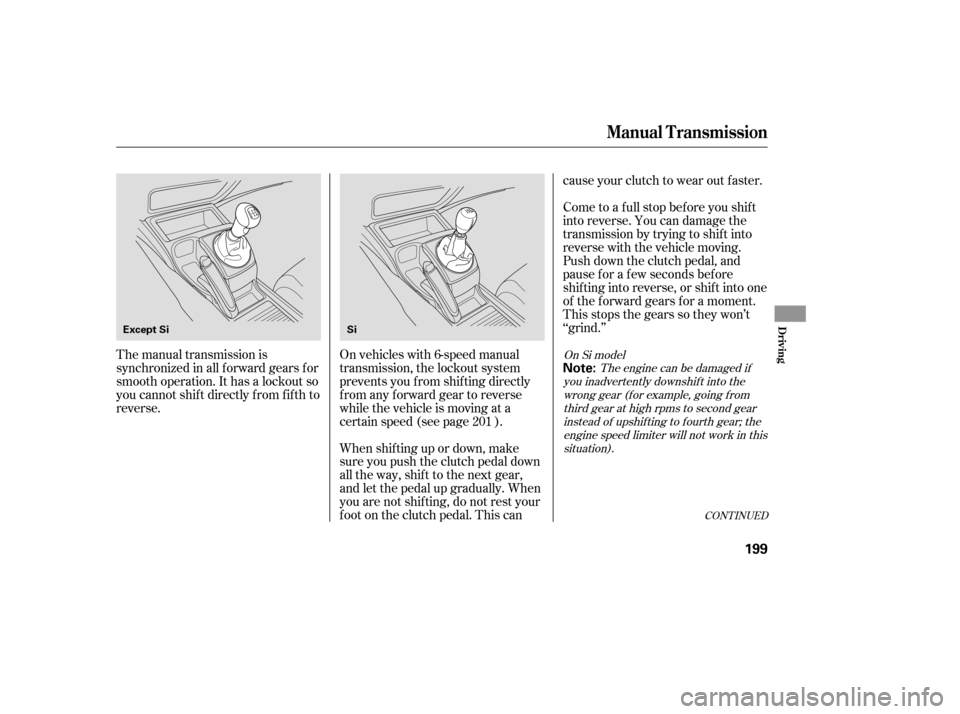
The manual transmission is
synchronized in all f orward gears f or
smooth operation. It has a lockout so
you cannot shift directly from fifth to
reverse.On vehicles with 6-speed manual
transmission, the lockout system
prevents you f rom shif ting directly
from any forward gear to reverse
while the vehicle is moving at a
certain speed (see page ).
When shif ting up or down, make
sure you push the clutch pedal down
all the way, shif t to the next gear,
and let the pedal up gradually. When
you are not shif ting, do not rest your
f oot on the clutch pedal. This cancause your clutch to wear out f aster.
Come to a full stop before you shift
into reverse. You can damage the
transmission by trying to shift into
reverse with the vehicle moving.
Push down the clutch pedal, and
pause f or a f ew seconds bef ore
shif ting into reverse, or shif t into one
of the f orward gears f or a moment.
This stops the gears so they won’t
‘‘grind.’’
201
The engine can be damaged if
you inadvertently downshif t into the
wrong gear (f or example, going f romthird gear at high rpms to second gear
instead of upshif ting to f ourth gear; theengine speed limiter will not work in thissituation).
On Si model
Manual T ransmission
Driving
199
Note:
Except Si
Si
�����—�����—�����y���
�����������y���
�(�#���������y���������y
Page 288 of 413
If you exceed the maximum speed
f or the gear you are in, the engine
speed will enter into the tachometer’s
red zone. If this occurs, you may f eel
the engine cut in and out. This is
caused by a limiter in the engine’s
computer controls. The engine will
run normally when you reduce the
rpm below the red zone.
Bef ore downshif ting, make sure the
engine will not go into the
tachometer’s red zone.
Your vehicle has a rev limit indicator
to show you when the engine speed
is near the tachometer’s red zone
(see page ).If you are still unable to shif t to
reverse, apply the parking brake,
and turn the ignition key to the
ACCESSORY (I) or LOCK (0)
position.
With the clutch pedal still pressed,
start the engine.
Press the clutch pedal, and shif t to
reverse.
If you need to use this procedure to
shif t to reverse, your vehicle may be
developing a problem. Have the
vehicle checked by your dealer.
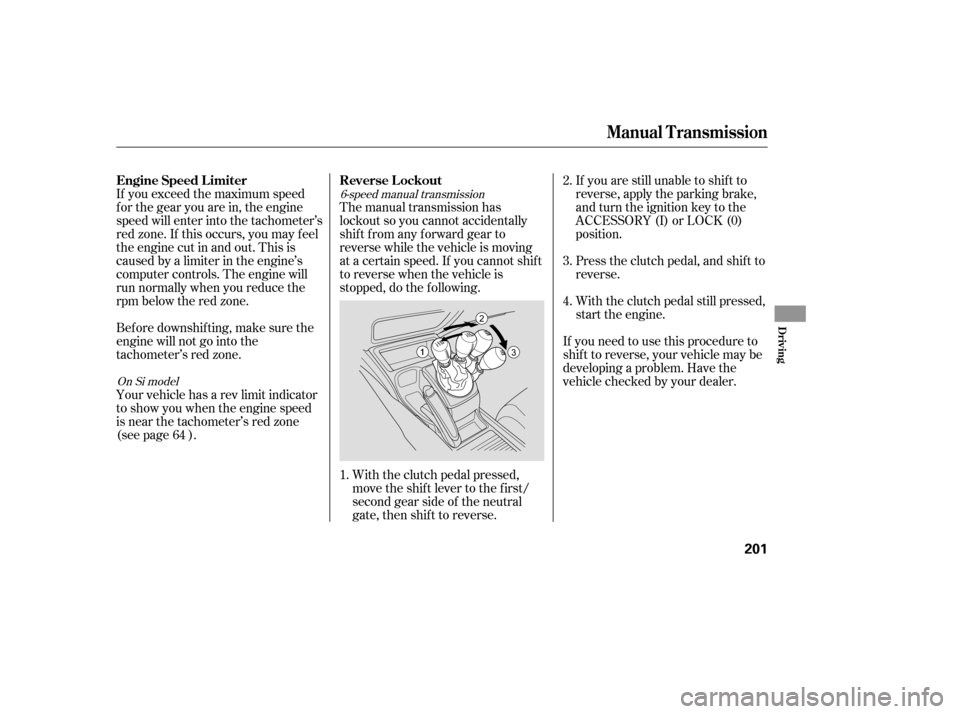
The manual transmission has
lockout so you cannot accidentally
shif t f rom any f orward gear to
reverse while the vehicle is moving
at a certain speed. If you cannot shif t
to reverse when the vehicle is
stopped, do the f ollowing.
With the clutch pedal pressed,
move the shift lever to the first/
second gear side of the neutral
gate, then shif t to reverse.
1. 2. 3. 4.
646-speed manual transmission
On Si model
Engine Speed L imiter Reverse L ockout
Manual T ransmission
Driving
201
�����—�����—�����y���
�������
���y���
�(�#���������y���������y
Page 289 of 413
These indicators on the instrument
panel show which position the shif t
lever is in.To shif t f rom Park to any position,
press firmly on the brake pedal and
pressthereleasebuttononthefront
of the shif t lever, then pull the lever.
YoucannotshiftoutofParkwhen
the ignition switch is in the LOCK
(0) or the ACCESSORY (I) position.
The ‘‘D’’ indicator comes on f or a
f ew seconds when you turn the
ignition switch to the ON (II)
position. If it f lashes while driving (in
any shif t position), it indicates a
possible problem in the transmission. If the malf unction indicator lamp
comes on along with the ‘‘D’’
indicator, there is a problem with the
automatic transmission control
system. Avoid rapid acceleration, and
have the transmission checked by
your dealer as soon as possible.
Automatic Transmission
Shif t L ever Position Indicators
Shif ting
202
SHIFT LEVER
RELEASE
BUTTON
�����—�����—�����y���
���������
�y���
�(�#���������y���������y
Page 290 of 413

�µ�µ �µ�µTo shift from:
PtoR
RtoP
NtoR
Dto2
2to1
1to2
2toD
DtoD
DtoN
DtoD NtoD
RtoN Do this:
Press the brake pedal, and
press the shift lever release
button.
Press the shift lever release
button.
Move the shift lever.
3
3
3
3
This position mechani-
cally locks the transmission. Use
Park whenever you are turning of f or
starting the engine. To shif t out of
Park, you must press on the brake
pedal and have your f oot of f the
accelerator pedal. Press the release
buttononthefrontof theshiftlever
to move it.
If you have done all of the above and
still cannot move the lever out of
Park, see on
page .
To avoid transmission damage, come
to a complete stop bef ore shif ting
into Park. You must also press the
release button to shift into Park. The
shif t lever must be in Park bef ore
you can remove the key f rom the
ignition switch.
Press the brake
pedal and press the release button to
shif t f rom Park to reverse. To shif t f rom reverse to neutral, come to a
completestopandthenshift.Press
the release button bef ore shif ting
into reverse f rom neutral.
Use this position f or
your normal driving. The
transmission automatically selects a
suitable gear (1 through 5) f or your
speed and acceleration. You may
notice the transmission shifting up at
higher engine speeds when the
engine is cold. This helps the engine
warm up f aster. Use neutral if you
need to restart a stalled engine, or if
it is necessary to stop brief ly with
the engine idling. Shif t to the Park
position if you need to leave your
vehicle for any reason. Press on the
brake pedal when you are moving
the shift lever from neutral to
another gear.
205
CONT INUED
Automatic Transmission
Park (P)
Shif t L ock Release
Reverse (R) Drive (D)
Neutral (N)
Driving
203
�����—�����—�����y���
�����������y���
�(�#���������y���������y