Page 133 of 413
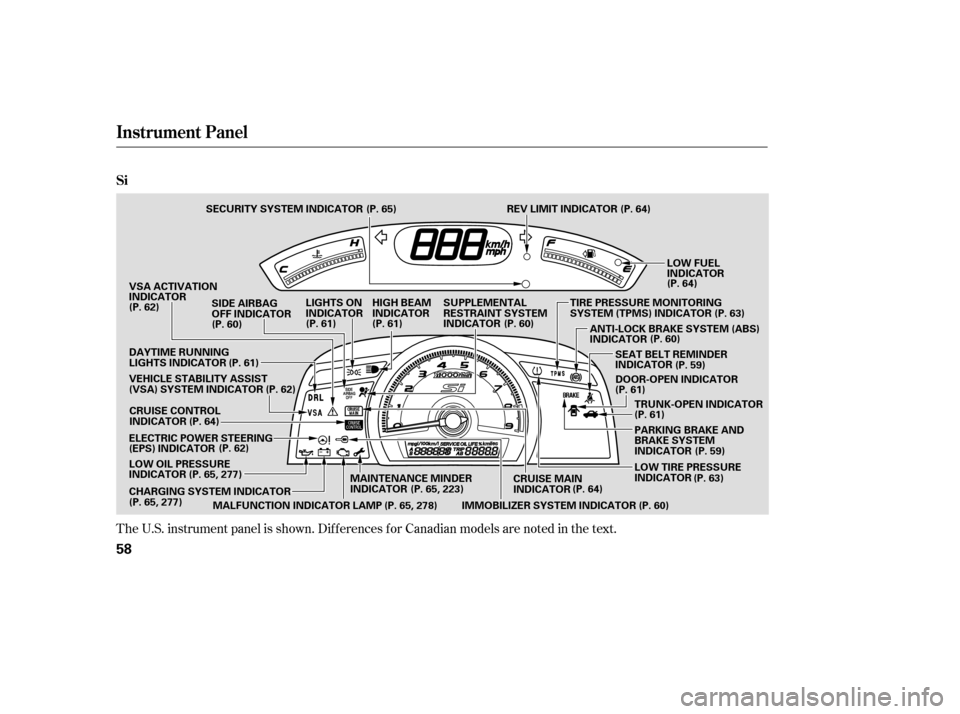
The U.S. instrument panel is shown. Dif f erences f or Canadian models are noted in the text.
Instrument Panel
Si
58
LOW FUEL
INDICATOR
(P. 64)
MAINTENANCE MINDER
INDICATOR
(P. 62)
(P. 61)(P. 62)
(P. 64)
CRUISE CONTROL
INDICATOR
(P. 60)
MALFUNCTION INDICATOR LAMP
IMMOBILIZER SYSTEM INDICATORCRUISE MAIN
INDICATOR
(P. 64)
LIGHTS ON
INDICATOR
HIGH BEAM
INDICATOR
(P. 61) (P. 60) SUPPLEMENTAL
RESTRAINT SYSTEM
INDICATOR
(P. 60)
TRUNK-OPEN INDICATOR
VSA ACTIVATION
INDICATOR
DAYTIME RUNNING
LIGHTS INDICATOR
VEHICLE STABILITY ASSIST
(VSA) SYSTEM INDICATOR
ELECTRIC POWER STEERING
(EPS) INDICATOR
LOW OIL PRESSURE
INDICATOR
CHARGING SYSTEM INDICATOR
(P. 62)
(P. 65, 277)
(P. 65, 277) (P. 65, 278)(P. 65, 223) (P. 61)
(P. 61)
(P. 63)(P. 63)
(P. 60) (P. 61)
SECURITY SYSTEM INDICATOR (P. 65) REV LIMIT INDICATOR (P. 64)
SEAT BELT REMINDER
INDICATORDOOR-OPEN INDICATOR (P. 59)
SIDE AIRBAG
OFF INDICATOR
ANTI-LOCK BRAKE SYSTEM (ABS)
INDICATOR
PARKING BRAKE AND
BRAKE SYSTEM
INDICATOR (P. 59)
TIRE PRESSURE MONITORING
SYSTEM (TPMS) INDICATOR
LOW TIRE PRESSURE
INDICATOR
�����—�����—�����y������
����
���y���
�(�#���������y���������y
Page 135 of 413

This indicator normally comes on f or
a f ew seconds when you turn the
ignition switch to the ON (II)
position. If it comes on at any other
time, there is a problem with the
ABS. If this happens, have your
vehicle checked at a dealer. With
this indicator on, your vehicle still
has normal braking ability but no
anti-lock f unction. For more
inf ormation, see page .
This indicator comes on f or several
seconds when you turn the ignition
switch to the ON (II) position. If it
comes on at any other time, it
indicates a potential problem with
your f ront airbags. This indicator will
also alert you to a potential problem
with your side airbags, passenger’s
side airbag automatic cutoff system,
side curtain airbags, automatic seat
belt tensioners, driver’s seat position
sensor, or the f ront passenger’s
weight sensors. For more
inf ormation, see page .
This indicator comes on brief ly when
you turn the ignition switch to the
ON (II) position. It will then go of f if
you have inserted a properly-coded
ignition key. If it is not a properly-
coded key, the indicator will blink,
and the engine’s f uel system will be
disabled (see page ).
This indicator comes on f or several
seconds when you turn the ignition
switch to the ON (II) position. If it
comes on at any other time, it
indicates that the passenger’s side
airbag has automatically shut off.
For more inf ormation, see page . 77
29
20830
Supplemental Restraint
System Indicator
Immobilizer System
Indicator
Anti-lock Brake System
(A BS) Indicator Side A irbag Of f
Indicator
Instrument Panel Indicators
60
U.S. Canada
�����—�����—�����y���������������y���
�(�#���������y���������y
Page 136 of 413

When you press the hazard warning
button, both turn signal indicators
and all turn signals on the outside of
the vehicle f lash.If this indicator comes on when the
ignition switch is turned to the ON
(II) position and the parking brake is
released, it means there is a problem
in the circuit. Have your vehicle
checked by your dealer.
This indicator comes on with the
high beam headlights. For more
inf ormation, see page .
This indicator also comes on with
reduced brightness when the
daytime running lights (DRL) are on
(see page ).This indicator reminds you that the
exterior lights are on. It comes on
when the light switch is in either the
or position. If you turn the
ignition switch to the ACCESSORY
(I) or the LOCK (0) position without
turning of f the light switch, this
indicator will remain on. A reminder
chime will also sound when you open
the driver’s door and remove the key
from the ignition switch.
The lef t or right turn signal indicator
blinks when you signal a lane change
or turn. If an indicator does not blink
or blinks rapidly, it usually means
one of the turn signal bulbs is
burned out (see pages and ).
Replace the bulb as soon as possible,
since other drivers cannot see that
you are signaling.
This indicator comes on if the trunk
lid is not closed tightly.
This indicator comes on if any door
is not closed tightly.
247
246
72
73
Turn Signal and
Hazard Warning
Indicators
Lights On Indicator
‘‘Daytime Running
Lights’’ Indicator
High Beam Indicator
Trunk-open Indicator
Door-open Indicator
Instrument Panel Indicators
Inst rument s and Cont rols
61
�����—�����—�����y���������������y���
�(�#���������y���������y
Page 149 of 413

�´�µ
The buttons under the lef t side vent
control the brightness of the
instrument panel. Push the or
button to adjust the brightness.
Separate adjustments can be made
when the headlights are on and of f .
With the headlight switch of f or
position, the high beam
headlights come on with reduced
brightness when you turn the
ignition switch to the ON (II)
position and release the parking
brake. They remain on until you turn
the ignition switch of f , even if you
set the parking brake.
The headlights revert to normal
operation when you turn them on
with the switch.
There are six brightness levels.
When you push either button, the
inf ormation display indicates the
current level. You will hear a tonewhen you reach the maximum or
minimum brightness. The display
returns to the odometer 5 seconds
af ter you stop adjusting the
brightness.
To reduce glare at night, the
instrument panel illumination dims
when you turn the light switch to the
or position.
The center of each meter (upper and
lower) illuminates with reduced
brightness when you unlock and
open the driver’s door, and then goes
back to the selected brightness when
you turn the ignition switch to the
ON (II) position.
If you insert the key but do not turn
the ignition switch to the ON (II)
position, the illumination turns of f in
about 10 seconds.
Daytime Running L ights Instrument Panel Brightness
Headlights, Instrument Panel Brightness
Inst rument s and Cont rols
73
INSTRUMENT PANEL BRIGHTNESS
CONTROL BUTTONS
�����—�����—�����y��������
����
�y���
�(�#���������y���������y
Page 151 of 413
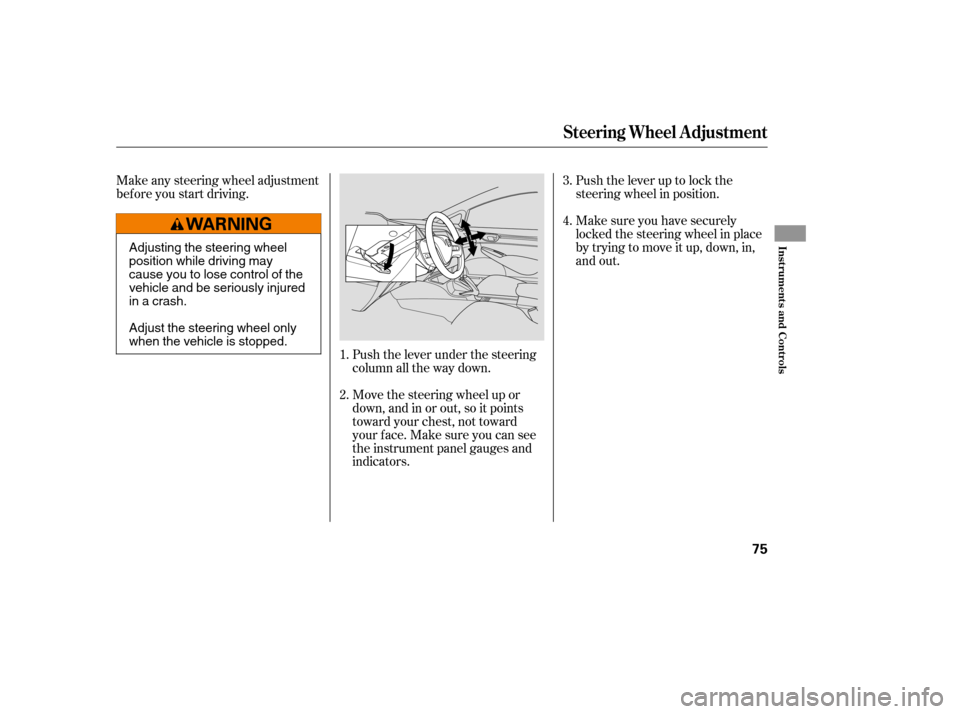
Make sure you have securely
locked the steering wheel in place
by trying to move it up, down, in,
and out.
Push the lever up to lock the
steering wheel in position.
Push the lever under the steering
column all the way down.
Move the steering wheel up or
down, and in or out, so it points
toward your chest, not toward
your f ace. Make sure you can see
the instrument panel gauges and
indicators.
Make any steering wheel adjustment
bef ore you start driving.
1.4.
2. 3.
Steering Wheel A djustment
Inst rument s and Cont rols
75
Adjusting the steering wheel
position while driving may
cause you to lose control of the
vehicle and be seriously injured
inacrash.
Adjust the steering wheel only
when the vehicle is stopped.
�����—�����—�����y��������
������y���
�(�#���������y���������y
Page 152 of 413
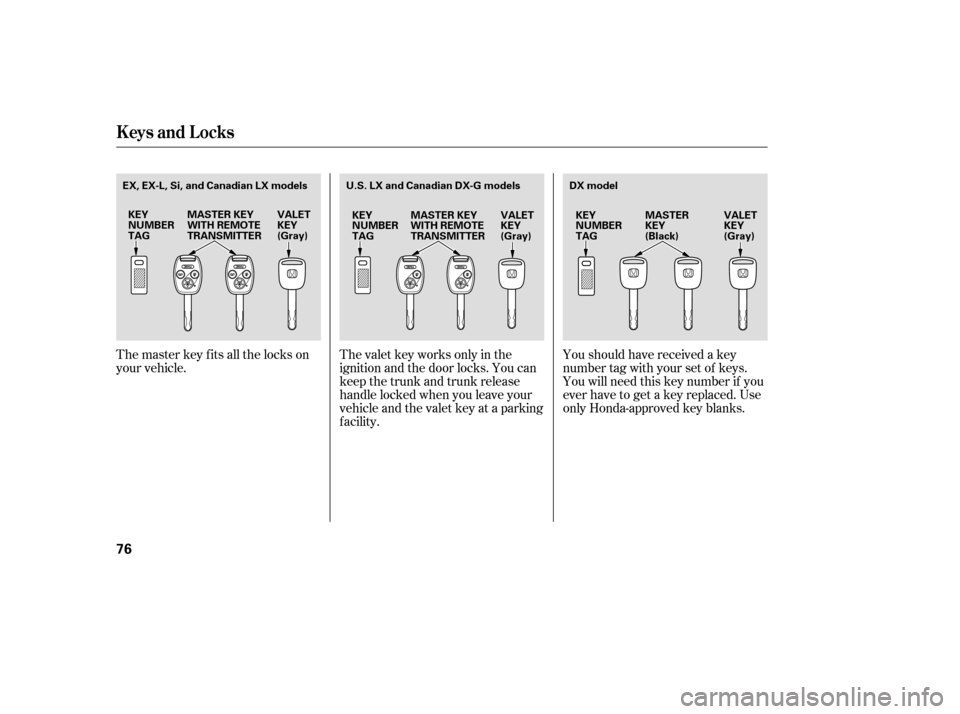
Youshouldhavereceivedakey
number tag with your set of keys.
You will need this key number if you
ever have to get a key replaced. Use
only Honda-approved key blanks.
The valet key works only in the
ignition and the door locks. You can
keep the trunk and trunk release
handle locked when you leave your
vehicle and the valet key at a parking
f acility.
The master key fits all the locks on
your vehicle.
Keys and Locks
76
KEY
NUMBERTAG
MASTER KEY
WITH REMOTE
TRANSMITTER VALET
KEY
(Gray)KEY
NUMBERTAG VALET
KEY
(Gray)
MASTER
KEY
(Black)
KEY
NUMBERTAG
MASTER KEY
WITH REMOTE
TRANSMITTER VALET
KEY
(Gray)U.S. LX and Canadian DX-G models DX model
EX, EX-L, Si, and Canadian LX models
�����—�����—�����y��������
������y���
�(�#���������y�������
�y
Page 153 of 413

CONT INUED
The system may not recognize your
key’s coding if another immobilizer
key or other metal object (i.e. key
f ob) is near the ignition switch when
you insert the key.
If the system repeatedly does not
recognize the coding of your key,
contact your dealer.
Do not attempt to alter this system
or add other devices to it. Electrical
problems could result that may make
your vehicle undrivable.
If you have lost your key and cannot
start your engine, contact your
dealer.
These keys contain electronic
circuits that are activated by the
immobilizer system. They will not
work to start the engine if the
circuits are damaged.
Protect the keys f rom direct
sunlight, high temperature, and
high humidity.
Donotdropthekeysorsetheavy
objects on them.
Keep the keys away f rom liquids.
If they get wet, dry them
immediately with a sof t cloth. When you turn the ignition switch to
the ON (II) position, the immobilizer
system indicator should come on
brief ly, then go of f . If the indicator
starts to blink, it means the system
does not recognize the coding of the
key. Turn the ignition switch to the
LOCK (0) position, remove the key,
reinsert it, and turn the ignition
switch to the ON (II) position again.
The immobilizer system protects
your vehicle f rom thef t. If an
improperly-coded key (or other
device) is used, the engine’s f uel
system is disabled.
The keys without a remote
transmitter do not contain batteries.
Do not try to take them apart.
Keys and Locks, Immobilizer System
Immobilizer System
Inst rument s and Cont rols
77
Always take the ignition key with you
whenever you leave the vehicle alone.
�����—�����—�����y���������������y���
�(�#���������y���������y
Page 154 of 413

CONT INUED
The system may not recognize your
key’s coding if another immobilizer
key or other metal object (i.e. key
f ob) is near the ignition switch when
you insert the key.
If the system repeatedly does not
recognize the coding of your key,
contact your dealer.
Do not attempt to alter this system
or add other devices to it. Electrical
problems could result that may make
your vehicle undrivable.
If you have lost your key and cannot
start your engine, contact your
dealer.
These keys contain electronic
circuits that are activated by the
immobilizer system. They will not
work to start the engine if the
circuits are damaged.
Protect the keys f rom direct
sunlight, high temperature, and
high humidity.
Donotdropthekeysorsetheavy
objects on them.
Keep the keys away f rom liquids.
If they get wet, dry them
immediately with a sof t cloth. When you turn the ignition switch to
the ON (II) position, the immobilizer
system indicator should come on
brief ly, then go of f . If the indicator
starts to blink, it means the system
does not recognize the coding of the
key. Turn the ignition switch to the
LOCK (0) position, remove the key,
reinsert it, and turn the ignition
switch to the ON (II) position again.
The immobilizer system protects
your vehicle f rom thef t. If an
improperly-coded key (or other
device) is used, the engine’s f uel
system is disabled.
The keys without a remote
transmitter do not contain batteries.
Do not try to take them apart.
Keys and Locks, Immobilizer System
Immobilizer System
Inst rument s and Cont rols
77
Always take the ignition key with you
whenever you leave the vehicle alone.
�����—�����—�����y���������������y���
�(�#���������y���������y