2008 GREAT WALL FLORID cylinder
[x] Cancel search: cylinderPage 102 of 281

Downloaded from www.Manualslib.com manuals search engine 95Brake System
Brake System Components Arrangement Schematics
Brake pedal assembly
Vacuum booster with brake cylinder assembly
Left steering knuckle and hub brake assembly
Left parking brake cable assembly
Rear brake assembly RHRear brake drum
Rear wheel speed sensor assembly RH
Right parking brake cable assembly
ABS controller assembly
Right steering knuckle and hub brake assembly
Brake line assembly
Rear wheel speed
sensor assembly LH
Front wheel speed sensor assembly RHFront wheel speed sensor assembly LH
Rear brake assembly LH
Parking brake control mechanism assembly
Page 103 of 281
Downloaded from www.Manualslib.com manuals search engine GWFLORID Maintenance Manual96
Brake System Maintenance
Brake fluid inspection and replacement
Brake fluid directly influences the brake performance and the operating conditions and use life of the brake
system components. Brake fluid has very strong hygroscopic properties, and thus absorbs water easily,
which will then deteriorate the metal and rubber pieces. Polluted and deteriorated brake fluid or its mixture
would cause the brake fluid to boil and gasify, hence reduces braking efficiency. Therefore, pay attention to
the items below when filling or changing the brake fluid:
1. Containers used to hold brake fluid must be tightly closed and sealed
2. Brake fluid is poisonous and damaging to the paint. Hence if it gets on the vehicle surface, rub it
off at once
3. If water or other contaminates found in the brake fluid, and the brake master cylinder's piston seal
has been broken, then the brake fluid and all the rubber pieces inside the brake system including
the brake hose must be replaced
4. The correct brake fluid level in the reservoir must be between MAX and MIN. After the vehicle has
been driven for over 1000 km, check the brake fluid level in the reservoir. If the brake fluid level is
not up to regulation, more brake fluid should be added to the reservoir \
until it reaches MAX.
Hydraulic component inspection and system flushing
1. If the oil-based solvent gets into the hydraulic system, flush the whole system and change all of
the rubber pieces
2. Clean your hands before installing new rubber pieces or other components
3. Do not use regular solvents (kerosene, gas, etc.) when inspecting or cleaning hydraulic
components, instead use absorbing alcohol or brake fluid
4. After inspecting the components, drain the brake fluid from the system. Use new brake fluid to
flush the system. Afterwards, add new brake fluid to perform hydraulic system exhaust
5. Flushing completion sign: When the brake fluid flowing out of the dump valve is clear from any
contaminate.
Hydraulic pressure system drainage
If the brake fluid inside the whole hydraulic pressure system needs to be emptied, open all the bleed screws
with each connected to a hose, as to allow the brake fluid to flow into a container. Step on the pedal slowly
until only air flows out. During the whole procedure, make sure all the \
valves are open.
Hydraulic pressure system air bleeding
The hydraulic brake system must work under a vacuum environment. The air will cause spongy brake or
overall brake failure when it flows into the hydraulic system. It is extremely necessary to bleed system air
when performing any operation on the brake system or if any air inside t\
he brake system is suspected.
1. Air bleeding sequence
If air inside the brake master cylinder is suspected, first perform air bleeding.
(a) If numerous valves are equipped, air bleed each valve
(b) Another sequence principle is: Air bleed from the wheel brake furthest away from the master cylinder.
The air bleeding sequence for the LHD modules is: rear right wheel - left rear wheel - front right wheel
- front left wheel, Right rudder vehicles: rear right wheel - left rear wheel - front left wheel - front right
wheel.
2. Air bleeding method
(1) Manual air bleeding
Use the brake pedal or pump as the air bleeding power source. When the air bleed screws are open, vent the
brake fluid containing the bubbles from the system. Usually this is simultaneously done by two people. One
steps on the brake pedal and the other operates the air bleed screws. Important points to take note of when
performing the operation:
(a) Place the ignition switch to the off position and step on the pedal repeatedly to remove the
vacuum pressure or hydraulic pressure.
(b) Before and after air bleeding, add clean brake fluid into the master cylinder until it reaches
the correct (stated) level.
(c) Check the fluid level frequently to make sure that more than half of the reservoir's capacity is
available.
(d) Bleed screws should only be opened when the pedal is pressed down, and closed before the
pedal is loosened. Meanwhile, check if the vented brake fluid has bubble\
s inside.
Page 104 of 281

Downloaded from www.Manualslib.com manuals search engine 97Brake System
(e) Make sure not to let the system valves block the air bleeding.
(f) When the brake fluid that flows out of the hose or connector has no bubbles, it means that the air
in the system has been exhausted. There is still air inside the system if the hose inserted into the
brake fluid is still bubbling when pressing down the pedal.
(g) Keep the free end of the hose immerged in the brake fluid to avoid air from flowing into the
system while opening the screw.
(h) While air bleeding, hammer the casting part of the vibrating brake device with a rubber hammer.
This is helpful for removing bubbles deep in the brake fluid.
(i) If air in the master cylinder is suspected, then perform air bleeding on the master cylinder first,
then the wheel cylinder or brake caliper.
(j) When releasing air from the tires, generally make sure to release air out of all the tires.
(k) To avoid the possibility of air reversely entering into the system, a bleeder hose that has a check
valve could be used.
(2) Pressure blow-off
Under the proper conditions, a pressure blow-off device can be used to release the air inside the brake system.
3. Air releasing sequence
(1) Master cylinder air bleeding
If the master cylinder does not have air bleed screws, perform the follo\
wing steps:
(a) Check the brake fluid level inside the master cylinder’s reservoir and add to it if necessary.
(b) Slowly take off the front brake pipe connector until the brake fluid flows out from the end.
(c) Reconnect the brake pipe, but do not tighten it.
(d) Slowly step down and press on the brake pedal, check if the brake fluid flowing out of the connector
contains bubbles.
(e) Tighten the pipe fitting.
(f) Have the assistant loosen the pedal, wait for 15 s.
(g) Repeat the above steps until all the air is released.
(h) Take off the rear brake pipe connector, repeat the above steps.
(2) Wheel brake air releasing
(a) Check the brake fluid level inside the master cylinder’s reservoir and add to it if necessary. During the
entire air releasing period, check repeatedly and add promptly.
(b) Connect one end of the bleeder hose with the bleed screw and the other end immerged in the brake fluid.
(c) Have the assistant step on the pedal several times, raise the pedal gradually until it cannot be stepped on
any more, then forcibly press on the pedal once more.
(d) Loosen the bleed screw, check if there are any bubbles in the brake fluid flowing out. Meanwhile, slowly
lower the pedal.
(e) When the brake pedal is close to the stroke end or the out flowing brake fluid does not have any bubbles,
tighten the bleed screw.
(f) Have the assistant release the pedal and wait for 15 s.
(g) Repeat the above steps until there are no bubbles in the flowing brake fluid when the screw is loosened.
(h) Release the air for all the wheels in turn using the same method.
(i) After releasing the air from the entire system, switch the ignition to the on position.
(j) Inspect the stroke of the brake pedal and its reaction.
(k) Inspect the lighting condition of the brake warning lamp, and repeatedly perform maintenance or air
bleeding if necessary.
( l ) Add brake fluid to the reservoir until the specified fluid level, air bleeding is complete.
Page 110 of 281

Downloaded from www.Manualslib.com manuals search engine 103Brake System
Vacuum Booster with Brake Cylinder Assembly
Components
Areas of Importance
1. The vacuum booster with brake cylinder assembly is tightly connected with the brake pedal assembly on
the cowl panel using four nuts. It is also connected with the brake pedal push rod via an center pin and
lock pin. Thus before removal of the assembly, first loosen the rigid pipe fitting with an open-end wrench,
disconnect the lock pin and center pin using pliers, loosen the four nuts, and then proceed with the booster.
2. Tighten the lock nuts on brake master cylinder and vacuum booster according to the specified torque,
and coat with signal paint.
3. Dimensions between the rear housing head face and the adjusting fork hole center is adjusted to
standard before it leaves factory. Please do not adjust it again.
4. The vacuum booster valve rod on the vehicle must be in a free state.
5. The brake master cylinder's working agent is DOT4 brake fluid. It must not be mixed with any other
brake fluid.
Problems and symptomsCausesEliminating methods
M a s t e r c y l i n d e r ' s o i l r e s e r v o i r i s severely leakingThe master cylinder, slave cylinder, or hydraulic line is leaking.Eliminate the areas with leaks (in general, it may be that the pipe fitting's tightening torque is not enough, check one by one and tighten as necessary)
1. Vacuum booster not sufficient2. No boost when the engine is off3. May lead to unsteady engine idling when severe
1. Under non-operating conditions, the vacuum booster leaks air.2. Front and rear housing connection are not sealed.3. Booster's front and rear gas seal sealing failure.4. Vacuum check valve leaks.
1. Replace the front and back gas seal and control valve assembly.2. Replace the vacuum booster.3. Replace the vacuum check valve assembly.
Brake pedal is heavy with no boost effect1. Under non-operating conditions, the vacuum booster leaks air.2. Booster diaphragm worn and damaged.3. Control valve ring cup worn and damaged.
1. Replace the front, back gas seal and booster diaphragm.2. Replace the vacuum booster.3. Replace the control valve assembly.
Spongy pedal when braking1. There is air in the brake fluid.2. Cylinder or slave cylinder leaks oil.3. There is brake line seepage.
1. Eliminate the air in the system.2. Inspect the cylinder and sub-pump cup and replace with new parts.3. Inspect the pipeline and eliminate the seepage.
When continuously step on the brake pedal, the pedal will gradually change and expand till the highest extend.
Pump valve opening blockage.Brake fluid cleanliness is insufficient, please replace the brake fluid.
Troubleshooting
Oil cup cover
Oil cup body
Check valve
Check valve seat
Vacuum booster
Pad
Lock nut
Rod clevisCoupling nut
Rectangular sealing ringCylinder body
Fluid supply sealing ring
Page 111 of 281
Downloaded from www.Manualslib.com manuals search engine GWFLORID Maintenance Manual104
Removal of the vacuum booster
with brake cylinder assembly
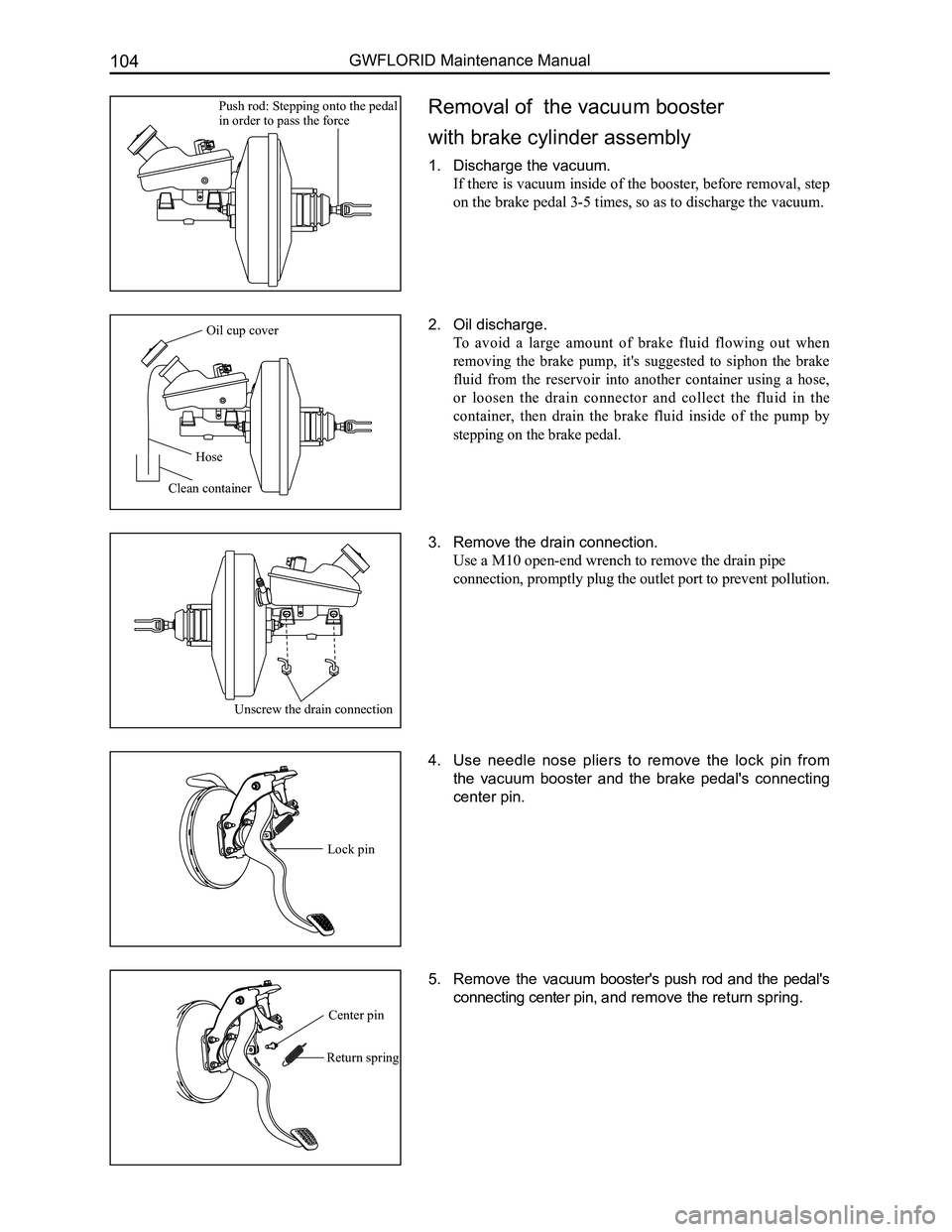
1. Discharge the vacuum.
If there is vacuum inside of the booster, before removal, step
on the brake pedal 3-5 times, so as to discharge the vacuum.
2. Oil discharge.
To avoid a large amount of brake fluid flowing out when
removing the brake pump, it's suggested to siphon the brake
fluid from the reservoir into another container using a hose,
or loosen the drain connector and collect the fluid in the
container, then drain the brake fluid inside of the pump by
stepping on the brake pedal.
3. Remove the drain connection.
Use a M10 open-end wrench to remove the drain pipe
connection, promptly plug the outlet port to prevent pollution.
4. Use needle nose pliers to remove the lock pin from
the vacuum booster and the brake pedal's connecting
center pin.
5. Remove the vacuum booster's push rod and the pedal's
connecting center pin, and remove the return spring.
Push rod: Stepping onto the pedal in order to pass the force
Oil cup cover
Hose
Clean container
Unscrew the drain connection
Lock pin
Return spring
Center pin
Page 112 of 281
Downloaded from www.Manualslib.com manuals search engine 105Brake System
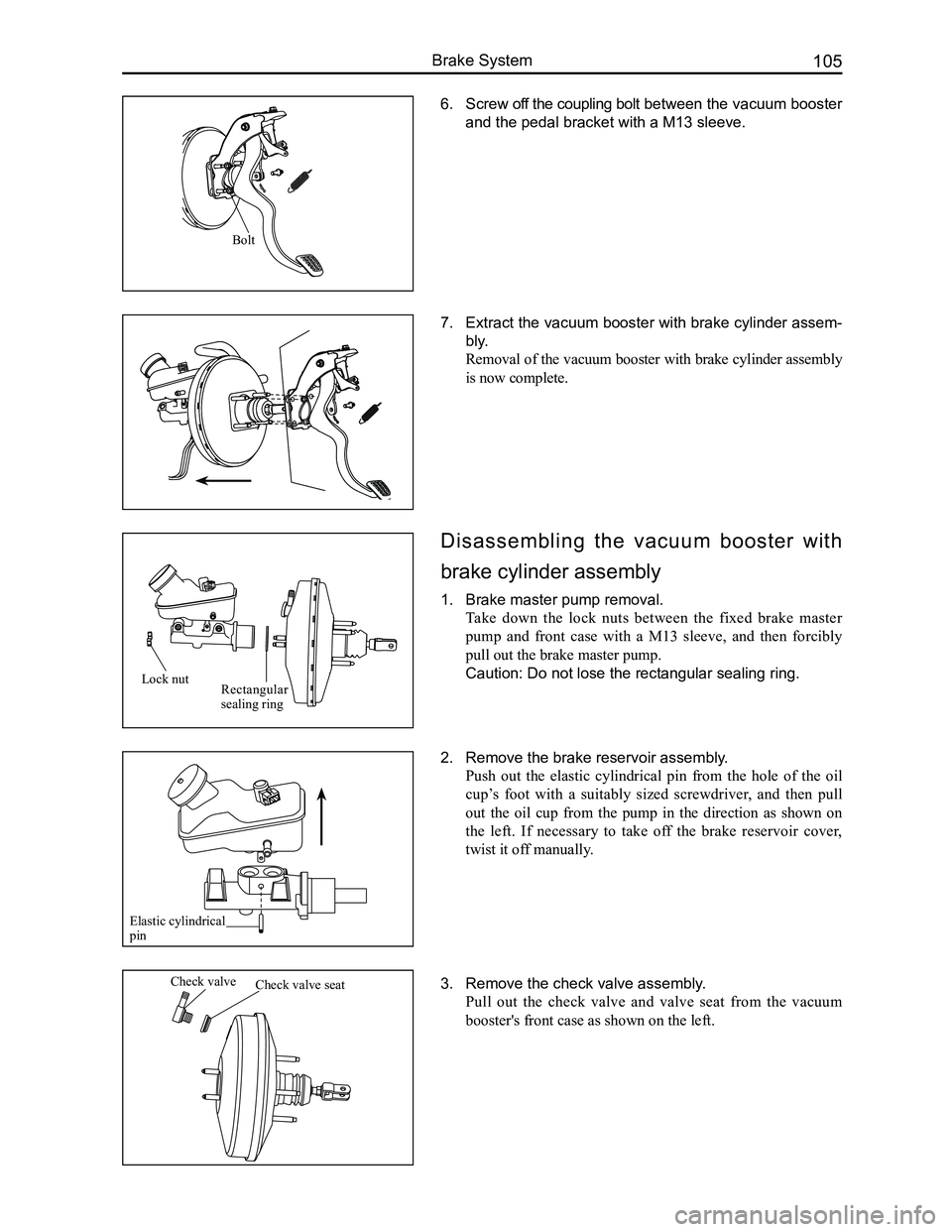
3. Remove the check valve assembly.
Pull out the check valve and valve seat from the vacuum
booster's front case as shown on the left.
Disassembling the vacuum booster with
brake cylinder assembly
1. Brake master pump removal.
Take down the lock nuts between the fixed brake master
pump and front case with a M13 sleeve, and then forcibly
pull out the brake master pump.
Caution: Do not lose the rectangular sealing ring.
2. Remove the brake reservoir assembly.
Push out the elastic cylindrical pin from the hole of the oil
cup’s foot with a suitably sized screwdriver, and then pull
out the oil cup from the pump in the direction as shown on
the left. If necessary to take off the brake reservoir cover,
twist it off manually.
6. Screw off the coupling bolt between the vacuum booster
and the pedal bracket with a M13 sleeve.
7. Extract the vacuum booster with brake cylinder assem-
bly.
Removal of the vacuum booster with brake cylinder assembly
is now complete.
Check valveCheck valve seat
Lock nutRectangular sealing ring
Elastic cylindrical pin
Bolt
Page 113 of 281
Downloaded from www.Manualslib.com manuals search engine GWFLORID Maintenance Manual106
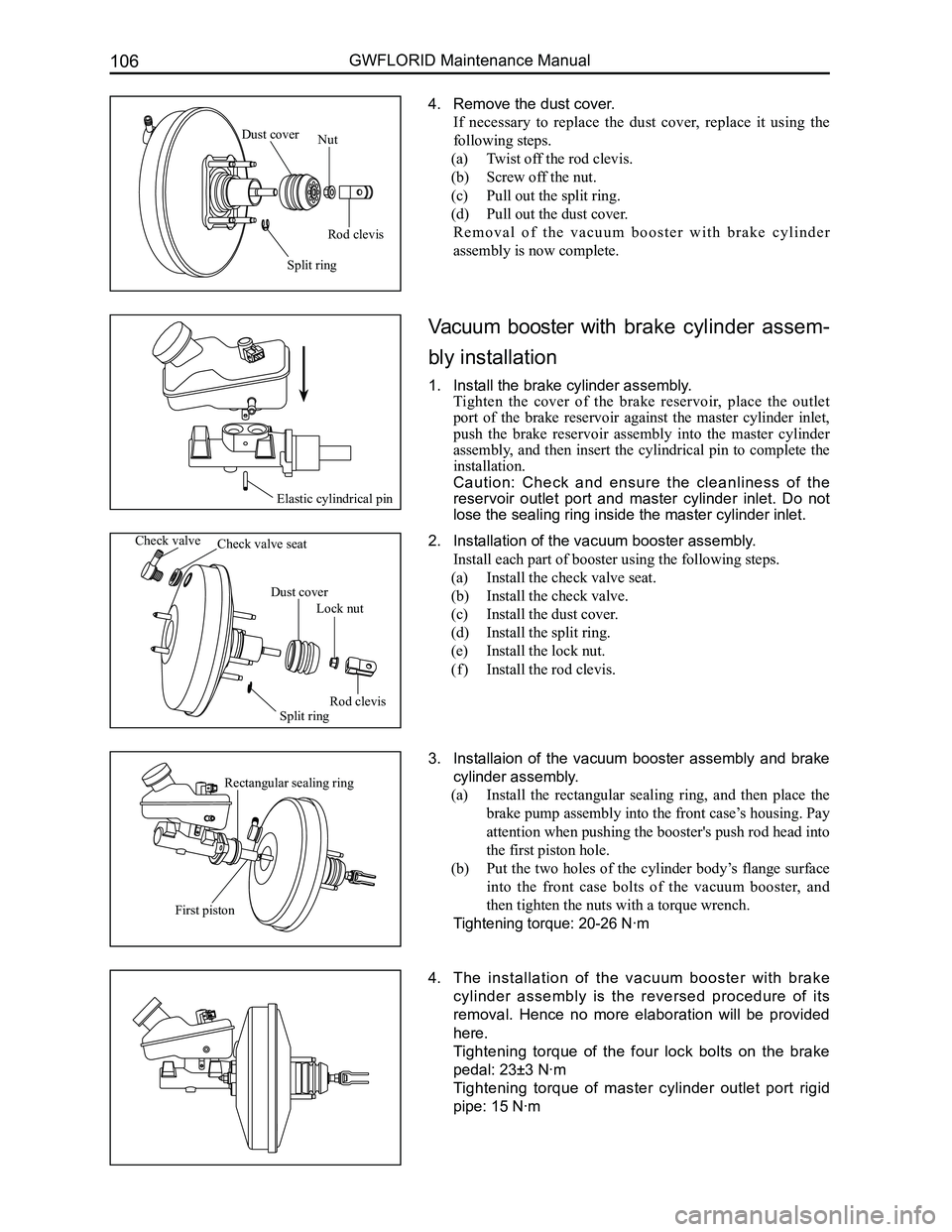
4. Remove the dust cover.
If necessary to replace the dust cover, replace it using the
following steps.
(a) Twist off the rod clevis.
(b) Screw off the nut.
(c) Pull out the split ring.
(d) Pull out the dust cover.
R e m o v a l o f t h e v a c u u m b o o s t e r w i t h b r a k e c y l i n d e r
assembly is now complete.
Vacuum booster with brake cylinder assem-
bly installation
1. Install the brake cylinder assembly.
Tighten the cover of the brake reservoir, place the outlet
port of the brake reservoir against the master cylinder inlet,
push the brake reservoir assembly into the master cylinder
assembly, and then insert the cylindrical pin to complete the
installation.
Caution: Check and ensure the cleanliness of the
reservoir outlet port and master cylinder inlet. Do not
lose the sealing ring inside the master cylinder inlet.
2. Installation of the vacuum booster assembly.
Install each part of booster using the following steps.
(a) Install the check valve seat.
(b) Install the check valve.
(c) Install the dust cover.
(d) Install the split ring.
(e) Install the lock nut.
( f ) Install the rod clevis.
3. Installaion of the vacuum booster assembly and brake
cylinder assembly.
(a) Install the rectangular sealing ring, and then place the
brake pump assembly into the front case’s housing. Pay
attention when pushing the booster's push rod head into
the first piston hole.
(b) Put the two holes of the cylinder body’s flange surface
into the front case bolts of the vacuum booster, and
then tighten the nuts with a torque wrench.
Tightening torque: 20-26 N·m
4. The installation of the vacuum booster with brake
cylinder assembly is the reversed procedure of its
removal. Hence no more elaboration will be provided
here.
Tightening torque of the four lock bolts on the brake
pedal: 23±3 N·m
Tightening torque of master cylinder outlet port rigid
pipe: 15 N·m
Rod clevis
Nut
Split ring
Dust cover
Elastic cylindrical pin
Check valveCheck valve seat
Lock nut
Rod clevis
Split ring
Dust cover
Rectangular sealing ring
First piston
Page 114 of 281
Downloaded from www.Manualslib.com manuals search engine 107Brake System
Anti-lock Brake System
ABS/EBD introduction
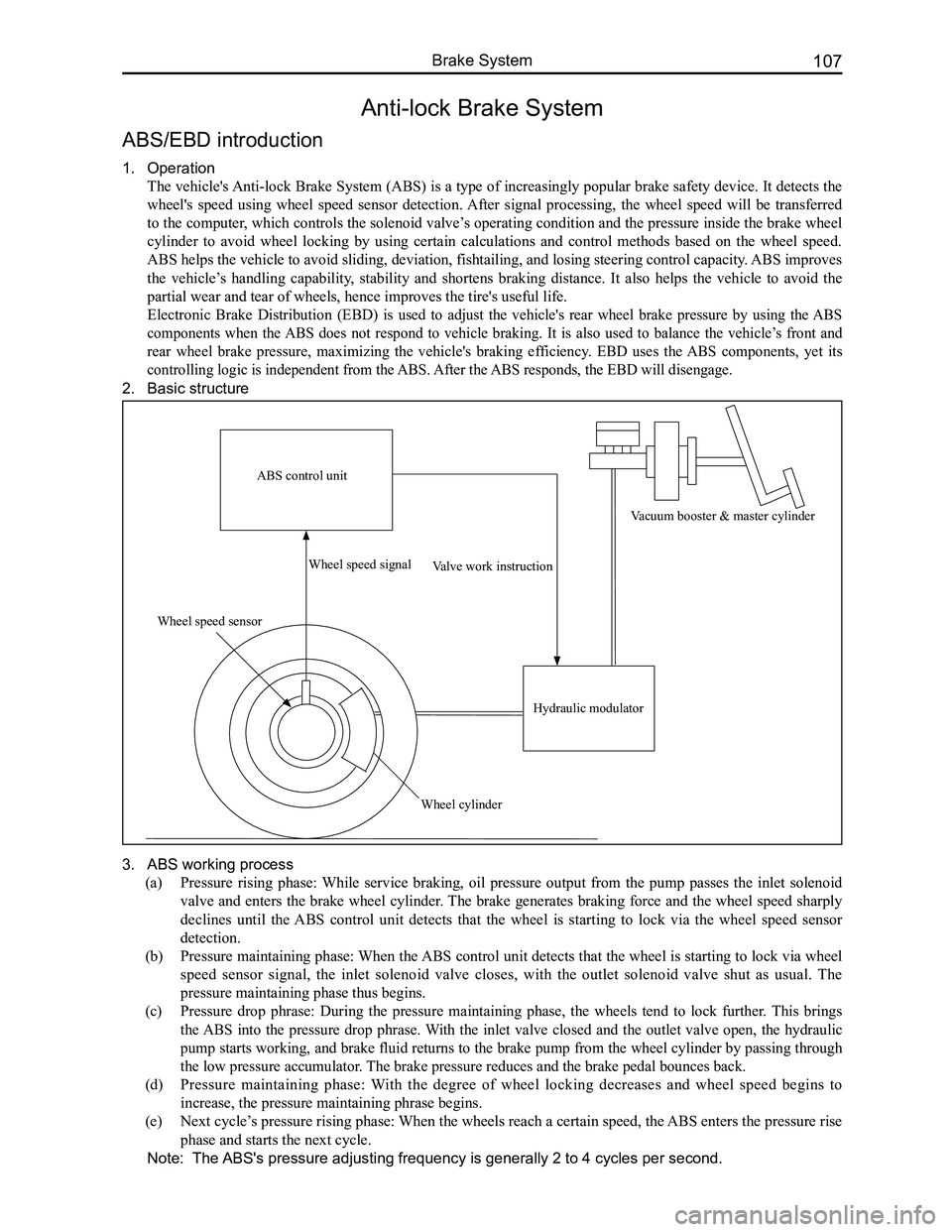
1. Operation
The vehicle's Anti-lock Brake System (ABS) is a type of increasingly popular brake safety device. It detects the
wheel's speed using wheel speed sensor detection. After signal processing, the wheel speed will be transferred
to the computer, which controls the solenoid valve’s operating condition and the pressure inside the brake wheel
cylinder to avoid wheel locking by using certain calculations and control methods based on the wheel speed.
ABS helps the vehicle to avoid sliding, deviation, fishtailing, and losing steering control capacity. ABS improves
the vehicle’s handling capability, stability and shortens braking distance. It also helps the vehicle to avoid the
partial wear and tear of wheels, hence improves the tire's useful life.
Electronic Brake Distribution (EBD) is used to adjust the vehicle's rear wheel brake pressure by using the ABS
components when the ABS does not respond to vehicle braking. It is also used to balance the vehicle’s front and
rear wheel brake pressure, maximizing the vehicle's braking efficiency. EBD uses the ABS components, yet its
controlling logic is independent from the ABS. After the ABS responds, the EBD will disengage.
2. Basic structure
3. ABS working process
(a) Pressure rising phase: While service braking, oil pressure output from the pump passes the inlet solenoid
valve and enters the brake wheel cylinder. The brake generates braking force and the wheel speed sharply
declines until the ABS control unit detects that the wheel is starting to lock via the wheel speed sensor
detection.
(b) Pressure maintaining phase: When the ABS control unit detects that the wheel is starting to lock via wheel
speed sensor signal, the inlet solenoid valve closes, with the outlet solenoid valve shut as usual. The
pressure maintaining phase thus begins.
(c) Pressure drop phrase: During the pressure maintaining phase, the wheels tend to lock further. This brings
the ABS into the pressure drop phrase. With the inlet valve closed and the outlet valve open, the hydraulic
pump starts working, and brake fluid returns to the brake pump from the wheel cylinder by passing through
the low pressure accumulator. The brake pressure reduces and the brake pedal bounces back.
(d) Pressure maintaining phase: With the degree of wheel locking decreases and wheel speed begins to
increase, the pressure maintaining phrase begins.
(e) Next cycle’s pressure rising phase: When the wheels reach a certain speed, the ABS enters the pressure rise
phase and starts the next cycle.
Note: The ABS's pressure adjusting frequency is generally 2 to 4 cycles per second.
ABS control unit
Wheel speed sensor
Wheel speed signal
Wheel cylinder
Valve work instruction
Hydraulic modulator
Vacuum booster & master cylinder