2008 GREAT WALL FLORID cylinder
[x] Cancel search: cylinderPage 115 of 281
Downloaded from www.Manualslib.com manuals search engine GWFLORID Maintenance Manual108
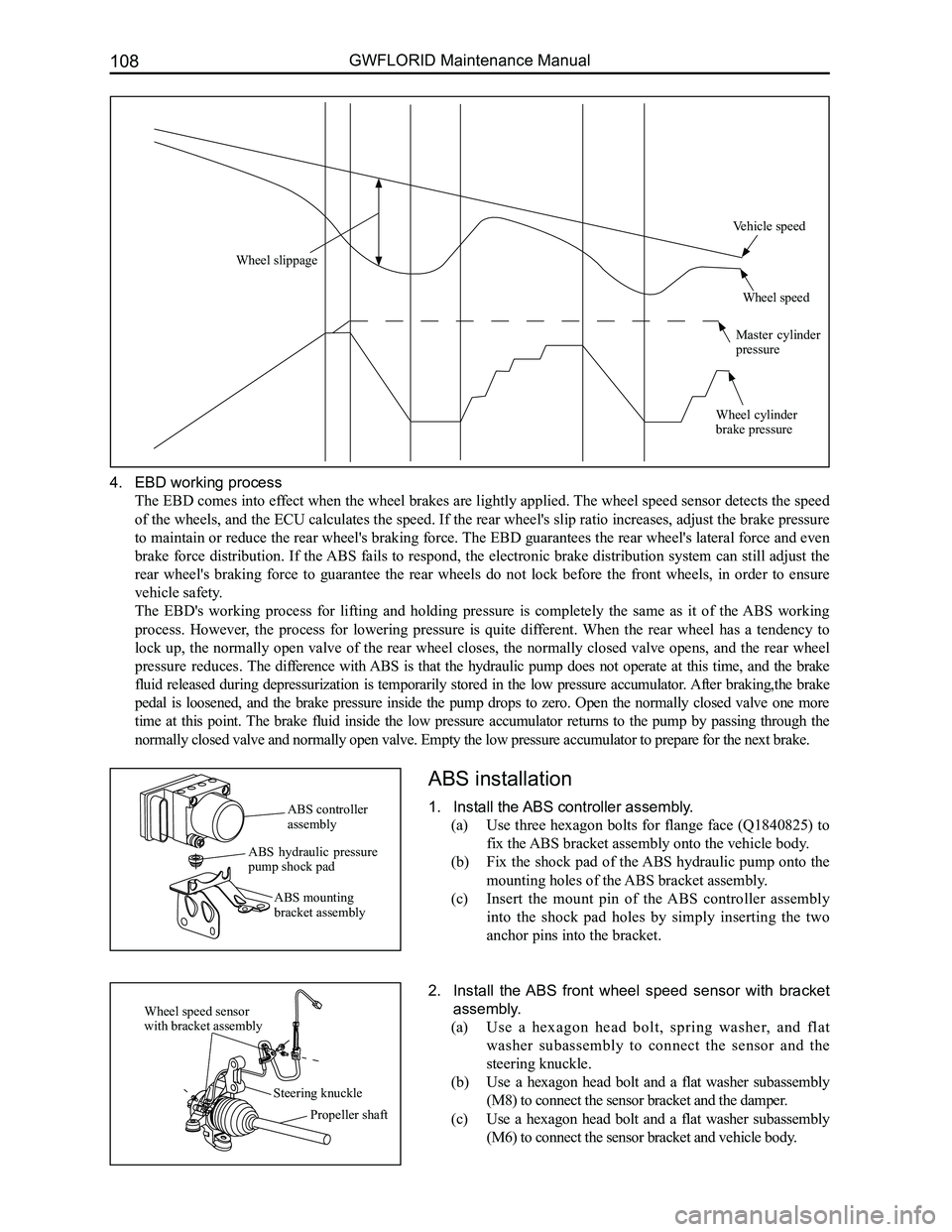
4. EBD working process
The EBD comes into effect when the wheel brakes are lightly applied. The wheel speed sensor detects the speed
of the wheels, and the ECU calculates the speed. If the rear wheel's slip ratio increases, adjust the brake pressure
to maintain or reduce the rear wheel's braking force. The EBD guarantees the rear wheel's lateral force and even
brake force distribution. If the ABS fails to respond, the electronic brake distribution system can still adjust the
rear wheel's braking force to guarantee the rear wheels do not lock before the front wheels, in order to ensure
vehicle safety.
The EBD's working process for lifting and holding pressure is completely the same as it of the ABS working
process. However, the process for lowering pressure is quite different. When the rear wheel has a tendency to
lock up, the normally open valve of the rear wheel closes, the normally closed valve opens, and the rear wheel
pressure reduces. The difference with ABS is that the hydraulic pump does not operate at this time, and the brake
fluid released during depressurization is temporarily stored in the low pressure accumulator. After braking,the brake
pedal is loosened, and the brake pressure inside the pump drops to zero. Open the normally closed valve one more
time at this point. The brake fluid inside the low pressure accumulator returns to the pump by passing through the
normally closed valve and normally open valve. Empty the low pressure ac\
cumulator to prepare for the next brake.
ABS installation
1. Install the ABS controller assembly.
(a) Use three hexagon bolts for flange face (Q1840825) to
fix the ABS bracket assembly onto the vehicle body.
(b) Fix the shock pad of the ABS hydraulic pump onto the
mounting holes of the ABS bracket assembly.
(c) Insert the mount pin of the ABS controller assembly
into the shock pad holes by simply inserting the two
anchor pins into the bracket.
2. Install the ABS front wheel speed sensor with bracket
assembly.
(a) Use a hexagon head bolt, spring washer, and flat
washer subassembly to connect the sensor and the
steering knuckle.
(b) Use a hexagon head bolt and a flat washer subassembly
(M8) to connect the sensor bracket and the damper.
(c) Use a hexagon head bolt and a flat washer subassembly
(M6) to connect the sensor bracket and vehicle body.
ABS controller assembly
ABS hydraulic pressure pump shock pad
ABS mounting bracket assembly
Wheel speed sensor with bracket assembly
Steering knuckle
Propeller shaft
Wheel slippage
Vehicle speed
Wheel speed
Master cylinder pressure
Wheel cylinder brake pressure
Page 129 of 281

Downloaded from www.Manualslib.com manuals search engine GWFLORID Maintenance Manual122
Front brake caliper assembly installation
1. Preparations
Make sure all parts are clean and free of foreign materials
before installation.When installing, apply an appropriate
amount of rubber grease to the guide pin and piston's
working surface, as well as the rectangular sealing ring and
the piston protective cover's working surface.
2. Install the rectangular sealing ring to the caliper.
(a) Screw the bleed screw into the caliper's vent holes.
Tightening torque: 10±2 N·m
(b) After applying an appropriate amount of rubber grease
on the rectangular sealing ring's working surface, install
them into the caliper's seal groove.
3. Install the piston with piston dust cover on the caliper.
(a) Place the piston dust cover on the piston.
(b) Stretch the piston dust cover, until its card holder
exposes the bottom of the piston. Use tools (for
example, about Ф2 mm of iron wire) to assist by
stuffing the card holder into the cylinder bore card
holder's groove.
Caution: The tools being used should not be sharp, as
to avoid tearing the dust cover.
(c) Then manually press the piston into the bottom of the
cylinder bore.
4. Install the guide pin and guide pin dust cover onto the
caliper frame.
(a) Install the guide pin dust cover onto the guide pin.
(b) Screw the guide pin into the caliper frame.
Caution: Do not damage the guide pin dust cover.
5. Install an inner and outer brake pad assembly and
inner and outer muffler plate subassembly.
6. Install the brake block yoke spring plate as well as the
inner and outer brake pad assembly and inner and
outer muffler plate subassembly on the caliper frame.
Guide pin
Guide pin dust cover
Caliper frameBrake block yoke spring plate
Air bleed screw cap
Air bleed screw Caliper
Inner muffler plate subassembly
Alarm plate
Inner brake pad assembly
Outer brake pad assembly
Outer muffler plate subassembly
Page 131 of 281

Downloaded from www.Manualslib.com manuals search engine GWFLORID Maintenance Manual124
Rear Brake
Components
4. Remove the rear brake drum.
Remark: If it is difficult to remove the rear brake drum,
follow the steps below:
Method one:
(a) Remove the rubber plug of the adjuster's observation
port, and insert a slotted screwdriver into the brake's
back plate assembly hole, and pry off the adjusting
paddle from the adjusting clearance wheel.
(b) Use another slotted screwdriver to toggle the adjusting
clearance wheel and loosen the brake's leading and
trailing shoe assembly's tension on the rear brake drum.
Disposable parts
Dust cover
Brake leading shoe assembly
Pressure spring
Pressure spring cap
Brake shoe tension spring
Rear brake drum
Lever rotating shaft
Retainer spring
Locking cap
Split ring
Brake lever
Brake trailing shoe assembly
Brake back plate assembly
Pressure spring bar
Rubber plug of the adjuster's observation port
Rubber plug of the observation port gap
Washer
Bleed screw cap
Bleed screwPiston
Ring cup
Piston spring
Wheel cylinder
Adjusting clearance shaft head
Adjusting clearance wheel
Adjusting clearance screw rod
Return springAdjusting paddle
Pin
Side spring
Dust cover
Piston
Ring cup
Rubber grease
: Specified torqueN·m
7.8-11.8
High temperature resistant grease
Rear brake removal
1. Inspecting the brake's friction plate thickness.
Remove the rubber plug of the observation port gap and
examine the friction plate thickness via the observation port.
If it's smaller than the minimum value, the brake's leading
and trailing shoe assemblies should be replaced.
Minimum thickness: 1.0 mm
2. Remove the rear wheel.
3. Release the brake fluid.
Caution: Be sure not to spill the brake fluid onto the
paint's surface. Otherwise it must be immediately
cleaned.
Page 133 of 281

Downloaded from www.Manualslib.com manuals search engine GWFLORID Maintenance Manual126
6. Remove the return spring and ratchet adjuster assem-
bly.
(a) Remove the adjusting clearance shaft head.
(b) Remove the adjusting clearance wheel.
(c) Remove the return spring.
7. Remove the parking brake lever.
(a) Remove the split ring with pliers.
(b) Remove the brake lever rotating shaft.
(c) Remove the brake lever.
Caution: If it is the riveted structure, there is no need to
remove the parking brake lever, instead of replace the
brake trailing shoe assembly.
8. Remove the brake wheel cylinder.
(a) Remove the brake line with a M10 open-end wrench,
and use a clean plug to clog it.
(b) Use a M8 open-end wrench to remove the two bolts, thus
removing the wheel cylinder assembly.
9. Remove the following parts from the wheel cylinder as-
sembly.
(a) Two dust covers.
(b) Two pistons.
(c) One piston spring.
(d) Bleed screw.
(e) Bleed screw cap.
Brake components inspection
and maintenance
1. Inspect the components after disassembly.
After disassembling the components, check them for wear
and tear, rust, and damage.
2. Measure the rear brake drum's internal diameter.
Standard internal diameter: Ф200 mm
Maximum internal diameter: Ф201 mm
Page 135 of 281

Downloaded from www.Manualslib.com manuals search engine GWFLORID Maintenance Manual128
Rear Brake Installation
1. Install the brake wheel cylinder.
(a) Apply a small amount of lithium grease onto two piston
assemblies.
(b) Install the wheel cylinder assembly.
• Install two dust covers onto the two piston assemblies.
• Install a piston spring and two piston components in the
wheel cylinder body.
R e m a r k : R e f e r t o t h e d i a g r a m f o r p r e c i s e i n s t a l l a t i o n
directions.
2. Install the wheel cylinder assembly.
(a) Use two bolts to install the wheel cylinder assembly
onto the brake back plate assembly.
Tightening torque: 7.8-11.8 N·m
(b) Connect the brake line to the wheel cylinder assembly.
Tightening torque: 16 N·m
3. Apply an appropriate amount of grease to the following
parts.
(a) Apply a small amount of high temperature resistant
grease on the brake back plate assembly and the brake
shoe connection's six convex plate surface.
Caution: Refer to the diagram for installation directions.
ForewardForeward
Left wheelRight wheel
Page 137 of 281

Downloaded from www.Manualslib.com manuals search engine GWFLORID Maintenance Manual130
7. Install the brake cable connector on the brake trailing
shoe with brake lever assembly.
(a) Install the brake cable connector on the brake trailing
shoe with brake lever assembly.
(b) Insert the brake trailing shoe with brake lever assembly
and the shoe end of the brake leading shoe assembly
into the wheel cylinder assembly.
Remark: Do not let oil or grease drip on the brake shoe's
lining.
8. Install the retainer spring.
9. Install the brake leading and trailing shoe assemblies
onto the brake back plate assembly.
(a) Insert the pressure spring bar into the brake back plate
assembly and brake leading and trailing shoe assemblies.
(b) Put the pressure spring on the pressure spring bar,
put in the pressure spring cap, and use SST (Special
Service Tools) to lock the pressure spring cap onto the
pressure spring bar.
10. Inspect the operating procedures of the automatic ad-
juster.
(a) Refer to the diagram for directions, step on and off the
brake pedal, and make sure the self-adjusting screws
can rotate. If they are unable to rotate, inspect the rear
brake to try to determine the source of the problem.
(b) Adjust the adjusting mechanisms length and make it as
short as possible.
(c) Install the rear brake drum.
(d) Press the brake pedal towards the floor until a clicking
noise cannot be heard.
11. Inspect the space between the brake's friction plate
and rear brake drum.
(a) Remove the rear brake drum.
(b) Measure the rear brake drum's internal diameter and
the brake shoe friction plate's external diameter, and
inspect if the difference between the two diameters is
within the regulated clearance range.
Single sided clearance: 0.25 mm
If not correct, inspect the braking system.
12. Install the rear wheel.
Tightening torque: 100 N·m
13. Fill the brake fluid reservoir up with brake fluid and
exhaust the air out of the brake system.
14. Check for leaking brake fluid
SST
Page 162 of 281

Downloaded from www.Manualslib.com manuals search engine 155Vehicle Body Electronic System
Condenser fan motor
Connected compressor
Oil pressure switch
Front oxygen sensor
Connected reverse switch
Connected engine speed sensor Connected
ignition coil
Connected speed sensor Connected coolant temp. sensor
Canister control valve
Connected combination meter A
Connected antenna
Diagnostic port
Connected AC switch Connected air conditioner temperature sensor
Front passenger side airbag
Connected speed adjustive resistance, blower
Front window regulator RH
Front window regulator switch RH
Front medium woofer RH
Front tweeter LH Right outer electric mirror
Front passenger side central door lock switch
Front door lamp switch RH
Front passenger seat belt pretensioner Front door lock motor RH
Ground
plate 3
Connected cigarette lighter (lighting)
Connected cigarette lighter
Front passenger seat belt switch
Connected parking brake switch Connected air conditioner governor & front
passenger seat belt unfastened indicator lamp
Connected CD player
Connected engine ECUConnected ground P1#
Connected ground P2#
Connected starter
Connected knock sensor
Connected starter field coil
Connected inlet
temperature pressure
sensor
connected
electronic throttle
Rear oxygen sensor
Connected 4th
cylinder injection
nozzle
Connected 3rd
cylinder injection
nozzle
Connected 2nd
cylinder injection
nozzle
Connected 1st
cylinder
injection nozzle
Connected generator
Connected engine armature Connected front combination lamp RH
Connected front fog lamp RH
Connected rear washer motor
Connected front washer motor
Connected front wheel speed sensor RH
Right ground
Connected A/C pressure switch
Connected phase sensor
Connected low
pitched horn
Connected front
combination lamp LH
Rediator fan motor
Connected front
fog lamp LH
Connected high pitched horn
Battery
negative
Body
ground
Battery
Left ground Connected
brake lamp
switch Connected brake fluid warning switch
Connected theft deterrent indicator Theft deterrent ECU 1Connected lock
cylinder lightConnected ignition
switch (white)
The key is inserted into the switch
Right combination switch (wiper) Connected airbag ECU (yellow)Ground
plate 2
Ground
plate 4
Connected accelerator pedal
Ground plate 1
Left outer electric mirror
Front medium woofer LH Front door lock motor LH
Rear medium woofer LH
Rear window regulator switch LH
Rear door lock motor LH Rear door lamp switch LH
Ground point ACapacitor
Vehicle power supply
Rear fog lamp LH Left license plate lamp
High mounted brake lamp
Ground point Trunk opener switch
Trunk motorRear wiper motor
Rear windshield defroster “-”
Trunk lamp switch Right license plate lamp
Rear fog lamp RH
Rear combination lamp RHRear wheel speed sensor RH
Rear window
regulator RH
Rear window
regulator switch RH
Rear door lock motor RH
Rear door lamp switch RH Rear medium woofer RH
Ground point B
Rear combination lamp LH
Rear windshield defroster “+”
Rear wheel speed
sensor LH
Rear window regulator LH
Fuel pump, fuel sensor
Rear interior dome lamp
Front door lamp
switch LH
Driver seat belt pretensioner Driver seat belt switch
Front tweeter LH
Connected light brightness regulator switch
Connected rearview mirror switch (white)
Connected glove box lamp
Front window regulator LH Left combination switch (light)
Connected main airbag, horn switch
Window regulator mainly
control switch, central door
lock mainly control switch Connected central door lock controller (white)
Connected front wiper motor
Connected clutch
switch
Connected ABS ECUBattery
positive
Connected front wheel
speed sensor LH Engine groud
Starter connect to
battery positive
Generator connect to
battery positive
Wire Harness Relationship and Plug-in Connections Numbered Diagram
Page 180 of 281

Downloaded from www.Manualslib.com manuals search engine 173Vehicle Body Electronic System
Engine
Connected generator
Canister control valve
Rear oxygen sensor
1st cylinder injection nozzle
Phase sensor Electronic throttle AC pressure switchConnected clutch switch
Air conditioner
temperature sensor
Connected accelerator pedal Front oxygen sensorRear oxygen sensorKnock sensorCondenser fan motor
Connected brake lamp switch
Engine ECU
2nd cylinder injection
nozzle 3rd cylinder injection
nozzle 4th cylinder injection
nozzle Connected oil
pressure switch Canister control
valve
Front oxygen sensor
Inlet pressure & tem. sensor
Coolant temperature sensor Accelerator pedal module Electronic throttle AC temperature
sensor Knock sensor
Engine speed sensor
Phase sensor
Fuel pump relay
Connected combination meter Connected speed sensor
Engine malfunction indicator lamp Engine service indicator lamp
Compressor relay
Compressor clutch
Central pressure switch Starter relay 86
Connected AC switch AC pressure switch
Connected brake lamp switch
Connected brake lamp switch Condenser fan
Rediator fan Fan relay lowScanner
Fan relay high
Connected airbag
Connected theft deterrent controller A8
Connected
combination meter
Ignition coil
Coolant temperature sensor
Rediator fan motor
Engine speed sensor Wheel speed sensor
Fuel pump, fuel sensor Inlet temperature
pressure sensor
Connected ABS
Spark plug
Fuel pump
Electric control module
Ignition coil
Main relay
Injection nozzle
IG1 relay