2008 GREAT WALL FLORID oil level
[x] Cancel search: oil levelPage 191 of 281

Downloaded from www.Manualslib.com manuals search engine GWFLORID Maintenance Manual184
Power Windows
The GWFLORID electric power window actuator consist of a motor and module. Its functions include: jam
protection, centralized control rise, soft-stop, characterized by easy control, long life, etc.
The functions of electric power window actuator
1. Jam protection
Power windows have an jam protection function when manually or automatically rising after it has been
initialized. There is no limit on the amount of jam protections. When room temperature is 25±5oC, wire
resistance 150 mΩ and 14.5 V working voltage, the jam protection force risen glass is less than 100 N. When the
window is manually or electrically rising, once it encounters a force greater than the jam protection force, the glass
will immediately stop rising and make the motor rotate in reverse. Rever\
se rotation distance is about 125 mm.
2. Centralized control rise
The central door lock controller provides four lifters with a low level signal. The power windows will close until
they are completely closed. This enables the two power window actuators to start separately, which can avoid
hitting peak currents if they start up at the same time. As long as the centralized controller's rising pin receives
the low level signal, the motor will close the window until it is comple\
tely closed.
3. Soft-stop
If the motor suffers from an impacting block when the window is rolled all the way up or all the way down, it
would shorten the power window actuator's use life. In order to avoid this, the soft-stop function must be used,
in which both manual and automatic rolling up and down should have this \
function.
(a) Soft close function:
When the window is about to get to the top, that is to say, when it's rising to the soft-stop point, the engine's
power will cut off to make the motor stop working, meanwhile the rising inertia will continue to roll the
window up to the top. The soft-stop point is about 2 mm under the top limiting position.
(b) When the window is about to lower to the bottom, that is to say, when it's lowering to the soft-stop point,
the engine's power will cut off to make it stop working, meanwhile the lowering inertia will continue to roll
the window down to the bottom. The soft-stop point is about 12 mm above the bottom limiting position.
(c) Zero position calibration: This position takes the top limiting position as the zero position. In order to
guarantee reliable and safer system operation while in use, the zero pos\
ition will need constant calibration.
Manual calibration: When the window stops at the rising soft-stop position after rising for a period,
press the rise button so it will rise to the limiting position. Zero cal\
ibration is then complete.
Automatic calibration: After the motor runs forward and reverse more than 20 times, it will undergo
zero position calibration one time. That is to say, when it completely starts or stops operating, the motor will
be blocked one time. Currently, there is no soft close or start-up function. Zero position calibration is com-
pleted when the window is completely closed to the limiting position.
4. Motor locked protection
The control module will cut off the power supply to stop the motor from working within 250 ms of the l\
ocking.
5. Motor temperature protection
When the control module is powered on, the initial temperature of the motor is set at 40oC. There are two
temperature limits for the motor's thermal protection function. If the temperature of the coil exceeds the first
temperature limit (170oC), the motor will not respond to any new operation input, but it will still complete the present
operation. If the motor's temperature exceeds the first temperature limit during its operation, it will keep working until
the temperature of the motor coil reaches the second temperature limit (190oC), then the motor will not be limited by
the second temperature's threshold while reversing, so as to guarantee the safety of the users. Once the temperature of
the motor has lowered below the temperature limit, the motor will work normally.
6. Self-diagnostic protection function
So as to guarantee the system's reliability while improving the system's average non-failure time, self-diagnostic
protection measures are used: If the power supply voltage exceeds 16 V, the control module will close the auto-
rising function.
(a) Switch contact point adhesion:
If it is detected that the switch contact point adhesion has reached up to 10 m input instructions will no
longer be received. If later the switch contact is detected to be disconnected again, it's function will return
to normal.
(b) Relay contact point adhesion:
The power window actuator is controlled by two contact point relays.
After a shutoff command is sent to one of the relays, if the system detects that this relay is still on, then
the system will choose this relay contact point for adhesion. Thereupon, the system will send out another
command to make the other electric relay switch on as well, so as to guarantee the motor's power supply is
Page 210 of 281

Downloaded from www.Manualslib.com manuals search engine 203Air Conditioning System
Areas of Importance
1. When putting in a new compressor, adjust the new compressor's inner lubricant to make it the same
level as of the old compressor's.
2. When the air conditioner malfunctions, if the pipeline, condenser or evaporator is the source of the
damage leading to its replacement, just add model number RS20 profession\
al lubricant 5-10 ml.
3. The compressor is a high speed operating component, the smallest impurity in the air conditioning
system can lead to the compressor's damage, therefore the entire air conditioning system must be
cleaned.
4. In order to avoid liquid damage to the compressor, pay careful attention when filling the refrigerant.
When the vehicle stopped, fill the liquid refrigerant from the high pressure side. When in operation, fill
the liquid refrigerant from the low pressure side.
5. When undergoing maintenance, pay attention that the amount of refrigerant being added is 510±10 g.
Observe through the check glass to determine if there is sufficient new refrigerant charge.
ItemParameter
Compressor
ModelRotary vane compressor (JSS-96TV4-4)
Discharge capacity96 ml/r
Number of vanes5
Normal rotational speed range800-7800 r/min
Max. speed8400 r/min
Weight4.744 kg (without clutch)
Pressure resistanceLow pressure side 50 kg/cm2, High pressure
side 75 kg/cm2
Leakage≤14 g/year
Direction of rotationClockwise (looking from the clutch)
RefrigerantR134a
Lubricant numberRS20
Lubricant capacity 200±10 ml
Clutch
Min. pull-in voltage7.5 V (12 V)
Pulley style 4PK810
Weight2.1 kg
Rated voltage12 V (DC)
Power consumption≤45W (20oC DC 12 V)
Static friction torque≥40 N·m
Pulley diameterφ110 mm
Coil resistance(3.5±5%) Ω
Thermal protectorOperating temperatureOn / Off (130±5)oC/(150±5)oC
Rated voltage, current16 V, 5 A
Technical Parameters
Page 219 of 281
Downloaded from www.Manualslib.com manuals search engine GWFLORID Maintenance Manual212
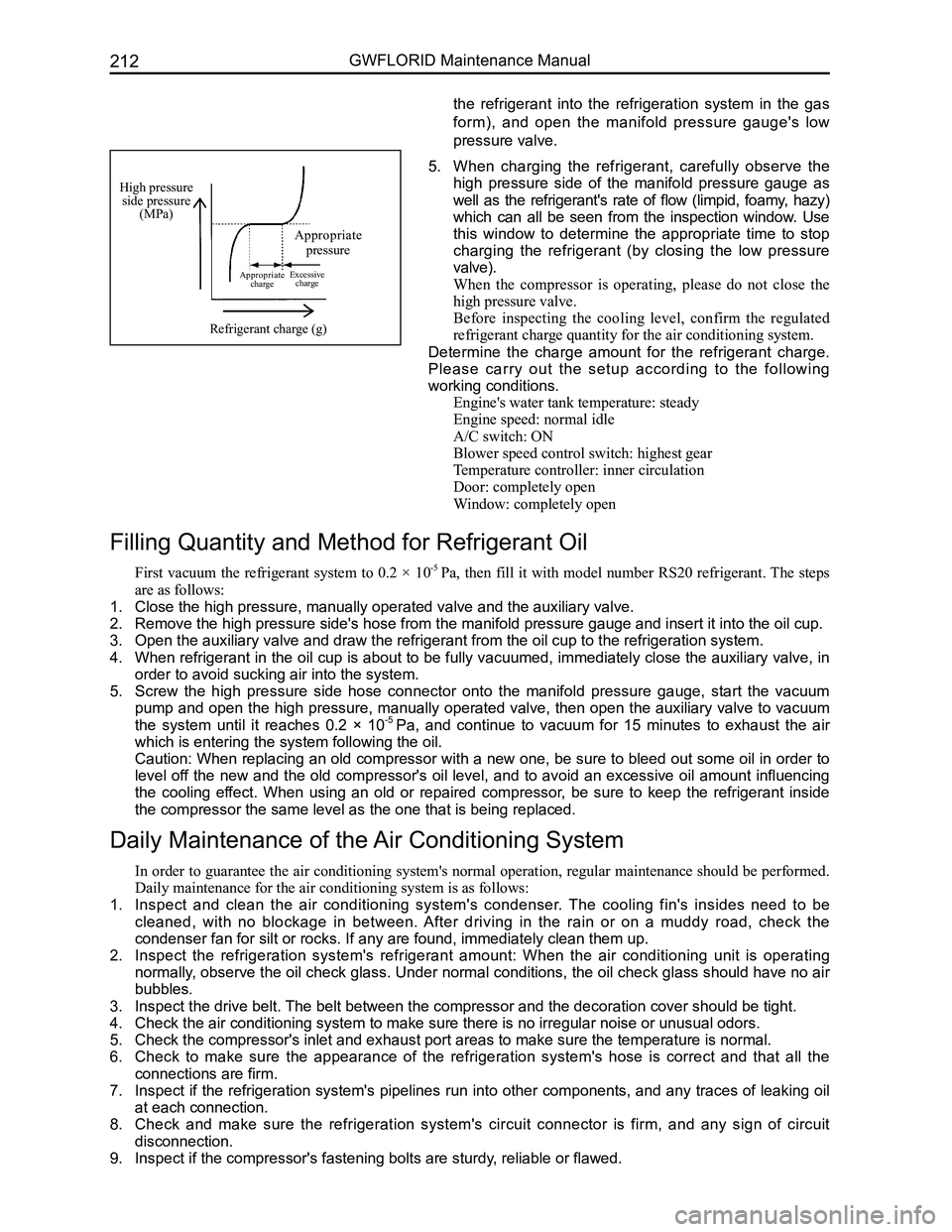
High pressure side pressure(MPa)
Appropriate pressure
Appropriate chargeExcessive charge
Refrigerant charge (g)
5. When charging the refrigerant, carefully observe the
high pressure side of the manifold pressure gauge as
well as the refrigerant's rate of flow (limpid, foamy, hazy)
which can all be seen from the inspection window. Use
this window to determine the appropriate time to stop
charging the refrigerant (by closing the low pressure
valve).
When the compressor is operating, please do not close the
high pressure valve.
Before inspecting the cooling level, confirm the regulated
refrigerant charge quantity for the air conditioning system.
Determine the charge amount for the refrigerant charge.
Please carry out the setup according to the following
working conditions.
Engine's water tank temperature: steady
Engine speed: normal idle
A/C switch: ON
Blower speed control switch: highest gear
Temperature controller: inner circulation
Door: completely open
Window: completely open
Filling Quantity and Method for Refrigerant Oil
First vacuum the refrigerant system to 0.2 × 10⁻⁵ Pa, then fill it with model number RS20 refrigerant. The steps
are as follows:
1. Close the high pressure, manually operated valve and the auxiliary valve\
.
2. Remove the high pressure side's hose from the manifold pressure gauge an\
d insert it into the oil cup.
3. Open the auxiliary valve and draw the refrigerant from the oil cup to th\
e refrigeration system.
4. When refrigerant in the oil cup is about to be fully vacuumed, immediately close the auxiliary valve, in
order to avoid sucking air into the system.
5. Screw the high pressure side hose connector onto the manifold pressure gauge, start the vacuum
pump and open the high pressure, manually operated valve, then open the auxiliary valve to vacuum
the system until it reaches 0.2 × 10⁻⁵ Pa, and continue to vacuum for 15 minutes to exhaust the air
which is entering the system following the oil.
Caution: When replacing an old compressor with a new one, be sure to bleed out some oil in order to
level off the new and the old compressor's oil level, and to avoid an excessive oil amount influencing
the cooling effect. When using an old or repaired compressor, be sure to keep the refrigerant inside
the compressor the same level as the one that is being replaced.
Daily Maintenance of the Air Conditioning System
In order to guarantee the air conditioning system's normal operation, regular maintenance should be performed.
Daily maintenance for the air conditioning system is as follows:
1. Inspect and clean the air conditioning system's condenser. The cooling fin's insides need to be
cleaned, with no blockage in between. After driving in the rain or on a muddy road, check the
condenser fan for silt or rocks. If any are found, immediately clean the\
m up.
2. Inspect the refrigeration system's refrigerant amount: When the air conditioning unit is operating
normally, observe the oil check glass. Under normal conditions, the oil check glass should have no air
bubbles.
3. Inspect the drive belt. The belt between the compressor and the decoration cover should be tight\
.
4. Check the air conditioning system to make sure there is no irregular noi\
se or unusual odors.
5. Check the compressor's inlet and exhaust port areas to make sure the tem\
perature is normal.
6. Check to make sure the appearance of the refrigeration system's hose is correct and that all the
connections are firm.
7. Inspect if the refrigeration system's pipelines run into other components, and any traces of leaking oil
at each connection.
8. Check and make sure the refrigeration system's circuit connector is firm, and any sign of circuit
disconnection.
9. Inspect if the compressor's fastening bolts are sturdy, reliable or flawed.
the refrigerant into the refrigeration system in the gas
form), and open the manifold pressure gauge's low
pressure valve.