2008 CHEVROLET CORVETTE child seat
[x] Cancel search: child seatPage 56 of 432

The passenger sensing system will turn off the right
front passenger’s frontal airbag and seat-mounted side
impact airbag (if equipped) under certain conditions.
The driver’s airbags are not part of the passenger
sensing system.
The passenger sensing system works with sensors that
are part of the right front passenger’s seat. The sensors
are designed to detect the presence of a properly-seated
occupant and determine if the right front passenger’s
frontal airbag and seat-mounted side impact airbag
should be enabled (may inate) or not.
Accident statistics show that children are safer if they are
restrained in the rear rather than the front seat. We
recommend that rear-facing child restraints not be
transported in your vehicle, even if the airbags are off.
A label on your sun visor says, “Never put a rear-facing
child seat in the front.” This is because the risk to the
rear-facing child is so great, if the airbag deploys.
{CAUTION:
A child in a rear-facing child restraint can be
seriously injured or killed if the right front
passenger airbag inates. This is because the
back of the rear-facing child restraint would be
very close to the inating airbag. A child in a
forward-facing child restraint can be seriously
injured or killed if the right front passenger
airbag inates and the passenger seat is in a
forward position.
Even if the passenger sensing system has
turned off the right front passenger frontal
airbag and seat-mounted side impact airbag
(if equipped), no system is fail-safe. No one
can guarantee that an airbag will not deploy
under some unusual circumstance, even
though the airbag(s) are off.
Secure rear-facing child restraints in a rear
seat, even if the airbag(s) are off. If you secure
a forward-facing child restraint in the right
front seat, always move the front passenger
seat as far back as it will go. It is better to
secure the child restraint in a rear seat.
1-52
Page 57 of 432
The passenger sensing system is designed to turn
off the right front passenger’s frontal airbag and
seat-mounted side impact airbag (if equipped) if:
The right front passenger seat is unoccupied.
The system determines that an infant is present in
a rear-facing infant seat.
The system determines that a small child is present
in a child restraint.
The system determines that a small child is present
in a booster seat.
A right front passenger takes his/her weight off of
the seat for a period of time.
The right front passenger seat is occupied by a
smaller person, such as a child who has outgrown
child restraints.
Or, if there is a critical problem with the airbag
system or the passenger sensing system.
When the passenger sensing system has turned off the
right front passenger’s frontal airbag and seat-mounted
side impact airbag (if equipped), the off indicator will
light and stay lit to remind you that the airbags are off.
SeePassenger Airbag Status Indicator on page 3-38.If a child restraint has been installed and the on indicator
is lit, turn the vehicle off. Remove the child restraint from
the vehicle and reinstall the child restraint following the
child restraint manufacturer’s directions and refer to
Securing a Child Restraint in the Right Front Seat
Position on page 1-39.
If, after reinstalling the child restraint and restarting the
vehicle, the on indicator is still lit, check to make
sure that the vehicle’s seatback is not pressing the child
restraint into the seat cushion. If this happens, slightly
recline the vehicle’s seatback and adjust the seat
cushion if possible.
Remove any additional material from the seat such as
blankets, cushions, seat covers, seat heaters, or
seat massagers before reinstalling or securing the child
restraint.
If the on indicator is still lit, do not install a child restraint
in this vehicle and check with your dealer/retailer.
The passenger sensing system is designed to enable
(may inate) the right front passenger’s frontal airbag and
seat-mounted side impact airbag (if equipped) anytime
the system senses that a person of adult size is sitting
properly in the right front passenger’s seat. When the
passenger sensing system has allowed the airbags to be
enabled, the on indicator will light and stay lit to remind
you that the airbags are active.
1-53
Page 58 of 432

For some children who have outgrown child restraints
and for very small adults, the passenger sensing system
may or may not turn off the right front passenger’s
frontal airbag and seat-mounted side impact airbag
(if equipped), depending upon the person’s seating
posture and body build. Everyone in your vehicle who
has outgrown child restraints should wear a safety
belt properly — whether or not there is an airbag for
that person.
If a person of adult-size is sitting in the right front
passenger’s seat, but the off indicator is lit, it could be
because that person is not sitting properly in the seat.
If this happens, turn the vehicle off, remove any
additional material from the seat, such as blankets,
cushions, seat covers, seat heaters or seat massagers
and ask the person to place the seatback in the fully
upright position, then sit upright in the seat, centered
on the seat cushion, with the person’s legs comfortably
extended. Restart the vehicle and have the person
remain in this position for two to three minutes.
This will allow the system to detect that person and
then enable the right front passenger’s frontal airbag
and seat-mounted side impact airbag (if equipped).Safety belts help keep the passenger in position on the
seat during vehicle maneuvers and braking, which
helps the passenger sensing system maintain the
passenger airbag status. See “Safety Belts” and “Child
Restraints” in the Index for additional information
about the importance of proper restraint use.
1-54
Page 59 of 432
If you ever pull the shoulder portion of the belt out all
the way, you will engage the child restraint locking
feature. This may unintentionally cause the passenger
sensing system to turn the airbag(s) off for some
adult size occupants. If this happens, just let the belt go
back all the way and start again.
{CAUTION:
If the airbag readiness light in the instrument
panel cluster ever comes on and stays on,
it means that something may be wrong with
the airbag system. If this ever happens, have
the vehicle serviced promptly, because an
adult-size person sitting in the right front
passenger’s seat may not have the protection
of the airbag(s). SeeAirbag Readiness Light
on page 3-37for more on this, including
important safety information.A thick layer of additional material, such as a blanket
or cushion, or aftermarket equipment such as seat
covers, seat heaters, and seat massagers can affect
how well the passenger sensing system operates.
We recommend that you not use seat covers or other
aftermarket equipment other than any that GM has
approved for your specic vehicle. SeeAdding
Equipment to Your Airbag-Equipped Vehicle on
page 1-56for more information about modications
that can affect how the system operates.
{CAUTION:
Stowing of articles under the passenger seat
or between the passenger seat cushion and
seatback may interfere with the proper
operation of the passenger sensing system.
1-55
Page 174 of 432
Passenger Airbag Status Indicator
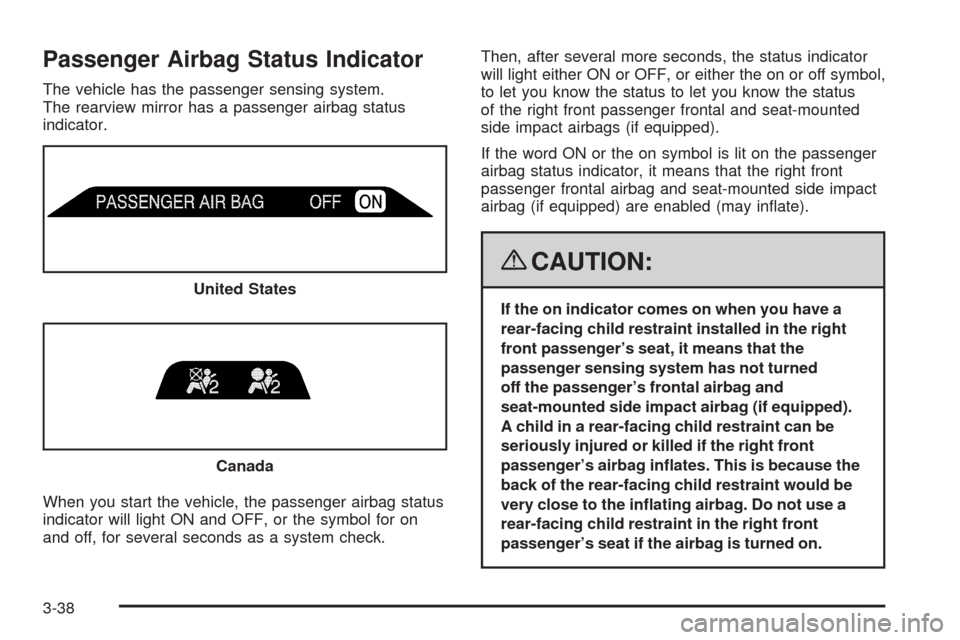
The vehicle has the passenger sensing system.
The rearview mirror has a passenger airbag status
indicator.
When you start the vehicle, the passenger airbag status
indicator will light ON and OFF, or the symbol for on
and off, for several seconds as a system check.Then, after several more seconds, the status indicator
will light either ON or OFF, or either the on or off symbol,
to let you know the status to let you know the status
of the right front passenger frontal and seat-mounted
side impact airbags (if equipped).
If the word ON or the on symbol is lit on the passenger
airbag status indicator, it means that the right front
passenger frontal airbag and seat-mounted side impact
airbag (if equipped) are enabled (may inate).
{CAUTION:
If the on indicator comes on when you have a
rear-facing child restraint installed in the right
front passenger’s seat, it means that the
passenger sensing system has not turned
off the passenger’s frontal airbag and
seat-mounted side impact airbag (if equipped).
A child in a rear-facing child restraint can be
seriously injured or killed if the right front
passenger’s airbag inates. This is because the
back of the rear-facing child restraint would be
very close to the inating airbag. Do not use a
rear-facing child restraint in the right front
passenger’s seat if the airbag is turned on. United States
Canada
3-38
Page 175 of 432

{CAUTION:
Even though the passenger sensing system is
designed to turn off the right front passenger’s
frontal airbag and seat-mounted side impact
airbag (if equipped) if the system detects a
rear-facing child restraint, no system is
fail-safe, and no one can guarantee that an
airbag will not deploy under some unusual
circumstance, even though it is turned off.
We recommend that rear-facing child restraints
be secured in a rear seat, even if the airbag is
or airbags are off.
If the word OFF or the off symbol is lit on the passenger
airbag status indicator, it means that the passenger
sensing system has turned off the right front passenger
frontal airbag and seat-mounted side impact airbag
(if equipped). SeePassenger Sensing System on
page 1-51for more on this, including important safety
information.If, after several seconds, both status indicator lights
remain on, or if there are no lights at all, there may be
a problem with the lights or the passenger sensing
system. See your dealer/retailer for service.
{CAUTION:
If the airbag readiness light in the instrument
panel cluster ever comes on and stays on, it
means that something may be wrong with the
airbag system. If this ever happens, have the
vehicle serviced promptly, because an
adult-size person sitting in the right front
passenger’s seat may not have the protection
of the airbag(s). SeeAirbag Readiness Light
on page 3-37for more on this, including
important safety information.
3-39
Page 271 of 432
If you put things inside your vehicle — like
suitcases, tools, packages or anything else — they
will go as fast as the vehicle goes. If you have to
stop or turn quickly, or if there is a crash, they will
keep going.
{CAUTION:
Things you put inside your vehicle can
strike and injure people in a sudden stop
or turn, or in a crash.
Put things in the rear area of your
vehicle. Try to spread the weight
evenly.
Never stack heavier things, like
suitcases, inside the vehicle so that
some of them are above the tops of
the seats.
Do not leave an unsecured child
restraint in your vehicle.
When you carry something inside the
vehicle, secure it whenever you can.
Towing
Towing Your Vehicle
The vehicle was neither designed nor intended to be
towed with any of its wheels on the ground.
Consult your dealer/retailer or a professional towing
service if the disabled vehicle needs to be towed.
SeeRoadside Assistance Program on page 7-8.
Notice:Dolly towing or dinghy towing your vehicle
may cause damage because of reduced ground
clearance. Always put your vehicle on a atbed truck.
Recreational Vehicle Towing
Notice:Dolly towing or dinghy towing your vehicle
may cause damage because of reduced ground
clearance. Always put your vehicle on a atbed truck.
The vehicle was neither designed nor intended to be
towed with any of its wheels on the ground. If the vehicle
must be towed, see “Towing Your Vehicle” earlier in this
section.
Towing a Trailer
Your vehicle is neither designed nor intended to tow
a trailer.
4-29
Page 421 of 432

Checking Things Under the Hood......................5-12
Chemical Paint Spotting...................................5-96
Child Restraints
Child Restraint Systems...............................1-34
Infants and Young Children...........................1-30
Lower Anchors and Tethers for
Children..........................................1-36, 1-39
Older Children.............................................1-26
Securing a Child Restraint in the
Right Front Seat Position..........................1-39
Cigarette Lighter.............................................3-25
Cleaning
Aluminum or Chrome-Plated Wheels..............5-94
Cargo Cover and Convenience Net................5-90
Coated Moldings.........................................5-89
Convertible Top...........................................5-94
Exterior Lamps/Lenses.................................5-91
Fabric/Carpet..............................................5-88
Fiberglass Springs.......................................5-96
Finish Care.................................................5-92
Instrument Panel, Vinyl, and Other Plastic
Surfaces.................................................5-90
Interior.......................................................5-87
Leather......................................................5-89
Removable Roof Panel.................................5-93
Tires..........................................................5-95
Underbody Maintenance...............................5-96Cleaning (cont.)
Washing Your Vehicle...................................5-91
Weatherstrips..............................................5-91
Windshield and Wiper Blades........................5-93
Climate Control System
Air Filter, Passenger Compartment.................3-32
Dual Automatic............................................3-26
Outlet Adjustment........................................3-32
Clock, Setting.................................................3-85
Clutch, Hydraulic.............................................5-27
Collision Damage Repair..................................7-12
Compass
...............................................2-37, 2-39
Competitive Driving, Racing or Other.................4-15
Control of a Vehicle.......................................... 4-3
Convenience Net............................................2-55
Convertible Top......................................2-62, 2-68
Coolant
Engine.......................................................5-28
Engine Temperature Gage............................3-44
Surge Tank Pressure Cap.............................5-31
Cooling System..............................................5-34
Courtesy Lamps.............................................3-19
Cruise Control................................................3-11
Cupholders....................................................2-53
Customer Assistance Information
Courtesy Transportation................................7-11
Customer Assistance for Text
Telephone (TTY) Users............................... 7-6
Customer Assistance Offices........................... 7-6
3