2008 AUDI S5 headlights
[x] Cancel search: headlightsPage 69 of 294
Downloaded from www.Manualslib.com manuals search engine Lights and vision67
Controls
Safety
Driving tips
General maintenance
Self-help
Technical data Memory for exterior mirrors*
On vehicles with memory function for the driver's seat, the setting
of the exterior mirrors is automatically stored together with the seat
position ⇒page 72.
Tilting function for exterior mirror on passenger side*
(only if equipped with memory for exterior mirrors)
When reverse gear is engaged, the mirror surface tilts slightly
downwards, provided the mirror control is switched to the exterior
mirror on the passenger's side (knob in position ⇒page 66,
fig. 68). This provides a better view of the kerb when parking.
The mirror returns to its original position when reverse gear is
disengaged and the vehicle is driven forwards at a speed above
about 15 km/h. The mirror will also return to its original position
when the adjuster knob is turned to the position for the driver's
exterior mirror or when the ignition is switched off.
If the position of the mirror surface is changed while the mirror is
tilted, this new position is automatically stored and assigned to the
remote control key when you disengage reverse gear.
Caution
•
Convex or wide-angle* exterior mirrors give a larger field of
vision. However, they also make objects appear further away than
they actually are. For this reason, you should not rely on these
mirrors for judging the distance of vehicles behind.
•
If one of the mirror housings is knocked out of position (e.g.
when parking), the mirrors must first be fully retracted with the elec-
tric control. Do not readjust the mirror housing by hand, as this will
interfere with the mirror adjuster function.Note
If the electrical adjustment should ever fail to operate, the mirrors
can be adjusted by hand by lightly pressing the edge of the mirror
glass.
Applies to vehicles: with automatic anti-dazzle adjustment for exterior mirrorsAutomatic anti-dazzle adjustment for exterior mirrorsThe exterior mirrors darken together with the automatically
adjusting interior mirror. When the ignition is on, the mirrors will
darken automatically according to the amount of light received (for
example from the headlights of a vehicle behind).
When the interior lights are switched on, or when reverse gear is
engaged, the mirrors revert to their original (i.e. not darkened)
condition.
WARNING
Electrolyte fluid can leak from a broken mirror. This fluid can cause
irritation to the skin, eyes, and respiratory organs. Wash thor-
oughly with clean water should you come into contact with this
fluid. Seek medical assistance if needed.
Caution
Electrolyte fluid leaking from a broken mirror can cause damage to
the paintwork or plastic surfaces. Use a sponge or similar to remove
the fluid as soon as possible.
Note
•
If you switch off the anti-dazzle function for the interior mirror,
this will also deactivate the anti-dazzle function for the exterior
mirrors.
•
The automatic anti-dazzle function will only work properly if the
sun blind* for the rear window is not in use and there are no other
objects preventing light from reaching the interior mirror.
AR
AL
document_0900452a81793dcc.book Seite 67 Mittwoch, 21. März 2007 5:42 17
Page 197 of 294
Downloaded from www.Manualslib.com manuals search engine Your vehicle and the environment195
Controls
Safety
Driving tips
General maintenance
Self-help
Technical data
Your vehicle and the environmentRunning inA new vehicle should be run in over a distance of 1,500 km. For the
first 1,000 km the engine speed should not exceed 2/3 of the
maximum permissible engine speed – do not use full throttle and do
not tow a trailer or caravan. From 1,000 to 1,500 km you can gradu-
ally increase the engine rpm and road speed.
During its first few hours of running, the internal friction in the
engine is greater than later on when all the moving parts have
bedded down.
How the vehicle is driven for the first 1,500 km also influences the
engine quality. After the first 1,500 km you should continue driving
at moderate engine speeds, in particular when the engine is cold.
This helps to reduce wear and tear on the engine and increases the
potential mileage which can be covered by the engine.
You should also avoid driving with the engine speed too low.
Change down to a lower gear when the engine no longer runs
“smoothly”. Excessively high engine speeds are prevented by an
automatic rev limiter.Catalytic converterThe vehicle must only be used with unleaded petrol, otherwise the
catalytic converter will be destroyed.
Never run the tank completely dry. The irregular fuel supply can
cause misfiring, which would allow unburnt fuel to enter the
exhaust system, which could cause overheating and damage the
catalytic converter.
WARNING
•
Because of the high temperatures which can occur in the cata-
lytic converter, do not park the vehicle where the catalytic
converter can come into contact with flammable materials under
the car (e.g. on grass or at the forest edge). - Fire hazard!
•
Do not apply any underseal agents in the area around the
exhaust system - fire hazard!
Driving abroadChanging over headlight dip settings
The asymmetric low beams of the headlights are designed to light
up the near side of the road more intensely. If you drive in a country
where traffic drives on the opposite side of the road to the home
country, this will dazzle oncoming traffic. The headlight dip settings
must be changed to avoid dazzling oncoming traffic. For safety
reasons, the dip settings may only be changed by a qualified work-
shop.
For further information, please consult an Audi dealer or other qual-
ified workshop.
Unleaded petrol
A car with catalytic converter must not be run with leaded petrol
⇒page 195. Before driving abroad make sure that unleaded petrol
is available there.
document_0900452a81793dcc.book Seite 195 Mittwoch, 21. März 2007 5:42 17
Page 213 of 294
Downloaded from www.Manualslib.com manuals search engine Care of vehicle and cleaning211
Controls
Safety
Driving tips
General maintenance
Self-help
Technical data
WARNING
•
Do not wash the vehicle with the ignition switched on – risk of
accident.
•
Do not clean the underside of the car or inside the wheel arches
without protecting your hands and arms. You may cut yourself on
sharp metal parts.
•
Take care when washing the car during the winter: moisture
and ice on the brakes may affect braking efficiency – this could
cause an accident.Caution
•
Do not wash the vehicle in direct sunlight – otherwise the paint
can be damaged.
•
Do not use insect sponges, or abrasive household sponges, etc.
– they can damage the surfaces.
•
The headlights should only be washed with water – do not wipe
them with a dry cloth or sponge. It is best to use soapy water.
•
Never wash tyres with a jet that sprays the water out in a direct
stream. This could damage the tyres – even if the spray is kept at a
distance and only used for a very short time.For the sake of the environment
The car should only be washed in special wash bays. This prevents
oily water from getting into the public drains. In some districts,
washing vehicles anywhere else may be prohibited.Waxing and polishingWaxing
Waxing protects the paintwork. It is time to apply a good coat of wax
when water no longer forms droplets and rolls off the clean paint-
work.Even if a wax solution is used regularly in the car wash, it is advis-
able to protect the paint with a coat of wax at least twice a year.
In the summer, you will find it is much easier to remove dead insects
(which accumulate on the bumper and the front of the bonnet) if the
car has been waxed recently.
Polishing
Polishing is only necessary if the paint has lost its shine, and the
gloss cannot be brought back by putting on wax.
The car must be waxed after polishing if the polish used does not
contain wax compounds to seal the paint.
Caution
Matt painted and plastic parts must not be treated with wax or
polish.Ornamental trim and mouldingsThe metal brightwork on the body is made of aluminium rather than
chrome (for environmental reasons).
Dirt or marks on the trim mouldings should be removed with an
acid-free cleaning agent (do not use a chrome cleaner). Body polish
is also unsuitable for use on trim mouldings. The intensive cleaning
fluids often used before the car goes into a car wash may contain
alkaline substances, which can cause dull or milky patches when
they dry out.
Audi dealers carry stocks of cleaning products which have been
tested for use on your vehicle and are not harmful to the
environment.
document_0900452a81793dcc.book Seite 211 Mittwoch, 21. März 2007 5:42 17
Page 267 of 294
Downloaded from www.Manualslib.com manuals search engine Fuses and bulbs265
Controls
Safety
Driving tips
General maintenance
Self-help
Technical data
BulbsChanging bulbs
Changing bulbs requires a certain degree of practical
skill.You can change the following bulbs for exterior lights yourself:•
Bulb for turn signals
•
Bulb for fog light
•
Bulbs for rear lights in boot lid
•
Bulbs for rear lights in side panel
•
Bulbs for number plate light
The following bulbs should only be changed by a qualified work-
shop:
•
Xenon headlights: Light source for daytime running
lights/parking lights
•
Bulb for headlights: Bi-xenon lights ⇒
•
Light source for turn signal in exterior mirror housing
•
Light source for high-level brake light
As a rule, you require a certain degree of practical skill to change
defective bulbs. This applies in particular to those bulbs which are
only accessible from the engine compartment.
If in doubt, we recommend that you have defective bulbs changed
by a qualified workshop or qualified mechanic.
If you do decide to change bulbs in the engine compartment your-
self, be aware of the safety risks involved ⇒page 221 ⇒.
Types of bulbs
You must only replace a bulb with a bulb of the same type. Informa-
tion regarding e.g. the wattage can be found on the base of the
bulb.
WARNING
•
Take particular care when working on components in the
engine compartment if the engine is warm - risk of burns!
•
Bulbs are sensitive to pressure. The glass can break when you
touch the bulb, causing injury.
4
Cigarette lighter
15
5
Parking aid
5
6
Phone pre-installation without handsfree sys-
tem (VDA interface)
5
7
Vacant
8
Vacant
9
EPB switch (electro-mechanical parking brake)
5
10
Lane change assist feature
5
11
Seat heating, rear
5
12
Airbag
5
No.
Electrical equipment
amps
Front bulb (12 V)
Version
Front fog lights
55 W (H7)
Turn signals (front)
Hiper PY 24 W
Rear bulb (12 V)
Version
Brake lights / tail lights
P 21 W
Turn signals (rear)
P 21 W
Reversing lights
W 16 W
Rear fog light
H 21 W
Number plate lights
5 W
document_0900452a81793dcc.book Seite 265 Mittwoch, 21. März 2007 5:42 17
Page 269 of 294
Downloaded from www.Manualslib.com manuals search engine Fuses and bulbs267
Controls
Safety
Driving tips
General maintenance
Self-help
Technical data
In the case of bulb holders with a bayonet fastener please
proceed as follows:
Removing the bulb holder
– Turn the bulb holder in the direction of the arrow
⇒page 266, fig. 245 as far as it will go and then take the
bulb holder out of the light unit.
Fitting the bulb holder
– Insert the bulb holder into the light unit, making sure you
keep the bulb holder straight, i.e. the rubber seal makes
even contact all around.
– Turn the bulb holder in the direction indicated by the
arrow ⇒page 266, fig. 245 as far as it will go.Changing bulbs for headlightsRemoving and installing headlights
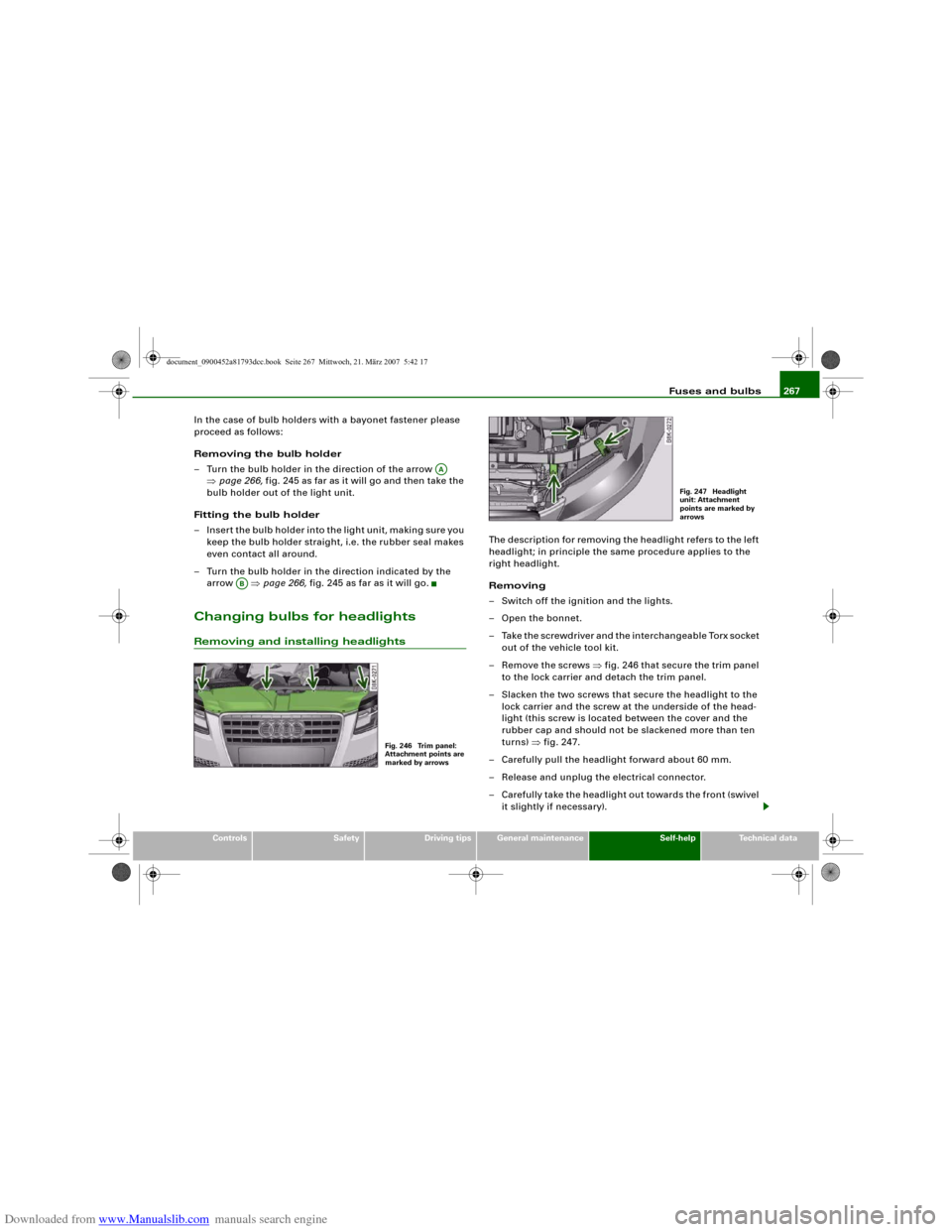
The description for removing the headlight refers to the left
headlight; in principle the same procedure applies to the
right headlight.
Removing
– Switch off the ignition and the lights.
– Open the bonnet.
– Take the screwdriver and the interchangeable Torx socket
out of the vehicle tool kit.
– Remove the screws ⇒fig. 246 that secure the trim panel
to the lock carrier and detach the trim panel.
– Slacken the two screws that secure the headlight to the
lock carrier and the screw at the underside of the head-
light (this screw is located between the cover and the
rubber cap and should not be slackened more than ten
turns) ⇒fig. 247.
– Carefully pull the headlight forward about 60 mm.
– Release and unplug the electrical connector.
– Carefully take the headlight out towards the front (swivel
it slightly if necessary).
AA
AB
Fig. 246 Trim panel:
Attachment points are
marked by arrows
Fig. 247 Headlight
unit: Attachment
points are marked by
arrows
document_0900452a81793dcc.book Seite 267 Mittwoch, 21. März 2007 5:42 17
Page 270 of 294
Downloaded from www.Manualslib.com manuals search engine Fuses and bulbs 268
Installing
– Perform all of the above steps in reverse sequence.The headlight must be inserted in two guides (on the underside of
the headlight). This is the only way to ensure that the headlight is
installed in the correct position. To determine whether the headlight
is correctly installed, check that it is aligned flush with adjacent
body parts (such as the wing panel).
Do not interchange the securing screws.
Caution
Please take particular care not to damage or scratch the adjacent
parts of the body when removing or installing the headlights.Applies to vehicles: with xenon headlight bulbsChanging bulb for turn signalsThe bulb is secured in the bulb carrier with a bayonet
fastener.
– Remove the headlight ⇒page 267.
– Take off the rubber cap (small cover) and remove the bulb
carrier.
– Lightly press the defective bulb into the bulb carrier, then
turn it anti-clockwise and remove it.
– Do not touch the glass part of the new bulb with your
bare hands, use a cloth or paper towel instead.
– Fit the new bulb, pressing it into the bulb carrier, and turn
it clockwise as far as it will go.
– If necessary, use a cloth to remove any fingerprints from
the glass part of the bulb.– Insert the bulb carrier into the headlight.
Note
Ensure that the rubber cap is seated correctly so that no water can
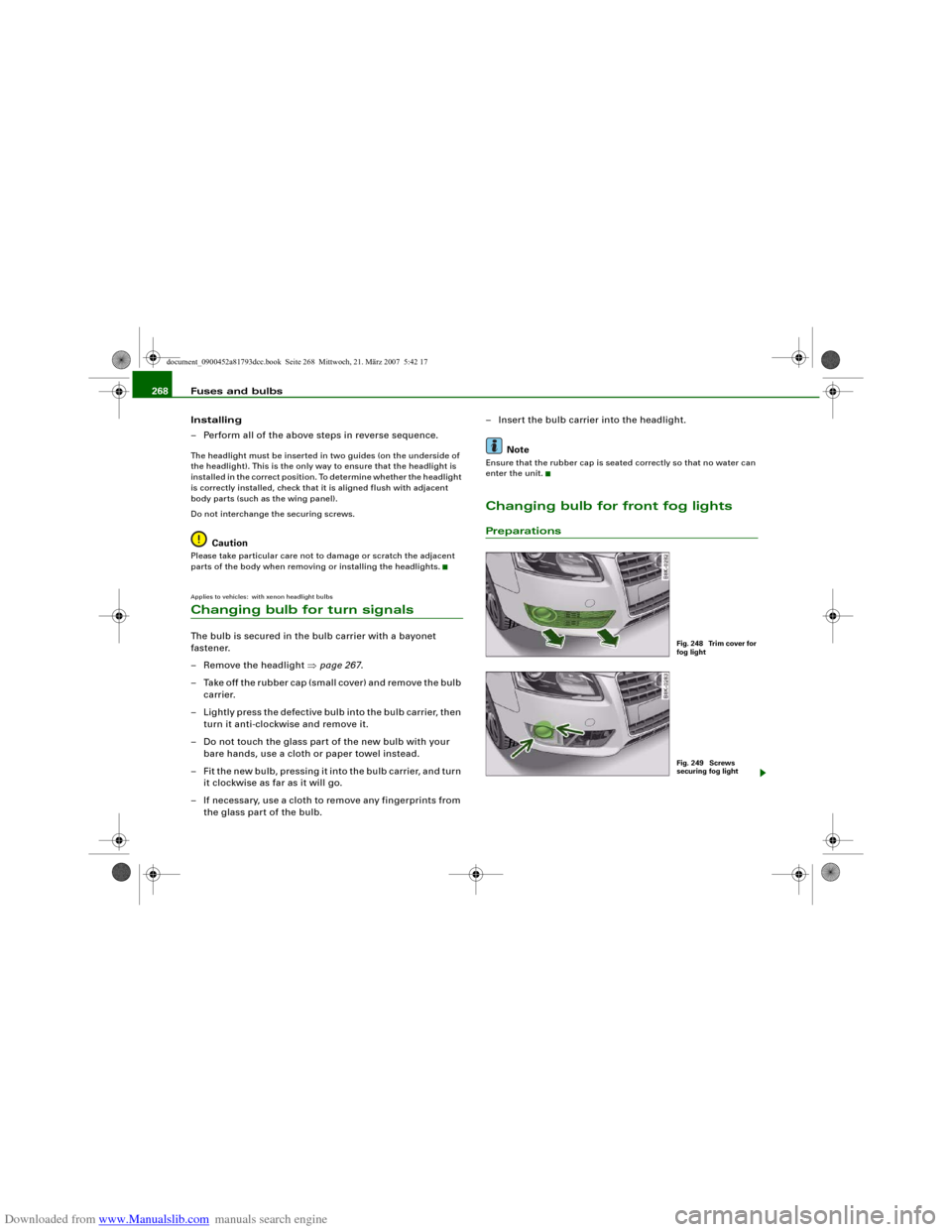
enter the unit.Changing bulb for front fog lightsPreparations
Fig. 248 Trim cover for
fog lightFig. 249 Screws
securing fog light
document_0900452a81793dcc.book Seite 268 Mittwoch, 21. März 2007 5:42 17
Page 288 of 294

Downloaded from www.Manualslib.com manuals search engine Index 286Cruise control system
Adjusting speed . . . . . . . . . . . . . . . . . 125
Control lever on steering wheel . . . . 123
Cruise mode . . . . . . . . . . . . . . . . . . . . 124
Indicator lamp . . . . . . . . . . . . . . . . . . . . 17
Introduction . . . . . . . . . . . . . . . . . . . . . 123
Pre-selecting a speed . . . . . . . . . . . . . 126
Resuming cruise control . . . . . . . . . . 126
Safety notes . . . . . . . . . . . . . . . . . . . . . 123
Switching off . . . . . . . . . . . . . . . . . . . . 127
Switching off temporarily . . . . . . . . . 126
Cup holders . . . . . . . . . . . . . . . . . . . . . . . . . 83
Current fuel consumption . . . . . . . . . . . . . 25DDate display . . . . . . . . . . . . . . . . . . . . . . . . 13
Daytime running lights . . . . . . . . . . . . . . . 56
Deactivating front passenger's airbag . . 173
Deadlock mechanism . . . . . . . . . . . . . . 42, 45
Defrosting windows . . . . . . . . . . . . . . 96, 104
Deluxe automatic air conditioner . . . . . . . 91
Air distribution . . . . . . . . . . . . . . . . . . . 95
Air outlets . . . . . . . . . . . . . . . . . . . . . . . 97
Air outlets for rear passengers . . . . . . 97
Air recirculation mode . . . . . . . . . . . . . 95
Automatic mode . . . . . . . . . . . . . . . . . . 93
Basic settings . . . . . . . . . . . . . . . . . . . . 98
Blower . . . . . . . . . . . . . . . . . . . . . . . . . . 94
Controls . . . . . . . . . . . . . . . . . . . . . . . . . 92
Defrosting . . . . . . . . . . . . . . . . . . . . . . . 96
Description . . . . . . . . . . . . . . . . . . . . . . 91
Economical operation . . . . . . . . . . . . . 98Heated rear window . . . . . . . . . . . . . . . 96
Seat heating, front . . . . . . . . . . . . . . . 112
Switching on and off . . . . . . . . . . . . . . 93
Temperature . . . . . . . . . . . . . . . . . . . . . 94
Deluxe automatic air conditioner plus . . . 99
AC mode . . . . . . . . . . . . . . . . . . . . . . . . 105
Air distribution . . . . . . . . . . . . . . . . . . 104
Air outlets . . . . . . . . . . . . . . . . . . . . . . . 105
Air outlets for rear passengers . . . . . 106
Air recirculation mode . . . . . . . . . . . . 103
Automatic mode . . . . . . . . . . . . . . . . . 101
Automatic recirculation . . . . . . . . . . . 107
Auxiliary heating . . . . . . . . . . . . . . . . . 108
Auxiliary heating - remote control . . 111
Auxiliary heating - running time . . . . 111
Basic settings . . . . . . . . . . . . . . . . . . . 107
Blower . . . . . . . . . . . . . . . . . . . . . . . . . 102
Controls . . . . . . . . . . . . . . . . . . . . . . . . 100
Defrosting . . . . . . . . . . . . . . . . . . . . . . 104
Description . . . . . . . . . . . . . . . . . . . . . . . 99
Economical operation . . . . . . . . . . . . . 106
Heated rear window . . . . . . . . . . . . . . 104
Switching on and off . . . . . . . . . . . . . 101
Synchronisation . . . . . . . . . . . . . . . . . 108
Temperature . . . . . . . . . . . . . . . . . . . . 102
Digital clock . . . . . . . . . . . . . . . . . . . . . . . . . 13
Digital compass . . . . . . . . . . . . . . . . . . . . . 68
Digital speedometer . . . . . . . . . . . . . . . . . . 22
Dimensions . . . . . . . . . . . . . . . . . . . . . . . . 278
Dipped headlights . . . . . . . . . . . . . . . . . . . 54
Defective . . . . . . . . . . . . . . . . . . . . . . . . 36
DIS
SeeDriver information system . . . . . . 20Door catches/boot lid warning . . . . . . . . . 23
Doors
Manual locking . . . . . . . . . . . . . . . . . . . 47
Driver
SeeSitting position . . . . . . . . . . . . . . . 154
Driver information system . . . . . . . . . . . . . 20
Auto-check control . . . . . . . . . . . . . . . . 29
Bulb monitor . . . . . . . . . . . . . . . . . . . . . 36
CD and radio display . . . . . . . . . . . . . . . 21
Digital speedometer . . . . . . . . . . . . . . . 22
Door catches/boot lid warning . . . . . . 23
Driver messages . . . . . . . . . . . . . . . . . . 30
On-board computer . . . . . . . . . . . . . . . . 25
Outside temperature display . . . . . . . . 21
Red symbols . . . . . . . . . . . . . . . . . . . . . 30
Service interval display . . . . . . . . . . . . . 23
Speed warning . . . . . . . . . . . . . . . . . . . . 28
Yellow symbols . . . . . . . . . . . . . . . . . . . 34
Driver messages . . . . . . . . . . . . . . . . . . . . . 30
Driving abroad . . . . . . . . . . . . . . . . . . . . . 195
Headlights . . . . . . . . . . . . . . . . . . . . . . 195
Unleaded fuel . . . . . . . . . . . . . . . . . . . 195
Driving away from a standstill . . . . . . . . 120
Driving away when towing a trailer . . . . 121
Driving safety . . . . . . . . . . . . . . . . . . . . . . 153
Driving time . . . . . . . . . . . . . . . . . . . . . . . . . 25
Dust filter
Deluxe automatic air conditioner . . . . 91
Deluxe automatic air conditioner plus 99
DVD player . . . . . . . . . . . . . . . . . . . . . . . . . . 77
document_0900452a81793dcc.book Seite 286 Mittwoch, 21. März 2007 5:42 17
Page 290 of 294
Downloaded from www.Manualslib.com manuals search engine Index 288
Ethanol . . . . . . . . . . . . . . . . . . . . . . . . . 217
Fuel gauge . . . . . . . . . . . . . . . . . . . . . . . 19
Fuel level low . . . . . . . . . . . . . . . . . . . . . 36
Petrol . . . . . . . . . . . . . . . . . . . . . . . . . . 217
Saving fuel . . . . . . . . . . . . . . . . . . . . . . 196
Fuel consumption . . . . . . . . . . . . . . . . . . . 279
Fuel gauge . . . . . . . . . . . . . . . . . . . . . . . . . . 19
Fuel range . . . . . . . . . . . . . . . . . . . . . . . . . . 25
Fuel tank flap . . . . . . . . . . . . . . . . . . . . . . 217
Fuse, changing . . . . . . . . . . . . . . . . . . . . . 261
GGarage door opener . . . . . . . . . . . . . . . . . 145
Gear-change indicator . . . . . . . . . . . . . . . . 21
Generator
SeeAlternator . . . . . . . . . . . . . . . . . . . . 31
Glove box . . . . . . . . . . . . . . . . . . . . . . . . . . . 89HHandbrake
SeeElectro-mechanical parking brake . . .
119
Hazard warning lights . . . . . . . . . . . . . . . . 58
Indicator lamp . . . . . . . . . . . . . . . . . . . . 16
Head restraints
Front seats . . . . . . . . . . . . . . . . . . . . . . . 74
Rear seats . . . . . . . . . . . . . . . . . . . . . . . 74
Headlight flasher . . . . . . . . . . . . . . . . . . . . 58
Headlight range control
Malfunction . . . . . . . . . . . . . . . . . . . . . . 37Headlights . . . . . . . . . . . . . . . . . . . . . . . . . . 54
adaptive light . . . . . . . . . . . . . . . . . . . . . 57
Changing dip settings . . . . . . . . . . . . 195
Washer system . . . . . . . . . . . . . . . . . . . 63
Heated
Exterior mirrors . . . . . . . . . . . . . . . . . . . 66
Front seats (deluxe automatic air
conditioner) . . . . . . . . . . . . . . . . . . . . 112
Rear seats . . . . . . . . . . . . . . . . . . . . . . 113
Rear window . . . . . . . . . . . . . . . . . 96, 104
Washer jets . . . . . . . . . . . . . . . . . . . . . . 62
Heated rear window . . . . . . . . . . . . . . 96, 104
Heating
Deluxe automatic air conditioner . . . . 91
Deluxe automatic air conditioner plus 99
HomeLink . . . . . . . . . . . . . . . . . . . . . . . . . . 145
Horn . . . . . . . . . . . . . . . . . . . . . . . . . . . . . . . . 9
IIgnition key
Emergency release . . . . . . . . . . . . . . . . 41
Safety interlock . . . . . . . . . . . . . . . . . . 114
Ignition lock . . . . . . . . . . . . . . . . . . . . . . . . 114
Malfunction . . . . . . . . . . . . . . . . . . . 34, 37
Immobiliser . . . . . . . . . . . . . . . . . . . . . . 14, 38
Indicator lamps . . . . . . . . . . . . . . . . . . . . . . 15
Cruise control system . . . . . . . . . . . . . . 17
Main beam headlights . . . . . . . . . . . . . 17
Overview . . . . . . . . . . . . . . . . . . . . . . . . . 15
Trailer turn signals . . . . . . . . . . . . . . . . 17
Turn signals . . . . . . . . . . . . . . . . . . . . . . 16
Inflation pressures (tyres) . . . . . . . . . . . . 232Inspection intervals . . . . . . . . . . . . . . . . . . 23
Instrument cluster . . . . . . . . . . . . . . . . . . . 11
Instrument lighting . . . . . . . . . . . . . . . . . . . 56
Interior lights
Dimming . . . . . . . . . . . . . . . . . . . . . . . . . 59
Front . . . . . . . . . . . . . . . . . . . . . . . . . . . . 59
Rear . . . . . . . . . . . . . . . . . . . . . . . . . . . . . 60
Interior mirrors
SeeMirrors . . . . . . . . . . . . . . . . . . . . . . . 65
Interior monitor . . . . . . . . . . . . . . . . . . . . . . 47
Intermittent wipe . . . . . . . . . . . . . . . . . . . . 62
Rain sensor . . . . . . . . . . . . . . . . . . . . . . 62
ISOFIX . . . . . . . . . . . . . . . . . . . . . . . . . . . . . 181
JJack . . . . . . . . . . . . . . . . . . . . . . . . . . 245, 252
Jacking points . . . . . . . . . . . . . . . . . . . . . . 252
Jump-starting . . . . . . . . . . . . . . . . . . . . . . 255KKey-operated switch for front passenger's
airbag . . . . . . . . . . . . . . . . . . . . . . . . . 173
Keys . . . . . . . . . . . . . . . . . . . . . . . . . . . . . . . 38
Emergency key . . . . . . . . . . . . . . . . . . . . 40
Replacement keys . . . . . . . . . . . . . . . . . 38
Replacing the battery . . . . . . . . . . . . . . 39LLeather care
Alcantara . . . . . . . . . . . . . . . . . . . . . . . 216
Natural leather . . . . . . . . . . . . . . . . . . . 215
document_0900452a81793dcc.book Seite 288 Mittwoch, 21. März 2007 5:42 17