2008 AUDI A4 AVANT coolant
[x] Cancel search: coolantPage 275 of 368

Checking and filling -
-----------------------------==--------=--
& WARNING (continued)
ment. Wait until no steam or coolant can be seen or heard before
carefully opening the hood.
•
Closing the engine hood
- Pull the hood down until the pressure from the strut is
reduced.
- Let the hood
drop down and latch in place. Do not try to
push
it shut; it may fail to engage =:>& .
& WARNING
A hood that is not completely latched could fly up and block your
view while driving.
• When you close the engine hood, check it to make sure the
safety catch has properly engaged. The hood should be flush with
the surrounding vehicle body parts.
• If you notice while driving that the hood is not secured prop
erly, stop at once and close it. •
Working in the engine compartment
Be especially careful whenever you work in the engine
compartment.
Whenever you must perform any work in the engine compartment,
for example checking and filling different fluids, there is a risk of
injury, burns and accidents. To prevent personal injury always
observe the following WARNINGS . The engine compartment of any
vehicle is a hazardous area
=> & .
• I I • • I
& WARNING
To help avoid injury, before you check anything under the hood:
• Turn off the engine.
• Remove the ignition key .
• Apply the parking brake.
• Move selector lever of automatic transmission to
"P" (Park);
put manual transmission in Neutral.
• Always let the engine cool down. Hot components will burn
skin on contact.
• To reduce the risk of being burned, never open the hood if you
see or hear steam or coolant escaping from the engine compart
ment. Wait until no steam or coolant can be seen or heard before
carefully opening the hood.
• Keep children away from the engine compartment.
• Never spill fluids on hot engine components. They can cause a
fire.
• Never touch the radiator fan. The auxiliary electric fan is
temperature controlled and can switch on suddenly.
• Never open the coolant reservoir cap when the engine is still
warm . The coolant system is pressurized and hot coolant could
spray out.
• Protect your face, hands and arm from steam or hot engine
coolant by placing a thick rag over the cap when you open the
coolant reservoir .
• If work on the fuel system or the electrical system is necessary: -Always disconnect the battery.
- Never smoke or work near heaters or open flames. Fluids in
the engine compartment could start a fire .
- Keep an approved fire extinguisher immediately available.
• To avoid electrical shock and personal injury while the engine
is running or being started, never touch:
- Ignition cables
.,_
Vehicle care
Page 277 of 368

Checking and filling -
------------ ----=---a::;;._...a
©
©
(i)
Coolant expansion tank ( ... L) ...... ... .. ..... .. ... .
Windshield/headlight washer container
( 0 ) ...... . .
Power steering reservoir (green cap)
& WARNING
Before you check anything in the engine compartment, always
read and heed all WARNINGS
=> & in "Working in the engine
compartment" on
page 273. •
Applies to vehicles: with 6 -cy lin d er engine
3.2 liter , 6-cylinder engine (255 hp)
281
291
241
These are the most important items that you can check.
Fig . 206 Engine compartment: 3 .2 liter , 6-cylinder
CD
0
©
Battery .. ............... ... .. ...... .... ...... .
Brake fluid reservoir (
... ) . .. ... ... .... .... ...... .
Coo lant expansion tank
(J _)
285
284
281
©
©
©
(i)
Engine oil filler cap (
Windshield/headlight washer container
( O ) ... .... .
Power steering reservoir (green cap)
& WARNING
Before you check anything in the engine compartment , always
read and heed all WARNINGS
=> & in "Working in the engine
compartment" on
page 273. •
Engine oil
Engine oil specifications
278
277
291
241
The engine oil used in your Audi needs the right kind of
oil.
The engine in your Audi is a sophisticated powerplant that was built
to exacting specifications . This engine needs the right kind of
engine oil that meets specifications regarding quality and viscosity
so that it can run smoothly and re liably . Choosing the right oil and
changing oil within the time and mileage intervals printed in your
vehicle's Maintenance
& Warranty booklet matters a lot more today
than it did years ago. Audi has developed a special quality standard
f or engine oil that wil l help assure that your vehicle's engine wi ll get
the lubrication it needs for proper operation .
Modern engine lubrication has taken a quantum leap in the last few
years. Many synthetic oils available today provide better engine
lubrication that can outlast traditional petroleum-based oils,
making them a smart choice for use throughout the life of your Audi .
Whether you use synthetic or petroleum -based engine oil, the oil
that you use must conform to Audi's oi l quality standard VW 502 00
to help keep your vehicle 's engine running smoothly and help
.,_
Ve hic le care Technical data
Page 282 of 368

-~_C_ h_ e_c _k _ i_n ..::g :..._ a_n_ d_ f_il _li _n_, g=-----------------------------------------------
Under some circumstances the engine oi l should be changed more
frequen tly . Change oil m ore often if you drive most ly shor t
distances, operate the vehicle in dusty areas or under predom i
n ant ly stop -and -go traffic conditions , or have yo ur vehicle whe re
temperatures remain below freezing for extended periods.
Detergent additives in the oil will make fresh oil look dark after the
engine has bee n run nin g fo r a sh ort time. This is nor mal and is not
a reason to change the oi l more often than recommended .
Beca use of the proble m of p roper d isposal, along wi th the s pec ia l
tools and necessary expertise required, we strongly recommend
t hat yo u have your oi l ch anged by an authorized
Audi dealer or a
qua lified serv ice stat ion .
If you choose to change your o il yourself , please note the follow ing
i mportan t informatio n:
& WARNING
To reduce the risk of personal injury if you must change the engine
oil in your vehicle yourself :
• Wear eye prote ction .
• To reduce the risk of burns from hot engine oil , let the engine
c ool down to the touch .
• When removing the oil drain plug with your fingers, stay as far
away as po ssible . Always keep your forearm parallel to the ground
to help prevent hot oil from running down your arm.
• Drain the oil into a container designed for this purpose , one
large enough to hold at least the total amount of oil in your engine.
• Engine oil is poisonous . Keep it well out of the rea ch of ch ildren .
• Continuous contact with used engine oil is harmful to your
skin . Always prote ct your skin by washing oil off thoroughly with
soap and water.
0 Note
Never m ix o il add it ives w ith your engine o il. These add it ives can
damage you r engine and adversely affect your A udi Limited New
Ve hicle Warranty.
'i> For the sake of the environment
• B efore chang ing you r oil, fi rst make sure you k now w here you
can properly dispose of the used o il.
• Always dispose o f used eng ine oil properly. Do not dump it o n
garden soi l, wooded areas, into open st reams or down sewage
drains .
• Recycle used engine oi l by ta king it to a used engine oi l collec
tion fac ility in your area, or contac t a service stat io n .•
Engine cooling system
Coolant
T he engine coolan t performs two fun ctions: it keeps the
engine from overhe ating and it pr otec ts the engine from
f reez ing i n th e win ter.
Th e cooling system is sea led and general ly requires l itt le attention.
T he coo ling system has been fi lled at the factory with a permanent
coo la nt which does not need to be c hange d. The c oolan t consis ts of
a mixture of water and the manufacturer's glycol -based coolant
additive G12 + an tifreeze wi th anticorros io n add itives (50% for USA
models; 60% for Canadian models). This mixture both assures the
necessary frost protection and protects me tal components in the
engine's cool ing system from corrosion and scaling . It also raises
the boiling poi nt of the coolant .
Do n ot reduce t he co ncentration o f the coolan t in the su mmer by
adding plain water .
The proportion of coolant additive must be at .,_
Page 283 of 368
_____________________________________________ C_h_ e_ c
_ k_in -= g_a
_ n_d _ f_il _li _n ..;::g ;;.___..
le as t 50 % but not more th an 60 % to maintain antifreeze protection
and cooling efficiency . If the coolant frost protection is too low, the
coolant could freeze and damage the vehic le heating and engine
cooling system.
For year -round driving, antifreeze is added at the factory for temper
atures down to :
•
-31 °F (- 35 °C) USA
•
-40 °F ( -40 °C) Canada.
You can mix the G12 + coolant additive with other additives (for
examp le G11 or G12) . Always check with your authorized Audi
dea ler.
& WARNING
Bef ore you check anything in the eng ine comp artm ent , a lw ays
re ad and h eed all W ARNING S
=> & in "Worki ng in the engine
c ompartm en t" on
page 273.
0 Note
• Before winter sets in, have the coolant checked to see if the
coolant additive in your vehicle is sufficient to meet the climate
conditions. This is especially important if you live in a region where
the winter is extremely cold. If necessary, increase the proportion of coolant additive to 60%.
• When adding coolant additive to your cooling system,
remember :
-We recommend using only coolant additive G12 + (check the
label) for your vehicle. This coo lant additive is avai lable at autho
rized Audi dealers . Other types of antifreeze can significantly
reduce corrosion protect ion. The resulting corrosion can cause a
loss of coolant and serious engine damage.
• Do no t add any type of radiator leak sealan t to you r vehicle's
engine coolant . Adding radiator repair fluid may adversely affect the function and performance of your cooling system and could result
in damage not covered by yo ur New Vehicle Limited Warranty. •
Checking the engine coolant level
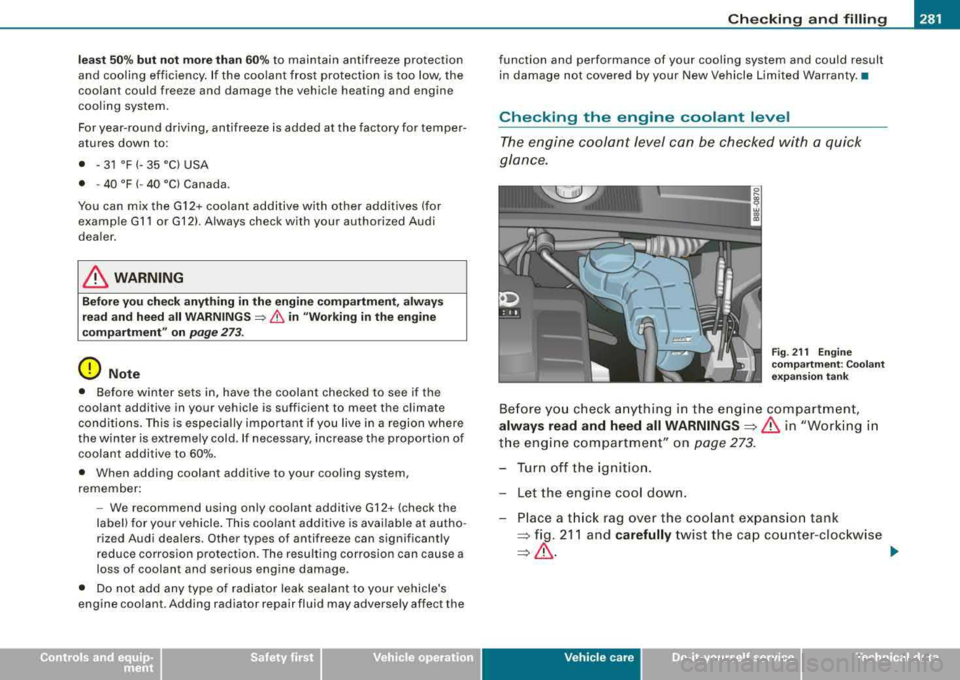
The engine coolant level can be checked with a quick
glance.
F ig . 211 E ngine
co mpa rtm ent: Co olan t
e xp an sion tan k
Before you che ck a ny thing in the e ng ine compar tmen t,
alway s read and heed all
WARNINGS => & in "Working in
t h e engine compartment" on
page 273.
Turn off the ignitio n.
Let the engine cool down.
P lace a t hick rag over the coo lant expans ion tank
=> fig. 211 and carefully twist the cap counter-clockwise
=>& . ...
Ve hic le care irechnical data
Page 284 of 368

___ C_ h_ e_c _k _ i_n ~g _ a_n_ d_ f_il _li _n_ g~--------------------------------------------
-Read the engine coolant level in the open coolant expan
sion
tank => fig. 211. With a cold engine, the coolant level
should be between the "min" and "max" markings. When
the engine is warm, the level may be slightly above the "max" marking.
The location of the coolant expansion tank can be seen in the
engine compartment
illustration=> page 275 .
To obtain an accurate reading, the engine must be sw itched off.
The expansion tank in your vehicle is equipped with an electric
coolant level sensor.
When the coolant level is too low, the warning light in the Auto
Check System
=> page 31 will blink until you add coolant and the
level has been restored to normal. Even though there is an electric
coolant level sensor, we still recommend you check the coolant level
from time to time.
Coolant loss
Coolant loss may indicate a leak in the cooling system . In the event
of coolant loss, the cooling system should be inspected immedi
ately by your authorized Audi dealer . It is not enough merely to add
coolant.
In a
sealed system, losses can occur only if the boiling point of the
coolant is exceeded as a result of overheating.
& WARNING
The cooling system is under pressure and can get very hot. Reduce
the risk of scalding from hot coolant by following these steps.
• Turn off the engine and allow it to cool down.
• Protect your face, hands and arms from escaping fluid and
steam by covering the cap with a large, thick rag.
& WARNING (continued)
• Turn the cap slowly and very carefully in a counter-clockwise
direction while applying light, downward pressure on the top of
the cap.
• To avoid being burned, do not spill antifreeze or coolant on the
exhaust system or hot engine parts. Under certain conditions, the
ethylene glycol in engine coolant can catch fire.
0 Note
Do not add any type of radiator leak sealant to your vehicle's engine
coolant. Adding radiator repair fluid may adversely affect the func
tion and performance of your cooling system and could result in damage not covered by your New Vehicle Limited Warranty. •
Adding coolant
Be very careful when adding engine coolant.
Before you check anything in the engine compartment,
always read and heed all WARNINGS => & in "Working in
the engine compartment" on
page 273.
-Turn off the engine.
-Let the engine cool down.
-Place a thick rag over the coolant expansion tank
=> page 281 , fig. 211 and carefully twist the cap counter
clockwise
=> & .
-Add coolant.
-Twist the cap on again tightly.
Replacement engine coolant must conform to exact spec ifications
=> page 280, "Coolant". If in an emergency coolant additive G12 + is .,,
Page 285 of 368

___________________________________________ C_ h_e _c_ k_ i_n ~g _ a_n _d_ f_il _li _n ~g __ ffllll
not available, do not use a different additive. Use plain water
instead until you can get the correct additive and can restore the
correct ratio. This should be done as soon as possible.
If you have lost a considerable amount of coolant, then you should
add cold antifreeze and cold water only when the engine is cold .
Always use
new engine coolant when refilling.
Do not fill coolant above the "MAX" mark. Excess coolant will be
forced out through the pressure relief valve in the cap when the engine becomes hot.
& WARNING
• The cooling system is under pressure and can get very hot.
Reduce the risk of scalding from hot coolant by following these
steps.
-Turn off the engine and allow it to cool down.
-Protect your face, hands and arms from escaping fluid and
steam by covering the cap with a large, thick rag.
- Turn the cap slowly and very carefully in a counter-clockwise
direction while applying light, downward pressure on the top
of the cap.
- To avoid being burned, do not spill antifreeze or coolant on
the exhaust system or hot engine parts. Under certain condi
tions, the ethylene glycol in engine coolant can catch fire .
• Antifreeze is poisonous. Always store antifreeze in its original
container and well out of the reach of children.
• If you drain the coolant, it must be caught and safely stored in
a proper container clearly marked
"poison".
0 Note
• Coolant pollutes the environment and could cause an engine
fire. Excess coolant will be forced out through the pressure relief
valve in the cap when the engine becomes hot. •
If, in an emergency , only water can be added, the correct ratio
between water and antifreeze=>
page 280 must be restored as soon
as possible.
~ For the sake of the environment
Drained coolant should not be reused . Always dispose of used
coolant while observing all environmental regulations.•
Radiator fan
The radiator fan switches on automatically by itself.
The radiator fan is driven by the engine via the V -belt. The viscous
clutch regulates the speed of the fan according to the temperature
of the coolant.
An auxiliary electric radiator fan* switches on and off depending on
coolant temperature and other vehicle operating conditions .
After you switch the engine off, the auxiliary fan can continue
running for up to 10 minutes -even with the ignition off. It can even
switch on again later by
itself =>& , if
• the temperature of the engine coolant rises due to the heat
build-up from the engine in the engine compartment, or
• the engine compartment heats up because the vehicle is parked
in intense sunlight .
& WARNING
• To reduce the risk of personal injury never touch the radiator
fan.
• The auxiliary electric fan is temperature controlled and can
switch on suddenly even when the engine is not running .
• The auxiliary radiator fan switches on automatically when the
engine coolant reaches a certain temperature and will continue to
run until the coolant temperature drops. •
Vehicle care
Page 296 of 368

___ T_ ir_e _ s_ a_ n
_ d_ w_ h_ e_ e_ls _________________________________________________ _
&, WARNING (continued)
crashes and serious personal injuries . Have worn or damaged tires
replaced immediately.
• Tires age even if they are not being used and can fail suddenly,
especially at high speeds. Tires that are more than 6 years old can
only be used in an emergency and then with special care and at
low speed.
Glossary of tire and loading terminology
Accessory weight
means the combined weight (in excess of those standard items
which may be replaced) of automatic transmission, power steering,
power brakes, power windows, power seats, radio, and heater, to
the extent that these items are available as factory-installed equip
ment (whether installed or not).
Aspect ratio means the ratio of the height to the width of the tire in percent.
Numb ers of 55 or lower indicate a low sidewall for improved
steering response and better overall handling on dry pavement.
Bead means the part of the tire that is made of steel wires, wrapped or
reinforced by ply cords and that is shaped to fit the rim.
Bead separation
means a breakdown of the bond between components in the bead.
Cord
means the strands forming the plies in the tire.
&, WARNING (continued)
• Never mount used tires on your vehicle if you are not sure of
their "previous history." Old used tires may have been damaged
even though the damage cannot be seen that can lead to sudden
tire failure and loss of vehicle control.
• If you notice unusual vibration or if the vehicle pulls to one side
when driving, always stop as soon as it is safe to do so and check
the wheels and tires for damage.
•
Cold tire inflation pressure
means the tire pressure recommended by the vehicle manufacturer
for a tire of a designated size that has not been driven for more than
a couple of miles (kilometers) at low speeds in the three hour period
before the tire pressure is measured or adjusted .
Curb weight
means the weight of a motor vehicle with standard equipment
including the maximum capacity of fuel, oil, and coolant, air condi
tioning and additional weight of optional equipment.
Extra load tire
means a tire designed to operate at higher loads and at higher infla
tion pressures then the corresponding standard tire. Extra load tires
my be identified as "XL", "xi", "EXTRA LOAD", or
"RF" on the side
wall.
Gross Axle Weight Rating ("GAWR")
means the load-carrying capacity of a single axle system, measured
at the tire-ground interfaces .
Gross Vehicle Weight Rating ("GVWR")
means the maximum total loaded weight of the vehicle.
Page 343 of 368

_________________________________________________ G_ e_ n_ e_r _a _l_ i_n _f_o _ r_ m_ a_ t
_ i
_ o _ n
__ __
T he sa fe ty co mplia nce s ticke r
is your assurance t hat your new vehicle complies with a ll applicable
Federa l Motor Vehic le Safety Standards which were in effect at the
t ime the veh ic le was manufactured . You can find t his st icker on the
left door jamb. It shows the mon th and year of production and the
vehic le identification number of your vehic le (perforation) as well as
the Gross Veh icle Weight Rating (GVWR) and the Gross Axle Weight
Rating (GAWRl.
Th e high volt ag e wa rning la bel
is located on the lock carrier .
The spark ignition syste m mee ts all requirement s of the Canadi an
Interf ere nc e-C au si ng Equipm ent Regulati ons. •
Weights
Gross Veh icle Weight R ating
The G ross Veh ic le Weight Rat ing (GVWR), and the Gross Ax le Weight
Rating (GAWR) for front and rear are listed on a sticker on the left
door jamb .
The Gross Vehicle Weight Rating includes the we ight of the basic
vehic le plus fu ll fuel tank, oil and coolant, plus maximum load,
whic h inc ludes passenger weight ( 150 lbs/68 kg per designated
seating position) and luggage weight.
Gr oss Axle Weight Ra ting
The Gross Ax le Weight Rating is the maximum load that can be
app lied at each axle of the
veh ic le =:> & .
Vehicl e cap acit y w eight
The vehicle capacity weight (max. load) is listed either on the
driver's side 8 -pillar or inside the fuel fi ller f lap .
Controls and equip
ment Safety first Vehicle operation
Roof
weight
The maximum permissible roof we ight is
165 lb (75 kg ). The roof
weight is made up of the weight of the roof rack system and the
weight of the object being
transported =:> page 117, "L oading the
roof rack".
LJ}. WARNING
• The actual Gr oss Axle Weight R atin g at the front and re ar ax les
s hould not ex ceed the permi ssible w eight s, and th eir combination
mu st not e xceed the Gr oss Vehicle Weight R atin g.
• Exceeding pe rmi ssible weight ratin gs can re sult in vehicle
d am age , acc ident s and per son al inju ry.
0 Note
• The vehicle capacity weight figures apply when the load is
distr ibuted even ly in t he ve hicle (passengers and l uggage). When
transporting a heavy load in the luggage compartment, carry the
load as near to the rear axle as possib le so that the vehic le's
handling is not impaired .
• Do not exceed the maxim um permissib le axle loads or the
maximum gross vehic le weight. Always remember that the vehic le's
handling wi ll be affected by the extra load . Therefore, adjust your
speed according ly.
• Always observe local reg ulations. •
Dimensions
The specifications refer to the basic mode l. Differences may occur
depending on the mode l type and options ordered, for example, tire
sizes.
..,
Vehicle care Do-it-yourself service Technical data