Page 1009 of 1449
31-1
WHEEL AND TYRE
CONTENTS
GENERAL INFORMATION 2..................
SERVICE SPECIFICATIONS 2.................
TROUBLESHOOTING 3.......................ON-VEHICLE SERVICE 6.....................
Tyre Inflation Pressure Check 6.................
Tyre Wear Check 6............................
Wheel Runout Check 6.........................
WHEEL AND TYRE 6........................
Page 1010 of 1449
WHEEL AND TYRE -General Information/Service Specifications31-2
GENERAL INFORMATION
The wheels and tyres of the following specifications
have been established.
SPECIFICATIONS
ItemsRS (standard)RS (option), RS-II
WheelTypeSteel typeAluminium type
Size15×6JJ17×8JJ
Amount of wheel offset mm4638
Pitch circle diameter
(P.C.D.) mm114.3114.3
TyreSize205/65R15 94H235/45ZR17
Spare wheelTypeSteel typeSteel typep
Size16×4T17×4T
Amount of wheel offset mm4030
Pitch circle diameter
(P.C.D.) mm114.3114.3
Spare tyre (High pressure)SizeT125/70D16T125/70D17
SERVICE SPECIFICATIONS
ItemsLimit
Tread depth of tyre mm1.6
Wheel runout (Radial runout) mmSteel wheel1.2 or less
Aluminium wheel1.0 or less
Wheel runout (Lateral runout) mmSteel wheel1.2 or less
Aluminium wheel1.0 or less
Page 1013 of 1449
WHEEL AND TYRE -Troubleshooting31-5
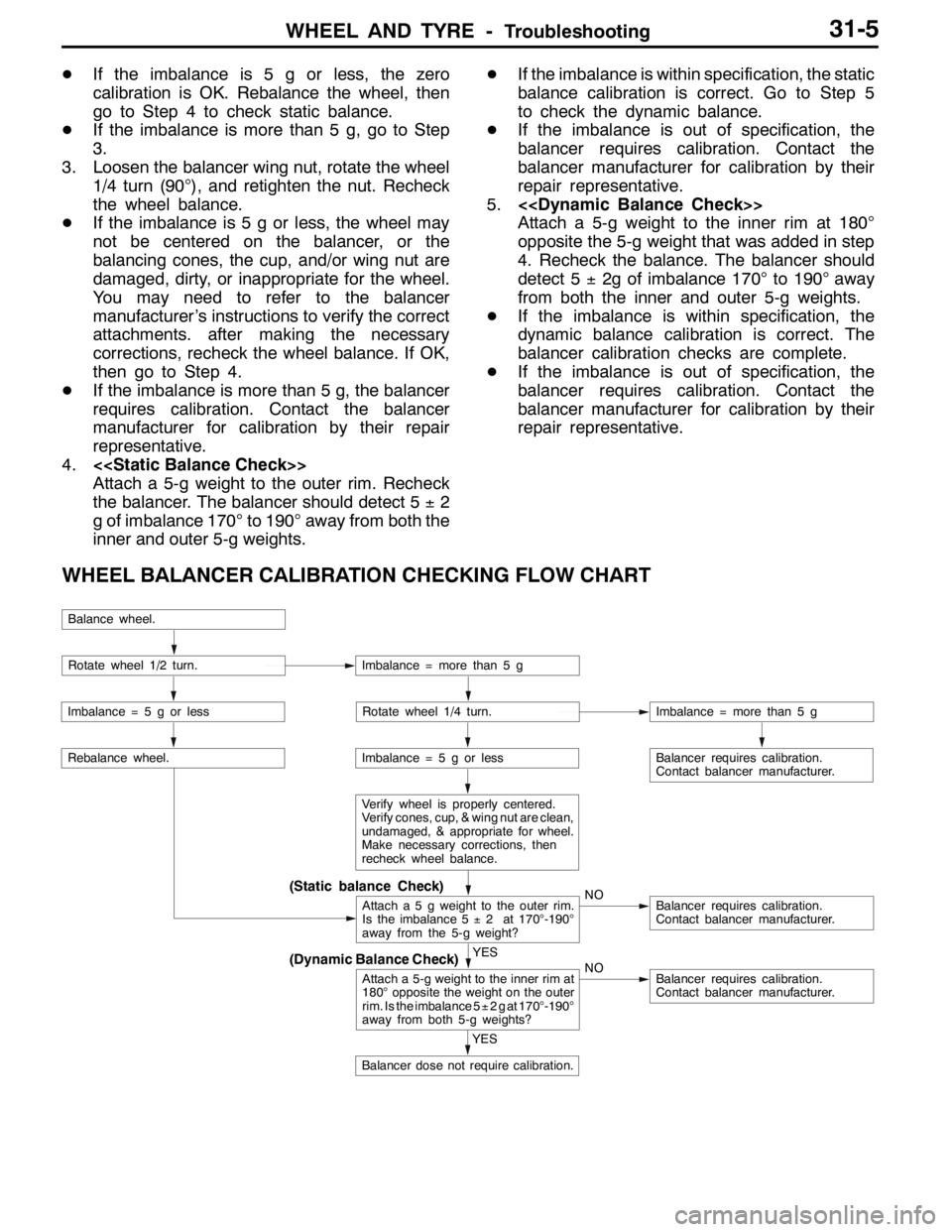
DIf the imbalance is 5 g or less, the zero
calibration is OK. Rebalance the wheel, then
go to Step 4 to check static balance.
DIf the imbalance is more than 5 g, go to Step
3.
3. Loosen the balancer wing nut, rotate the wheel
1/4 turn (90°), and retighten the nut. Recheck
the wheel balance.
DIf the imbalance is 5 g or less, the wheel may
not be centered on the balancer, or the
balancing cones, the cup, and/or wing nut are
damaged, dirty, or inappropriate for the wheel.
You may need to refer to the balancer
manufacturer’s instructions to verify the correct
attachments. after making the necessary
corrections, recheck the wheel balance. If OK,
then go to Step 4.
DIf the imbalance is more than 5 g, the balancer
requires calibration. Contact the balancer
manufacturer for calibration by their repair
representative.
4.<>
Attach a 5-g weight to the outer rim. Recheck
the balancer. The balancer should detect 5±2
g of imbalance 170°to 190°away from both the
inner and outer 5-g weights.DIf the imbalance is within specification, the static
balance calibration is correct. Go to Step 5
to check the dynamic balance.
DIf the imbalance is out of specification, the
balancer requires calibration. Contact the
balancer manufacturer for calibration by their
repair representative.
5.<>
Attach a 5-g weight to the inner rim at 180°
opposite the 5-g weight that was added in step
4. Recheck the balance. The balancer should
detect 5±2g of imbalance 170°to 190°away
from both the inner and outer 5-g weights.
DIf the imbalance is within specification, the
dynamic balance calibration is correct. The
balancer calibration checks are complete.
DIf the imbalance is out of specification, the
balancer requires calibration. Contact the
balancer manufacturer for calibration by their
repair representative.
WHEEL BALANCER CALIBRATION CHECKING FLOW CHART
(Dynamic Balance Check)
(Static balance Check)
Balance wheel.
Rotate wheel 1/2 turn.Imbalance = more than 5 g
Imbalance = 5 g or lessRotate wheel 1/4 turn.Imbalance = more than 5 g
Imbalance = 5 g or less
Verify wheel is properly centered.
Verify cones, cup, & wing nut are clean,
undamaged, & appropriate for wheel.
Make necessary corrections, then
recheck wheel balance.
Attach a 5 g weight to the outer rim.
Is the imbalance 5±2 at 170°-190°
away from the 5-g weight?NOBalancer requires calibration.
Contact balancer manufacturer.
Balancer requires calibration.
Contact balancer manufacturer.
YES
Attach a 5-g weight to the inner rim at
180°opposite the weight on the outer
rim. Is the imbalance 5±2gat170°-190°
away from both 5-g weights?NOBalancer requires calibration.
Contact balancer manufacturer.
Rebalance wheel.
YES
Balancer dose not require calibration.
Page 1027 of 1449
33A-1
FRONT
SUSPENSION
CONTENTS
GENERAL INFORMATION 2..................
SERVICE SPECIFICATIONS 3.................
SPECIAL TOOLS 3...........................
ON-VEHICLE SERVICE 4.....................
Wheel Alignment Check and Adjustment 4.......Ball Joint Dust Cover Check 5..................
STRUT ASSEMBLY 6.........................
LOWER ARM ASSEMBLY 9..................
STABILIZER BAR 12.........................
CROSSMEMBER BAR 15.....................
Page 1029 of 1449

FRONT SUSPENSION -Service Specifications/Special Tools33A-3
SERVICE SPECIFICATIONS
ItemsStandard value
Toe-inAt the centre of tyre tread mm0±2
Toe-angle (per wheel)0_00’±05’
Toe-out angle on turns (inner wheel when outer wheel at 20_)22_00’±1_30’
Steering angleInner wheel31_45’±1_30’
Outer wheel (for reference)27_15’
Camber (Selectable from 2 options)-1_00’±30’* or - 2_00’±30’*
Caster3_55’±30’*
Kingpin inclination13_45’±1_30’
Lower arm ball joint rotation starting torque N·m0.5 - 3.4
Lower arm pillow ball bushing rotation starting torque N·m0.5 - 3.0
NOTE
*: difference between right and left wheels: less than 30’
SPECIAL TOOLS
ToolsNumberNameUse
B
A
A: MB991237
B: MB991238A: Spring
compressor
body
B: Arm setCoil spring compression
BAMB991680
A: MB991681
B: MB991682Wrench set
A: Wrench
B: SocketStrut assembly disassembly and reassembly
MB991006Preload socketLower arm ball joint rotation starting torque
measurement
MB990326Preload socketLower arm pillow ball bushing rotation starting
torque measurement
Page 1031 of 1449
FRONT SUSPENSION -On-vehicle Service33A-5
Tightening torque: 52±2 N·m
3. Confirm that the toe-in is at the standard value.
4. Use a turning radius gauge to check that the steering
angle is at the standard value.
Standard value:
Inner wheels31_45’±1_30’
Outer wheels (for reference)27_15’
TOE-OUT ANGLE ON TURNS
To check the steering linkage, especially after the vehicle
has been involved in an accident or if an accident is presumed,
it is advisable to check the toe-out angle on turns in addition
to the wheel alignment.
Conduct this test on the left turn as well as on the right turn.
Standard value:
ItemsSpecifications
Toe-out angle on turns
(inner wheel when outer wheel at 20_)22_00’±1_30’
CAMBER, CASTER AND KINGPIN INCLINATION
Standard value:
ItemsSpecifications
Camber
(Selectable from 2 options)-1_00’±30’* or - 2_00’±30’*
Caster3_55’±30’*
Kingpin inclination13_45’±1_30’
NOTE
1. *: difference between right and left wheels must be less
than 30’
2. Caster and kingpin inclination are preset at the factory
and cannot be adjusted.
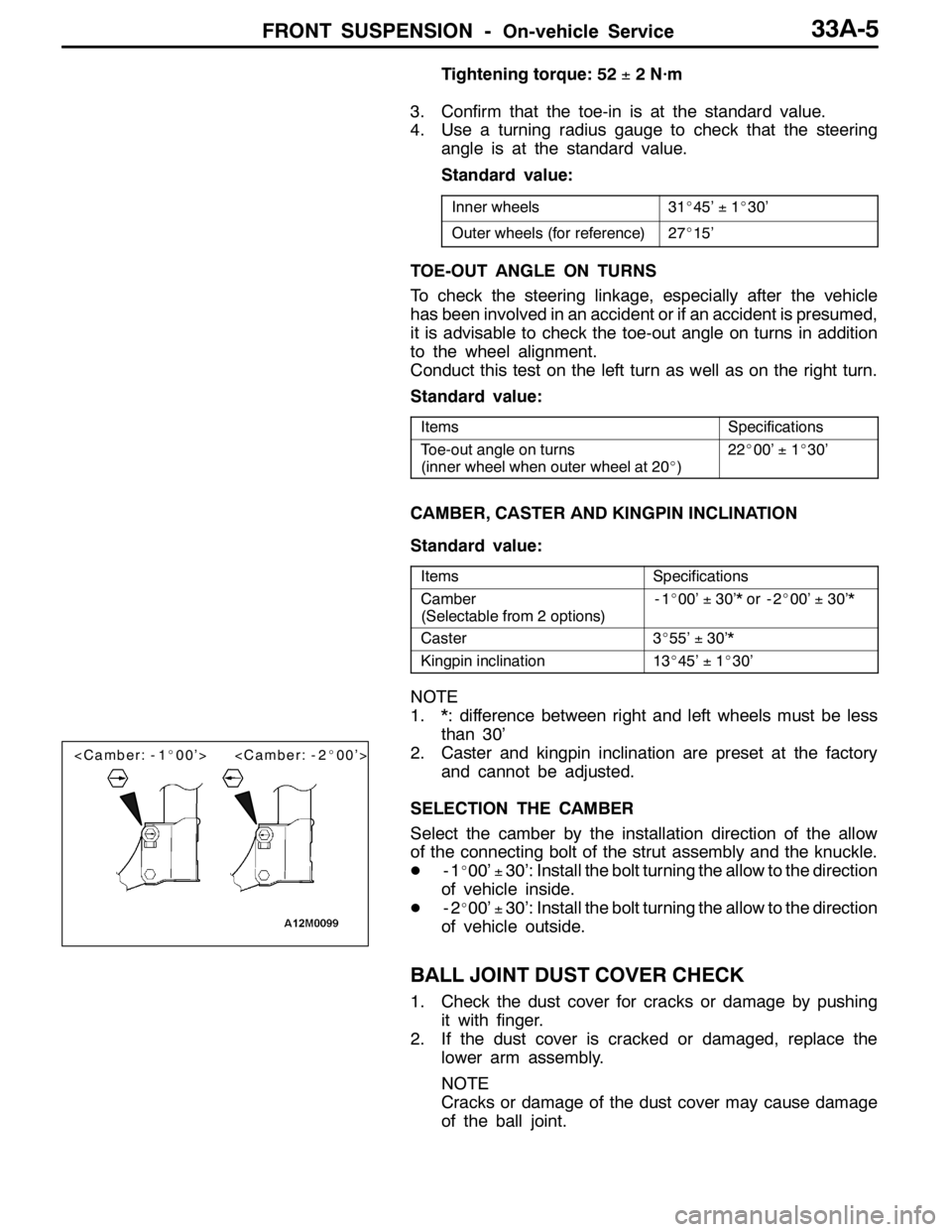
SELECTION THE CAMBER
Select the camber by the installation direction of the allow
of the connecting bolt of the strut assembly and the knuckle.
D-1
_00’±30’: Install the bolt turning the allow to the direction
of vehicle inside.
D-2
_00’±30’: Install the bolt turning the allow to the direction
of vehicle outside.
BALL JOINT DUST COVER CHECK
1. Check the dust cover for cracks or damage by pushing
it with finger.
2. If the dust cover is cracked or damaged, replace the
lower arm assembly.
NOTE
Cracks or damage of the dust cover may cause damage
of the ball joint.
Page 1044 of 1449
35A-2
BASIC BRAKE
SYSTEM
CONTENTS
GENERAL INFORMATION 3..................
SERVICE SPECIFICATIONS 5.................
LUBRICANTS 6..............................
SEALANT 6..................................
SPECIAL TOOLS 6...........................
ON-VEHICLE SERVICE 7.....................
Brake Pedal Check and Adjustment 7............
Brake Booster Operating Test 8.................
Check Valve Operation Check 9.................
Proportioning Valve Function Test
9......................Bleeding 10....................................
Brake Fluid Level Sensor Check 11.............
Disc Brake Pad Check and Replacement 11......
Disc Brake Rotor Check 13.....................
Brake Disc Thickness Check 14.................
Brake Disc Run-out Check and Correction 14....
BRAKE PEDAL 16...........................
PROPORTIONING VALVE, MASTER
CYLINDER AND BRAKE BOOSTER 17........
Master Cylinder 19.............................
DISC BRAKE 20.............................
Page 1045 of 1449

BASIC BRAKE SYSTEM -General Information35A-3
GENERAL INFORMATION
The brake system offers high dependability and durability along with improved braking performance and
brake sensitivity.
SERVICE PRECAUTION
Take care not to contact the parts or tools to the caliper because the paint of caliper will be scratched.
SPECIFICATIONS
ItemsSpecifications
Master cylinderTypeTandem type
I.D. mm26.9
Brake boosterTypeVacuum type, tandem
Effective dia. of power cylinder mm205 + 230
Boosting ratio4.5 (Pedal depressing force: 230 N)
Rear wheel hydraulic
controlmethod
Vehicles with ABS Electronic brake-force distribution (EBD)
control methodVehicles without ABS Proportioning valves
Proportioning valves
VehicleswithoutABS
TypeSingle type¢2
Decompression ratio0.25
Front brakes
RS(standard)
TypeFloating caliper, 2 piston, ventilated disc
Disc effective dia.¢thickness mm227¢24
Wheel cylinder I.D. mm42.9 (¢2)
Pad thickness mm10.0
Clearance adjustmentAutomatic
Front brakes
Type4 opposed piston, ventilated disc
Disc effective dia.¢thickness mm263¢32
Wheel cylinder I.D. mm40.0 (¢2), 46.0 (¢2)
Pad thickness mm10.0
Clearance adjustmentAutomatic
Rear brakes
RS(standard)
TypeFloating caliper, 1 piston, ventilated disc
Disc effective dia.¢thickness mm237¢20
Wheel cylinder I.D. mm34.9
Pad thickness mm10.0
Clearance adjustmentAutomatic
Rear brakes
Type2 opposed piston, ventilated disc
Disc effective dia.¢thickness mm252¢22
Wheel cylinder I.D. mm40.0 (¢2)
Pad thickness mm9.0
Clearance adjustmentAutomatic
Brake fluidDOT3 or DOT4