Page 65 of 1449
WELDED PANEL REPLACEMENT -Quarter, InnerC-21
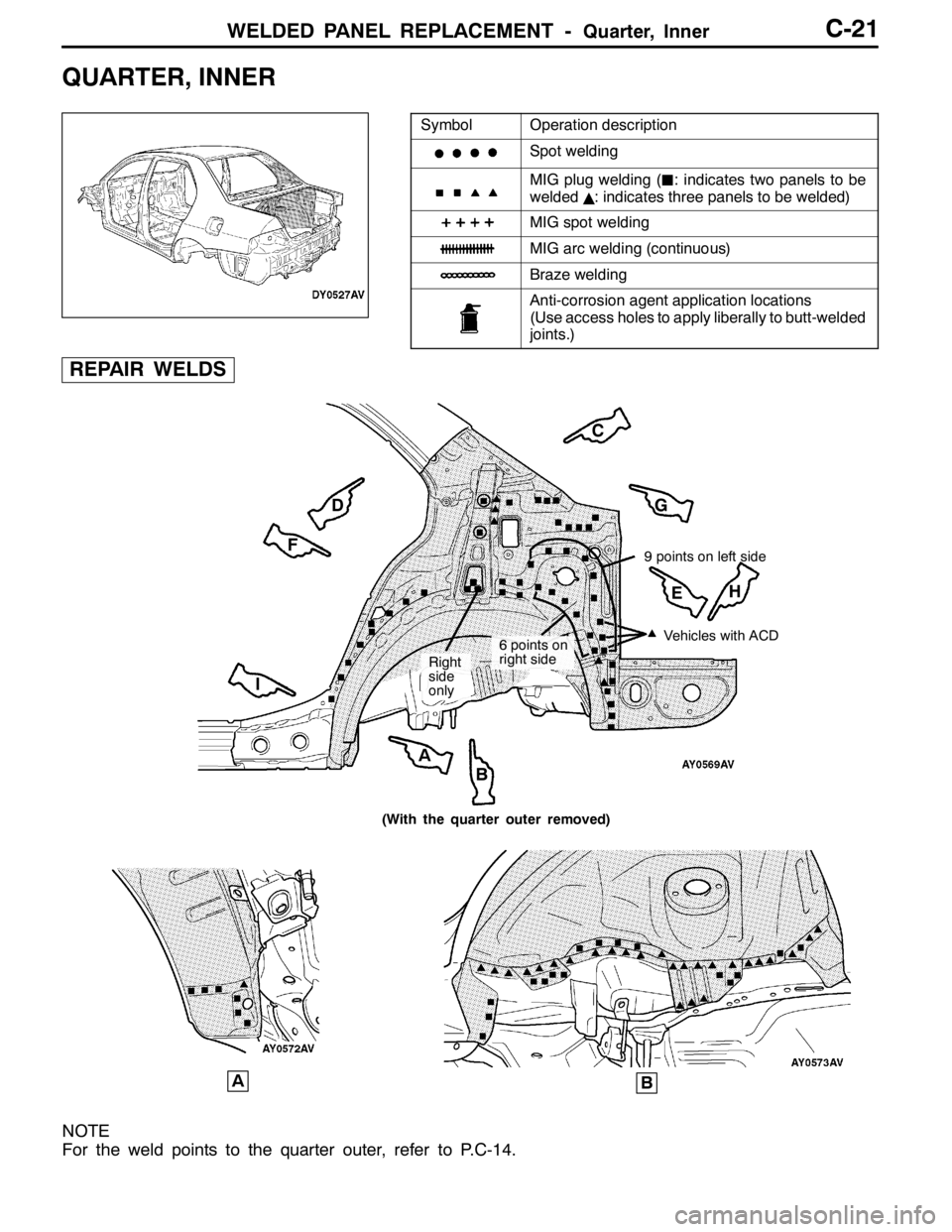
QUARTER, INNER
SymbolOperation description
Spot welding
MIG plug welding (J: indicates two panels to be
welded
Y: indicates three panels to be welded)
MIG spot welding
MIG arc welding (continuous)
Braze welding
Anti-corrosion agent application locations
(Use access holes to apply liberally to butt-welded
joints.)
AB
C
A
B
D
EG
H F
I
Vehicles with ACD
REPAIR WELDS
9 points on left side
(With the quarter outer removed)
6 points on
right side
Right
side
only
NOTE
For the weld points to the quarter outer, refer to P.C-14.
Page 67 of 1449
WELDED PANEL REPLACEMENT -Front Door Outer PanelC-23
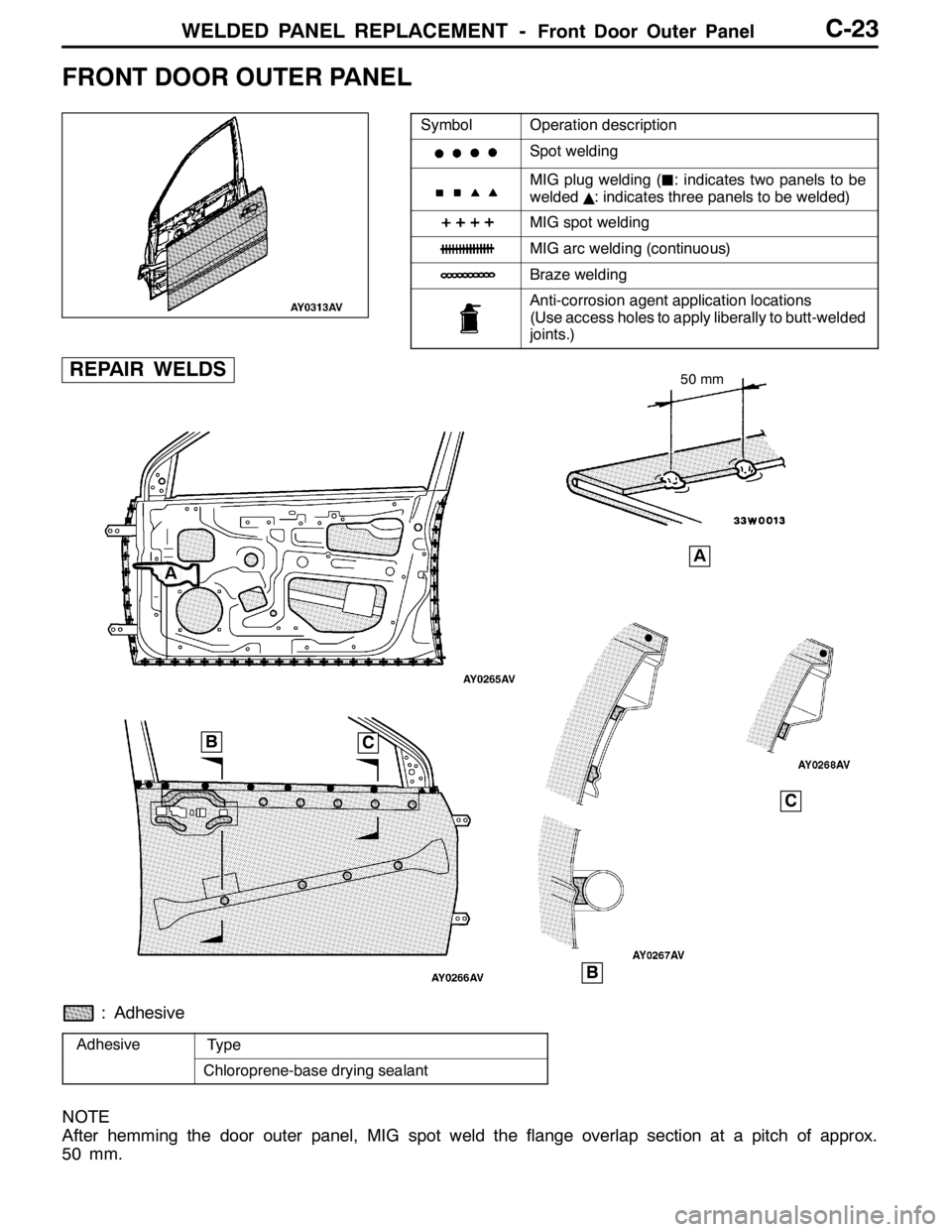
FRONT DOOR OUTER PANEL
SymbolOperation description
Spot welding
MIG plug welding (J: indicates two panels to be
welded
Y: indicates three panels to be welded)
MIG spot welding
MIG arc welding (continuous)
Braze welding
Anti-corrosion agent application locations
(Use access holes to apply liberally to butt-welded
joints.)
REPAIR WELDS
A
B
B
50 mm
C
C
A
: Adhesive
AdhesiveType
Chloroprene-base drying sealant
NOTE
After hemming the door outer panel, MIG spot weld the flange overlap section at a pitch of approx.
50 mm.
Page 68 of 1449
WELDED PANEL REPLACEMENT -Rear Door Outer PanelC-24
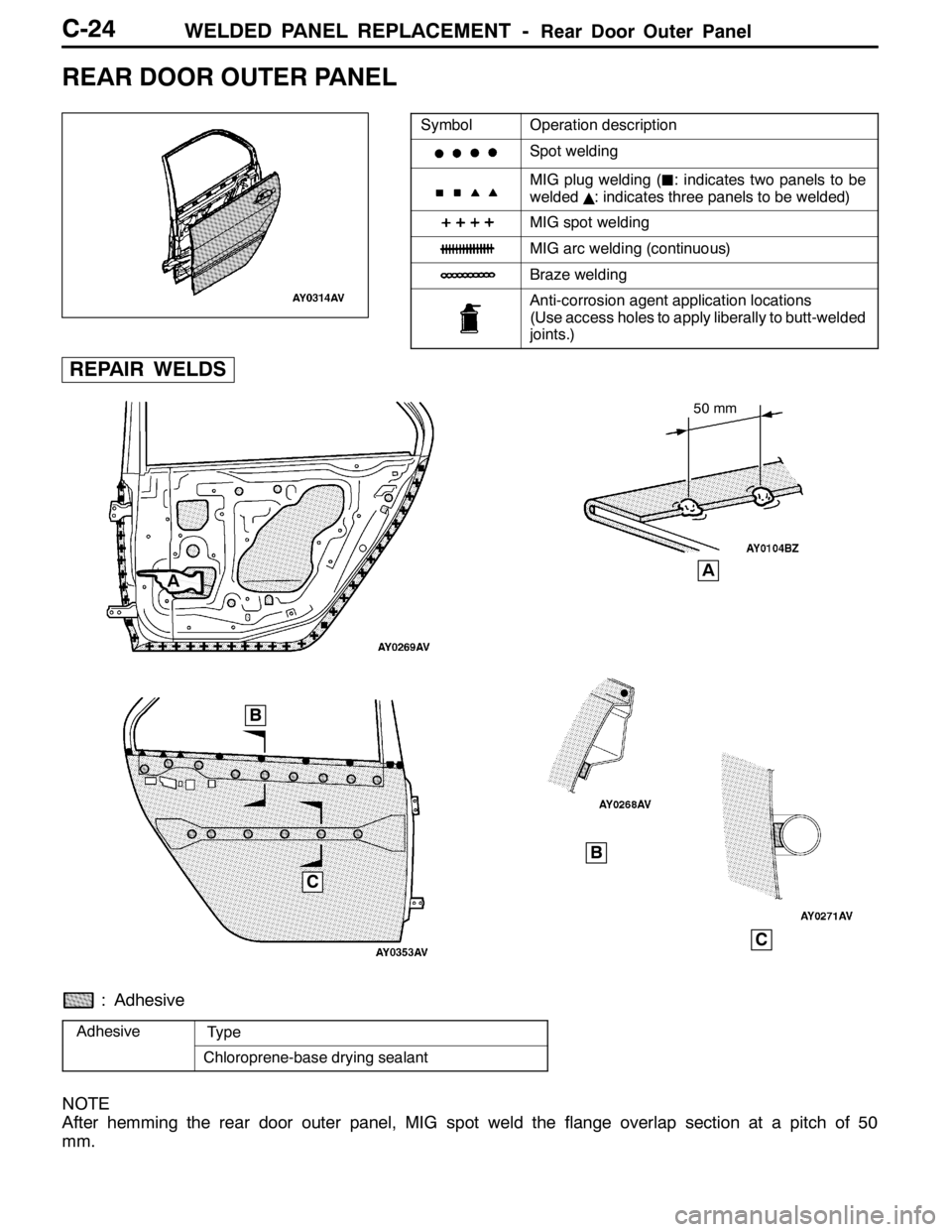
REAR DOOR OUTER PANEL
SymbolOperation description
Spot welding
MIG plug welding (J: indicates two panels to be
welded
Y: indicates three panels to be welded)
MIG spot welding
MIG arc welding (continuous)
Braze welding
Anti-corrosion agent application locations
(Use access holes to apply liberally to butt-welded
joints.)
A
B
B
C
C
A
REPAIR WELDS
50 mm
: Adhesive
AdhesiveType
Chloroprene-base drying sealant
NOTE
After hemming the rear door outer panel, MIG spot weld the flange overlap section at a pitch of 50
mm.
Page 69 of 1449
BODY
REPAIR
CONTENTS
BODY CONSTRUCTION A...................................................
BODY DIMENSIONS B......................................................
WELDED PANEL REPLACEMENT C.........................................
CORROSION PROTECTION D...............................................
SYNTHETIC-RESIN PARTS E................................................
BODY COLOUR F..........................................................
WIRING AND PIPING DIAGRAM G...........................................
Page 72 of 1449
CORROSION PROTECTION -Body Sealing LocationsD-2
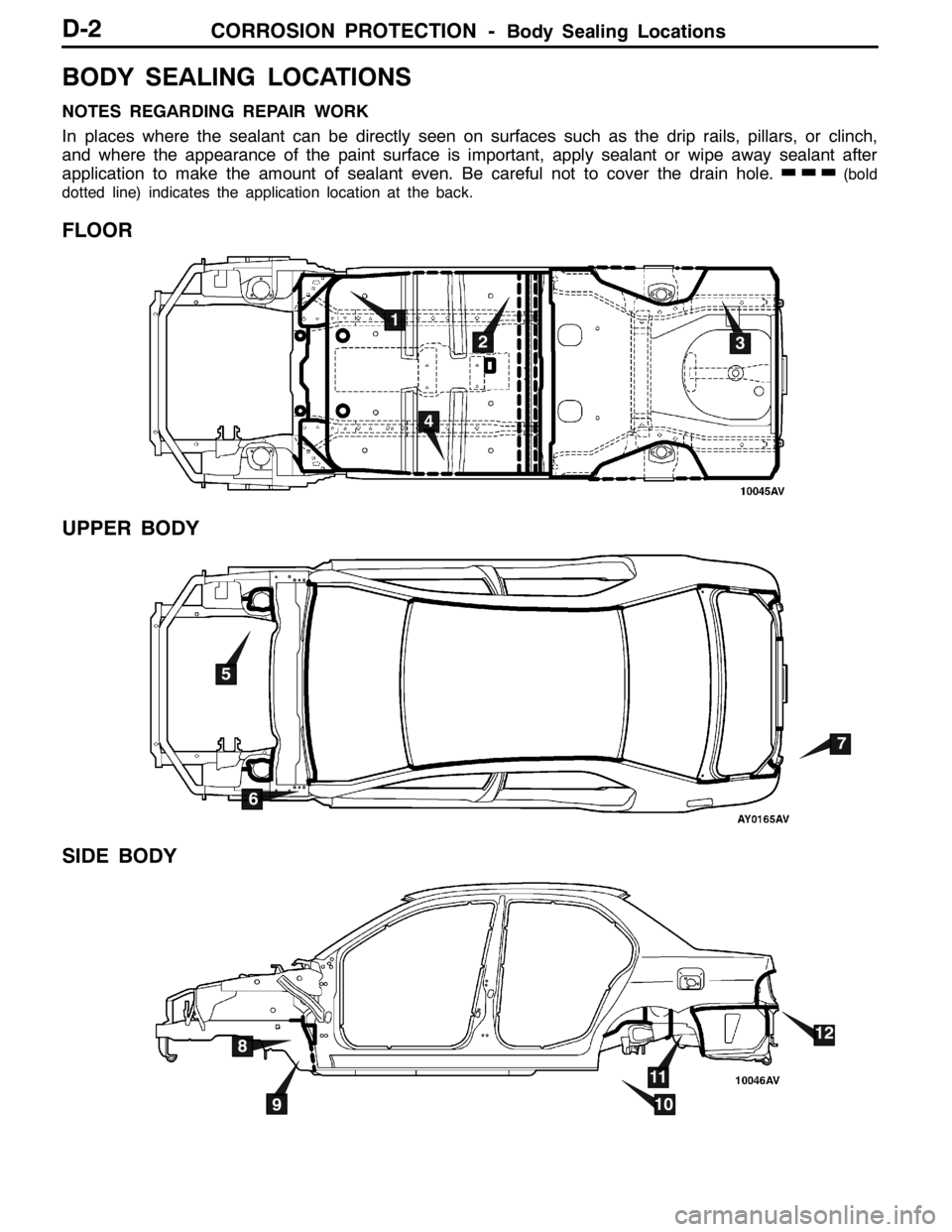
BODY SEALING LOCATIONS
NOTES REGARDING REPAIR WORK
In places where the sealant can be directly seen on surfaces such as the drip rails, pillars, or clinch,
and where the appearance of the paint surface is important, apply sealant or wipe away sealant after
application to make the amount of sealant even. Be careful not to cover the drain hole.
▄▄▄(bold
dotted line) indicates the application location at the back.
FLOOR
2
1
3
4
UPPER BODY
2
22
6
5
7
SIDE BODY
11
12
9
8
10
Page 75 of 1449
CORROSION PROTECTION -Undercoat Application LocationsD-5
UNDERCOAT APPLICATION LOCATIONS
In order to provide resistance to rust, corrosion, chipping, and vibration, an undercoat is applied to certain
areas of the underbody.
After completing body repairs, restore this undercoat if necessary.
* Mark the areas indicated with asterisks to make sure no undercoat adheres to these areas.
:Undercoat (Film thicknessof at least 0.5 mm)
*
* *
*
*
Page 379 of 1449

00-1
GENERAL
CONTENTS
HOW TO USE THIS MANUAL 2..............
Scope of Maintenance, Repair and Servicing
Explanations 2.................................
Indication of Destination 2......................
Definition of Terms 2...........................
Indication of Tightening Torque 2................
Model Indications 3............................
Explanation of Manual Contents 4...............
HOW TO USE
TROUBLESHOOTING/INSPECTION SERVICE
POINTS 6....................................
Troubleshooting Contents 6.....................
Diagnosis Function 7...........................
How to Use the Inspection Procedures 10........
Connector Measurement Service Points 11.......
Connector Inspection 12........................
Inspection Service Points for a Blown Fuse 13...
Points to Note for Intermittent Malfunctions 13....
VEHICLE IDENTIFICATION 14.................
Vehicle Information Code Plate 14...............Models 14.....................................
Model Code 15................................
Chassis Number 16............................
Engine Model Number 16.......................
MAJOR SPECIFICATIONS 17.................
PRECAUTIONS BEFORE SERVICE 18.........
SUPPLEMENTAL RESTRAINT SYSTEM
(SRS) 21...................................
SRS SERVICE PRECAUTIONS 22.............
SUPPORT LOCATIONS FOR LIFTING AND
JACKING 24.................................
Support Positions for a Garage Jack and Axle
Stands 24.....................................
Support Positions for a Single-Post Lift or
Double-Post Lift 25.............................
Support Positions and Support Method for an
H-Bar Lift 26..................................
STANDARD PART/TIGHTENING-TORQUE
TABLE 28....................................
Page 380 of 1449

GENERAL -How to Use This Manual00-2
HOW TO USE THIS MANUAL
SCOPE OF MAINTENANCE, REPAIR
AND SERVICING EXPLANATIONS
This manual provides explanations, etc. concerning
procedures for the inspection, maintenance, repair
and servicing of the subject model. Note, however,
that for engine and transmission-related component
parts, this manual covers only on-vehicle
inspections, adjustments, and the removal and
installation procedures for major components.
For detailed information concerning the inspection,
checking, adjustment, disassembly and reassembly
of the engine, transmission and major components
after they have been removed from the vehicle,
please refer to separate manuals covering the
engine and the transmission.
ON-VEHICLE SERVICE
“On-vehicle Service” is procedures for performing
inspections and adjustments of particularly
important locations with regard to the construction
and for maintenance and servicing, but other
inspection (for looseness, play, cracking, damage,
etc.) must also be performed.
INSPECTION
Under this title are presented inspection and
checking procedures to be performed by using
special tools and measuring instruments and by
feeling, but, for actual maintenance and servicing
procedures, visual inspections should always be
performed as well.
INDICATION OF DESTINATION
General Export and GCC are used for convenience
to indicate destination.
NOTE
(1) “General Export” means territories other than
Europe, GCC, Australia, New Zealand, the
U.S.A. and Canada.
(2) “GCC” indicates countries that are members
of the (Persian) Gulf Cooperation Council of
nations.
(3) In some instances, vehicles with other
specifications may be shipped to some
countries.
DEFINITION OF TERMS
STANDARD VALUE
Indicates the value used as the standard for judging
the quality of a part or assembly on inspection
or the value to which the part or assembly is
corrected and adjusted. It is given by tolerance.
LIMIT
Shows the standard for judging the quality of a
part or assembly on inspection and means the
maximum or minimum value within which the part
or assembly must be kept functionally or in strength.
It is a value established outside the range of
standard value.
REFERENCE VALUE
Indicates the adjustment value prior to starting the
work (presented in order to facilitate assembly and
adjustment procedures, and so they can be
completed in a shorter time).
CAUTION
Indicates the presentation of information particularly
vital to the worker during the performance of
maintenance and servicing procedures in order to
avoid the possibility of injury to the worker, or
damage to component parts, or a reduction of
component or vehicle function or performance, etc.
INDICATION OF TIGHTENING TORQUE
Tightening torques (units: N·m) are set to take into
account the central value and the allowable
tolerance. The central value is the target value,
and the allowable tolerance provides the checking
range for tightening torques. If bolts and nuts are
not provided with tightening torques, refer to
P.00-28.