2007 MITSUBISHI LANCER EVOLUTION stop start
[x] Cancel search: stop startPage 850 of 1449

MANUAL TRANSMISSION - On-vehicle Service22A-42
BLEEDING
1. Lift up the vehicle.
2. Set the MUT-IIto the 16-pin diagnosis connector.
Caution
Turn the ignition switch to the “LOCK”(OFF) position
before connecting or disconnecting the MUT-II.
3. Turn the ignition switch to the “ON” position.
4. Set the steering wheel in the straight-ahead position.
5. Perform the MUT-IIactuator test (Item No.02), and forcibly
drive the hydraulic unit.
NOTE
(1) The actuator test (Item No.01: Bleeding Mode) will
be performed for 5 minutes, after which it will be
cleared automatically. Drive can also be cleared during
forced driving using the clear key of the MUT-II.
(2) If the hydraulic unit function has been stopped by
fail-safe, the hydraulic unit cannot be forcibly driven.
6. Remove the cap of the bleeder screw on the transfer,
and connect the vinyl hose.
7
.Slowly turn the steering wheel to the left or right from
the neutral state. Loosen the bleeder screw, and check
that air is discharged together with the fluid.
8
.After the air is discharged, tighten the bleeder screw,
and return the steering wheel to the neutral state.
Caution
During bleeding, replenish the fluid so that some
always remains in the oil reservoir.
9. Repeat steps 6 and 7 several 2 to 3 times, and after
checking that no more air mixes in, tighten the bleeder
screw at the specified torque.
Tightening torque: 5±1 N·m
10. After bleeding, check the fluid level. (Refer to P. 22A-41.)
Caution
If bleeding is not performed completely, noise may
be produced from the hydraulic unit, or the durability
of the pump, etc. may drop.
11. On vehicles with AYC, perform bleeding when the
hydraulic unit is removed. (Refer to GROUP 27B -
On-vehicle Service.)
ACD OPERATION CHECK
1. Lift up the vehicle.
2
.Set the MUT-IIto the 16-pin diagnosis connector.
Caution
Turn the ignition switch to the “LOCK”(OFF) position
before connecting or disconnecting the MUT-II.
3. Start the engine.
Bleeder screw
Front exhaust pipe
Page 860 of 1449
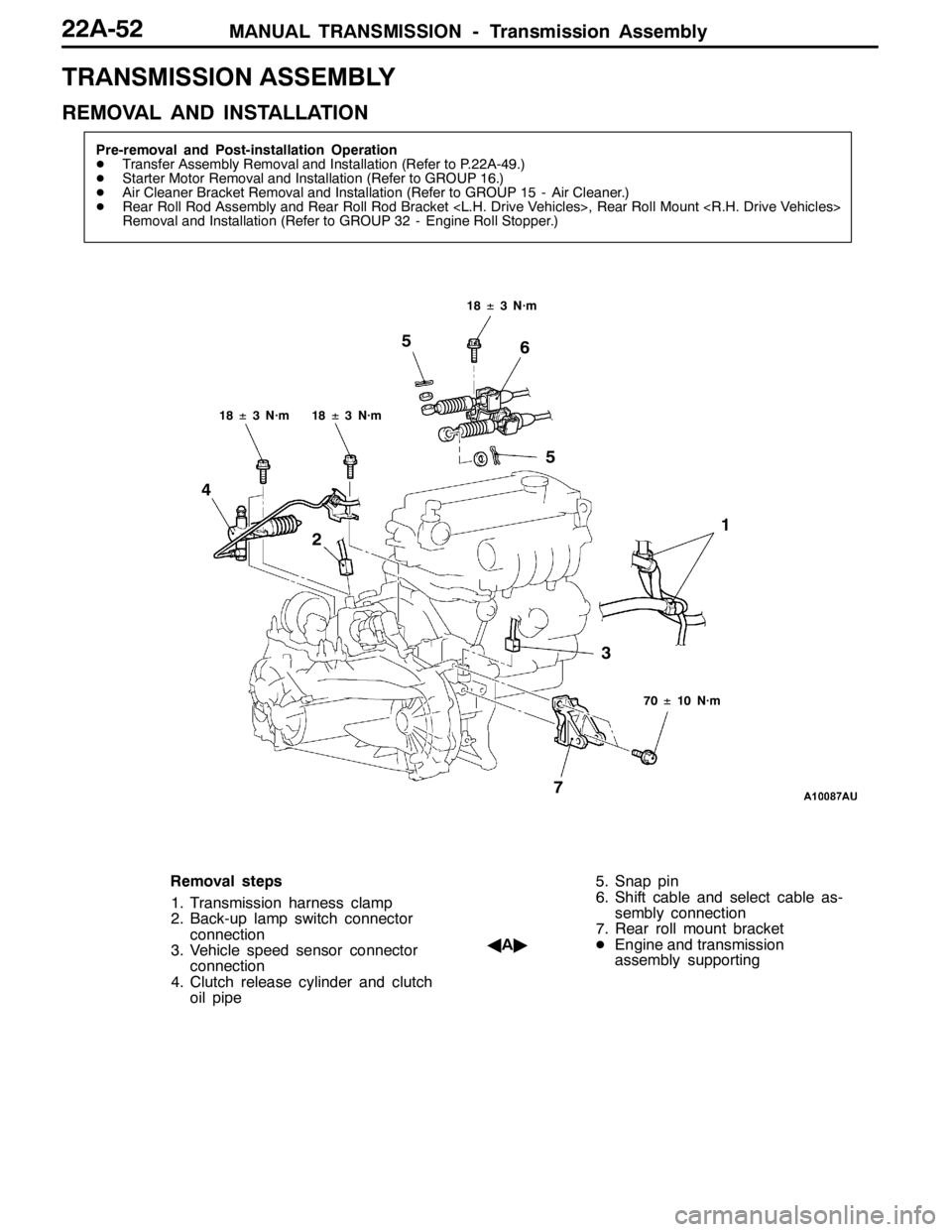
MANUAL TRANSMISSION - Transmission Assembly22A-52
TRANSMISSION ASSEMBLY
REMOVAL AND INSTALLATION
Pre-removal and Post-installation Operation
DTransfer Assembly Removal and Installation (Refer to P.22A-49.)
DStarter Motor Removal and Installation (Refer to GROUP 16.)
DAir Cleaner Bracket Removal and Installation (Refer to GROUP 15 - Air Cleaner.)
DRear Roll Rod Assembly and Rear Roll Rod Bracket
Removal and Installation (Refer to GROUP 32 - Engine Roll Stopper.)
1
2
3 45
5 6
7
18±3 N·m18±3 N·m
18±3 N·m
70±10 N·m
Removal steps
1. Transmission harness clamp
2. Back-up lamp switch connector
connection
3. Vehicle speed sensor connector
connection
4. Clutch release cylinder and clutch
oil pipe5. Snap pin
6. Shift cable and select cable as-
sembly connection
7. Rear roll mount bracket
AA"DEngine and transmission
assembly supporting
Page 966 of 1449

REAR AXLE -On-vehicle Service27B-20
6. Remove the cap of the left bleeder screw on the torque
transfer differential and connect a vinyl hose.
7. Gradually turn the steering wheel clockwise from the
straight-ahead position. At this time, loosen the left bleeder
screw and check that fluid is discharged with air.
8. After air has been completely discharged, tighten bleeder
screw and turn the steering wheel in the straight-ahead
position.
Caution
While the system is being bled of air, add fluid as
necessary to ensure that it is left in the oil reservoir
during the entire procedure.
9. Repeat steps 6 and 7 two to three times until no air
bubbles are recognized in the fluid that comes out. Then,
tighten the bleeder screw to the specified torque.
Tightening torque: 9±1 N·m
10. Perform steps 5 through 8 for the right bleeder screw.
Note, however, that the steering wheel should be turned
conterclockwise.
11. When removing the hydraulic unit, bleed the fluid line
in ACD side. (Refer to GROUP 22 – On-vehicle Service.)
12. After the system has been completely bled of air, check
for the fluid level. (Refer to P. 27B-19.)
Caution
If the system is not completely bled of air, the hydraulic
unit could generate noise, degrading pump durability.
AYC OPERATION CHECK
1. Lift up the vehicles.
2. Set the MUT-IIto the 16-pin diagnosis connector.
Caution
Turn the ignition switch to the LOCK (OFF) position
before connecting or disconnecting the MUT-II.
3. Start the engine.
4. Set the gear to the 2nd gear or above, operate MUT-II,
and check from the service data (Item No.09) that the
wheel speed is within 10 km/h to 20 km/h.
NOTE
(1) Set the steering wheel to the neutral position.
(2) When turning the steering wheel, AYC operates
continually (operation sound from the torque transfer
differential), but it is not system fault. In this case,
set the steering wheel to the neutral position, and
perform the following operations in order to stop the
ACD.
DRelease the clutch.
DSet the gear to ”Neutral”.
DStop the engine.
Bleeder
screw
Vinyl hose
Page 1050 of 1449

BASIC BRAKE SYSTEM -On-vehicle Service35A-8
2. If the brake pedal play is not within the standard value,
check the following, and adjust or replace if necessary:
DExcessive play between the brake pedal and the clevis
pin, or between the clevis pin and the brake booster
operating rod
DBrake pedal height
DInstallation position of the stop lamp switch, etc.
CLEARANCE BETWEEN BRAKE PEDAL AND FLOOR
BOARD
1. Turn up the carpet etc. under the brake pedal.
2. Start the engine, depress the brake pedal with
approximately 500 N of force, and measure the clearance
between the brake pedal and the floorboard.
Standard value (C): 90 mm or more
3. If the clearance is outside the standard value, check for
air trapped in the brake line and thickness of the disc
brake pad and dragging in the parking brake.
Adjust and replace defective parts as required.
4. Return the carpet, etc.
BRAKE BOOSTER OPERATING TEST
For simple checking of the brake booster operation, carry
out the following tests:
1. Run the engine for one or two minutes, and then stop
it.
If the pedal depresses fully the first time but gradually
becomes higher when depressed succeeding times, the
booster is operating properly. If the pedal height remains
unchanged, the booster is defective.
2. With the engine stopped, step on the brake pedal several
times.
Then start the engine while the brake pedal is stepped
on.
If the pedal moves downward slightly, the booster is in
good condition. If there is no change, the booster is
defective.
3. With the engine running, step on the brake pedal and
then stop the engine.
Hold the pedal depressed for 30 seconds. If the pedal
height does not change, the booster is in good condition.
If the pedal rises, the booster is defective.
If the above three tests are okay, the booster performance
can be determined as good.
If one of the above three tests is not okay at least, the check
valve, vacuum hose, or booster will be defective.
C
Good No good
When engine is
stoppedWhen engine is
started
GoodNo good
Page 1063 of 1449

BASIC BRAKE SYSTEM -Disc Brake35A-21
INSTALLATION SERVICE POINT
"AADISC BRAKE ASSEMBLY INSTALLATION
1. In order to measure the brake drag force after pad
installation, measure the rotary-sliding resistance of the
hub by the following procedure with the pads removed.
(1) Withdraw the drive shaft. (Refer to GROUP 26, 27.)
(2) Attach the special tool to the front hub assembly as
shown in the illustration, and tighten it to the specified
torque.
Tightening torque:
245±29 N·m
(3) Use a spring balance to measure the rotary-sliding
resistance of the hub in the forward direction.
2. Install the caliper support to the knuckle, and then
assemble the pad and the clip to the caliper support.
Caution
Do not contaminate the friction surfaces of the pads
and brake discs by any oil or grease.
3. Clean the piston and insert it into the cylinder with the
special tool.
4. Be careful that the piston boot does not become caught,
when lowering the caliper assembly and install the guide
pin to the caliper.
5. Start the engine, and then depress the brake pedal two
or three times strongly. Then stop the engine.
6. Turn the brake disc forward 10 times.
7. Use a spring balance to measure the rotary-sliding
resistance of the hub in the forward direction.
8. Calculate the drag force of the disc brake [difference
between the values measured at steps 1 and 7].
Standard value:
51 N or less
9. If that drag force exceeds the standard value, disassemble
the piston assembly. Then check the piston for
contamination or rust, and confirm if the piston or the
piston seal is deteriorated, and if the slide pins slide
smoothly.
1. Find the drag force of the disc brake. (Refer to P.35A-13.)
Standard value: 69 N or less
2. If that drag force exceeds the standard value, disassemble
the piston assembly. Then check the piston for
contamination or rust, and confirm if the piston or the
piston seal is deteriorated.MB990998
Bolt
MB990998Bolt
MB990520
Page 1085 of 1449

ABS <4WD> -Troubleshooting35B-15
INSPECTION CHART FOR TROUBLE SYMPTOMS
Trouble symptomsInspection procedure
No.Reference page
Communication between the MUT-IIand the whole system is not
possible.135B-16
Communication between the MUT-IIand the ABS-ECU is not possible.235B-17
When the ignition key is turned to “ON” (engine stopped), the ABS
warning lamp does not illuminate.335B-18
Even after the engine is started, the ABS warning lamp remains
illuminated.435B-18
In the inspection with MUT-II service data, the parking brake switch is not
turned ON or turn OFF.535B-19
The neutral position learning of the steering wheel sensor is not finished.635B-20
Faulty ABS operation735B-21
Caution
1. If steering movements are made when driving at high speed, or when driving on road surfaces
with low frictional resistance, or when passing over bumps, the ABS may operate even though
sudden braking is not being applied. Because of this, when getting information from the customer,
check if the problem occurred while driving under such conditions as these.
2. During ABS operation, the brake pedal may vibrate or may not be able to be depressed. Such
phenomena are due to intermittent changes in hydraulic pressure inside the brake line to prevent
the wheels from locking and is not an abnormality.
Page 1088 of 1449
ABS <4WD> -Troubleshooting35B-18
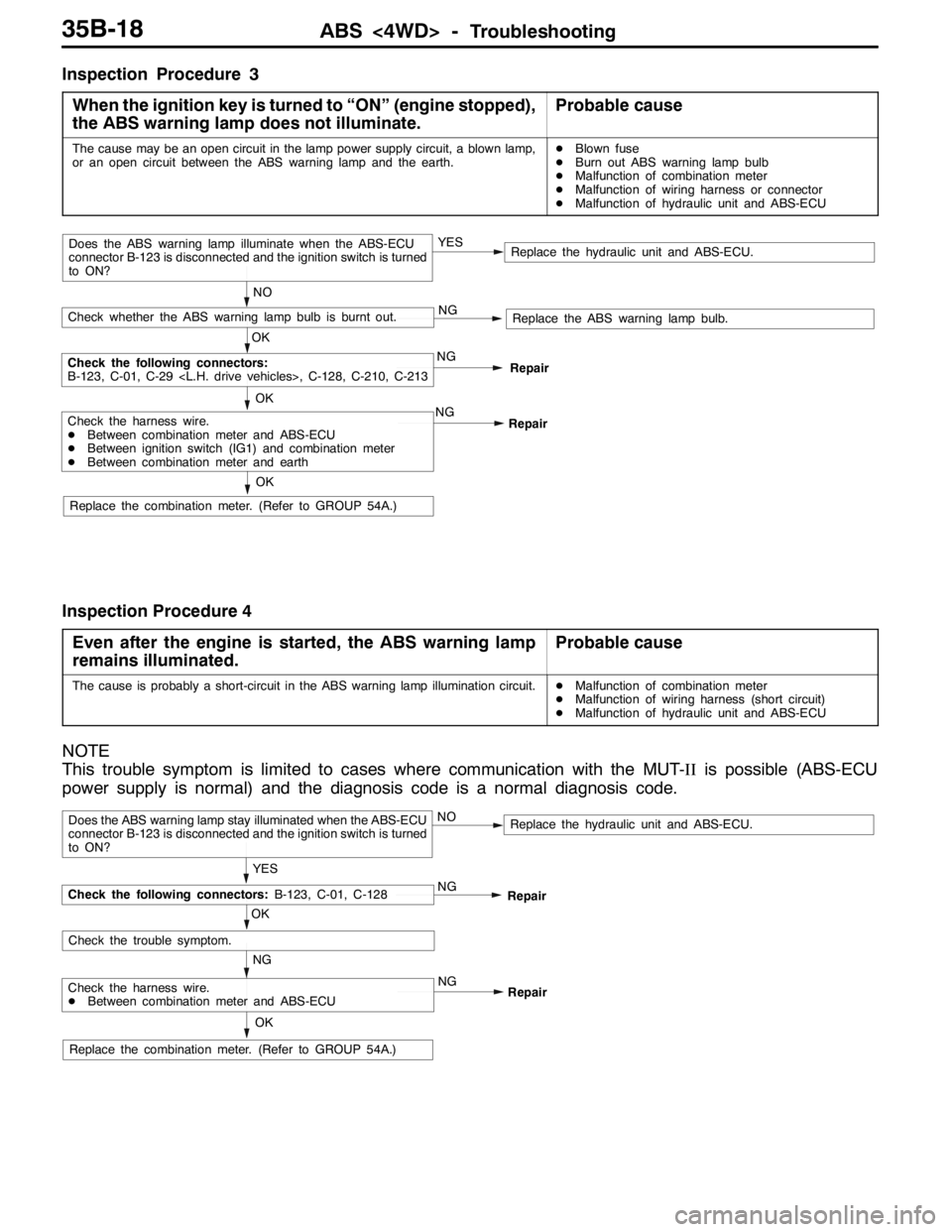
Inspection Procedure 3
When the ignition key is turned to “ON” (engine stopped),
the ABS warning lamp does not illuminate.
Probable cause
The cause may be an open circuit in the lamp power supply circuit, a blown lamp,
or an open circuit between the ABS warning lamp and the earth.DBlown fuse
DBurn out ABS warning lamp bulb
DMalfunction of combination meter
DMalfunction of wiring harness or connector
DMalfunction of hydraulic unit and ABS-ECU
NO
NG
Replace the ABS warning lamp bulb.
Check the harness wire.
DBetween combination meter and ABS-ECU
DBetween ignition switch (IG1) and combination meter
DBetween combination meter and earth
Replace the hydraulic unit and ABS-ECU.
OKNG
OK
Check the following connectors:
B-123, C-01, C-29
OK
Check whether the ABS warning lamp bulb is burnt out.
Does the ABS warning lamp illuminate when the ABS-ECU
connector B-123 is disconnected and the ignition switch is turned
to ON?YES
Repair
Replace the combination meter. (Refer to GROUP 54A.)NG
Repair
Inspection Procedure 4
Even after the engine is started, the ABS warning lamp
remains illuminated.
Probable cause
The cause is probably a short-circuit in the ABS warning lamp illumination circuit.DMalfunction of combination meter
DMalfunction of wiring harness (short circuit)
DMalfunction of hydraulic unit and ABS-ECU
NOTE
This trouble symptom is limited to cases where communication with the MUT-IIis possible (ABS-ECU
power supply is normal) and the diagnosis code is a normal diagnosis code.
YES
NG
Check the harness wire.
DBetween combination meter and ABS-ECU
Replace the hydraulic unit and ABS-ECU.
OK
NG
OK
Check the trouble symptom.
Does the ABS warning lamp stay illuminated when the ABS-ECU
connector B-123 is disconnected and the ignition switch is turned
to ON?NO
Repair
Replace the combination meter. (Refer to GROUP 54A.)NG
Repair
Check the following connectors:B-123, C-01, C-128
Page 1095 of 1449

ABS <4WD> -Troubleshooting35B-25
Terminal No. Normal conditionChecking requirements Check item
10ABS-ECU power
supply
Ignition switch: ONSystem voltage
supply
Ignition switch: START or ACC0V
11Solenoid valve power
supplyAlwaysSystem voltage
14Lateral G sensor inputIgnition switch: ON2.4 - 2.6 V (horizontal position)
15Longitudinal G sensor
earthAlways0V
17Steering wheel sensor
(ST-2) inputIgnition
switch: ONSteering wheel: Turn
laterallyVariation in the voltage value 0.8 -
2.1 V and 2.7 - 4.4 V
18Wheel speed sensor
(front right) outputMoving forward slowly0-5V
19Stop lamp monitor
input
Ignition
switch:ON
Stop lamp switch: ONSystem voltage
inputswitch:ON
Stop lamp switch: OFF1 V or less
20Wheel speed sensor
(rear left) outputMoving forward slowly0-5V
21Wheel speed sensor
(rear right) outputMoving forward slowly0-5V
24Lateral G sensor earthAlways0V
25Longitudinal G sensor
inputIgnition switch: ON2.4 - 2.6 V (horizontal position)
26Steering wheel sensor
(ST-1) inputIgnition
switch: ONSteering wheel: Turn
laterallyVariation in the voltage value 0.8 -
2.1 V and 2.7 - 4.4 V
27ABS warning lamp
transistor outputIgnition
switch: ONWhen the lamp is
switched off1 V or less
When the lamp is
illuminated7 V or more
32Wheel speed sensor
(front left) outputMoving forward slowly0-5V
33Motor power supplyAlwaysSystem voltage