Page 784 of 1449
ENGINE AND EMISSION CONTROL -Emission Control System
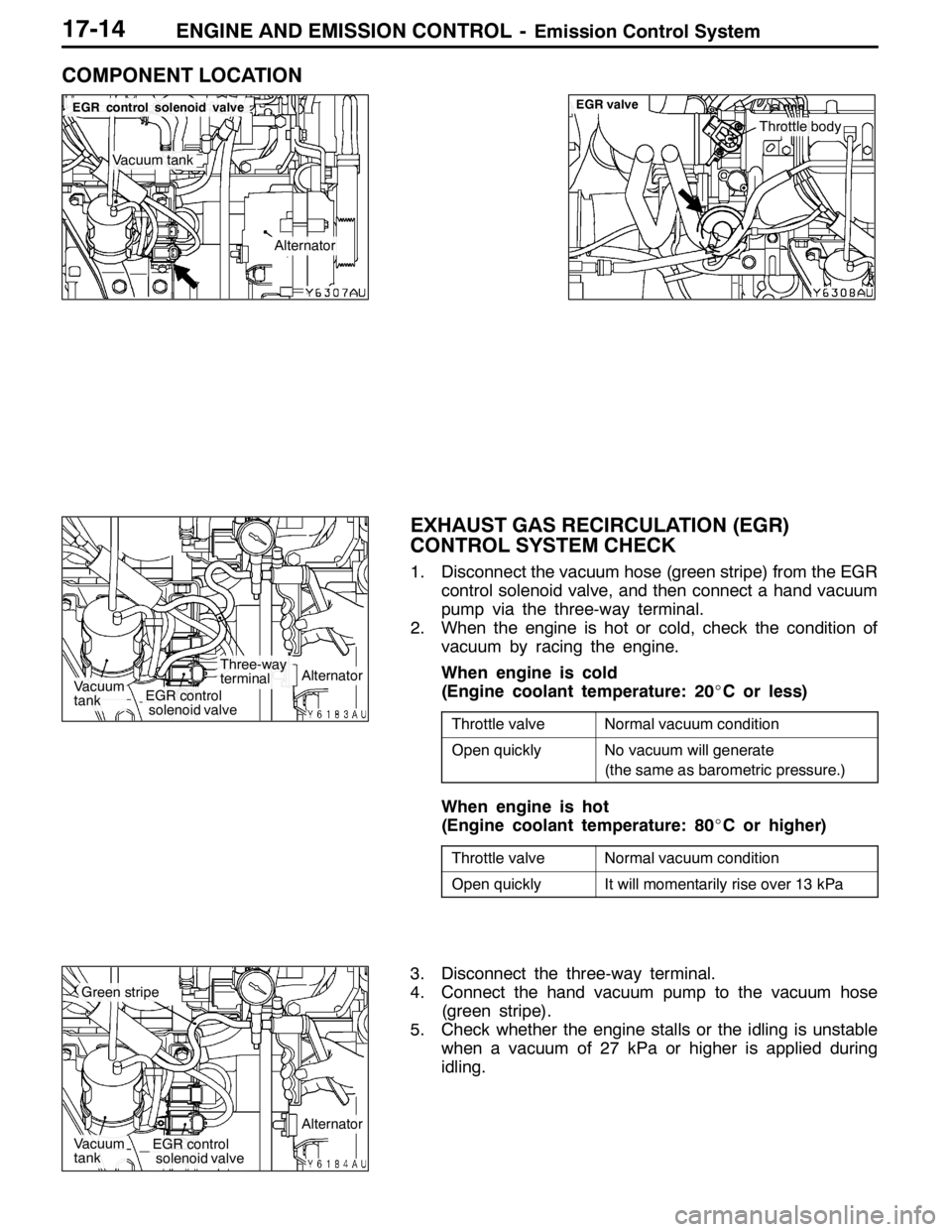
EGR control solenoid valve
Vacuum tank
Alternator
EGR valve
Throttle body
17-14
COMPONENT LOCATION
EXHAUST GAS RECIRCULATION (EGR)
CONTROL SYSTEM CHECK
1. Disconnect the vacuum hose (green stripe) from the EGR
control solenoid valve, and then connect a hand vacuum
pump via the three-way terminal.
2. When the engine is hot or cold, check the condition of
vacuum by racing the engine.
When engine is cold
(Engine coolant temperature: 20_C or less)
Throttle valveNormal vacuum condition
Open quicklyNo vacuum will generate
(the same as barometric pressure.)
When engine is hot
(Engine coolant temperature: 80_C or higher)
Throttle valveNormal vacuum condition
Open quicklyIt will momentarily rise over 13 kPa
3. Disconnect the three-way terminal.
4. Connect the hand vacuum pump to the vacuum hose
(green stripe).
5. Check whether the engine stalls or the idling is unstable
when a vacuum of 27 kPa or higher is applied during
idling.
Three-way
terminal
EGR control
solenoid valveVacuum
tankAlternator
EGR control
solenoid valveVacuum
tank
Alternator
Green stripe
Page 785 of 1449
ENGINE AND EMISSION CONTROL -Emission Control System17-15
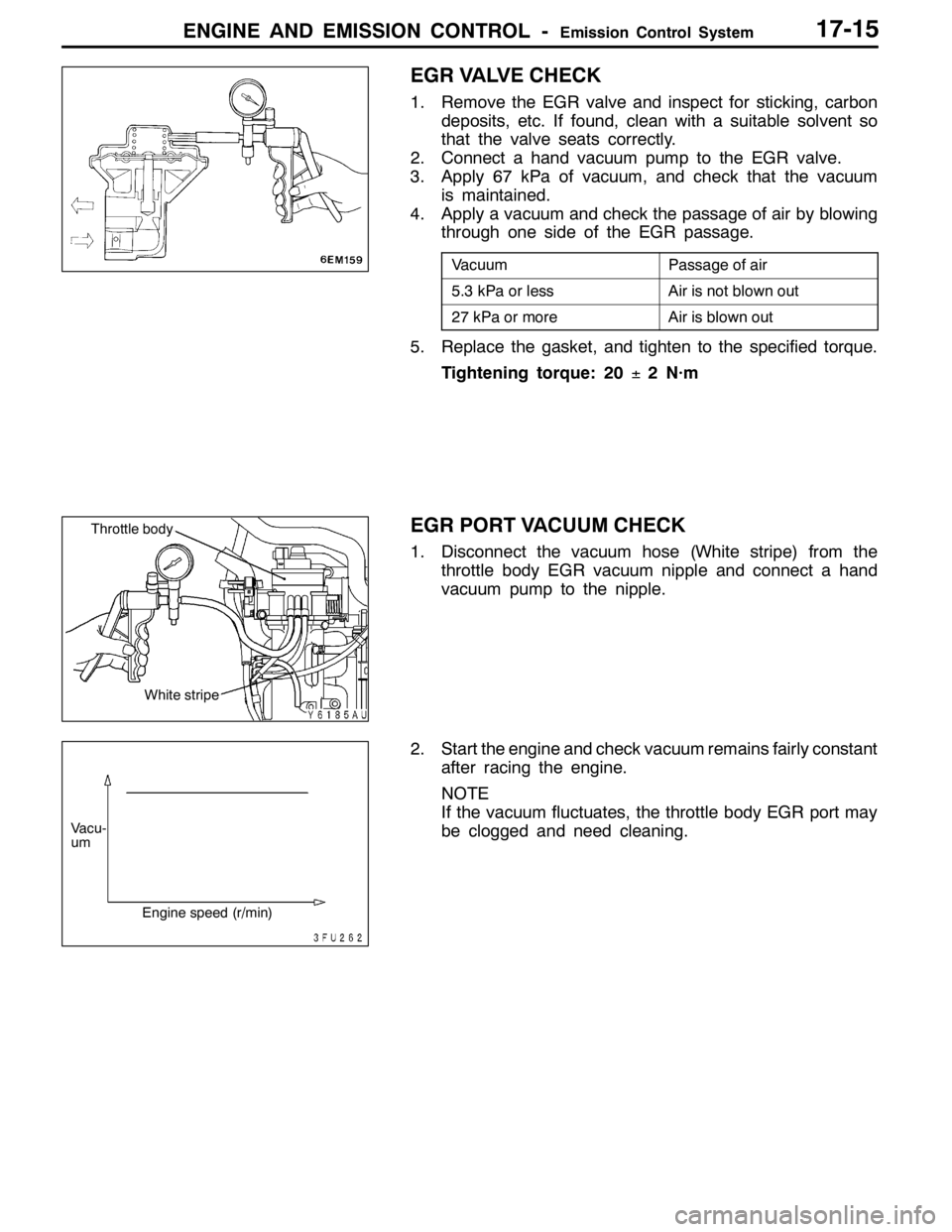
EGR VALVE CHECK
1. Remove the EGR valve and inspect for sticking, carbon
deposits, etc. If found, clean with a suitable solvent so
that the valve seats correctly.
2. Connect a hand vacuum pump to the EGR valve.
3. Apply 67 kPa of vacuum, and check that the vacuum
is maintained.
4. Apply a vacuum and check the passage of air by blowing
through one side of the EGR passage.
VacuumPassage of air
5.3 kPa or lessAir is not blown out
27 kPa or moreAir is blown out
5. Replace the gasket, and tighten to the specified torque.
Tightening torque: 20±2 N·m
EGR PORT VACUUM CHECK
1. Disconnect the vacuum hose (White stripe) from the
throttle body EGR vacuum nipple and connect a hand
vacuum pump to the nipple.
2. Start the engine and check vacuum remains fairly constant
after racing the engine.
NOTE
If the vacuum fluctuates, the throttle body EGR port may
be clogged and need cleaning.
White stripe
Throttle body
Vacu-
um
Engine speed (r/min)
Page 786 of 1449
ENGINE AND EMISSION CONTROL -Emission Control System17-16
EGR CONTROL SOLENOID VALVE CHECK
NOTE
When disconnecting the vacuum hose, always make a mark
so that it can be reconnected at original position.
1. Disconnect the vacuum hose (yellow stripe, green stripe,
white stripe) from the solenoid valve.
2. Disconnect the harness connector.
3. Connect a hand vacuum pump to the nipple to which
the green-striped vacuum hose was connected.
4. Check airtightness by applying a vacuum with voltage
applied directly from the battery to the EGR control
solenoid valve and without applying voltage.
Battery voltageB nipple conditionNormal condition
Not appliedOpenVacuum maintained
AppliedOpenVacuum leaks
ClosedVacuum maintained
5. Measure the resistance between the terminals of the
solenoid valve.
Standard value: 29 - 35Ω(at 20_C)
Battery
A B
C
Page 788 of 1449
ENGINE AND EMISSION CONTROL -Emission Control System17-18
CANISTER
REMOVAL AND INSTALLATION
Pre-removal and Post-installation Operation
DAir Pipe C, Air Hose D Removal and Installation (Refer to GROUP 15 - Inter Cooler.)
DBattery and Battery Tray Removal and Installation
DAir Cleaner Assembly Removal and Installation (Refer to GROUP 15 - Air Cleaner.)
1 2
3 4
5
67
89
Canister removal steps
1. Purge hose
2. Check valve
3. Vapor hose
4. Vent connector
5. Vapor hose6. Hose clamp
7. Canister
8. Fuel high pressure hose
9. Canister bracket assembly
Page 795 of 1449
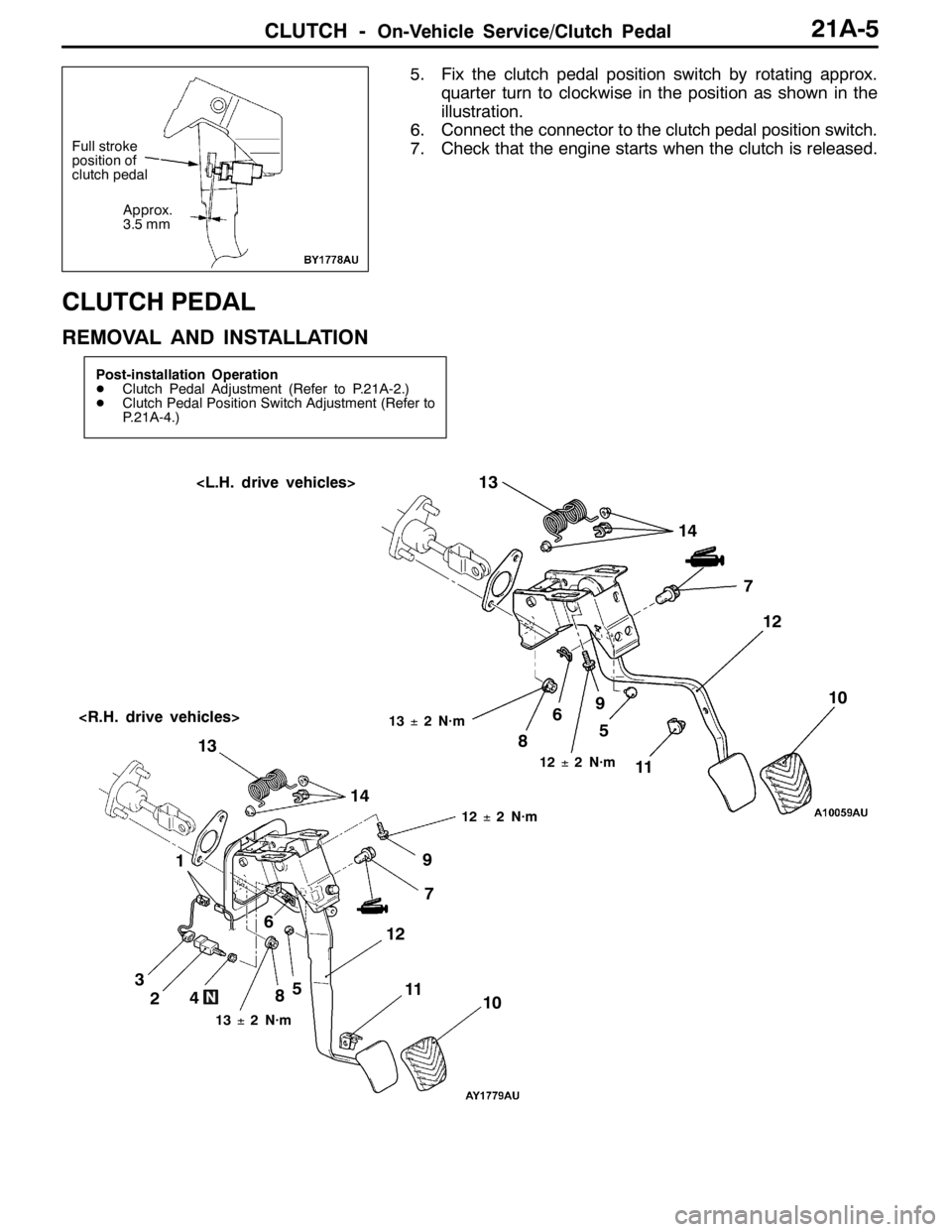
CLUTCH -On-Vehicle Service/Clutch Pedal21A-5
5. Fix the clutch pedal position switch by rotating approx.
quarter turn to clockwise in the position as shown in the
illustration.
6. Connect the connector to the clutch pedal position switch.
7. Check that the engine starts when the clutch is released.
CLUTCH PEDAL
REMOVAL AND INSTALLATION
Post-installation Operation
DClutch Pedal Adjustment (Refer to P.21A-2.)
DClutch Pedal Position Switch Adjustment (Refer to
P.21A-4.)
6713±2 N·m
1
12±2 N·m
8
11
2459
12±2 N·m
67
13±2 N·m
10 8
12 13
3145 910
1112 13
14
Full stroke
position of
clutch pedal
Approx.
3.5 mm
Page 812 of 1449
MANUAL TRANSMISSION - Special Tools22A-4
SPECIAL TOOLS
ToolNumberNameUse
MB991502MUT-IISub as-
semblyDiagnosis code checking
MB991529Diagnosis code
checking harness
MB991348Test harness setGsensor check
MD998330
(including
MD998331)Oil pressure gauge
(3.0 MPa)Hydraulic pressure measurement
MB991705Adapter
MB990635,
MB991113 or
MB991406
Steering linkage
pullerTie rod end and lower disconnection
GENERAL
SERVICE
TOOL
MZ203827Engine lifterSupporting the engine assembly during
removal and installation of the transmission
MB991453Engine hangerat-
tachment set
MB991721Slide hammerOutput shaft removal
Page 813 of 1449

MANUAL TRANSMISSION - Troubleshooting 22A-5
TROUBLESHOOTING
BASIC TROUBLESHOOTING CONDITIONS
Refer to GROUP 00 - How to Use Troubleshooting/Inspection Service Points.
NOTE
Before starting the troubleshooting procedure, make sure that the following items have been checked
okay.
DIs the appropriate steering wheel installed at the center of the steering column shaft correctly?
DAre the tire, wheel size, specifications, air pressure, balance, and wear state normal?
DIs the wheel alignment normal?
DHas the engine, suspension, etc. been remodeled in such a way that it will affect the ACD and AYC
systems?
DIAGNOSIS FUNCTION
READING DIAGNOSIS CODE
Read a diagnosis code by the MUT-IIor ACD mode indicator
lamp. (Refer to GROUP 00 - How to Use Troubleshooting/
Inspection Service Points.)
NOTE
Connect the MUT-IIto the diagnosis connector (16-pin).
ERASING DIAGNOSIS CODES
When using the MUT-II
Connect the MUT-IIto the diagnosis connector (16-pin) and
erase the diagnosis code.
Caution
Turn the ignition switch to the “LOCK”(OFF) position
before connecting or disconnecting the MUT-II.
ACDmode indicator lamp
Page 839 of 1449
MANUAL TRANSMISSION - Troubleshooting 22A-31
INSPECTION CHART FOR TROUBLE SYMPTOMS
Trouble symptomInspection
procedure No.Reference
page
No communication possible between MUT-IIand all systems.122A-31
No communication possible between MUT-IIand 4WD-ECU.222A-32
ACD mode indicator lamp does not light up when the ignition switch is set to ”ON“
(engine is stopped).322A-33
More than two ACD mode indicator lamps remain lit even after the engine is started422A-34
The ACD does not operate (no diagnostic code).522A-34
The AYC does not operate (no diagnostic code).6Refer to
GROUPThe rear tire sounds when turning at low speed corners (vehicle slows down)7GROUP
27B.
Noise is produced from the torque transfer differential during turning.8
27B.
INSPECTION PROCEDURES FOR TROUBLE SYMPTOMS
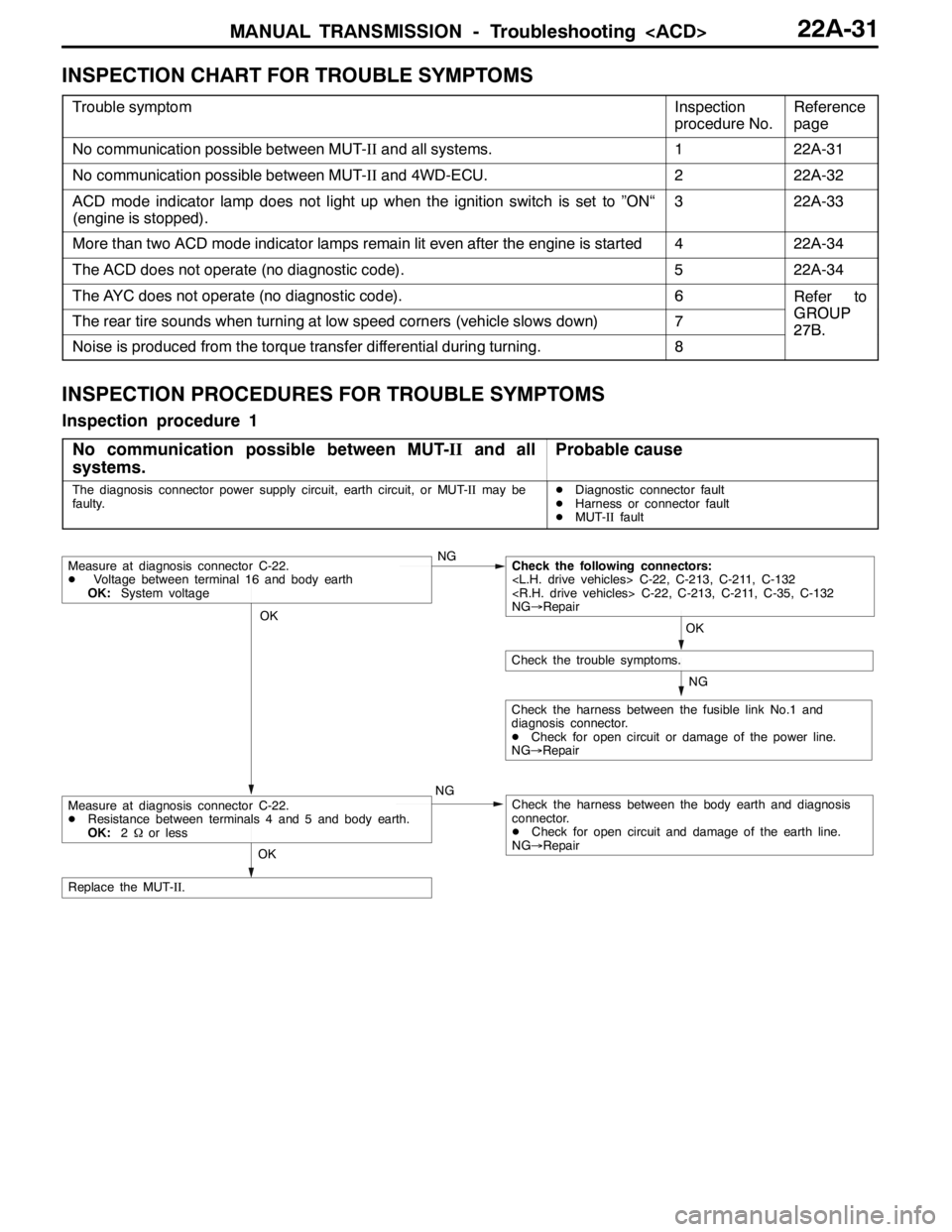
Inspection procedure 1
No communication possible between MUT-IIand all
systems.
Probable cause
The diagnosis connector power supply circuit, earth circuit, or MUT-IImay be
faulty.DDiagnostic connector fault
DHarness or connector fault
DMUT-IIfault
OK
NG
NG
Check the harness between the fusible link No.1 and
diagnosis connector.
DCheck for open circuit or damage of the power line.
NG→Repair
OK
Check the trouble symptoms.
Measure at diagnosis connector C-22.
DVoltage between terminal 16 and body earth
OK:System voltageNGCheck the following connectors:
C-22, C-213, C-211, C-132
C-22, C-213, C-211, C-35, C-132
NG→Repair
Check the harness between the body earth and diagnosis
connector.
DCheck for open circuit and damage of the earth line.
NG→Repair
OK
Replace the MUT-II.
Measure at diagnosis connector C-22.
DResistance between terminals 4 and 5 and body earth.
OK:2Ωor less