2007 MITSUBISHI LANCER EVOLUTION check engine
[x] Cancel search: check enginePage 1416 of 1449

HEATER, AIR CONDITIONER AND VENTILATION–On-vehicle Service55-14
ON-VEHICLE SERVICE
REFRIGERANT LEVEL TEST THROUGH
PERFORMANCE TEST
1. Start the engine.
2. Turn on the A/C switch, and set the A/C control to MAX.
COOL.
3. Adjust the engine speed to 1,500 r/min.
4. Check the refrigerant level (bubble state) through the
sight glass.
ItemState
Insufficient refriger-
antMany bubbles are seen. If refrigerant
is extremely low, it appears white.
Sufficient or excess
refrigerantNo bubbles are seen
NOTE
1. If insufficient, replenish the refrigerant as follows.
a) Replenish until bubbles disappear from the sight
glass.
b) After the bubbles disappear from the sight glass,
replenish 100g of refrigerant.
2. If excessive, replenish the refrigerant as follows.
a) Drain the refrigerant until bubbles can be seen
through the sight glass.
b) Replenish until bubbles disappear from the sight
glass.
c) After the bubbles disappear from the sight glass,
replenish 100g of refrigerant.
MAGNETIC CLUTCH TEST
1. Disconnect the connector to the magnetic clutch.
2. Connect battery (+) voltage directly to the connector for
the magnetic clutch.
3. If the magnetic clutch is normal, there will be ”click”. If
the pulley and armature do not make contact (’click’),
there is a malfunction.
RECEIVER DRIER TEST
Operate the unit and check the piping temperature by touching
the receiver drier outlet and inlet.
If there is a difference in the temperatures, the receiver drier
is restricted.
Replace the receiver drier.
Insufficient
refrigerantSufficient or excess
refrigerant
Bubbles
Page 1419 of 1449

HEATER, AIR CONDITIONER AND VENTILATION–On-vehicle Service55-17
12. Turn the vacuum pump adaptor switch to the R134a side
to start the vacuum pump.
Caution
Do not operate the compressor for evacuation.
13. Evacuate to a vacuum reading of 100 kPa or higher (takes
approx. 10 minutes).
14. Turn the vacuum pump adaptor switch OFF and allow
to stand it for 5 minutes.
Caution
Do not operate the compressor in the vacuum
condition; damage may occur.
15. Carry out a leak test. (Good if the negative pressure
does not drop.)
Caution
If the negative pressure drops, increase the tightness
of the connections, and then repeat the evacuation
procedure from step (12).
16. With the handle turned back all the way (valve open),
install the charging valve to the service can.
17. Turn the handle of the adaptor valve back all the way
(valve closed), remove it from the gauge manifold and
install the service can.
18. Tighten the handle of the charging valve (valve closed)
to puncture the service can.
19. Turn the handle of the charging valve back (valve open)
and tighten the handle of the adaptor valve (valve open) to
charge the system with refrigerant.
Caution
If the service can is inverted, liquid refrigerant may
be drawn into the compressor damaging it by liquid
compression. Keep the service can upright to ensure
that refrigerant is charged in gas state.
20. If the refrigerant is not drawn in, turn the handle of the
adaptor valve back all the way (valve closed).
21. Check for gas leaks using a leak detector.
If a gas leak is detected, re-tighten the connections, and
then repeat the charging procedure from evacuation in
step (12).
Caution
The leak detector for R-134a should be used.
22. Start the engine.
23. Operate the A/C and set to the lowest temperature (MAX.
COOL).
Low-pressure
service valveVacuum pump
Adaptor valveValve open
Valve close
Charging
valve
Service can
Charging valve
Service can
(Refrigerant container)
Low-pressure
service valve
Page 1421 of 1449

HEATER, AIR CONDITIONER AND VENTILATION–On-vehicle Service HEATER, AIR CONDITIONER AND VENTILATION–On-vehicle Service55-19
8. Start the engine.
9. Operate the air conditioner and set at the lowest
temperature (MAX. COOL).
10. Fix the engine speed at 1,500 r/min.
11. Tighten the handle of the adaptor valve (valve open),
and replenish refrigerant while checking the quantity
through the sight glass.
Caution
If the service can is inverted, liquid refrigerant may
be draw into the compressor damaging it by liquid
compression. Keep the service can upright to ensure
that refrigerant is changed in gas state.
12. After replenishing is completed, turn the handle of the
adaptor valve all the way back (valve close), and remove
the quick joint.
NOTE
When there is remainder of refrigerant in the service can,
keep it for next use with the charge value and the valve
of the adaptor valve being closed.
DISCHARGING SYSTEM
Use the refrigerant recovery unit to discharge refrigerant gas
from the system.
NOTE : Refer to the Refrigerant Recovery and Recycling
Unit Instruction Manual for operation of the unit.
REFILLING OF OIL IN THE A/C SYSTEM
Too little oil will provide inadequate compressor lubrication
and cause a compressor failure. Too much oil will increase
discharge air temperature.
When a compressor is installed at the factory, it contains
130 cm
3of refrigerant oil. While the A/C system is in operation,
the oil is carried through the entire system by the refrigerant.
Some of this oil will be trapped and retained in various parts
of the system.
When the following system components are changed, it is
necessary to add oil to the system to replace the oil being
removed with the component.
Compressor oil: SUN PAG 56
Quantity
Condenser: 180 cm
3
Charging valve
Service can
(Refrigerant container)
Low-pressure
service valve
Page 1423 of 1449

HEATER, AIR CONDITIONER AND VENTILATION–On-vehicle Service55-21
REFRIGERANT LEAK REPAIR
LOST CHARGE
If the system has lost all charge due to a leak:
1. Evacuate the system. (See procedure.)
2. Charge the system with approximately one
pound of refrigerant.
3. Check for leaks.
4. Discharge the system.
5. Repair leaks.
6. Replace receiver drier.
Caution
Replacement filter-drier units must be
sealed while in storage. The drier used in
these units will saturate water quickly upon
exposure to the atmosphere. When
installing a drier, have all tools and supplies
ready for quick reassembly to avoid keeping
the system open any longer than necessary.
7. Evacuate and charge system.
LOW CHARGE
If the system has not lost all of its refrigerant charge;
locate and repair all leaks. If it is necessary to
increase the system pressure to find the leak
(because of an especially low charge) add
refrigerant. If it is possible to repair the leak without
discharging the refrigerant system, use the
procedure for correcting low refrigerant level.HANDLING TUBING AND FITTINGS
Kinks in the refrigerant tubing or sharp bends in
the refrigerant hose lines will greatly reduce the
capacity of the entire system. High pressures are
produced in the system when it is operating.
Extreme care must be exercised to make sure that
all connections are pressure tight. Dirt and moisture
can enter the system when it is opened for repair
or replacement of lines or components. The
following precautions must be observed. The
system must be completely discharged before
opening any fitting of connection in the refrigeration
system. Open fittings with caution even after the
system has been discharged. If any pressure is
noticed as a fitting is loosened, allow trapped
pressure to bleed off very slowly.
Never attempt to rebend formed lines to fit. Use
the correct line for the installation you are servicing.
A good rule for the flexible hose lines is keep the
radius of all bends at least 10 times the diameter
of the hose.
Sharper bends will reduce the flow of refrigerant.
The flexible hose lines should be routed so that
they are at least 80 mm from the exhaust manifold.
It is good practice to inspect all flexible hose lines
at least once a year to make sure they are in good
condition and properly routed.
Unified plumbing connections with O-rings, these
O-rings are not reusable.
COMPRESSOR NOISE
You must first know the conditions when the noise
occurs. These conditions are: weather, vehicle
speed, in gear or neutral, engine temperature or
any other special conditions.
Noises that develop during A/C operation can often
be misleading. For example: what sounds like a
failed front bearing or connecting rod, may be
caused by loose bolts, nuts, mounting brackets,
or a loose clutch assembly. Verify accessory drive
belt tension (power steering or alternator).
Improper accessory drive belt tension can cause
a misleading noise when the compressor is
engaged and little or no noise when the compressor
is disengaged.
Drive belts are speed-sensitive. That is, at different
engine speeds, and depending upon belt tension,
belts can develop unusual noises that are often
mistaken for mechanical problems within the
compressor.ADJUSTMENT
1. Select a quiet area for testing. Duplicate
conditions as much as possible. Switch
compressor on and off several times to clearly
identify compressor noise. To duplicate high
ambient conditions (high head pressure),
restrict air flow through condenser. Install
manifold gauge set to make sure discharge
pressure doesn’t exceed 2,070 kPa.
2. Tighten all compressor mounting bolts, clutch
mounting bolt, and compressor drive belt.
Check to assure clutch coil is tight (no rotation
or wobble).
3. Check refrigerant hoses for rubbing or
interference that can cause unusual noises.
4. Check refrigerant charge. (See “Charging
System”.)
5. Recheck compressor noise as in Step 1.
6. If noise still exists, loosen compressor mounting
bolts and retorque. Repeat Step 1.
7. If noise continues, replace compressor and
repeat Step 1.
Page 1426 of 1449

HEATER, AIR CONDITIONER AND VENTILATION–On-vehicle Service55-24
IDLE-UP OPERATION CHECK
1. Set the vehicle in the pre-inspection condition:
Engine coolant temperature: 80 – 90_C
Lamps, electric cooling fan and all accessories: OFF
2. Check that the idle speed is within the standard value.
Standard value: 850±50 r/min
NOTE
The idle speed is controlled by the ISC system and should
not be adjusted.
3. The idle speed should be within the standard value when
the A/C switch is turned on and the A/C is operating.
Standard value:
850±50 r/min
Page 1438 of 1449

HEATER, AIR CONDITIONER AND VENTILATION-Compressor55-36
COMPRESSOR
REMOVAL AND INSTALLATION
Before Removal
Refrigerant Draining (Refer to P.55-19.)After Removal
DRefrigerant Replenishing (Refer to P.55-16.)
DDrive Belt Tension Check (Refer to GROUP
11A – Engine Adjustment.)
25±4
N·m
2 4
1
- Pipe coupling
O ring
A/C compressor oil:
SUN PAG 56
1, 2
5
3
Removal steps
AA"1. Flexible suction hose connection
AA"2. Flexible discharge hose connection
AB"3. Drive beltAC""AA4. Compressor
5. Compressor bracket
REMOVAL SERVICE POINTS
AA"DISCONNECTION OF FLEXIBLE SUCTION HOSE
AND FLEXIBLE DISCHARGE HOSE
To prevent the entry of dust or other foreign bodies, plug
the dismantled hoses and compressor nipples.
Caution
As the compressor oil and receiver are highly moisture
absorbent, use a non-porous material to plug the hose
and nipples.
Page 1441 of 1449
HEATER, AIR CONDITIONER AND VENTILATION-Compressor55-39
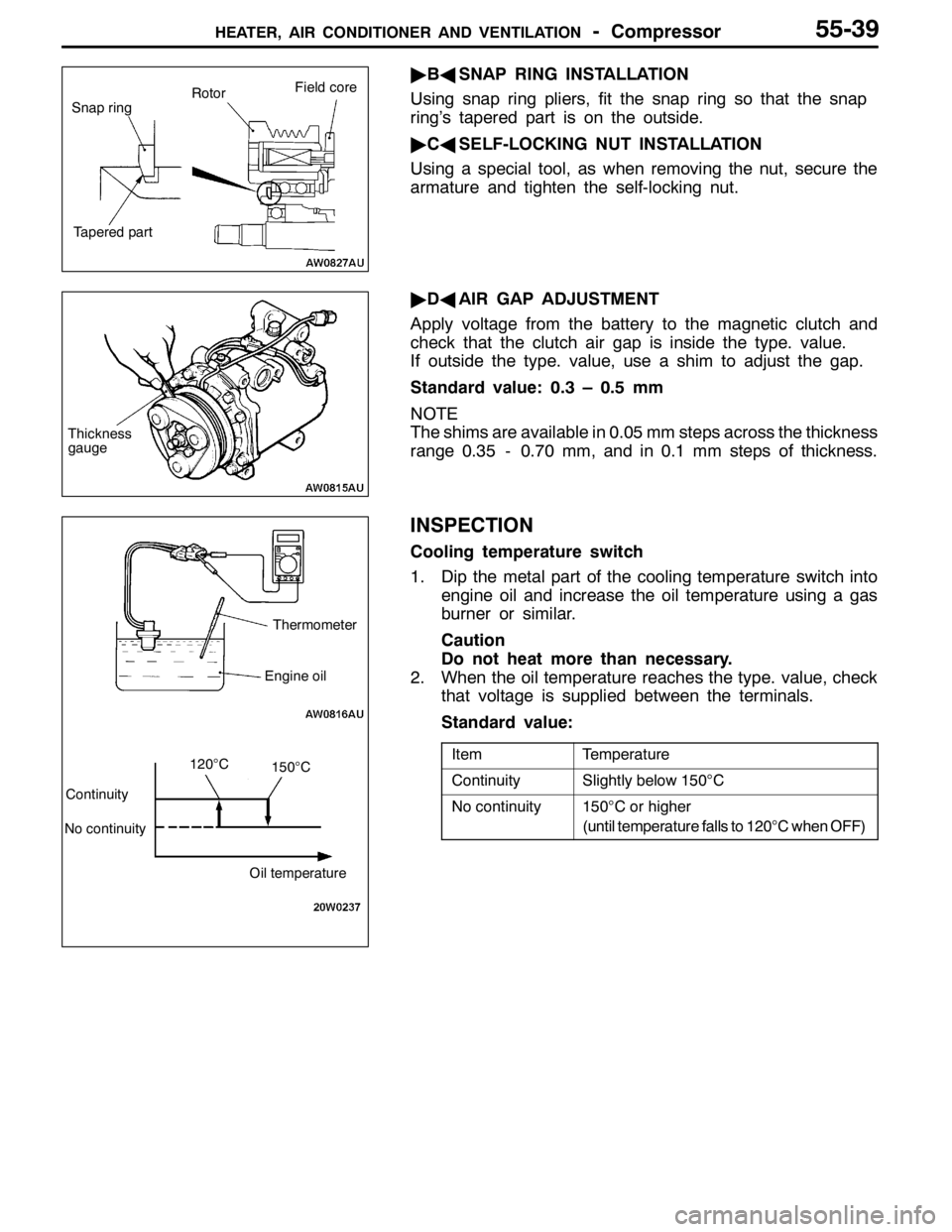
"BASNAP RING INSTALLATION
Using snap ring pliers, fit the snap ring so that the snap
ring’s tapered part is on the outside.
"CASELF-LOCKING NUT INSTALLATION
Using a special tool, as when removing the nut, secure the
armature and tighten the self-locking nut.
"DAAIR GAP ADJUSTMENT
Apply voltage from the battery to the magnetic clutch and
check that the clutch air gap is inside the type. value.
If outside the type. value, use a shim to adjust the gap.
Standard value: 0.3 – 0.5 mm
NOTE
The shims are available in 0.05 mm steps across the thickness
range 0.35 - 0.70 mm, and in 0.1 mm steps of thickness.
INSPECTION
Cooling temperature switch
1. Dip the metal part of the cooling temperature switch into
engine oil and increase the oil temperature using a gas
burner or similar.
Caution
Do not heat more than necessary.
2. When the oil temperature reaches the type. value, check
that voltage is supplied between the terminals.
Standard value:
ItemTemperature
ContinuitySlightly below 150°C
No continuity150°C or higher
(until temperature falls to 120°C when OFF)
Snap ringRotorField core
Tapered part
Thickness
gauge
Thermometer
Engine oil
Continuity
No continuity
Oil temperature
120°C150°C