Page 774 of 1449

ENGINE AND EMISSION CONTROL -Emission Control System17-4
EMISSION CONTROL SYSTEM
GENERAL INFORMATION
The emission control system consists of the following subsystems:
DCrankcase emission control system
DEvaporative emission control system
DExhaust emission control system
ItemsNameSpecification
Crankcase emission
control systemPositive crankcase ventilation (PCV) valveVariable flow type
(Purpose: HC reduction)
Evaporative emission
control systemCanister
Purge control solenoid valve
Check valveEquipped
Duty cycle type solenoid valve
Equipped
(Purpose: HC reduction)
Exhaust emission
control systemAir-fuel ratio control device - MPI systemOxygen sensor feedback type
(Purpose: CO, HC, NOx reduction)
Exhaust gas recirculation system
DEGR valve
DEGR control solenoid valveEquipped
Single type
Duty cycle type solenoid valve
(Purpose: NOx reduction)
Catalytic converterMonolith type
(Purpose: CO, HC, NOx reduction)
EMISSION CONTROL DEVICE REFERENCE TABLE
Related partsCrankcase
emission
control
systemEvaporative
emission
control
systemAir/fuel
ratio
control
systemCatalytic
converterExhaust
gas
recirculation
systemReference
page
PCV valve×17-9
Purge control solenoid valve×17-12
Check valve×17-12
MPI system component××GROUP 13A
Catalytic converter×17-19
EGR valve×17-15
EGR control solenoid valve×17-16
Page 775 of 1449
ENGINE AND EMISSION CONTROL -Emission Control System17-5
SERVICE SPECIFICATIONS
ItemsStandard value
Purge control solenoid valve coil resistance (at 20_C)Ω30 - 34
EGR control solenoid valve coil resistance (at 20_C)Ω29 - 35
VACUUM HOSE
VACUUM HOSE PIPING DIAGRAM
Fuel
pressure
control
solenoid
valve
Oxygen
sensor
(front)
Check
valve
Fuel
pressure
regulator
PCV valve To
fuel tank
Oxygen sensor (rear) From
fuel pump
Air
inletEGR control
solenoid valve
Purge
control
solenoid
valveCanisterFrom
fuel tank
EGR
valve Injector
Three - way
catalytic converter A
P
E
Page 776 of 1449
ENGINE AND EMISSION CONTROL -Emission Control System17-6
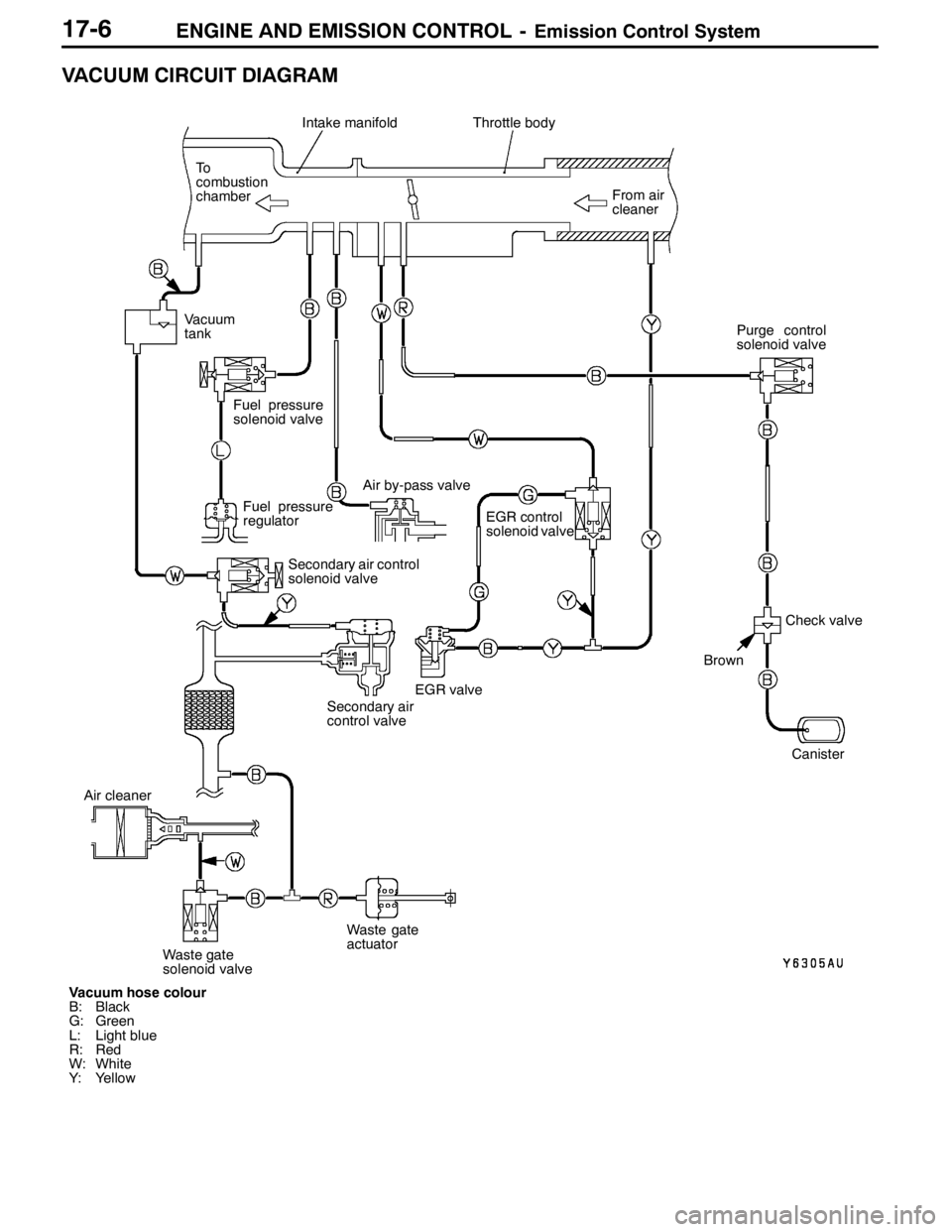
VACUUM CIRCUIT DIAGRAM
Vacuum hose colour
B: Black
G: Green
L: Light blue
R: Red
W: White
Y: YellowFrom air
cleaner
Intake manifoldThrottle body
To
combustion
chamber
Fuel pressure
regulator
EGR control
solenoid valve
Canister
EGR valve
Brown
Check valve Vacuum
tank
Fuel pressure
solenoid valve
Air by-pass valve
Secondary air control
solenoid valve
Secondary air
control valvePurge control
solenoid valve
Air cleaner
Waste gate
solenoid valveWaste gate
actuator
Page 777 of 1449
ENGINE AND EMISSION CONTROL -Emission Control System17-7
VACUUM HOSE CHECK
1. Using the piping diagram as a guide, check to be sure
that the vacuum hoses are correctly connected.
2. Check the connection condition of the vacuum hoses,
(removed, loose, etc.) and check to be sure that there
are no bends or damage.
VACUUM HOSE INSTALLATION
1. When connecting the vacuum hoses, they should be
securely inserted onto the nipples.
2. Connect the hoses correctly, using the vacuum hose piping
diagram as a guide.
Page 779 of 1449
ENGINE AND EMISSION CONTROL -Emission Control System
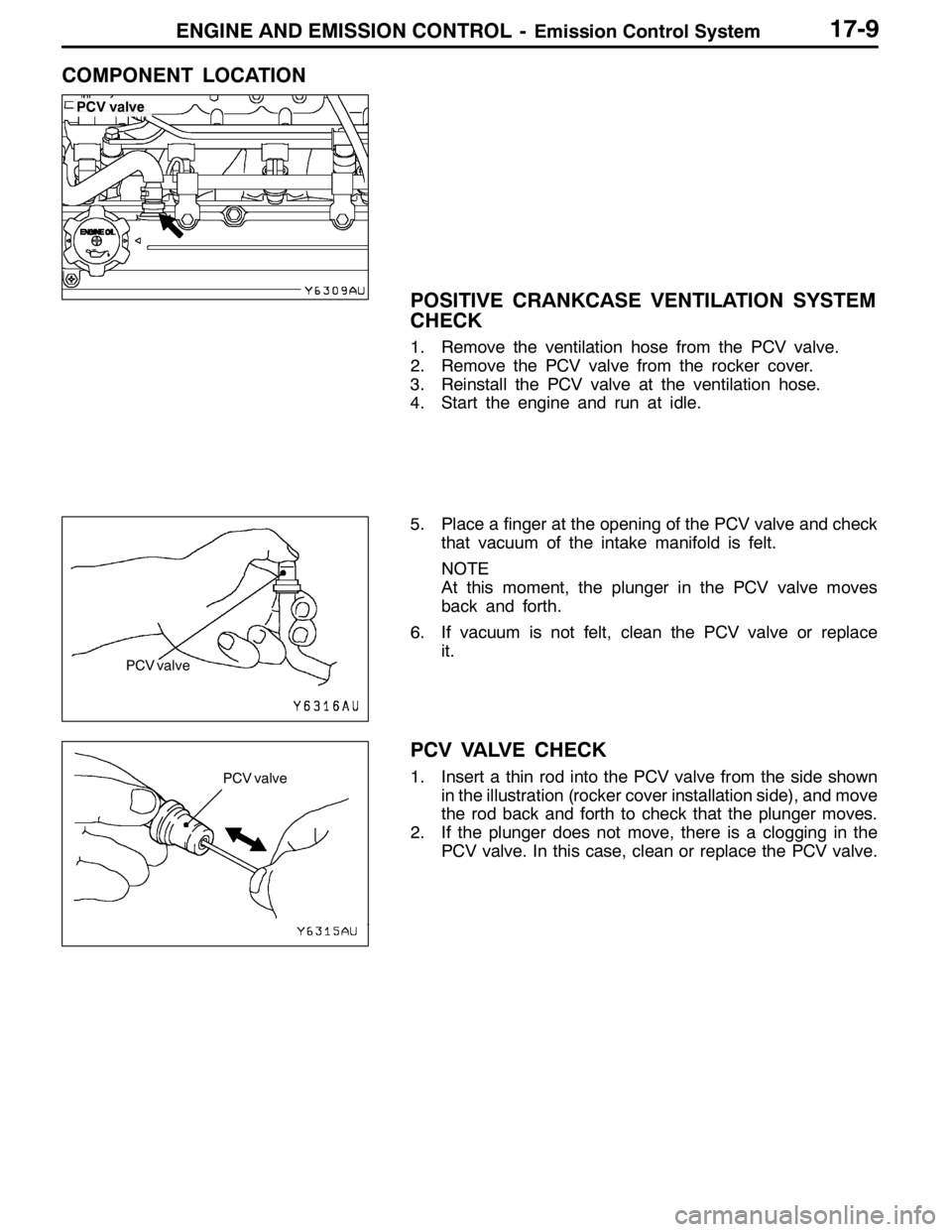
PCV valve
17-9
COMPONENT LOCATION
POSITIVE CRANKCASE VENTILATION SYSTEM
CHECK
1. Remove the ventilation hose from the PCV valve.
2. Remove the PCV valve from the rocker cover.
3. Reinstall the PCV valve at the ventilation hose.
4. Start the engine and run at idle.
5. Place a finger at the opening of the PCV valve and check
that vacuum of the intake manifold is felt.
NOTE
At this moment, the plunger in the PCV valve moves
back and forth.
6. If vacuum is not felt, clean the PCV valve or replace
it.
PCV VALVE CHECK
1. Insert a thin rod into the PCV valve from the side shown
in the illustration (rocker cover installation side), and move
the rod back and forth to check that the plunger moves.
2. If the plunger does not move, there is a clogging in the
PCV valve. In this case, clean or replace the PCV valve.
PCV valve
PCV valve
Page 780 of 1449
ENGINE AND EMISSION CONTROL -Emission Control System
Vacuum tank
Alternator
Purge control solenoid valve
17-10
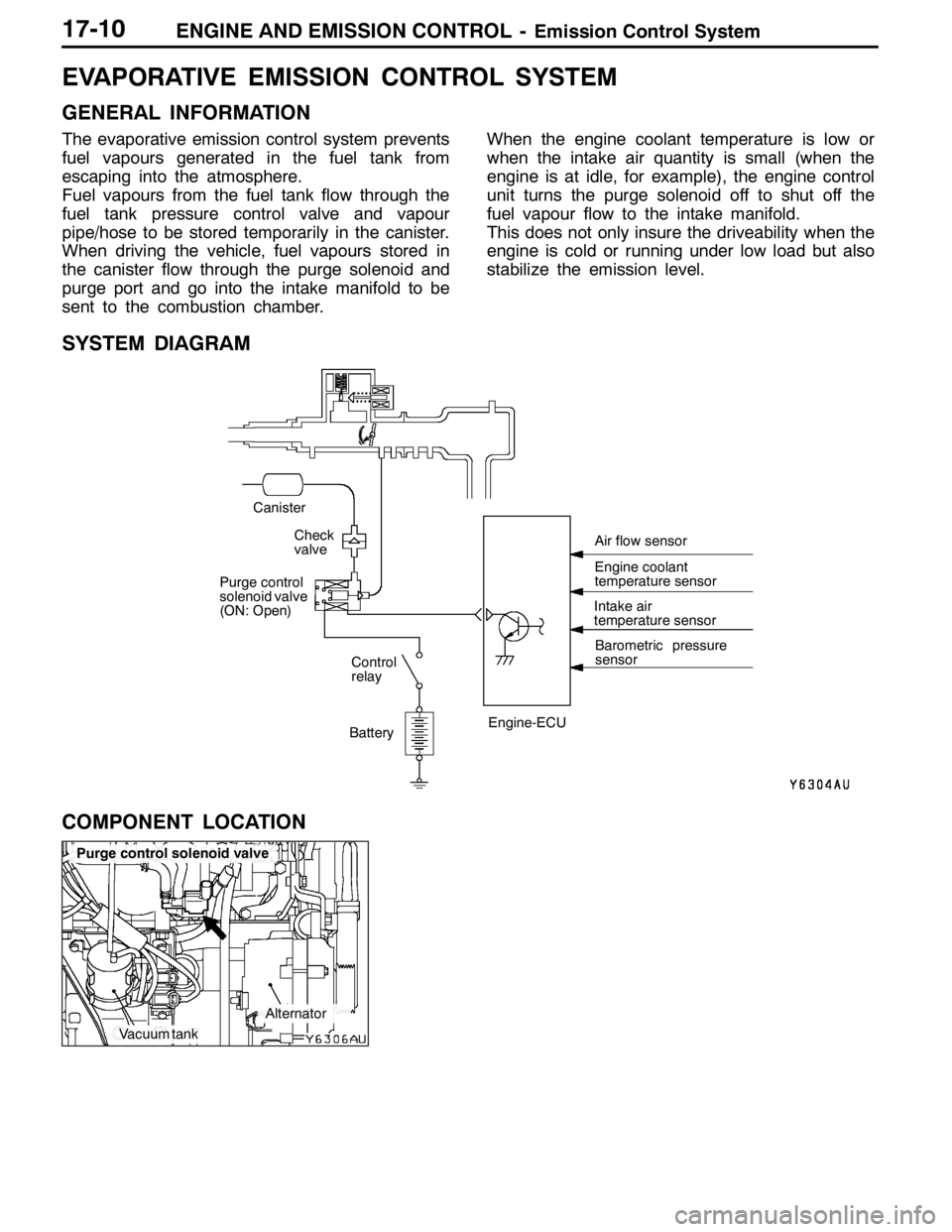
EVAPORATIVE EMISSION CONTROL SYSTEM
GENERAL INFORMATION
The evaporative emission control system prevents
fuel vapours generated in the fuel tank from
escaping into the atmosphere.
Fuel vapours from the fuel tank flow through the
fuel tank pressure control valve and vapour
pipe/hose to be stored temporarily in the canister.
When driving the vehicle, fuel vapours stored in
the canister flow through the purge solenoid and
purge port and go into the intake manifold to be
sent to the combustion chamber.When the engine coolant temperature is low or
when the intake air quantity is small (when the
engine is at idle, for example), the engine control
unit turns the purge solenoid off to shut off the
fuel vapour flow to the intake manifold.
This does not only insure the driveability when the
engine is cold or running under low load but also
stabilize the emission level.
SYSTEM DIAGRAM
BatteryIntake air
temperature sensor
Barometric pressure
sensor
Check
valve
Canister
Control
relay
Purge control
solenoid valve
(ON: Open)
Engine-ECUEngine coolant
temperature sensor Air flow sensor
COMPONENT LOCATION
Page 781 of 1449
ENGINE AND EMISSION CONTROL -Emission Control System17-11
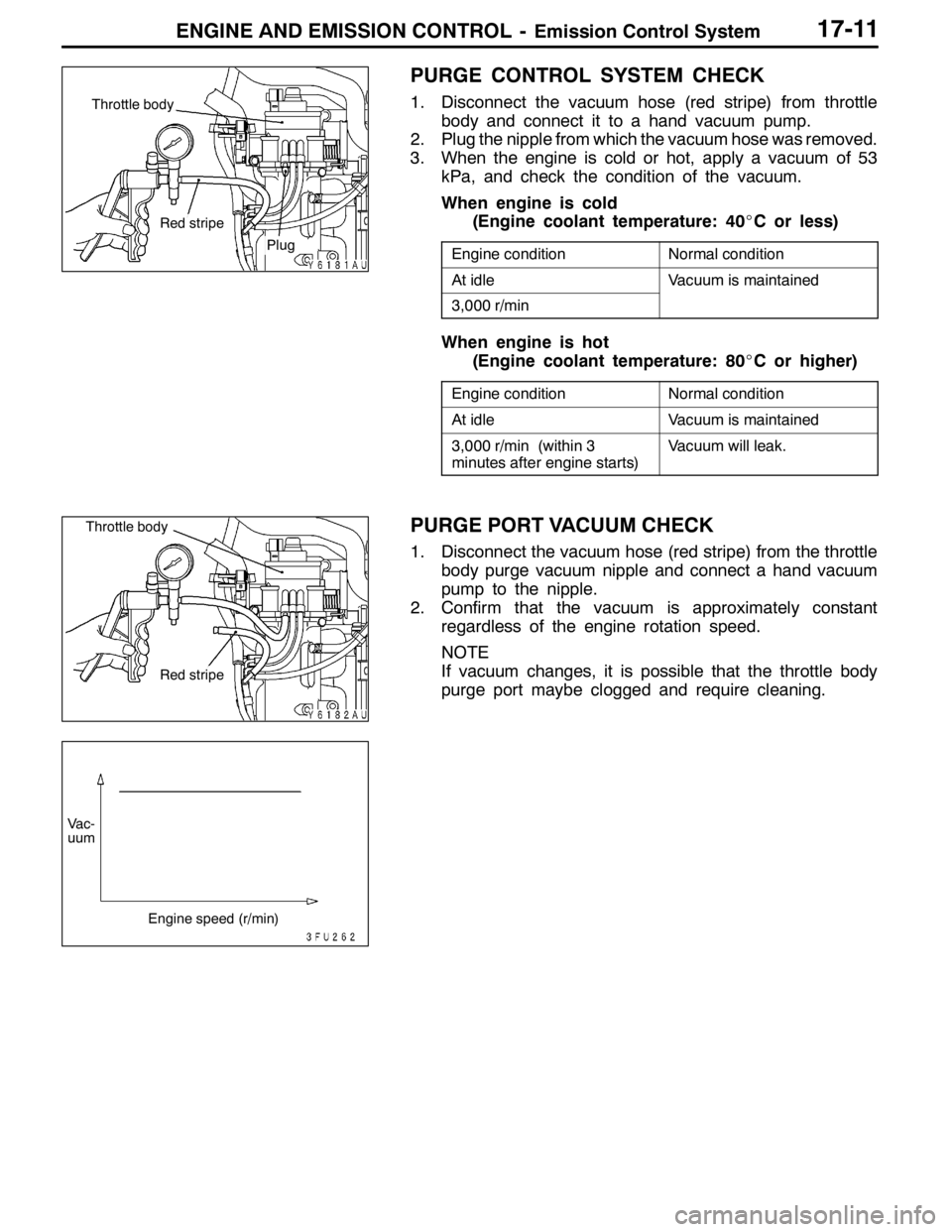
PURGE CONTROL SYSTEM CHECK
1. Disconnect the vacuum hose (red stripe) from throttle
body and connect it to a hand vacuum pump.
2. Plug the nipple from which the vacuum hose was removed.
3. When the engine is cold or hot, apply a vacuum of 53
kPa, and check the condition of the vacuum.
When engine is cold
(Engine coolant temperature: 40_C or less)
Engine conditionNormal condition
At idleVacuum is maintained
3,000 r/min
When engine is hot
(Engine coolant temperature: 80_C or higher)
Engine conditionNormal condition
At idleVacuum is maintained
3,000 r/min (within 3
minutes after engine starts)Vacuum will leak.
PURGE PORT VACUUM CHECK
1. Disconnect the vacuum hose (red stripe) from the throttle
body purge vacuum nipple and connect a hand vacuum
pump to the nipple.
2. Confirm that the vacuum is approximately constant
regardless of the engine rotation speed.
NOTE
If vacuum changes, it is possible that the throttle body
purge port maybe clogged and require cleaning.
Red stripe
Plug
Throttle body
Red stripe
Throttle body
Vac-
uum
Engine speed (r/min)
Page 782 of 1449
ENGINE AND EMISSION CONTROL -Emission Control System17-12
PURGE CONTROL SOLENOID VALVE CHECK
NOTE
When disconnecting the vacuum hose, always make a mark
so that it can be reconnected at original position.
1. Disconnect the vacuum hose from the solenoid valve.
2. Disconnect the harness connector.
3. Connect a hand vacuum pump to nipple (A) of the solenoid
valve (refer to the illustration at left).
4. Check airtightness by applying a vacuum with voltage
applied directly from the battery to the purge control
solenoid valve and without applying voltage.
Battery voltageNormal condition
AppliedVacuum leaks
Not appliedVacuum maintained
5. Measure the resistance between the terminals of the
solenoid valve.
Standard value: 30 - 34Ω(at 20_C)
CHECK VALVE CHECK
Connect a hand vacuum pump to the check valve, apply
vacuum and check the airtightness.
Connected nipple colourNormal condition
BlackVacuum leaks
BrownVacuum is maintained
Battery A