Page 666 of 1449
MPI -On-vehicle Service13A-134
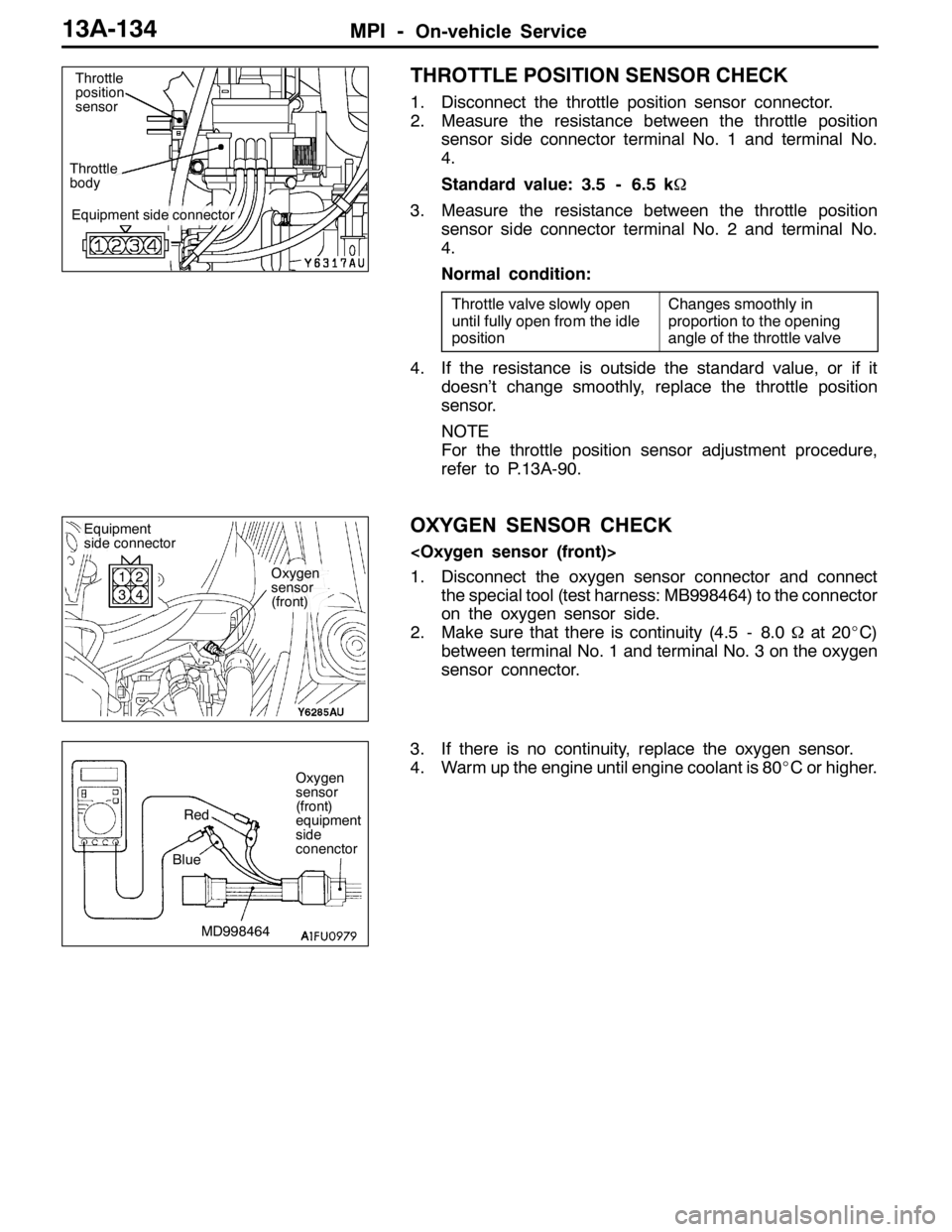
THROTTLE POSITION SENSOR CHECK
1. Disconnect the throttle position sensor connector.
2. Measure the resistance between the throttle position
sensor side connector terminal No. 1 and terminal No.
4.
Standard value: 3.5 - 6.5 kΩ
3. Measure the resistance between the throttle position
sensor side connector terminal No. 2 and terminal No.
4.
Normal condition:
Throttle valve slowly open
until fully open from the idle
positionChanges smoothly in
proportion to the opening
angle of the throttle valve
4. If the resistance is outside the standard value, or if it
doesn’t change smoothly, replace the throttle position
sensor.
NOTE
For the throttle position sensor adjustment procedure,
refer to P.13A-90.
OXYGEN SENSOR CHECK
1. Disconnect the oxygen sensor connector and connect
the special tool (test harness: MB998464) to the connector
on the oxygen sensor side.
2. Make sure that there is continuity (4.5 - 8.0Ωat 20_C)
between terminal No. 1 and terminal No. 3 on the oxygen
sensor connector.
3. If there is no continuity, replace the oxygen sensor.
4. Warm up the engine until engine coolant is 80_C or higher.
Equipment side connector
Throttle
bodyThrottle
position
sensor
Oxygen
sensor
(front)
Equipment
side connector
1
32
4
Oxygen
sensor
(front)
equipment
side
conenctor
MD998464 BlueRed
Page 667 of 1449
MPI -On-vehicle Service13A-135
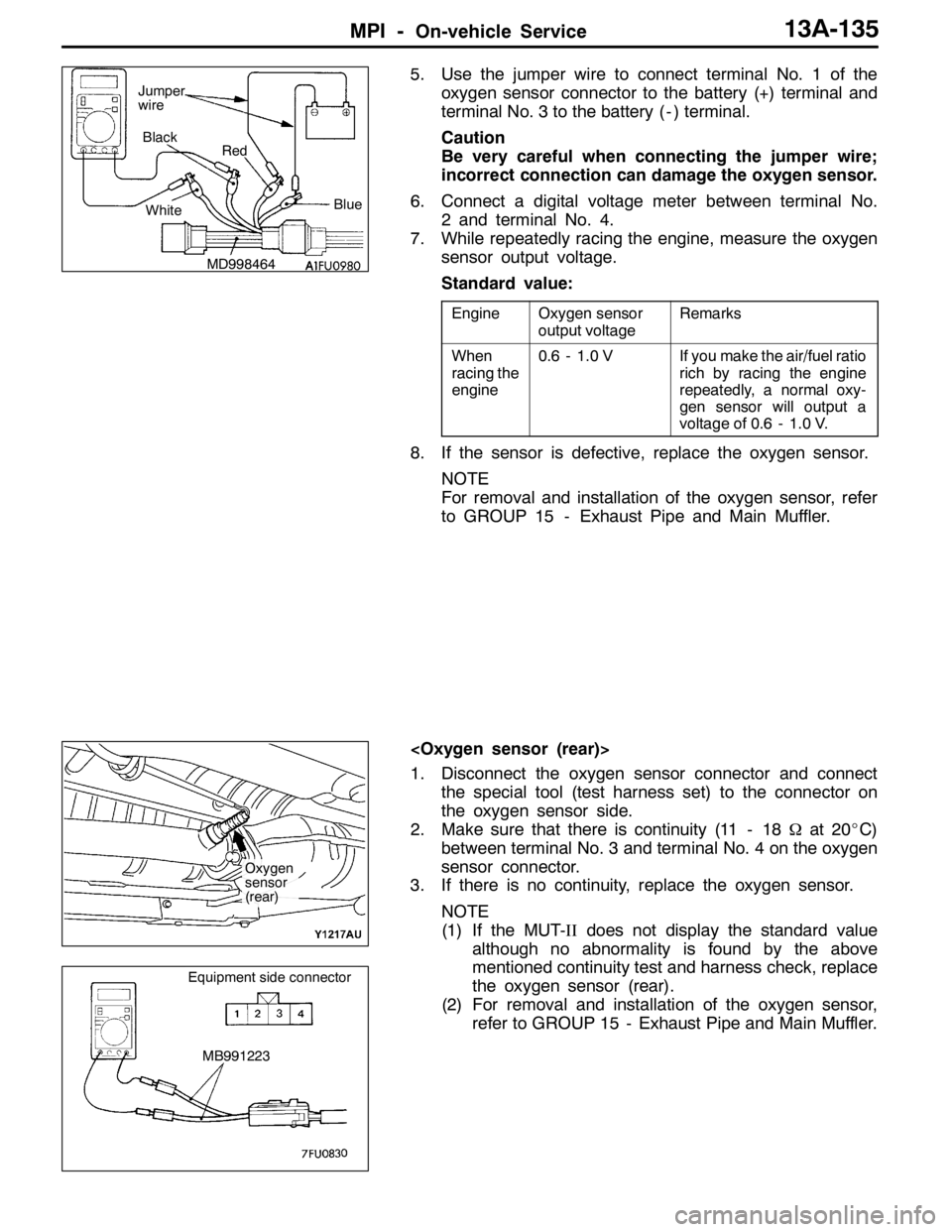
5. Use the jumper wire to connect terminal No. 1 of the
oxygen sensor connector to the battery (+) terminal and
terminal No. 3 to the battery ( - ) terminal.
Caution
Be very careful when connecting the jumper wire;
incorrect connection can damage the oxygen sensor.
6. Connect a digital voltage meter between terminal No.
2 and terminal No. 4.
7. While repeatedly racing the engine, measure the oxygen
sensor output voltage.
Standard value:
EngineOxygen sensor
output voltageRemarks
When
racing the
engine0.6 - 1.0 VIf you make the air/fuel ratio
rich by racing the engine
repeatedly, a normal oxy-
gen sensor will output a
voltage of 0.6 - 1.0 V.
8. If the sensor is defective, replace the oxygen sensor.
NOTE
For removal and installation of the oxygen sensor, refer
to GROUP 15 - Exhaust Pipe and Main Muffler.
1. Disconnect the oxygen sensor connector and connect
the special tool (test harness set) to the connector on
the oxygen sensor side.
2. Make sure that there is continuity (11 - 18Ωat 20_C)
between terminal No. 3 and terminal No. 4 on the oxygen
sensor connector.
3. If there is no continuity, replace the oxygen sensor.
NOTE
(1) If the MUT-IIdoes not display the standard value
although no abnormality is found by the above
mentioned continuity test and harness check, replace
the oxygen sensor (rear).
(2) For removal and installation of the oxygen sensor,
refer to GROUP 15 - Exhaust Pipe and Main Muffler.
MD998464Blue Black
Red
White Jumper
wire
Oxygen
sensor
(rear)
MB991223
Equipment side connector
Page 668 of 1449

MPI -On-vehicle Service13A-136
INJECTOR CHECK
OPERATION SOUND CHECK
Using a sound scope, check the operation sound of the injector
(“chh” sound) during idling and cranking.
Check that the operation sound increases when the speed
increases.
Caution
The sound of other injectors operating may be heard
even when the injector being checked is not operated.
NOTE
If no operation sound is heard, check the injector drive circuit.
If the circuit is normal, the injector or engine-ECU may be
faulty.
Measurement of Resistance between Terminals
1. Remove the injector connector.
2. Measure the resistance between terminals.
Standard value: 2 - 3Ω(at 20_C)
3. Install the injector connector.
Checking the Injection Condition
1. Following the steps below, bleed out the residual pressure
within the fuel pipe line to prevent flow of the fuel. (Refer
to P.13A-96.)
2. Remove the injector.
3. Arrange the special tool (injector test set), adaptor, fuel
pressure regulator and clips as shown in the illustration
below.
Page 669 of 1449
MPI -On-vehicle Service13A-137
MB991607
High-pressure fuel hoseMD998741
MD998706Return hose
BatteryInjectorFuel pressure regulator
Clip
(MB991608)
4. Connect the MUT-IIto the diagnosis connector.
5. Turn the ignition switch to “ON” position. (But do not start
the engine.)
6. Select “Item No. 07” from the MUT-IIActuator test to
drive the fuel pump.
7. Activate the injector and check the atomized spray
condition of the fuel.
The condition can be considered satisfactory unless it
is extremely poor.
8. Stop the actuation of the injector, and check for leakage
from the injector’s nozzle.
Standard value: 1 drop or less per minute
9. Activate the injector without activating the fuel pump; then,
when the spray emission of fuel from the injector stops,
disconnect the special tool and restore it to its original
condition.
10. Disconnect the MUT-II.
High-pressure
fuel hose
BatteryInjectorReturn hose
Page 670 of 1449
MPI -On-vehicle Service13A-138
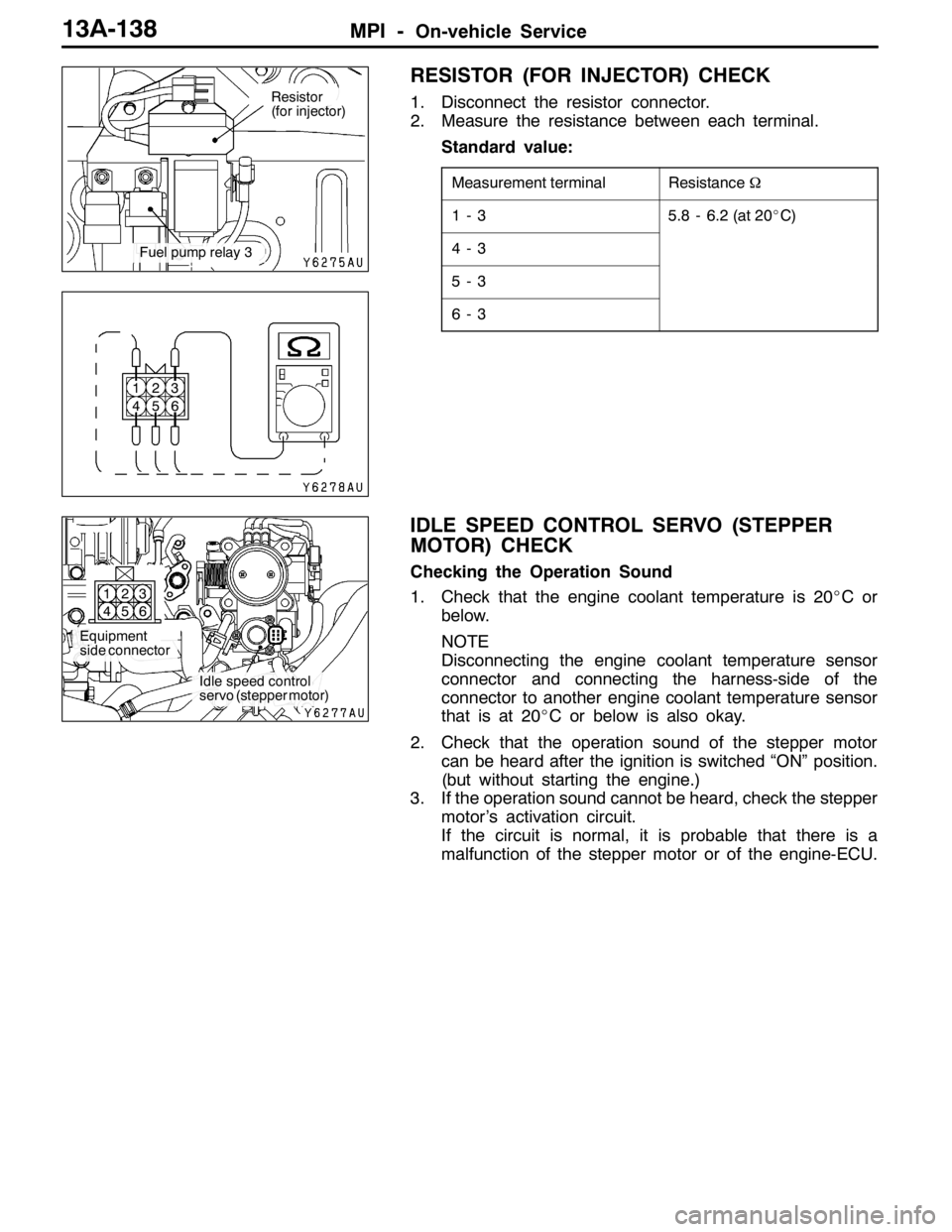
RESISTOR (FOR INJECTOR) CHECK
1. Disconnect the resistor connector.
2. Measure the resistance between each terminal.
Standard value:
Measurement terminalResistanceΩ
1-35.8 - 6.2 (at 20_C)
4-3
5-3
6-3
IDLE SPEED CONTROL SERVO (STEPPER
MOTOR) CHECK
Checking the Operation Sound
1. Check that the engine coolant temperature is 20_Cor
below.
NOTE
Disconnecting the engine coolant temperature sensor
connector and connecting the harness-side of the
connector to another engine coolant temperature sensor
that is at 20_C or below is also okay.
2. Check that the operation sound of the stepper motor
can be heard after the ignition is switched “ON” position.
(but without starting the engine.)
3. If the operation sound cannot be heard, check the stepper
motor’s activation circuit.
If the circuit is normal, it is probable that there is a
malfunction of the stepper motor or of the engine-ECU.
Resistor
(for injector)
Fuel pump relay 3
1
42
53
6
Equipment
side connector
Idle speed control
servo (stepper motor) 1
42
53
6
Page 673 of 1449
MPI -Injector13A-141
INJECTOR
REMOVAL AND INSTALLATION
Pre-removal and Post-installation Operation
DFuel Discharge Prevention (Refer to P.13A-125.)
DStrut Tower Bar Removal and Installation
(Refer to GROUP 42.)DAir Hose E, Air By-pass Hose, Air Pipe C Removal
and Installation (Refer to GROUP 15 - Intercooler.)
DFuel Leakage Check
21
3
13 5
6
7
8 9 1011 12
4
8.9±1.9N·m
8.9±1.9N·m 5.0±1.0N·m
Apply engine oil to all
moving parts during
installation.
14 15
16 12
6
5.0±1.0N·m
Removal steps
1. Control harness connector
2. Accelerator cable assembly
connection (Throttle body side)
3. Injector harness connector
"AA4. High-pressure fuel hose connection
5. O-ring
6. Fuel return hose connection
7. Vacuum sensor connector
"AA8. Fuel pressure regulator9. O-ring
10. Fuel return pipe
AA"11. Delivery pipe
12. Insulator
13. Insulator
AA""AA14. Injector
15. Grommet
16. O-ring
Page 674 of 1449

MPI -Injector13A-142
REMOVAL SERVICE POINT
AA"DELIVERY PIPE/INJECTOR REMOVAL
Remove the delivery pipe (with the injectors attached to it).
Caution
Care must be taken, when removing the delivery pipe,
not to drop the injector.
INSTALLATION SERVICE POINT
"AAINJECTOR/FUEL PRESSURE REGULATOR
/HIGH-PRESSURE FUEL HOSE INSTALLATION
1. Apply a drop of new engine oil to the O-ring.
Caution
Be sure not to let engine oil enter the delivery pipe.
2. While turning the injector, high-pressure fuel hose and
fuel pressure regulator to the right and left, install the
delivery pipe, while being careful not to damage the O-ring.
After installing, check that the hose turns smoothly.
3. If it does not turn smoothly, the O-ring may be trapped,
remove the injector, high-pressure fuel hose or fuel
pressure regulator and then re-insert it into the delivery
pipe and check once again.
4. Tighten the high-pressure fuel hose and fuel pressure
regulator to the specified torque.
Tightening torque:
5.0±1.0 N·m (High-pressure fuel hose)
8.9±1.9 N·m (Fuel pressure regulator)
Page 689 of 1449
14-1
ENGINE COOLING
CONTENTS
GENERAL INFORMATION 2..................
SERVICE SPECIFICATIONS 2.................
LUBRICANT 2...............................
SEALANT 2..................................
SPECIAL TOOLS 3...........................
TROUBLESHOOTING 3.......................
ON-VEHICLE SERVICE 6.....................
Engine Coolant Leak Checking 6................
Radiator Cap Opening Pressure Check 6........Engine Coolant Replacement 6..................
Concentration Measurement 7...................
Radiator Fan Relay Continuity Check 8..........
Radiator Fan Controller Check 8................
Radiator Fan Motor Check 10...................
THERMOSTAT 11............................
WATER PUMP 13............................
WATER HOSE AND WATER PIPE 14..........
RADIATOR 15................................