2007 MITSUBISHI LANCER EVOLUTION low beam
[x] Cancel search: low beamPage 1344 of 1449

CHASSIS ELECTRICAL -Headlamp Assembly54A-24
HEADLAMP ASSEMBLY
SERVICE SPECIFICATIONS
ItemStandard valueLimit
Headlamp aimingLow beamVertical
direction120mm (0.69_) below hor-
izontal line (H)±0.29_
Horizontal
directionPosition at which the
startup point of 15_is
crossed with vertical line
(V)±0.5_
High beamVertical
directionThe center of high intensi-
ty zone is on the point of
intersection of line (H) and
line (V).- 0.5_of the point of
intersection of line (H)
Horizontal
directionThe center of high intensi-
ty zone is on the point of
intersection of line (V).±0.5_of the center of
line (V)
Measurement of headlamp illuminous intensity
(at high beam)–30,000 cd or more per
one headlamp
NOTES ON HEADLAMP ASSEMBLY:
Plastic outer lens are equipped with headlamp assembly. For handling, care should be taken for
the following items:
DHeadlamps should not be illuminated for more than 3 minutes with scratch preventive protectors,
etc. covered on them.
DMasking such as taping should not be attached on outer lens.
DOuter lens surface should not be rubbed with a sharp-edged tool, etc.
DSpecified wax remover should be used for insistently washing.
DAuthorized Mitsubishi Genuine bulbs should be used.
TROUBLESHOOTING
Headlamps are controlled smart wiring system (SWS). For troubleshooting, refer to GROUP 54B.
NOTE
When ETACS-ECU is defective, headlamps can be illuminated only in a low beam mode as fail-safe
function.
ON-VEHICLE SERVICE
HEADLAMP AIMING
PRE-AIMING INSTRUCTION
1. Inspect for badly rusted or faulty headlamp assemblies.
2. These conditions must be corrected before a satisfactory
adjustment can be made.
3. Inspect tyres inflation, and adjust if necessary.
Page 1345 of 1449
CHASSIS ELECTRICAL -Headlamp Assembly54A-25
4. If the fuel tank is not full, place a weight in luggage room
of vehicle to simulate weight of a full tank 0.8 kg per litre.
5. There should be no other load in the vehicle other than
driver or substituted weight of approximately 75 kg placed
in driver’s position.
6. Thoroughly clean headlamp lenses.
7. Place the vehicle on a level floor, perpendicular to a flat
screen 10m away from the bulb center - marks on the
headlamp lens.
8. Rock vehicle sideways to allow vehicle to assume its
normal position.
9. Bounce the front suspension through three (3) oscillations
by applying the body weight to hood or bumper.
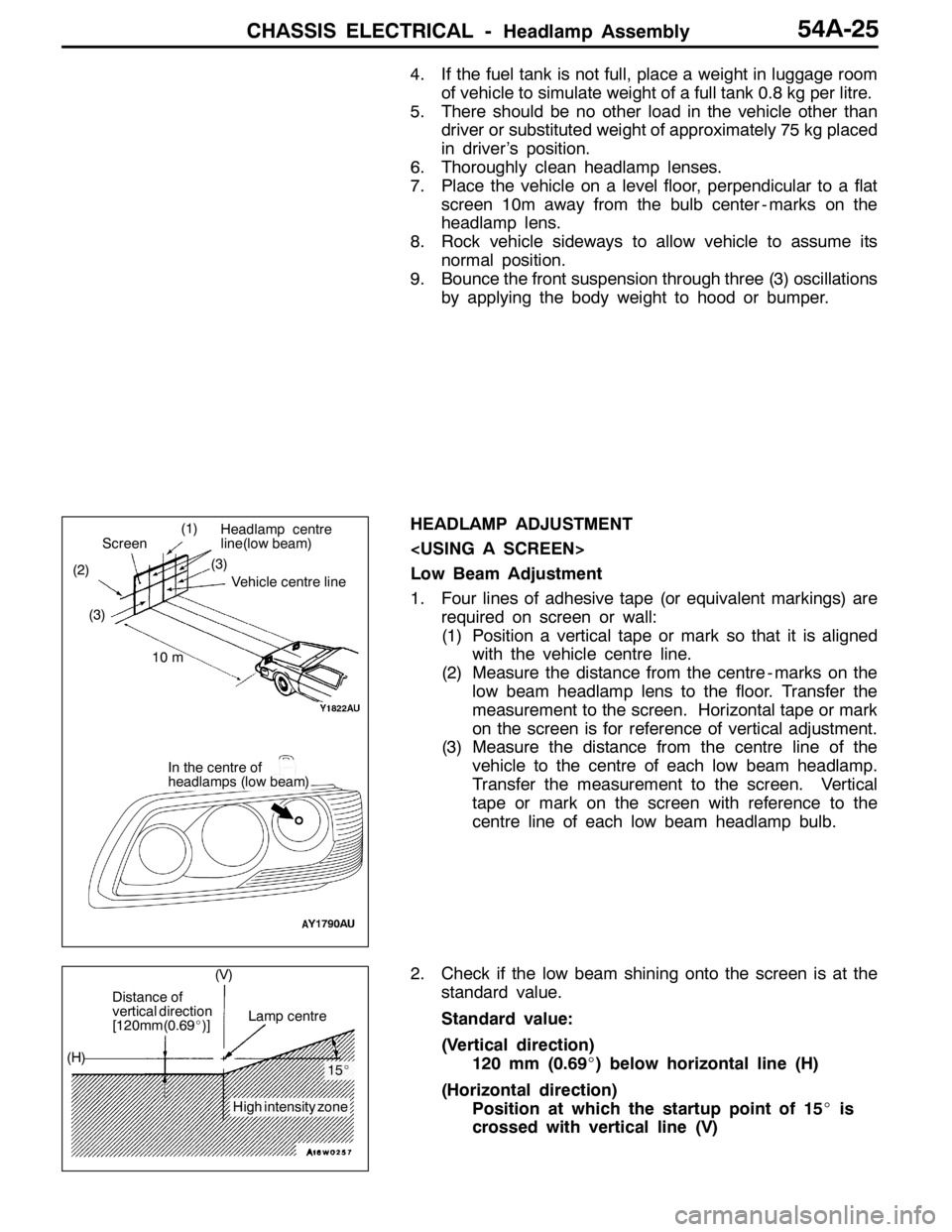
HEADLAMP ADJUSTMENT
Low Beam Adjustment
1. Four lines of adhesive tape (or equivalent markings) are
required on screen or wall:
(1) Position a vertical tape or mark so that it is aligned
with the vehicle centre line.
(2) Measure the distance from the centre - marks on the
low beam headlamp lens to the floor. Transfer the
measurement to the screen. Horizontal tape or mark
on the screen is for reference of vertical adjustment.
(3) Measure the distance from the centre line of the
vehicle to the centre of each low beam headlamp.
Transfer the measurement to the screen. Vertical
tape or mark on the screen with reference to the
centre line of each low beam headlamp bulb.
2. Check if the low beam shining onto the screen is at the
standard value.
Standard value:
(Vertical direction)
120 mm (0.69_) below horizontal line (H)
(Horizontal direction)
Position at which the startup point of 15_is
crossed with vertical line (V)
(1)
(2)(3)
Headlamp centre
line(low beam)
Vehicle centre line
Screen
10 m
In the centre of
headlamps (low beam) (3)
Distance of
vertical direction
[120mm(0.69_)]Lamp centre
15_
High intensity zone (H)(V)
Page 1346 of 1449
CHASSIS ELECTRICAL -Headlamp Assembly54A-26
Limit:
(Vertical direction)±0.29_
(Horizontal direction)±0.5_
NOTE
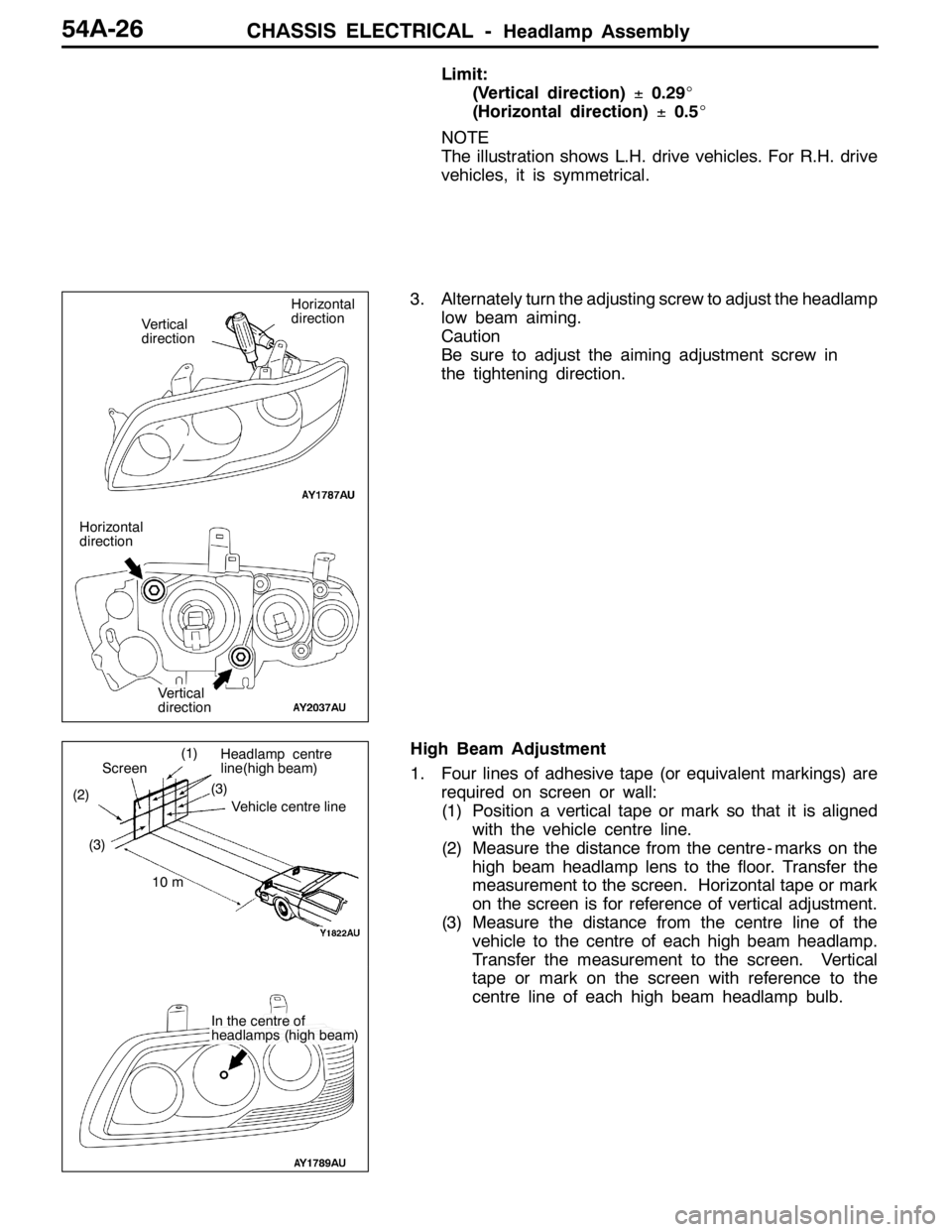
The illustration shows L.H. drive vehicles. For R.H. drive
vehicles, it is symmetrical.
3. Alternately turn the adjusting screw to adjust the headlamp
low beam aiming.
Caution
Be sure to adjust the aiming adjustment screw in
the tightening direction.
High Beam Adjustment
1. Four lines of adhesive tape (or equivalent markings) are
required on screen or wall:
(1) Position a vertical tape or mark so that it is aligned
with the vehicle centre line.
(2) Measure the distance from the centre - marks on the
high beam headlamp lens to the floor. Transfer the
measurement to the screen. Horizontal tape or mark
on the screen is for reference of vertical adjustment.
(3) Measure the distance from the centre line of the
vehicle to the centre of each high beam headlamp.
Transfer the measurement to the screen. Vertical
tape or mark on the screen with reference to the
centre line of each high beam headlamp bulb.
Horizontal
direction
Vertical
direction
Horizontal
direction
Vertical
direction
(1)
(2)(3)Vehicle centre line
Screen
10 m
In the centre of
headlamps (high beam)
Headlamp centre
line(high beam)
(3)
Page 1348 of 1449
CHASSIS ELECTRICAL -Headlamp Assembly54A-28
HEADLAMP INTENSITY MEASUREMENT
1. Using a photometer, and following its manufacture’s
instruction manual.
2. Maintain an engine speed of 2,000 r/min., with the battery
in the charging condition
3. Set the headlamps to high beam
4. Measure the headlamp centre intensity (a point of H line
and V line) and check to be sure that the limit value
is satisfied.
Limit:
High beam 30,000 cd or more per one headlamp
NOTE
1. There may be special local regulations pertaining to
headlamp intensity, be sure to make any adjustments
necessary to satisfy such regulations.
2. If an illuminometer is used to make the measurements,
convert its values to photometer values by using the
following formula.
I=Er
2Where:
I=intensity (cd)
E=illumination (lux)
r=distance (m) from headlamps to illuminometer
Caution
1. On the headlamp not yet adjusted, perform aiming
with connector removed and the lamps switched off,
if applicable. In addition, care should be taken to
prevent a change of optical axis when connector is
reconnected.
2. Plastic outer lens are equipped with headlamps. When
lens surface is covered with materials for not
penetrating light, headlamp operation time should be
within 3 minutes. In addition, masking such as taping
should not be performed.
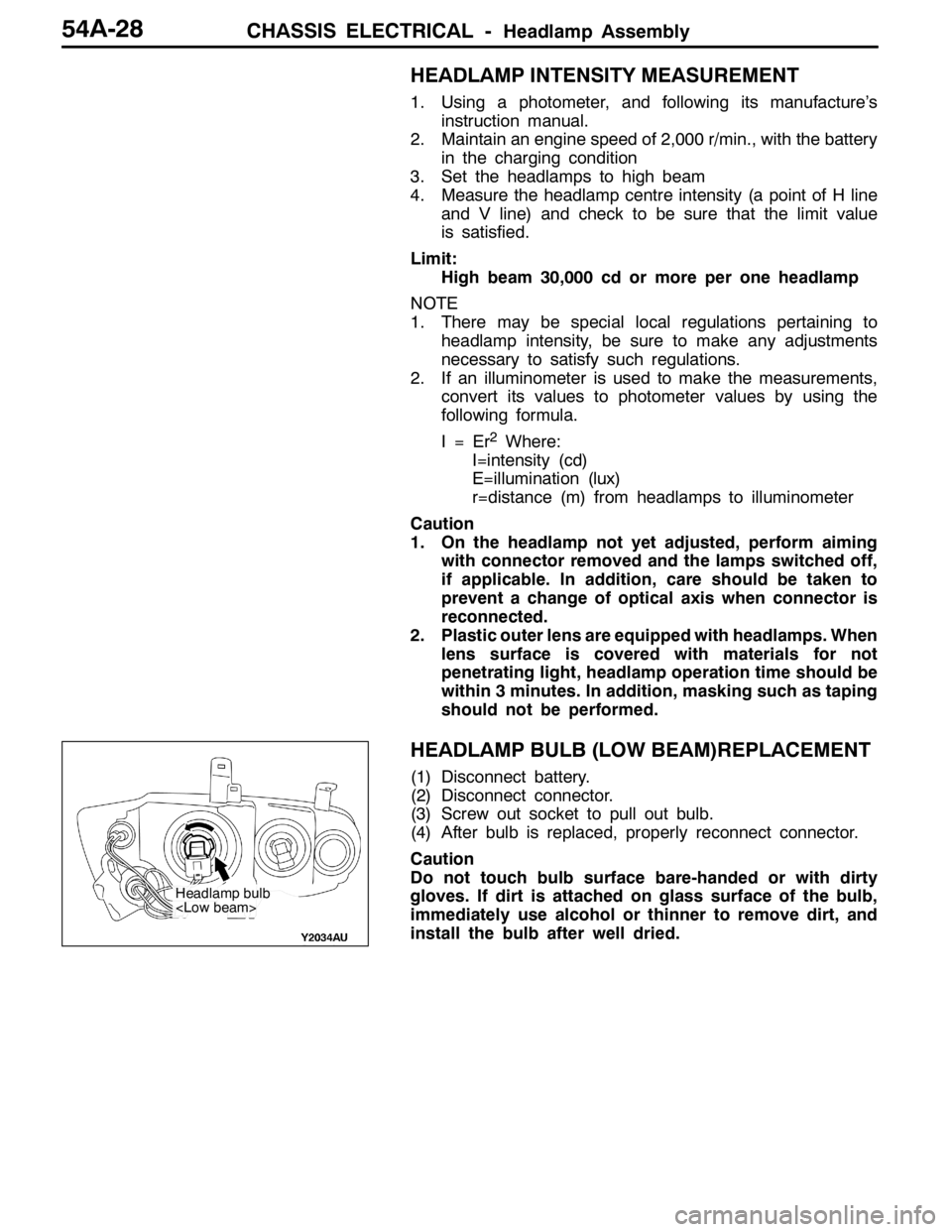
HEADLAMP BULB (LOW BEAM)REPLACEMENT
(1) Disconnect battery.
(2) Disconnect connector.
(3) Screw out socket to pull out bulb.
(4) After bulb is replaced, properly reconnect connector.
Caution
Do not touch bulb surface bare-handed or with dirty
gloves. If dirt is attached on glass surface of the bulb,
immediately use alcohol or thinner to remove dirt, and
install the bulb after well dried.
Headlamp bulb
Page 1371 of 1449

SWS -Troubleshooting54B-7
TROUBLE SYMPTOM CHART
Trouble symptomInspection
procedureReference
page
No communication with MUT-IIA-154B-10
BuzzersLights left ON reminder warning function not working normally.B-154B-10
Central lockingCentral door locking system not working at all.C-154B-11g
Some doors not locking or unlocking.C-254B-11
Power windowPower windows not working at all.D-154B-12
Power windows are not operated with the power window main
switch.
Driver’s power window not responding to power window main
switch.D-254B-13
Windows not responding to passenger or rear power window
switches.D-354B-14
Passenger or rear power windows not responding to power window
main switch.D-454B-15
Power window timer function not working normally.D-554B-15
While the window is winding up, it suddenly starts coming down
again.D-654B-16
Safety mechanism (to prevent jamming of fingers, etc.) not
working.D-754B-16
Windshield wipers
dh
The windshield wipers do not work at all.E-154B-17p
and washerThe windshield wipers only operate at LO speed (though the wipers
and washer can be switched OFF).E-254B-17
The windshield wipers do not respond to any switch position.E-354B-18
The windshield wipers do not stop in the normal predetermined
position.E-454B-18
The windshield washer does not work at all.E-554B-19
Windshield wipers are not operated with the switch in INT,
WASHER and MIST positions, and operated in a low mode with the
switch in Lo and Hi positions.E-654B-19
Headlamps, tail lampsExcept for lighting switch“OFF,” the headlamps only respond to the
“low-beam” position.
F-154B-20
The tail lamps do not work.F-254B-20
The headlamps (low-beam) do not light.F-354B-21
The headlamps (high-beam) do not light.F-454B-21
The headlamps (low or high-beam) do not work when the passing
switch is ON.F-554B-22
The headlamp automatic cut-off function is not working normally.F-654B-22
Rear fog lampRear fog lamp is not properly illuminated.G-154B-23
Flasher timerThe turn signal lamps do not light.H-154B-24
The hazard warning lamps do not light up.H-254B-24
Room lampsThe room lamps do not come ON or OFF normally.I-154B-25
Page 1384 of 1449
SWS -Troubleshooting54B-20
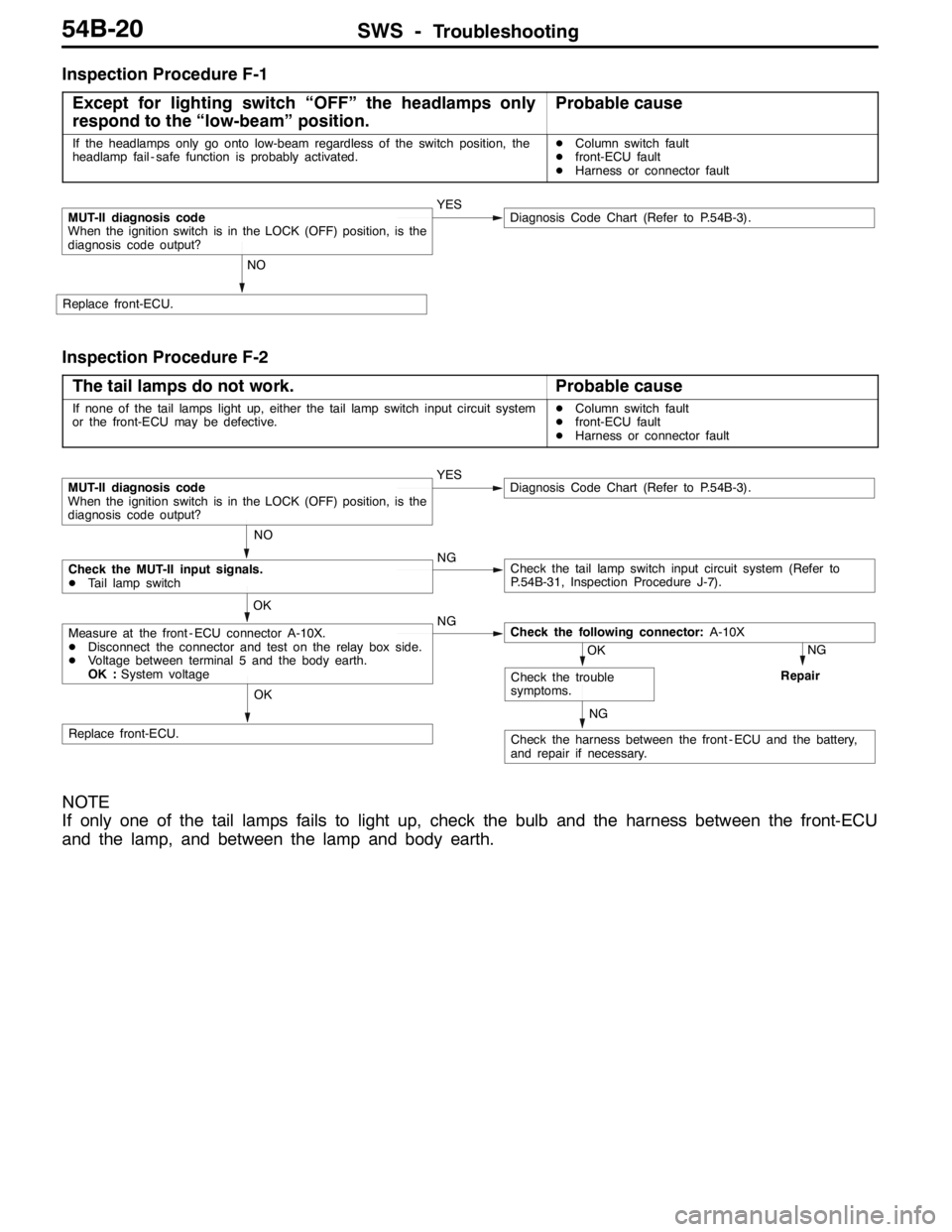
Inspection Procedure F-1
Except for lighting switch “OFF” the headlamps only
respond to the “low-beam” position.
Probable cause
If the headlamps only go onto low-beam regardless of the switch position, the
headlamp fail - safe function is probably activated.DColumn switch fault
Dfront-ECU fault
DHarness or connector fault
NO
Replace front-ECU.
MUT-II diagnosis code
When the ignition switch is in the LOCK (OFF) position, is the
diagnosis code output?YESDiagnosis Code Chart (Refer to P.54B-3).
Inspection Procedure F-2
The tail lamps do not work.
Probable cause
If none of the tail lamps light up, either the tail lamp switch input circuit system
or the front-ECU may be defective.DColumn switch fault
Dfront-ECU fault
DHarness or connector fault
NG
Repair
NG
Check the harness between the front - ECU and the battery,
and repair if necessary.
OK
Replace front-ECU.
OK
Check the trouble
symptoms.
OK
Measure at the front - ECU connector A-10X.
DDisconnect the connector and test on the relay box side.
DVoltage between terminal 5 and the body earth.
OK :System voltageNGCheck the following connector:A-10X
NO
Check the MUT-II input signals.
DTail lamp switchNGCheck the tail lamp switch input circuit system (Refer to
P.54B-31, Inspection Procedure J-7).
MUT-II diagnosis code
When the ignition switch is in the LOCK (OFF) position, is the
diagnosis code output?YESDiagnosis Code Chart (Refer to P.54B-3).
NOTE
If only one of the tail lamps fails to light up, check the bulb and the harness between the front-ECU
and the lamp, and between the lamp and body earth.
Page 1385 of 1449
SWS -Troubleshooting54B-21
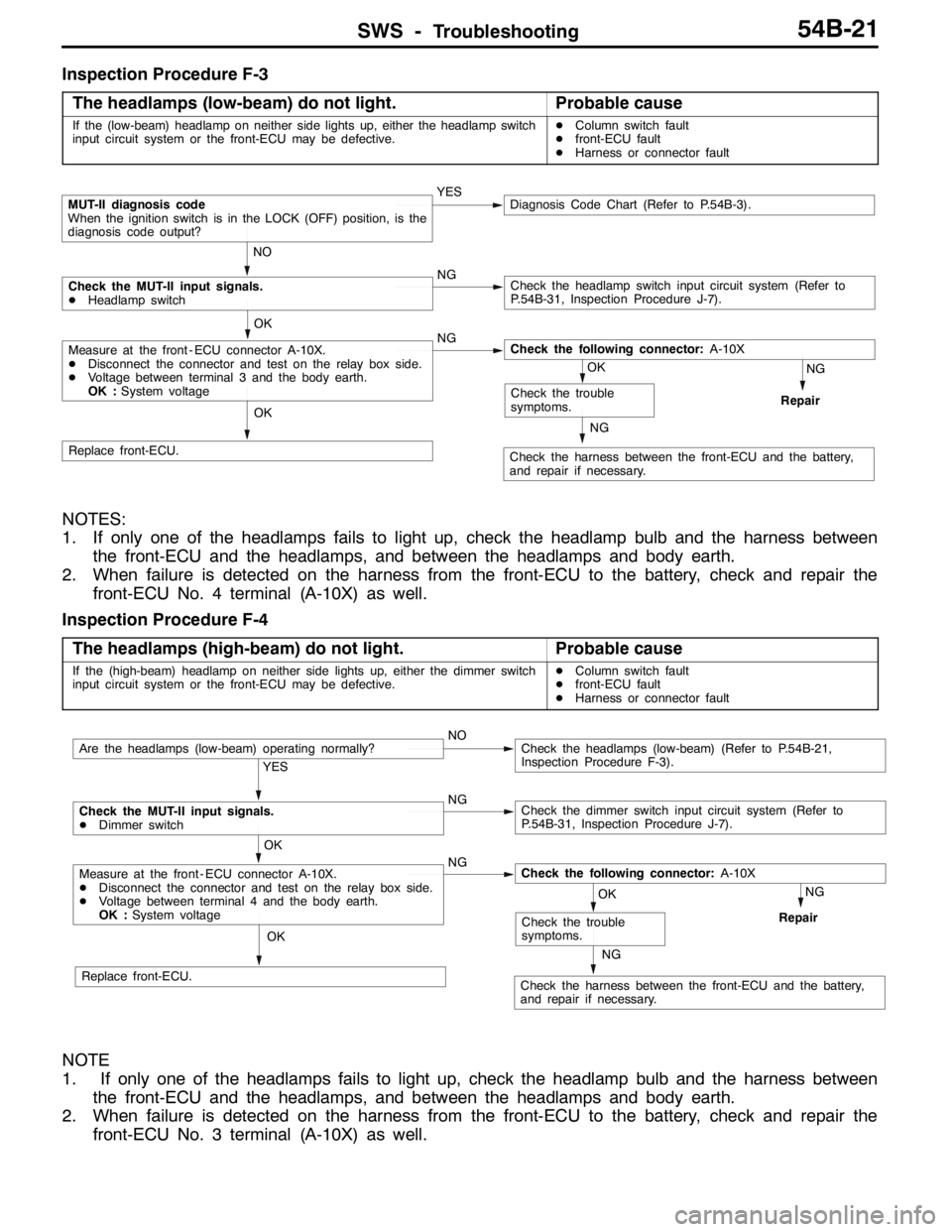
Inspection Procedure F-3
The headlamps (low-beam) do not light.
Probable cause
If the (low-beam) headlamp on neither side lights up, either the headlamp switch
input circuit system or the front-ECU may be defective.DColumn switch fault
Dfront-ECU fault
DHarness or connector fault
NO
Check the MUT-II input signals.
DHeadlamp switchNGCheck the headlamp switch input circuit system (Refer to
P.54B-31, Inspection Procedure J-7).
NG
Repair
NG
Check the harness between the front-ECU and the battery,
and repair if necessary.
OK
Replace front-ECU.
OK
Check the trouble
symptoms.
OK
Measure at the front - ECU connector A-10X.
DDisconnect the connector and test on the relay box side.
DVoltage between terminal 3 and the body earth.
OK :System voltageNGCheck the following connector:A-10X
MUT-II diagnosis code
When the ignition switch is in the LOCK (OFF) position, is the
diagnosis code output?YESDiagnosis Code Chart (Refer to P.54B-3).
NOTES:
1. If only one of the headlamps fails to light up, check the headlamp bulb and the harness between
the front-ECU and the headlamps, and between the headlamps and body earth.
2. When failure is detected on the harness from the front-ECU to the battery, check and repair the
front-ECU No. 4 terminal (A-10X) as well.
Inspection Procedure F-4
The headlamps (high-beam) do not light.
Probable cause
If the (high-beam) headlamp on neither side lights up, either the dimmer switch
input circuit system or the front-ECU may be defective.DColumn switch fault
Dfront-ECU fault
DHarness or connector fault
NG
Check the harness between the front-ECU and the battery,
and repair if necessary.OK
Check the trouble
symptoms.
NG
Repair
OK
Measure at the front - ECU connector A-10X.
DDisconnect the connector and test on the relay box side.
DVoltage between terminal 4 and the body earth.
OK :System voltageNGCheck the following connector:A-10X
YES
Check the MUT-II input signals.
DDimmer switchNGCheck the dimmer switch input circuit system (Refer to
P.54B-31, Inspection Procedure J-7).
OK
Replace front-ECU.
Are the headlamps (low-beam) operating normally?NOCheck the headlamps (low-beam) (Refer to P.54B-21,
Inspection Procedure F-3).
NOTE
1. If only one of the headlamps fails to light up, check the headlamp bulb and the harness between
the front-ECU and the headlamps, and between the headlamps and body earth.
2. When failure is detected on the harness from the front-ECU to the battery, check and repair the
front-ECU No. 3 terminal (A-10X) as well.
Page 1386 of 1449
SWS -Troubleshooting54B-22
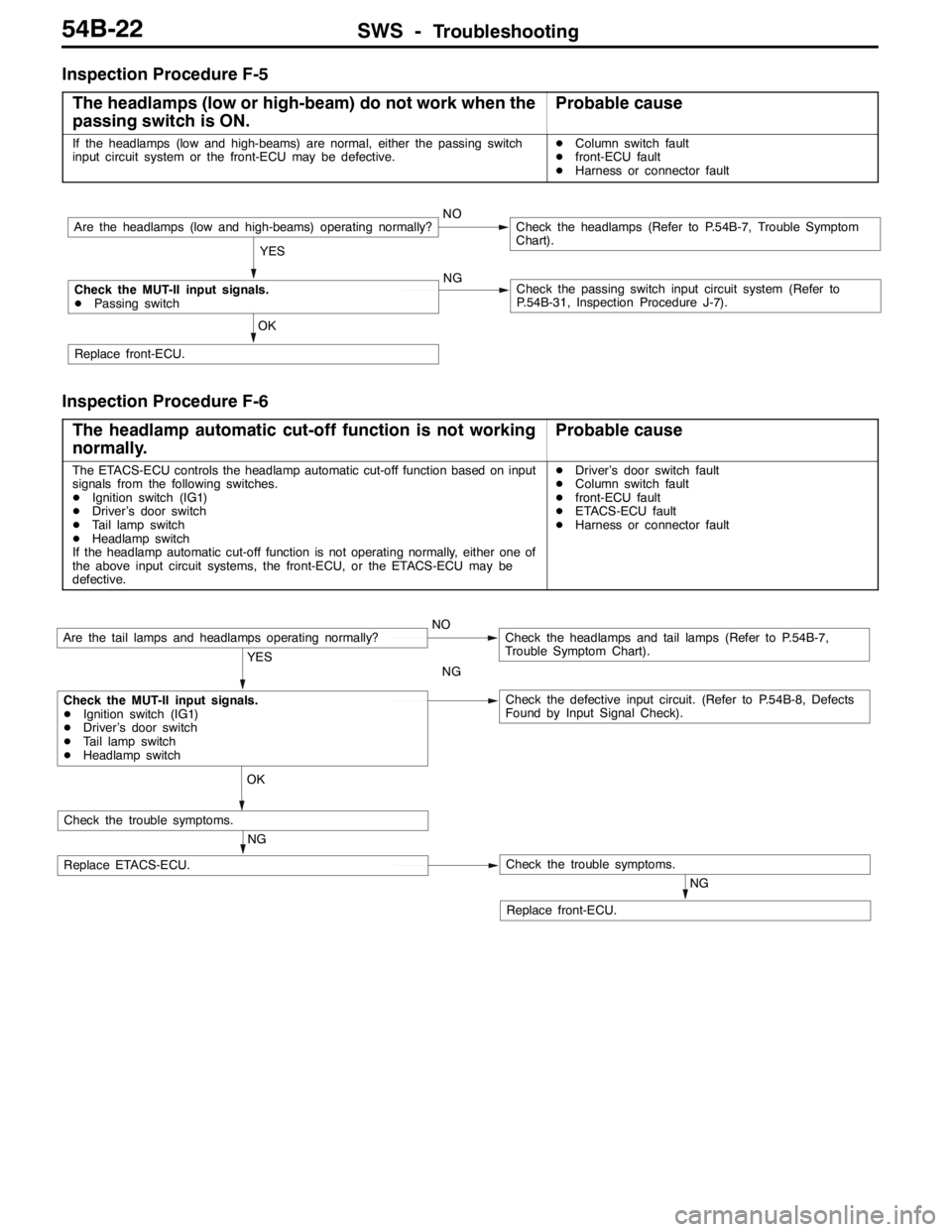
Inspection Procedure F-5
The headlamps (low or high-beam) do not work when the
passing switch is ON.
Probable cause
If the headlamps (low and high-beams) are normal, either the passing switch
input circuit system or the front-ECU may be defective.DColumn switch fault
Dfront-ECU fault
DHarness or connector fault
OK
Replace front-ECU.
YES
Check the MUT-II input signals.
DPassing switchNGCheck the passing switch input circuit system (Refer to
P.54B-31, Inspection Procedure J-7).
Are the headlamps (low and high-beams) operating normally?NOCheck the headlamps (Refer to P.54B-7, Trouble Symptom
Chart).
Inspection Procedure F-6
The headlamp automatic cut-off function is not working
normally.
Probable cause
The ETACS-ECU controls the headlamp automatic cut-off function based on input
signals from the following switches.
DIgnition switch (IG1)
DDriver’s door switch
DTail lamp switch
DHeadlamp switch
If the headlamp automatic cut-off function is not operating normally, either one of
the above input circuit systems, the front-ECU, or the ETACS-ECU may be
defective.DDriver’s door switch fault
DColumn switch fault
Dfront-ECU fault
DETACS-ECU fault
DHarness or connector fault
NG
Replace front-ECU.
NG
Replace ETACS-ECU.Check the trouble symptoms.
Check the trouble symptoms.
YES
NG
Check the defective input circuit. (Refer to P.54B-8, Defects
Found by Input Signal Check).
Are the tail lamps and headlamps operating normally?NOCheck the headlamps and tail lamps (Refer to P.54B-7,
Trouble Symptom Chart).
Check the MUT-II input signals.
DIgnition switch (IG1)
DDriver’s door switch
DTail lamp switch
DHeadlamp switch
OK