2007 MITSUBISHI LANCER EVOLUTION fuse diagram
[x] Cancel search: fuse diagramPage 169 of 1449

CIRCUIT DIAGRAMSB-71
MULTI-PURPOSE FUSE (In junction block)
Power supply
circuitNo.Rated
capacity (A)Identification
colourCircuit
Ignition
switch
IG1110RedIgnition coil
switch
27.5BrownColumn switch, combination meter, ETACS-ECU,
SRS-ECU, vehicle speed sensor and ACD mode
changeover switch
37.5BrownETACS-ECU and SRS-ECU
4---
IG257.5BrownA/C compressor relay, A/C-ECU, blower relay,
condenser fan relay, defogger relay, front-ECU,
4WD-ECU, steering wheel sensor and inter cooler
water splay relay
Multi-purpose fuse
No. 20 (Defogger
relay)6---
Ignition
switch
ACC720YellowFront-ECU and windshield wiper motor
switch
IG187.5BrownEngine-ECU and fuel pump relay (1) and fuel pump
relay (2)
ACC915BlueCigarette lighter
10---
117.5BrownA/C-ECU and remote controlled mirror switch
IG2127.5BrownABS-ECU, G-sensor (longitudinal) and G-sensor
(lateral)
ACC13---
14---
Fusible link No. 1
Battery/alternator
1515BlueDiagnosis connector
Battery/alternator
1610RedRear fog lamp relay
1710RedETACS-ECU
18---
1930GreenBlower motor and resistor
2030GreenDefogger
Page 183 of 1449

CIRCUIT DIAGRAMSB-85
CHARGING SYSTEM (See P.B-84.)
OPERATION
When engine is stationary
DWhen the ignition switch is turned to the ON
position, current flows the alternator L terminal
and, at the same time, the charge warning lamp
illuminates.
When engine is started and after engine has
started
DWhen the engine is started, the charge warning
lamp goes out because of the charging voltage
begin applied to the alternator L terminal.
DThe battery voltage being applied to the
alternator S terminal is monitored by the voltage
regulator. Therefore, the amount of electricity
produced by the alternator is controlled by
allowing and cutting off the current flowing to
the field coil.
DThe alternator B terminal supplies power to
each load.TROUBLESHOOTING HINTS
1. Charging indicator lamp does not illuminate
when the ignition switch is turned to ON
position, before the engine starts.
DCheck multi-purpose fuse No.(2).
DCheck the bulb.
2. Charging indicator lamp fails to switch off once
the engine starts.
DCheck voltage regulator of alternator.
3. Discharged or overcharged battery.
DCheck voltage regulator of alternator.
4. Charge warning lamp illuminates dimly.
DCheck combination meter diode (for short).
Page 253 of 1449

CIRCUIT DIAGRAMSB-155
FUEL WARNING LAMP (See P.B-156.)
OIL PRESSURE WARNING LAMP (See P.B-157.)
BRAKE WARNING LAMP (See P.B-157.)
OPERATION
DWhen the ignition switch is at the “ON” position,
the fuel gauge unit resistance is small when
the fuel level is high, and the fuel gauge unit
resistance is large when the fuel level is low.
When this resistance rises above a specified
value, the fuel warning lamp illuminates to notify
the driver that the fuel level is low.
DWhen the lubrication system fails after engine
starting, resulting in the oil pressure failing to
build up, the oil pressure switch turns on
causing the oil pressure warning lamp to
illuminate.
DWhen the brake fluid level goes down below
a predetermined level with the ignition switch
in the “ON” position, the brake fluid level switch
is activated or the parking brake switch is turned
on, causing the brake warning lamp to
illuminate.TROUBLESHOOTING HINTS
1. No warning lamps illuminate.
DCheck multi-purpose fuse No.(2).
2. Some warning lamps do not illuminate.
DCheck lamp valve.
DCheck the switches and the gauge unit.
Page 388 of 1449

GENERAL -How to Use Troubleshooting/Inspection Service Points00-10
HOW TO USE THE INSPECTION PROCEDURES
The causes of a high frequency of problems occurring in electronic circuitry are generally the connectors,
components, the ECU and the harnesses between connectors, in that order. These inspection procedures
follow this order, and they first try to discover a problem with a connector or a defective component.
DIndicator does not turn on or off even if control
mode switch is pressed.
DIndicator switch should not be illuminated is
illuminated.Probable cause
OK
OK
OK
Measure at switch connector A-44
DDisconnect the connector, and measure at the harness
side.
DVoltage between terminal 6 - earth and terminal 8 -
earth
OK:Approx. 5V
OK
NG
Check the following connector.A-44
Repair
OK
Check trouble symptom.
Replace the ECS-ECU.
In the above cases, the ECS switch circuit is defective or the indicator
circuit is defective.
CHECKING PROCEDURE 4
2. Indicates inspection carried out using the
MUT-II.
Indicates the operation and inspection proce-
dures.
Indicates the OK judgement conditions.
3. Detailed inspection procedures (methods)
such as component inspection and circuit
inspection are listed on a separate page, and
are given here for reference.
5. Inspect the contact condition at each connector terminal.
(Refer to Connector Inspection Service Points.)
The connector position can be located in the wiring diagram in the
electrical wiring manual by means of this symbol.
Caution
After carrying out connector inspection, always be sure to
reconnect the connector as it was before.
6. Confirm that there are trouble symptoms. If trouble symptoms have
disappeared, the connector may have been inserted incorrectly and the
trouble symptom may have disappeared during inspection.
If it seems that trouble symptoms still remain, proceed to the next page of
instructions.
7. If trouble symptoms still remain up to this stage, there is a possibility that there is an
open or short circuit in the harness between the connectors, so check the harness.
Alternatively, the cause may be a defective ECU, so try replacing the ECU and check
if the trouble symptom disappears.
NGECU switch component inspection (Refer to P.33-44.)
NG
1. Comments on the diagnosis code or trouble
symptom above.
MUT-IIData list
17 Control mode selection switch
OK:Voltage changes between approx. 0V→approx.
2.5V→approx. 5V when the switch is operated.
4. Indicates voltage and resistance to be measured at a particular
connector.
(Refer to Connector Measurement Service Points.)
The connector position can be located in the wiring diagram in the
electrical wiring manual by means of this symbol.
Indicates operation and inspection procedures, inspection terminals
and inspection conditions.
Indicates the OK judgement conditions.
HARNESS INSPECTION
Check for an open or short circuit in the harness between the terminals which were defective according
to the connector measurements. Carry out this inspection while referring to the electrical wiring manual.
Here, “Check harness between power supply and terminal xx” also includes checking for blown fuses.
For inspection service points when there is a blown fuse, refer to “Inspection Service Points for a Blown
Fuse.”
MEASURES TO TAKE AFTER REPLACING THE ECU
If the trouble symptoms have not disappeared even after replacing the ECU, repeat the inspection procedure
from the beginning.
Page 1251 of 1449

SRS -Troubleshooting52B-7
SRS SYSTEM CIRCUIT DIAGRAM
Ignition switch (IG1)
J/B
(common fuse)
Combination
Meter
Connector lock switch*
ON
ON OFF
OFF
Driver’s air
bag module
(squib)
Front pas-
senger’s seat
air bag mod-
ule(squib)
Seat belt
pre-tensioner
(L.H.)Clock spring
ONONOFF
OFF
Connector lock switch* Diagnosis connector SRS-ECU
No.3
7.5A No.2
7.5A
OFF
OFF
OFF
OFF
OFF
OFF
OFF
OFFON
ON
ON
ON
ON
ON
ON
ONOFF
ON
ON OFF
C-207
C-204
C-109
D-28
D-26C-22
SRS - ECU connector16
13
7 8
11
12
10
9
30
29
28
2720 Connector lock switch*
Connector lock switch*
Connector lock switch*
Connector lock switch*
Connector lock switch*
NOTE
*:connector engaged:ON
connector disengaged:OFF Seat belt
pre-tensioner
(R.H.)
Page 1274 of 1449
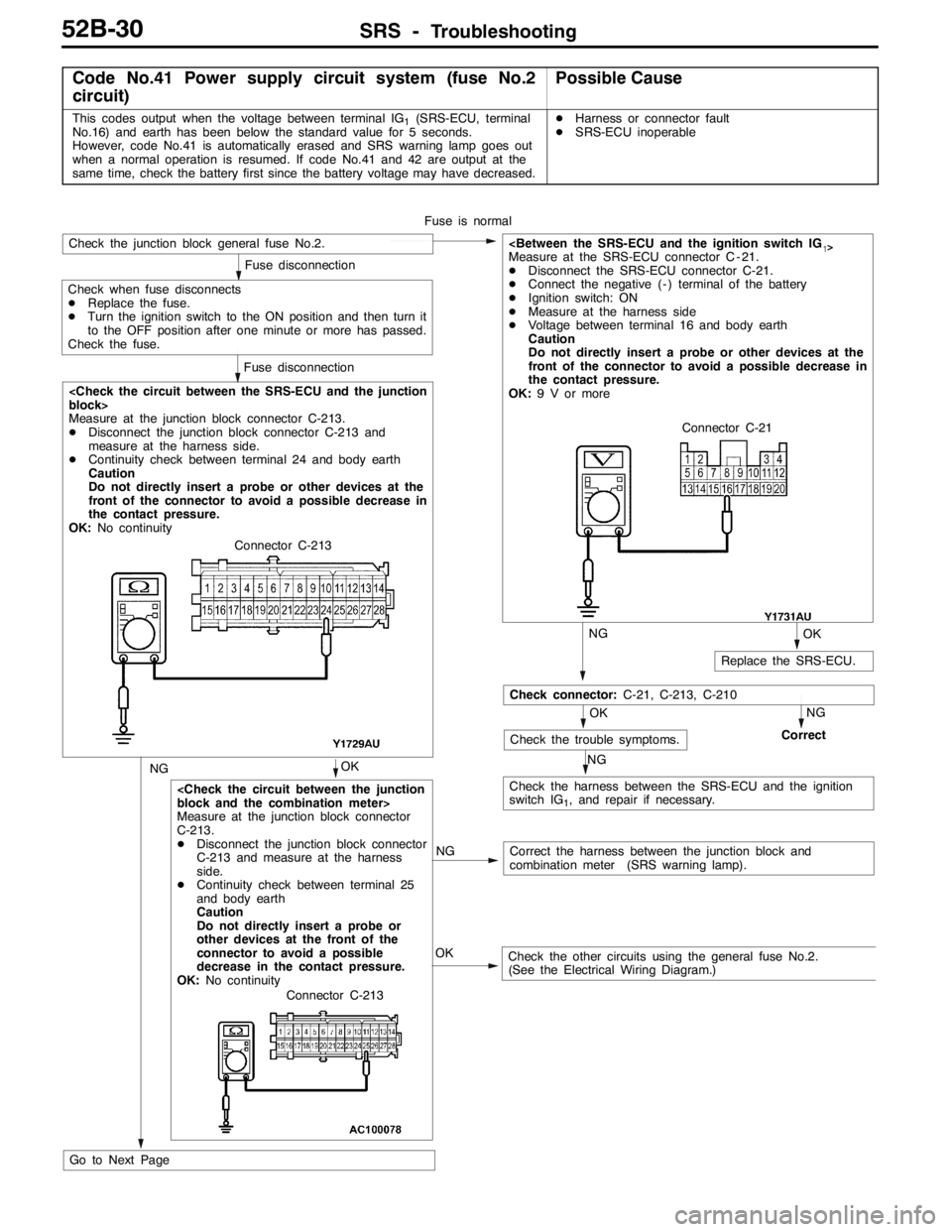
SRS -Troubleshooting52B-30
Code No.41 Power supply circuit system (fuse No.2
circuit)Possible Cause
This codes output when the voltage between terminal IG1(SRS-ECU, terminal
No.16) and earth has been below the standard value for 5 seconds.
However, code No.41 is automatically erased and SRS warning lamp goes out
when a normal operation is resumed. If code No.41 and 42 are output at the
same time, check the battery first since the battery voltage may have decreased.DHarness or connector fault
DSRS-ECU inoperable
Measure at the junction block connector
C-213.
DDisconnect the junction block connector
C-213 and measure at the harness
side.
DContinuity check between terminal 25
and body earth
Caution
Do not directly insert a probe or
other devices at the front of the
connector to avoid a possible
decrease in the contact pressure.
OK:No continuity
Measure at the junction block connector C-213.
DDisconnect the junction block connector C-213 and
measure at the harness side.
DContinuity check between terminal 24 and body earth
Caution
Do not directly insert a probe or other devices at the
front of the connector to avoid a possible decrease in
the contact pressure.
OK:No continuity
NGCorrect the harness between the junction block and
combination meter (SRS warning lamp).
NGOK
NGNG
Check the trouble symptoms.Correct
Check the harness between the SRS-ECU and the ignition
switch IG
1, and repair if necessary. Fuse is normal
NG
Fuse disconnection
Check the junction block general fuse No.2.
Fuse disconnection
Check when fuse disconnects
DReplace the fuse.
DTurn the ignition switch to the ON position and then turn it
to the OFF position after one minute or more has passed.
Check the fuse.
OK
OK
Replace the SRS-ECU.
DDisconnect the SRS-ECU connector C-21.
DConnect the negative ( - ) terminal of the battery
DIgnition switch: ON
DMeasure at the harness side
DVoltage between terminal 16 and body earth
Caution
Do not directly insert a probe or other devices at the
front of the connector to avoid a possible decrease in
the contact pressure.
OK:9 V or more
Check the other circuits using the general fuse No.2.
(See the Electrical Wiring Diagram.) OK
Check connector:C-21, C-213, C-210
Go to Next PageConnector C-21
Connector C-213
Connector C-213
Page 1276 of 1449
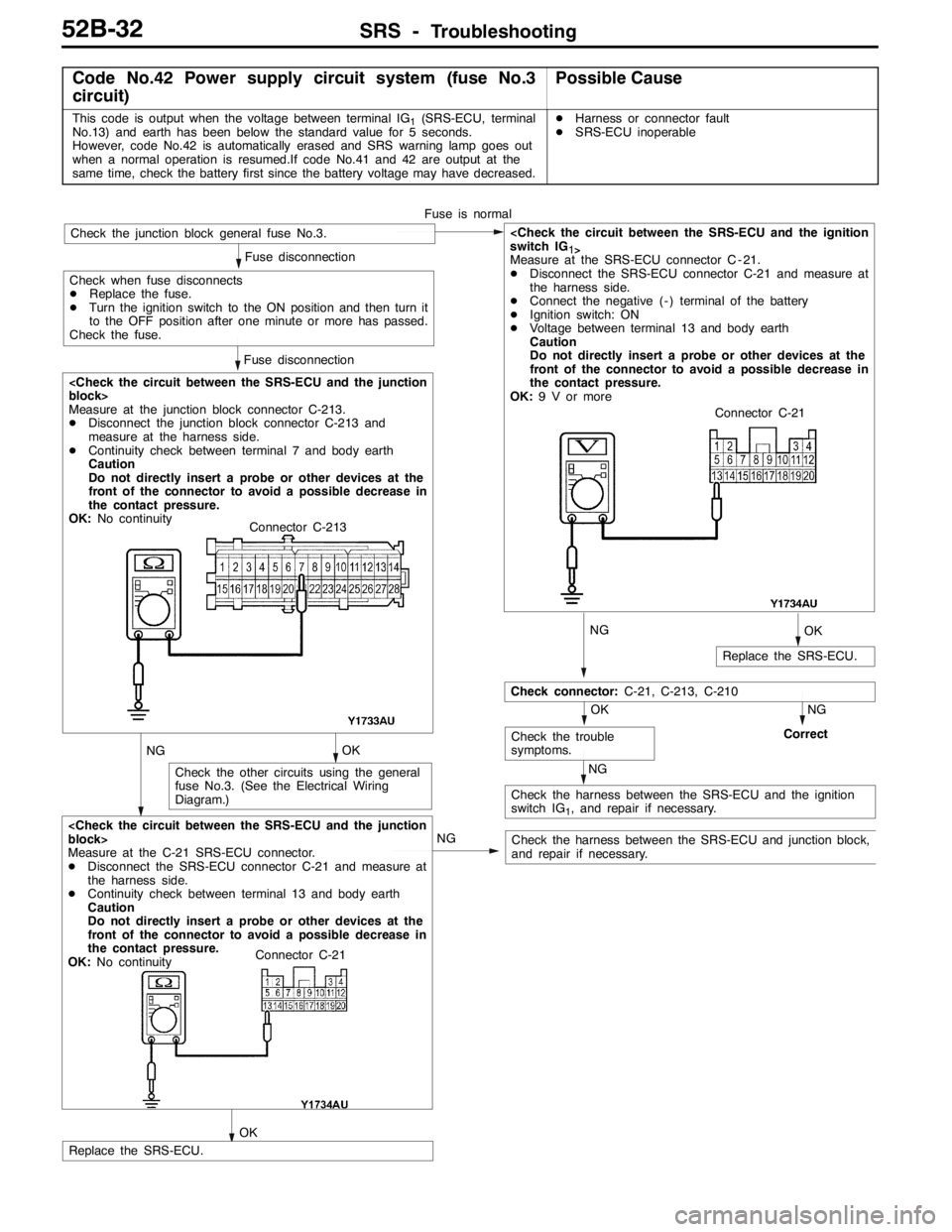
SRS -Troubleshooting52B-32
Code No.42 Power supply circuit system (fuse No.3
circuit)Possible Cause
This code is output when the voltage between terminal IG1(SRS-ECU, terminal
No.13) and earth has been below the standard value for 5 seconds.
However, code No.42 is automatically erased and SRS warning lamp goes out
when a normal operation is resumed.If code No.41 and 42 are output at the
same time, check the battery first since the battery voltage may have decreased.DHarness or connector fault
DSRS-ECU inoperable
OK
Check the other circuits using the general
fuse No.3. (See the Electrical Wiring
Diagram.)
NGOK
NG
NG
NG
Check connector:C-21, C-213, C-210
Check the trouble
symptoms.Correct
Check the harness between the SRS-ECU and the ignition
switch IG
1, and repair if necessary.
NG
Fuse disconnection
Fuse disconnection
OK
Replace the SRS-ECU.
1
>Measure at the SRS-ECU connector C - 21.
DDisconnect the SRS-ECU connector C-21 and measure at
the harness side.
DConnect the negative ( - ) terminal of the battery
DIgnition switch: ON
DVoltage between terminal 13 and body earth
Caution
Do not directly insert a probe or other devices at the
front of the connector to avoid a possible decrease in
the contact pressure.
OK:9 V or more
OK
Check the harness between the SRS-ECU and junction block,
and repair if necessary.
Measure at the C-21 SRS-ECU connector.
DDisconnect the SRS-ECU connector C-21 and measure at
the harness side.
DContinuity check between terminal 13 and body earth
Caution
Do not directly insert a probe or other devices at the
front of the connector to avoid a possible decrease in
the contact pressure.
OK:No continuity
Replace the SRS-ECU.Fuse is normal
Check the junction block general fuse No.3.
Check when fuse disconnects
DReplace the fuse.
DTurn the ignition switch to the ON position and then turn it
to the OFF position after one minute or more has passed.
Check the fuse.
Measure at the junction block connector C-213.
DDisconnect the junction block connector C-213 and
measure at the harness side.
DContinuity check between terminal 7 and body earth
Caution
Do not directly insert a probe or other devices at the
front of the connector to avoid a possible decrease in
the contact pressure.
OK:No continuityConnector C-21
Connector C-213
Connector C-21