2007 MITSUBISHI LANCER EVOLUTION lock
[x] Cancel search: lockPage 538 of 1449

MPI -Service Specifications/Sealant13A-6
SERVICE SPECIFICATIONS
ItemsSpecifications
Basic idle speed r/min850±100
Throttle position sensor adjusting voltage mV535 - 735
Throttle position sensor resistance kΩ3.5 - 6.5
Idle speed control servo coil resistance (at 20_C)Ω28 - 33
Intake air temperature sensor
resistancekΩ
-20_C13 - 17
resistance kΩ0_C5.7 - 6.7
20_C2.3 - 3.0
40_C1.0 - 1.5
60_C0.56 - 0.76
80_C0.30 - 0.42
Engine coolant temperature
sensorresistancekΩ
-20_C14 - 17
sensor resistance kΩ0_C5.1 - 6.5
20_C2.1 - 2.7
40_C0.9 - 1.3
60_C0.48 - 0.68
80_C0.26 - 0.36
Oxygen sensor heater
resistance(at20_C)Ω
Front4.5 - 8.0
resistance (at 20_C)ΩRear11 - 1 8
Oxygen sensor output voltage (at racing) V0.6 - 1.0
Fuel pressure kPaVacuum hose disconnection289 - 309 at curb idle
Vacuum hose connectionApproximately 230 at curb idle
Fuel pressure control solenoid valve resistance (at 20_C)Ω28 - 36
Fuel pump resistor resistanceΩ0.45 - 0.65
Injector coil resistance (at 20_C)Ω2-3
Injector fuel leakage rate Drop/minute1 or less
Resistor (for injector) resistance (at 20_C)Ω5.8 - 6.2
SEALANT
ItemSpecified sealantRemark
Engine coolant temperature sensor
threaded portion3M Nut Locking Part No. 4171 or equivalentDrying sealant
Page 543 of 1449

MPI -TroubleshootingMPI -Troubleshooting13A-11
CONFIRMING FREEZE FRAME DATA
When the engine-ECU detects a malfunction and stores a diagnosis code, it also stores a current status
of the engine. This function is called “Freeze frame” data. By analyzing this “Freeze frame” data with
MUT-II, an effective troubleshooting can be performed.
NOTE
If mulfunctions have been detected in multiple systems, engine-ECU stores one malfunction only, which
has been detected first.
Item No.Data itemUnit/StateItem No.Data itemUnit/State
21Engine coolant temperature
sensor_C81Learn value%
22Crank angle sensorr/min82Feedback%
24Vehicle speedkm/h87Engine load%
FAIL-SAFE FUNCTION REFERENCE TABLE
When the main sensor malfunctions are detected by the diagnosis function, the vehicle is controlled
by means of the pre-set control logic to maintain safe conditions for driving.
Malfunctioning itemControl contents during malfunction
Air flow sensor1. Uses the throttle position sensor signal and engine speed signal (crank angle sensor
signal) to take reading of the basic injector drive time and basic ignition timing from
the pre-set mapping.
2. Fixes the idle speed control servo in the appointed position so idle control is not
performed.
Intake air temperature
sensorControls as if the intake air temperature is 25_C.
Throttle position
sensorNo increase in fuel injection amount during acceleration due to the throttle position sensor
signal.
Engine coolant
temperature sensor1. Controls as if the engine coolant temperature is 80_C.
(Even after sensor signal is correctly recovered, continues until the ignition switch
is set to the “LOCK” (OFF) position.)
2. Rotates radiator fan and condenser fan at high speed.
Camshaft position
sensor1. Inject all fuel cylinders simultaneously. (However, when the No.1 cylinder top dead
centre is not detected at all after the ignition switch is turned to “ON” position.)
2. Shuts off fuel supply after 4 seconds have passed since a failure was detected.
(However, when the No.1 cylinder top dead centre is not detected at all after the
ignition switch is turned to “ON” position.)
Barometric pressure
sensorControls as if the barometric pressure is 101 kPa.
Detonation sensorSwitches the ignition timing from ignition timing for super petrol to ignition timing for standard
petrol.
Alternator FR terminalDoes not control the output of the alternator according to an electrical load. (works as a
normal alternator)
Page 582 of 1449
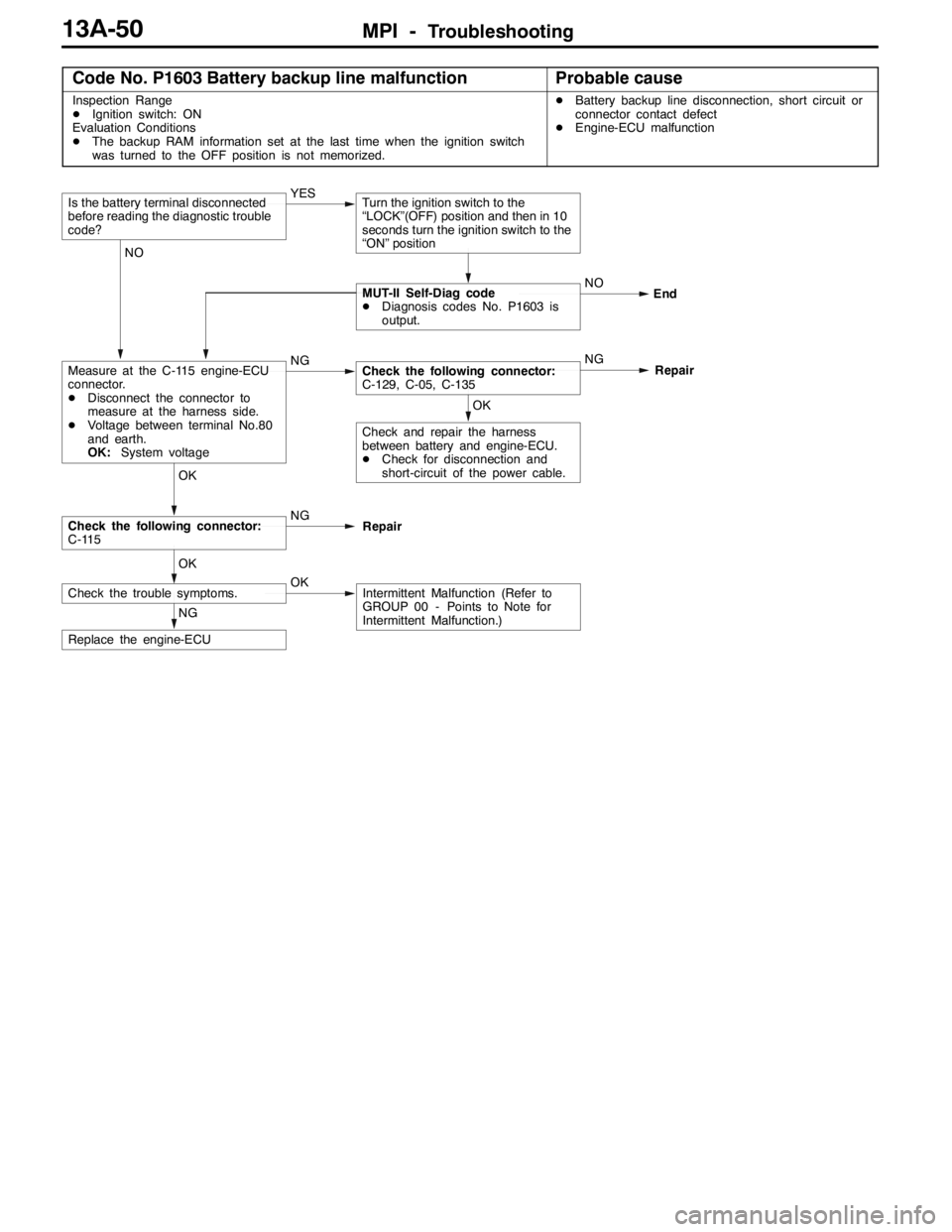
MPI -Troubleshooting13A-50
Code No. P1603 Battery backup line malfunctionProbable cause
Inspection Range
DIgnition switch: ON
Evaluation Conditions
DThe backup RAM information set at the last time when the ignition switch
was turned to the OFF position is not memorized.DBattery backup line disconnection, short circuit or
connector contact defect
DEngine-ECU malfunction
NG
Replace the engine-ECU
OK
Check the trouble symptoms.OKIntermittent Malfunction (Refer to
GROUP 00 - Points to Note for
Intermittent Malfunction.)
OK
Check the following connector:
C-115NG
Repair
OK
Check and repair the harness
between battery and engine-ECU.
DCheck for disconnection and
short-circuit of the power cable.
NGCheck the following connector:
C-129, C-05, C-135NG
Repair NO
MUT-II Self-Diag code
DDiagnosis codes No. P1603 is
output.End
NO
Measure at the C-115 engine-ECU
connector.
DDisconnect the connector to
measure at the harness side.
DVoltage between terminal No.80
and earth.
OK:System voltageYES
Turn the ignition switch to the
“LOCK”(OFF) position and then in 10
seconds turn the ignition switch to the
“ON” positionIs the battery terminal disconnected
before reading the diagnostic trouble
code?
Page 585 of 1449

MPI -Troubleshooting
Fig. 1
Vehicle
speedInitial ac-
celerator
pedal de-
pressionNormalHesitation
Sag
TimeFig. 2
Normal
Initial ac-
celerator
pedal de-
pression
IdlingStumble
Time Vehicle
speed
13A-53
PROBLEM SYMPTOMS TABLE (FOR YOUR INFORMATION)
ItemsSymptom
StartingWon’t startThe starter is used to crank the engine, but there is no combustion within the
cylinders, and the engine won’t start.
Fires up and diesThere is combustion within the cylinders, but then the engine soon stalls.
Hard startingEngine starts after cranking a while.
Idling
stability
HuntingEngine speed doesn’t remain constant; changes at idle.
stability
Rough idleUsually, a judgement can be based upon the movement of the tachometer
pointer, and the vibration transmitted to the steering wheel, shift lever, body, etc.
This is called rough idle.
Incorrect idle speedThe engine doesn’t idle at the usual correct speed.
Engine stall
(Die out)The engine stalls when the foot is taken from the accelerator pedal, regardless
of whether the vehicles is moving or not.
Engine stall
(Pass out)The engine stalls when the accelerator pedal is depressed or while it is being
used.
DrivingHesitation Sag“Hesitation” is the delay in response of the vehicle speed (engine speed) that
occurs when the accelerator is depressed in order to accelerate from the speed
at which the vehicle is now traveling, or a temporary drop in vehicle speed
(engine speed) during such acceleration.
Serious hesitation is called “sag”. (Refer to Fig. 1)
Poor accelerationPoor acceleration is inability to obtain an acceleration corresponding to the
degree of throttle opening, even though acceleration is smooth, or the inability
to reach maximum speed.
StumbleEngine speed increase is delayed when the accelerator pedal is initially
depressed for acceleration. (Refer to Fig. 2)
ShockThe feeling of a comparatively large impact or vibration when the engine is
accelerated or decelerated.
SurgeThis is repeated surging ahead during constant speed travel or during variable
speed travel.
KnockingA sharp sound like a hammer striking the cylinder walls during driving and which
adversely affects driving.
StoppingRun on
(“Dieseling”)The condition in which the engine continues to run after the ignition switch is
turned to “LOCK” (OFF) position. Also called “Dieseling”.
Page 642 of 1449

MPI -Troubleshooting13A-110
Terminal No.Normal condition Check condition (Engine condition) Check item
12Power supplyIgnition switch: “ON”System voltage
25
19Air flow sensor reset
signal
Engine: Idle operation0-1V
signal
Engine speed: 3,000 r/min6-9V
21Fan controllerRadiator fan is not operating0 - 0.3 V
Radiator fan is operating0.7 V or more
22Fuel pump relay 2Ignition switch: “ON”System voltage
Engine: Idle operation1 V or less
24A/C load signalDEngine:
Idle operation
DA/C switch: ON
(A/C compressor
runs)DOutdoor air
sensor ambient
temperature:
18_C or more
DA/C setting
temperature:
Minimum
temperature
DA/C air volume:
Maximum1 V or less
DA/C setting
temperature:
indoor
temperature
DA/C air volume:
MinimumSystem voltage
32Condenser fan motor
relay (HI)Fan inactive state
(Engine coolant temperature: 90_C or less)System voltage
Fan high-speed rotation state
(Engine coolant temperature: 105_C or more)1 V or less
33Alternator G terminalDEngine: After warm-up, idle operation
DRadiator fan: Not operating
DHeadlamp: OFF→ON
DStop lamp: OFF→ON
DRear defogger switch: OFF→ONVoltage increases by
0.2 - 3.5 V
34Condenser fan motor
relay (LOW)Fan inactive state
(Engine coolant temperature: 90_C or less)System voltage
Fan low-speed rotation state (Engine coolant
temperature: 95 - 100_C or more)1 V or less
35Intercooler water
spraylamp
Ignition switch: “ON”System voltage
spraylamp
Ignition switch: “LOCK” (OFF)1 V or less
36Engine warning lampIgnition switch: “LOCK” (OFF)→“ON”1 V or less→System
voltage (After several se-
conds have elapsed)
Page 643 of 1449

MPI -Troubleshooting13A-111
Terminal No.Normal condition Check condition (Engine condition) Check item
37Power steering fluid
pressure switchEngine: Idling after
warming upWhen steering wheel
is stationarySystem voltage
When steering wheel
is turned1 V or less
38Engine control relayIgnition switch: “LOCK” (OFF)System voltage
Ignition switch: “ON”1 V or less
39Fuel pump relay 3While engine is idling, suddenly depress the
accelerator pedal.Temporarily rises slightly
from 1 V or less.
41Alternator FR
terminalDEngine: After warm-up, idle operation
DRadiator fan: Not operating
DHead lamp: OFF→ON
DStop lamp: OFF→ON
DRear deffogger switch: OFF→ONVoltage decrease
44Intercooler water
spray switch (Auto)DIgnition switch: “ON”
DIntercooler water spray switch: ON1 V or less
DIgnition switch: “ON”
DIntercooler water spray switch: OFFSystem voltage
45A/C switchEngine: Idle operationTurn the A/C switch
OFF0.5 V or less
DA/C switch: ON
DA/C setting
temperature
When room tem-
perature is 25_C
or more: Max
Cool
When room tem-
perature is 25_C
or less: Max. HotSystem voltage
53Secondary air control
solenoid valveIgnition switch: “ON”System voltage
54Oxygen sensor
heater(Rear)
Engine: Idling after warming up1 V or less
heater(Rear)
Engine speed: 5,000r/minSystem voltage
55Intercooler water
sprayrelay
Ignition switch: “ON”System voltage
spray relay
Ignition switch: “LOCK” (OFF)1 V or less
58Tachometer signalEngine speed: 3,000r/min0.3 - 3.0 V
60Oxygen sensor
heater(front)
Engine: Idling after warming up1 V or less
heater(front)
Engine speed: 5,000r/minSystem voltage
71Ignition switch - STEngine: Cranking8 V or more
Page 644 of 1449

MPI -Troubleshooting13A-112
Terminal No.Normal condition Check condition (Engine condition) Check item
72Intake air
temperature sensorIgnition switch: “ON”Intake air
temperature: - 20_C3.8 - 4.4 V
Intake air
temperature: 0_C3.2 - 3.8 V
Intake air
temperature: 20_C2.3 - 2.9 V
Intake air
temperature: 40_C1.5 - 2.1 V
Intake air
temperature: 60_C0.8 - 1.4 V
Intake air
temperature: 80_C0.4 - 1.0 V
75Oxygen sensor
(Rear)DTransmission: Second gear
DDriving with the throttle widely open
DEngine: 3,500 r/min or more0.6 - 1.0 V
76Oxygen sensor (front)Engine: Running at 2,500 r/min after warmed
up (Check using a digital type voltmeter)0↔0.8 V
(Changes repeatedly)
80Backup power supplyIgnition switch: “LOCK” (OFF)System voltage
81Sensor impressed
voltageIgnition switch: “ON”4.9 - 5.1 V
82Ignition switch - IGIgnition switch: “ON”System voltage
83Engine coolant
temperature sensorIgnition switch: “ON”Coolant temperature:
-20_C3.9 - 4.5 V
Coolant temperature:
0_C3.2 - 3.8 V
Coolant temperature:
20_C2.3 - 2.9 V
Coolant temperature:
40_C1.3 - 1.9 V
Coolant temperature:
60_C0.7 - 1.3 V
Coolant temperature:
80_C0.3 - 0.9 V
84Throttle position
sensorIgnition switch: “ON”Set throttle valve to
idle position0.535 - 0.735 V
Fully open throttle
valve4.5 - 5.0 V
85Barometric pressure
sensor
Ignition switch: “ON”Altitude: 0 m3.8 - 4.2 V
sensor
Altitude: 600 m3.5 - 3.9 V
Altitude: 1,200 m3.2 - 3.8 V
Altitude: 1,800 m3.0 - 3.4 V
Page 646 of 1449

MPI -Troubleshooting13A-114
CHECK CHART FOR RESISTANCE AND CONTINUITY
BETWEEN TERMINALS
1. Turn the ignition switch to “LOCK” (OFF) position.
2. Disconnect the engine-ECU connector.
3. Measure the resistance and check for continuity between
the terminals of the engine-ECU harness-side connector
while referring to the check chart.
NOTE
(1) When measuring resistance and checking continuity,
a harness for checking contact pin pressure should
be used instead of inserting a test probe.
(2) Checking need not be carried out in the order given
in the chart.
Caution
If the terminals that should be checked are mistaken,
or if connector terminals are not correctly shorted
to earth, damage may be caused to the vehicle wiring,
sensors, engine-ECU and/or ohmmeter.
Be careful to prevent this!
4. If the ohmmeter shows any deviation from the standard
value, check the corresponding sensor, actuator and
related electrical wiring, and then repair or replace.
5. After repair or replacement, recheck with the ohmmeter
to confirm that the repair or replacement has corrected
the problem.
Engine-ECU Harness Side Connector Terminal Arrangement
Terminal No.Inspection itemNormal condition (Check condition)
1-12No. 1 injector2-3Ω(at 20_C)
14 - 12No. 2 injector
2-12No. 3 injector
15 - 12No. 4 injector