Page 64 of 1575
5.Remove the under cover.
6.Drain the engine coolant.
7. Remove the upper radiator hose(A) and lower radiator hose(B).
8.Remove the transaxle oil cooler hoses(A/T vehicles only).
9. Remove the fuel inlet hose(A) from the delivery pipe.
10. Disconnect the engine wiring harness connectors.
Page 69 of 1575
The bottom side bolt(A) which can be seen after removing the under cover should be loosened for removal of
the radiator support upper member assembly.
18.Drain engine oil.
19. Remove the brake caliper.(Refer to DS group).
20. Disconnect the air conditioning compressor hoses.(Refer to HA group).
21. Remove the front wheels and tires.(Refer to DS group).
22. Remove the brake caliper hub nut.(Refer to DS group).
23. Remove the tie rod end ball joint from the knuckle.(Refer to DS group)
24. Remove the driver shaft and the stabilizer bar link(Refer to SS group).
25. Remove the front muffler(A).
26.Using a floor jack, support the engine and transaxle assembly.
After removing the sub frame mounting bolt , the engine and transaxle assembly may fall downward, and so
support them securely with floor jack.
Page 71 of 1575
INSTALLATION
Installation is in the reverse order of removal.
Perform the following :a. Adjust the shift cable.
b. Refill the engine with engine oil.
c. Refill the transaxle with fluid.
d. Refill the radiator with engine coolant.
e. Bleed air from the cooling system with the heater valve open.
f. Clean the battery posts and cable terminals with sandpaper assemble them, then apply grease to prevent
corrosion.
g. Inspect for fuel leakage.
After assembling the fuel line, turn on the ignition switch (do not operate the starter) so that the fuel pump runs for
approximately two seconds and fuel line pressurizes.
Repeat this operation two or three times, then check for fuel leakage at any point in the fuel line.
Page 92 of 1575
Piston pin- to- connecting rod interference
- 0.033 ~ - 0.016mm ( - 0.0013 ~ - 0.0006in.)
REASSEMBLY
a.Thoroughly clean all parts before reassembling.
b. Before installing the parts, apply fresh engine oil to all sliding and rotating surfaces.
c. Replace all gaskets, O - rings and oil seals with new parts.
1. Assemble the piston and the connecting rod.
(1) Use a hydraulic press for installation.
(2) The piston front mark(A) and the connecting rod front mark must face the timing belt side of the engine.
2.Install piston rings.
(1) Install the oil ring spacer and 2 side rails by hand.
(2) Using a piston ring expander, install the 2 compression rings with the code mark facing upward.
(3) Position the piston rings so that the ring ends are as shown.
3.Install the connecting rod bearings.
(1) Align the bearing(A) claw with the groove of the connecting rod or connecting rod cap(B).
(2) Install the bearings(A) in the connecting rod and connecting rod cap(B).
Page 95 of 1575
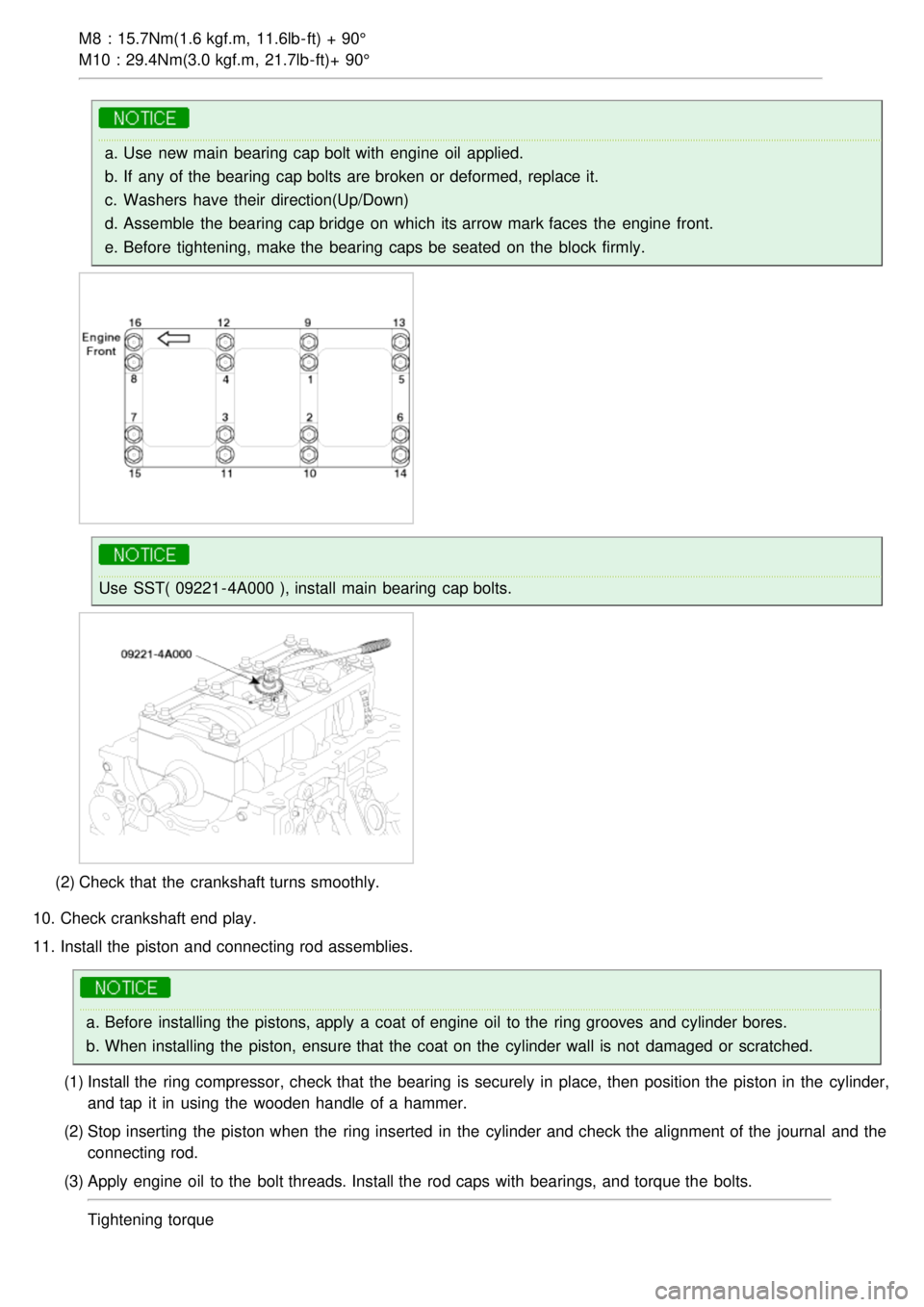
M8 : 15.7Nm(1.6 kgf.m, 11.6lb- ft) + 90°
M10 : 29.4Nm(3.0 kgf.m, 21.7lb- ft)+ 90°
a.Use new main bearing cap bolt with engine oil applied.
b. If any of the bearing cap bolts are broken or deformed, replace it.
c. Washers have their direction(Up/Down)
d. Assemble the bearing cap bridge on which its arrow mark faces the engine front.
e. Before tightening, make the bearing caps be seated on the block firmly.
Use SST( 09221 - 4A000 ), install main bearing cap bolts.
(2) Check that the crankshaft turns smoothly.
10. Check crankshaft end play.
11. Install the piston and connecting rod assemblies.
a.Before installing the pistons, apply a coat of engine oil to the ring grooves and cylinder bores.
b. When installing the piston, ensure that the coat on the cylinder wall is not damaged or scratched.
(1) Install the ring compressor, check that the bearing is securely in place, then position the piston in the cylinder,
and tap it in using the wooden handle of a hammer.
(2) Stop inserting the piston when the ring inserted in the cylinder and check the alignment of the journal and the
connecting rod.
(3) Apply engine oil to the bolt threads. Install the rod caps with bearings, and torque the bolts.
Tightening torque
Page 97 of 1575
(1)Make clean the sealing face before assembling two parts.
a.Remove harmful foreign materials on the sealing face before applying sealant
b. Apply sealant to the inner threads of the bolt holes.
(2) Assembling rear oil seal case, the liquid sealant TB1217H should be applied to the rear oil seal case.
The part must be assembled within 5 minutes after sealant was applied.
13. Using SST(09231- 33000), install rear oil seal after applying engine oil on the rip of the oil seal.
14. Install the oil pump case.
15. Install upper oil pan.
(1) Using a gasket scraper, remove all the old packing material from the gasket surfaces.
(2) Before assembling the oil pan, the liquid sealant TB1217H should be applied on upper oil pan.
The part must be assembled within 5 minutes after the sealant was applied.
Page 117 of 1575
2007 > 2.7L V6 GASOLINE >
REMOVAL
Oil pump case
1. Drain engine oil.
2. Remove the front right wheel and tire.
3. Remove the front right side cover.
4. Remove the front muffler.
5. Remove the generator.
6. Remove the timing belt.
7. Remove the oil filter bracket(A).
8.Using SST(09215- 3C000), remove the lower oil pan(A).
Be careful not to damage the contact surfaces of upper oil pan and lower oil pan.
9. Remove the oil screen(A).
Page 118 of 1575
10.Remove the upper oil pan, using the SST(09215- 3C000)(A).
Be careful not to damage the contact surfaces of upper oil pan and lower oil pan.
11. Remove the oil pump case(A).
12.After removing the plug(A), remove the relief spring(B) and the velief plunger(C).
REPLACEMENT
OIL AND FILTER
a.Prolonged and repeated contact with mineral oil will result in the removal of natural fats from the skin, leading
to dryness, irritation and dermatitis. In addition, used engine oil contains potentially harmful contaminants
which may cause skin cancer.
b. Wear protective clothing and gloves in order to minimize the length and frequency of contact of your skin to
used oil. Wash your skin thoroughly with soap and water, or use water- less hand cleaner, to remove any used
engine oil. Do not use gasoline, thinners, or solvents.


