Page 1508 of 1575
2007 > 2.7L V6 GASOLINE >
TEACHING PROCEDURES
1.Key Teaching Procedure
Key teaching must be done after replacing an inoperative PCM(ECM) or when providing additional keys to the
vehicle owner.
The procedure starts with an PCM(ECM) request for vehicle specific data (PIN code: 6digits) from the tester. The
"virgin" PCM(ECM) stores the vehicle specific data and the key teaching can be started. The "learnt" PCM(ECM)
compares the vehicle specific data from the tester with the stored data. If the data are correct, the teaching can
proceed.
If incorrect vehicle specific data have been sent to the PCM(ECM) three times, the PCM(ECM) will reject the
request of key teaching for one hour. This time cannot be reduced by disconnecting the battery or any other
manipulation. After reconnecting the battery, the timer starts again for one hour.
The key teaching is done by ignition on with the key and additional tester commands. The PCM(ECM) stores the
relevant data in the EEPROM and in the transponder. Then the PCM(ECM) runs the authentication required for
confirmation of the teaching process. The successful programming is then confirmed by a message to the tester.
If the key is already known to the PCM(ECM) from a previous teaching, the authentication will be accepted and the
EEPROM data are updated. There is no changed transponder content (this is impossible for a learnt transponder).
The attempt to repeatedly teach a key, which has been taught already during the same teaching cycle, is
recognized by the PCM(ECM). This rejects the key and a message is sent to the tester.
The PCM(ECM) rejects invalid keys, which are presented for teaching. A message is sent to the tester. The key
can be invalid due to faults in the transponder or other reasons, which result from unsuccessful programming of
data. If the PCM(ECM) detects different authenticators of a transponder and an PCM(ECM), the key is considered
to be invalid.
The maximum number of taught keys is 4
If an error occurs during the Immobilizer Service Menu, the PCM(ECM) status remains unchanged and a specific
fault code is stored.
If the PCM(ECM) status and the key status do not match for teaching of keys, the tester procedure will be stopped
and a specific fault code will be stored at PCM(ECM).
Page 1512 of 1575
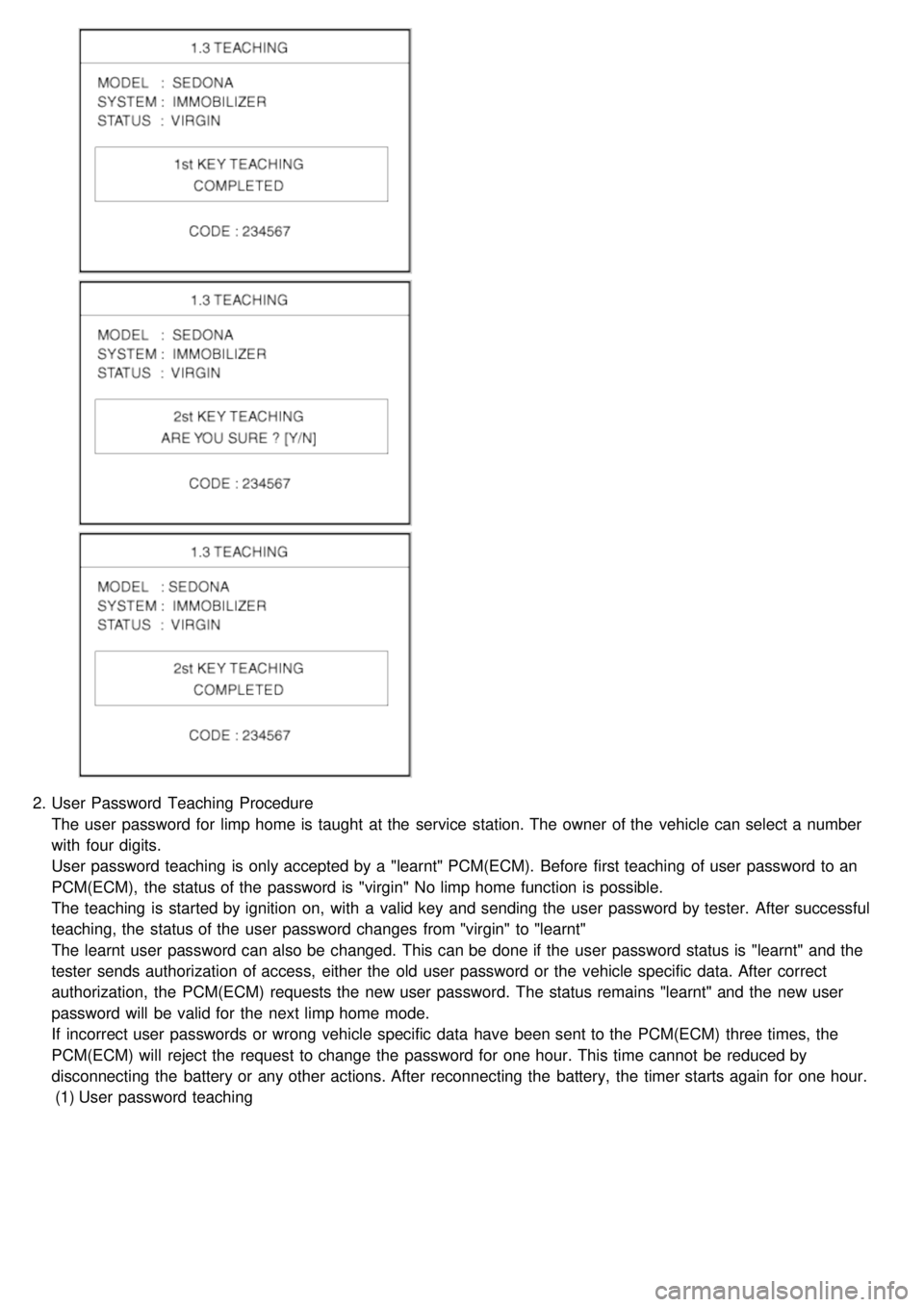
2.User Password Teaching Procedure
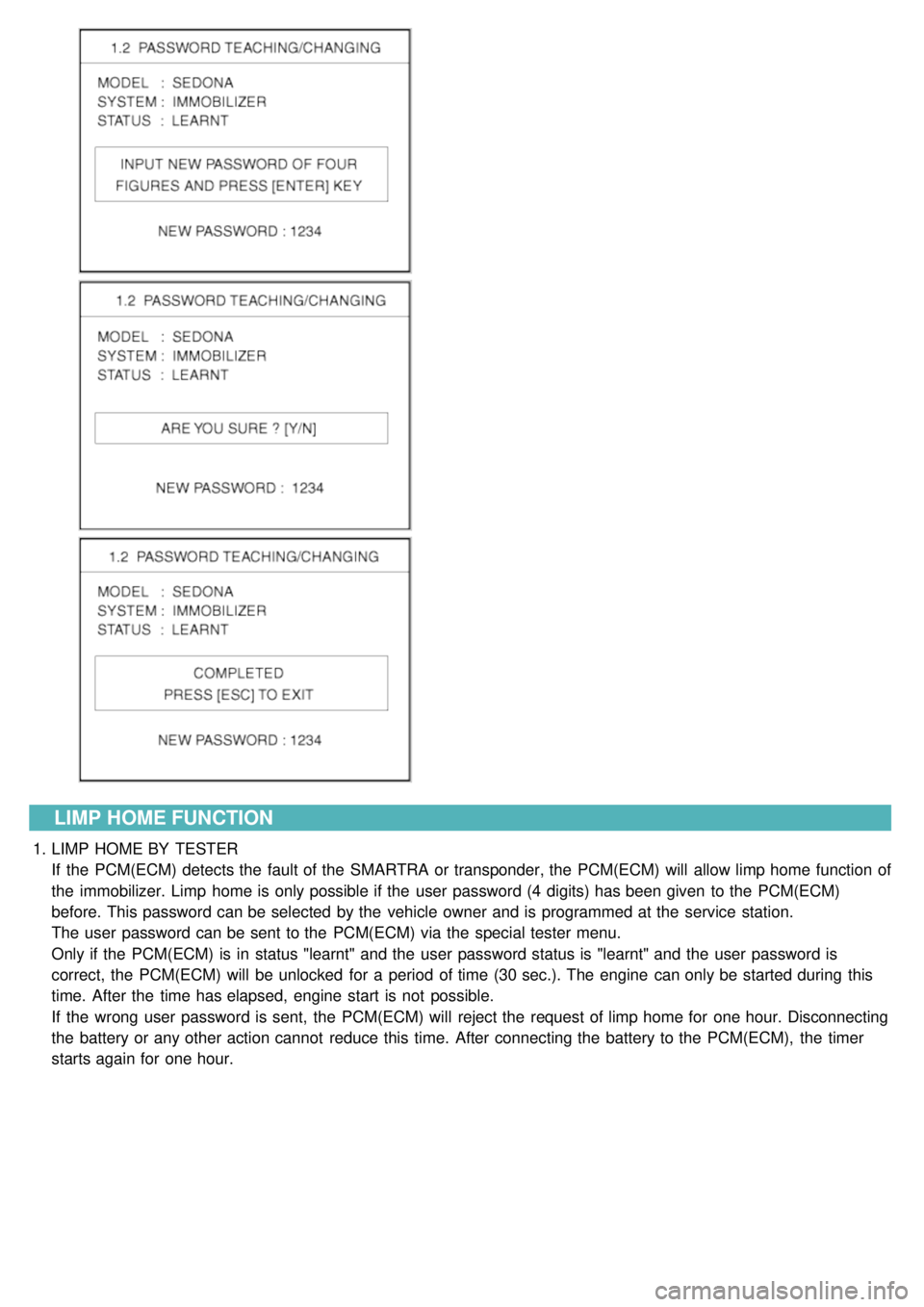
The user password for limp home is taught at the service station. The owner of the vehicle can select a number
with four digits.
User password teaching is only accepted by a "learnt" PCM(ECM). Before first teaching of user password to an
PCM(ECM), the status of the password is "virgin" No limp home function is possible.
The teaching is started by ignition on, with a valid key and sending the user password by tester. After successful
teaching, the status of the user password changes from "virgin" to "learnt"
The learnt user password can also be changed. This can be done if the user password status is "learnt" and the
tester sends authorization of access, either the old user password or the vehicle specific data. After correct
authorization, the PCM(ECM) requests the new user password. The status remains "learnt" and the new user
password will be valid for the next limp home mode.
If incorrect user passwords or wrong vehicle specific data have been sent to the PCM(ECM) three times, the
PCM(ECM) will reject the request to change the password for one hour. This time cannot be reduced by
disconnecting the battery or any other actions. After reconnecting the battery, the timer starts again for one hour.
(1) User password teaching
Page 1515 of 1575
LIMP HOME FUNCTION
1.LIMP HOME BY TESTER
If the PCM(ECM) detects the fault of the SMARTRA or transponder, the PCM(ECM) will allow limp home function of
the immobilizer. Limp home is only possible if the user password (4 digits) has been given to the PCM(ECM)
before. This password can be selected by the vehicle owner and is programmed at the service station.
The user password can be sent to the PCM(ECM) via the special tester menu.
Only if the PCM(ECM) is in status "learnt" and the user password status is "learnt" and the user password is
correct, the PCM(ECM) will be unlocked for a period of time (30 sec.). The engine can only be started during this
time. After the time has elapsed, engine start is not possible.
If the wrong user password is sent, the PCM(ECM) will reject the request of limp home for one hour. Disconnecting
the battery or any other action cannot reduce this time. After connecting the battery to the PCM(ECM), the timer
starts again for one hour.
Page 1522 of 1575
2007 > 2.7L V6 GASOLINE >
REPLACEMENT
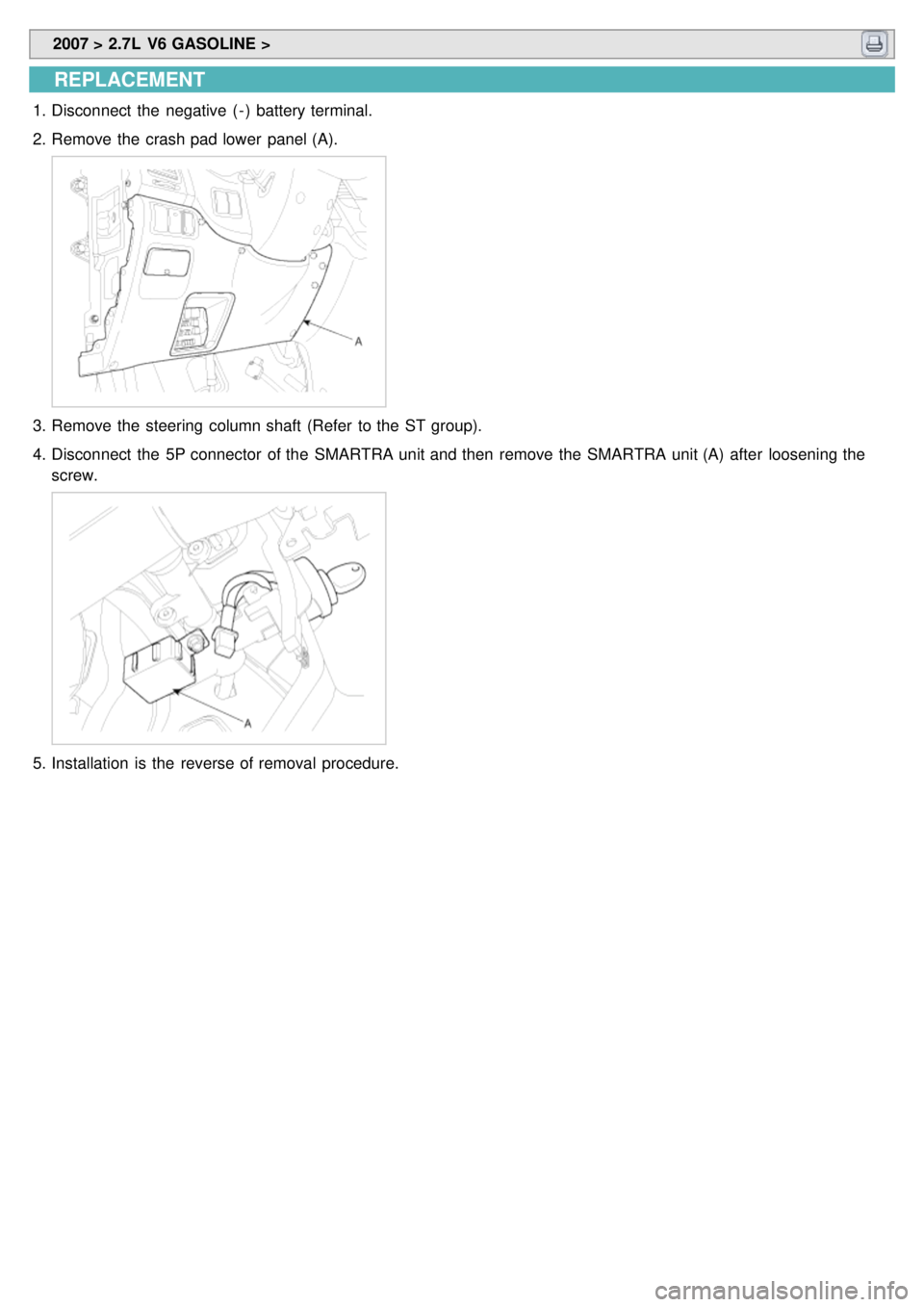
1.Disconnect the negative ( - ) battery terminal.
2. Remove the crash pad lower panel (A).
3.Remove the steering column shaft (Refer to the ST group).
4. Disconnect the 5P connector of the SMARTRA unit and then remove the SMARTRA unit (A) after loosening the
screw.
5.Installation is the reverse of removal procedure.
Page 1524 of 1575
2007 > 2.7L V6 GASOLINE >
REPLACEMENT
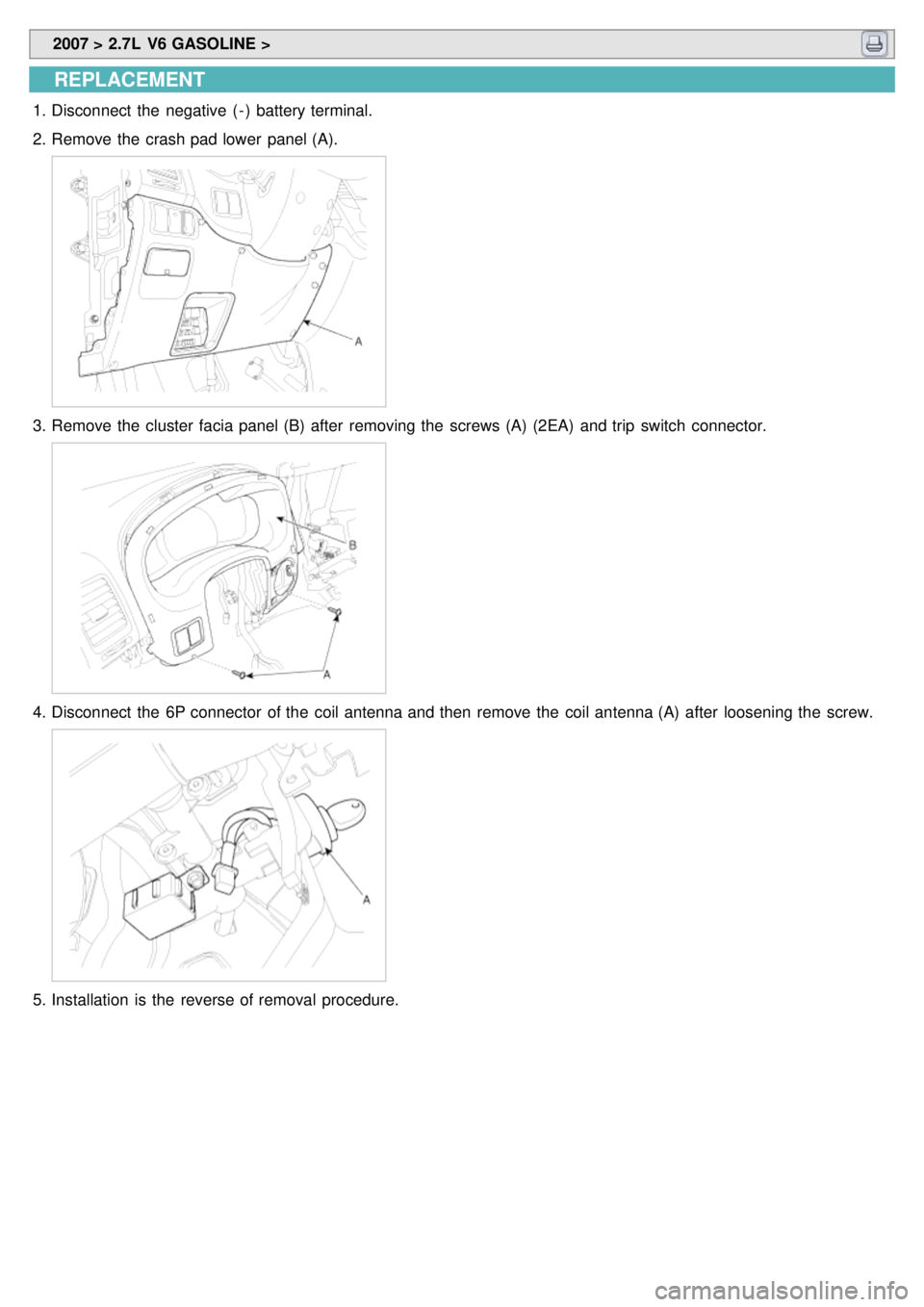
1.Disconnect the negative ( - ) battery terminal.
2. Remove the crash pad lower panel (A).
3.Remove the cluster facia panel (B) after removing the screws (A) (2EA) and trip switch connector.
4.Disconnect the 6P connector of the coil antenna and then remove the coil antenna (A) after loosening the screw.
5.Installation is the reverse of removal procedure.
Page 1530 of 1575
a.Do not install a ski rack, antenna, etc. that are attached to the vehicle using a magnet as anything attached
to the roof of the vehicle with a magnet will effect compass operation.
b. If the compass deviates from the correct indication soon after repeated adjustment, have the compass
checked at an authorized dealer.
c. The compass may not indicate the correct compass point in tunnels or while driving up or down a steep
hill. (The compass returns to the correct compass point when the vehicle moves to an area where the
geomagnetism is stabilized.)
a. Declination correction and correction setting value is not deleted during the B(+) OFF.
DISPLACEMENT
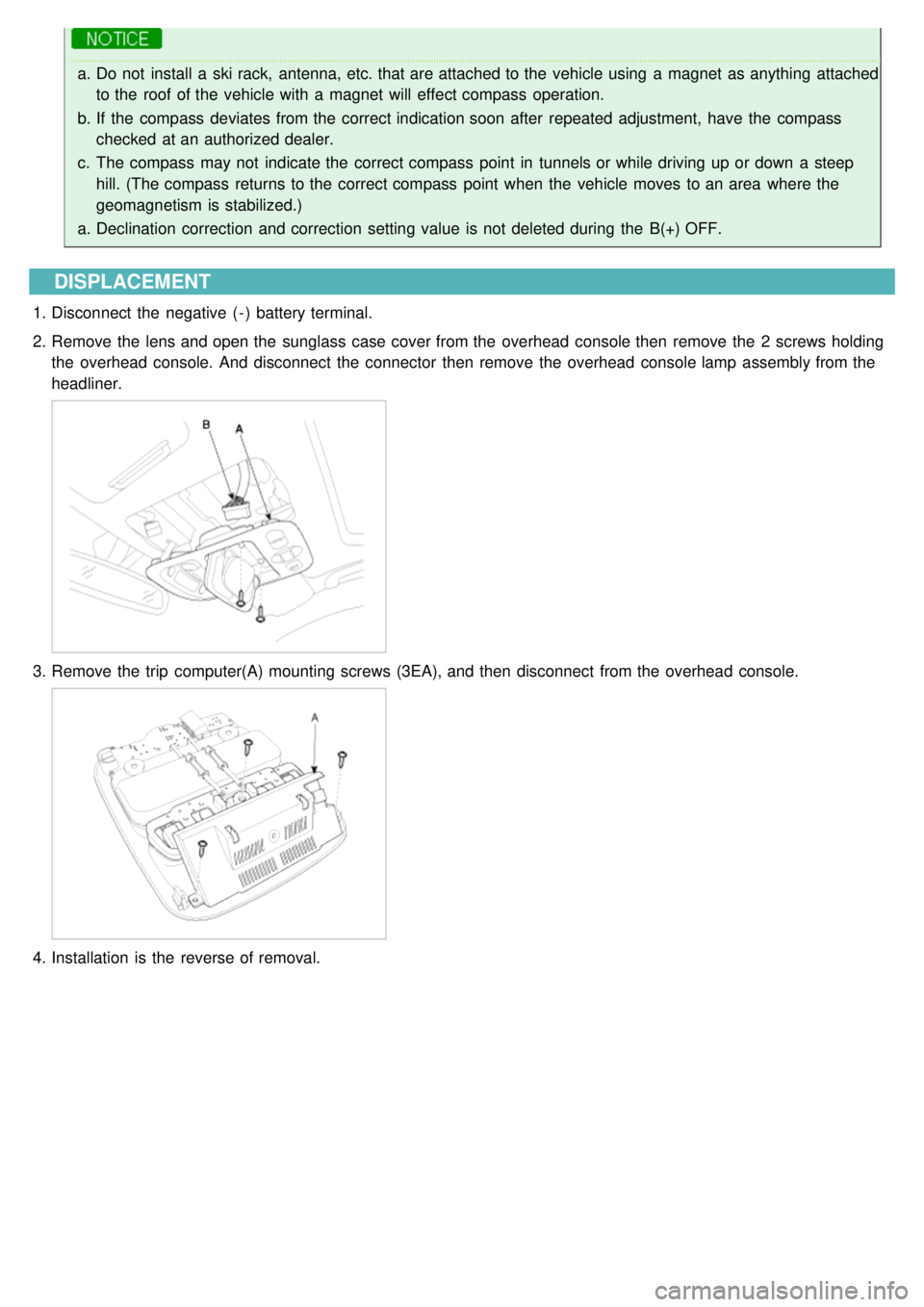
1.Disconnect the negative ( - ) battery terminal.
2. Remove the lens and open the sunglass case cover from the overhead console then remove the 2 screws holding
the overhead console. And disconnect the connector then remove the overhead console lamp assembly from the
headliner.
3.Remove the trip computer(A) mounting screws (3EA), and then disconnect from the overhead console.
4.Installation is the reverse of removal.
Page 1545 of 1575
2007 > 2.7L V6 GASOLINE >
INSPECTION
Test the buzzer by connecting battery voltage to terminal 1, and ground terminal 2.
The buzzer should make a sound. If the buzzer fails to make a sound, replace it.
REPLACEMENT
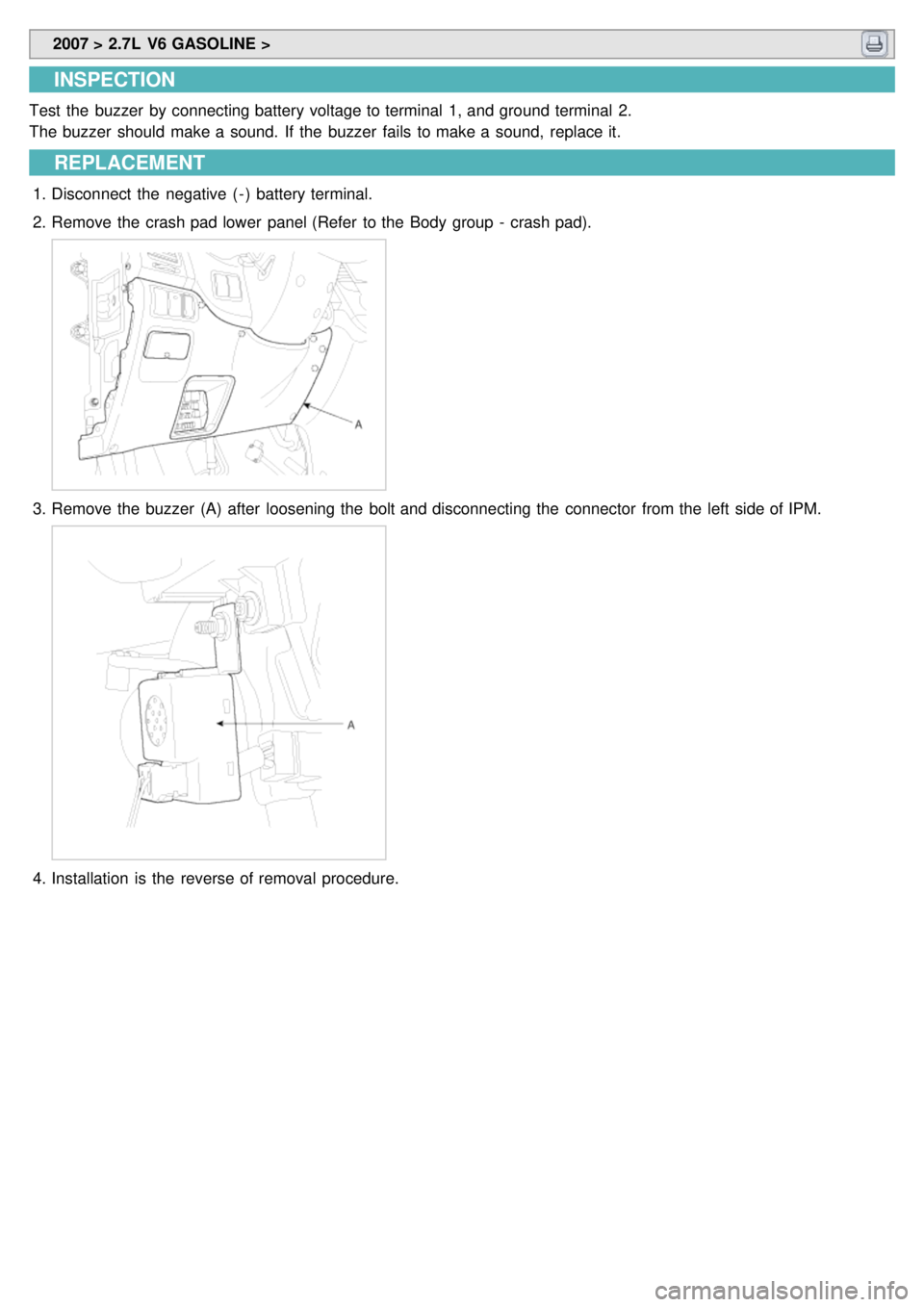
1.Disconnect the negative ( - ) battery terminal.
2. Remove the crash pad lower panel (Refer to the Body group - crash pad).
3.Remove the buzzer (A) after loosening the bolt and disconnecting the connector from the left side of IPM.
4.Installation is the reverse of removal procedure.
Page 1547 of 1575
2007 > 2.7L V6 GASOLINE >
REPLACEMENT
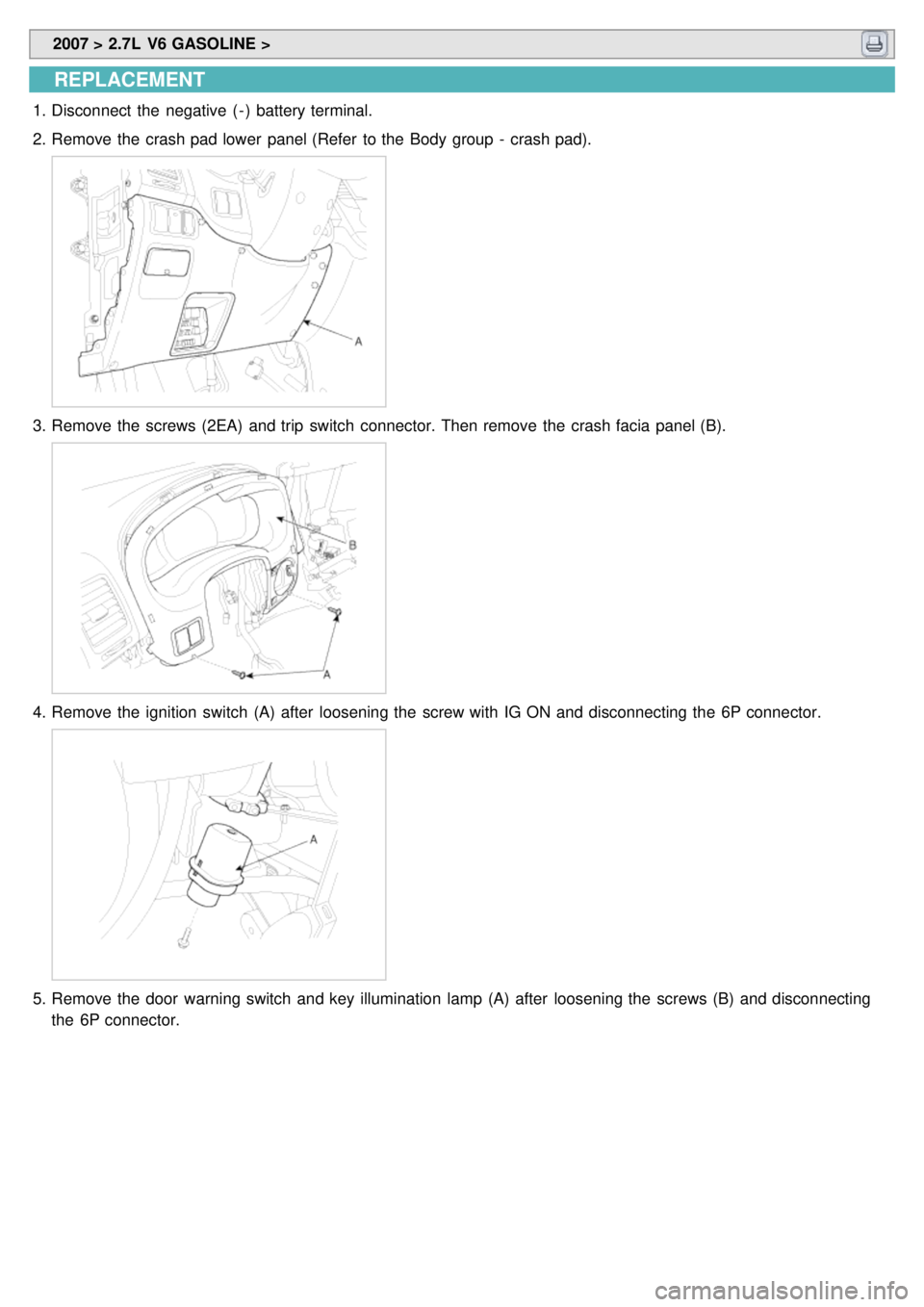
1.Disconnect the negative ( - ) battery terminal.
2. Remove the crash pad lower panel (Refer to the Body group - crash pad).
3.Remove the screws (2EA) and trip switch connector. Then remove the crash facia panel (B).
4.Remove the ignition switch (A) after loosening the screw with IG ON and disconnecting the 6P connector.
5.Remove the door warning switch and key illumination lamp (A) after loosening the screws (B) and disconnecting
the 6P connector.