Page 156 of 1575
INSPECT SPARK PLUG
1.Inspect the electrodes(A) an ceramic insulator(B).
INSPECTION OF ELECTRODES
Condition Dark deposits White deposits
Description a.
Fuel mixture too rich
b. Low air intake a.
Fuel mixture too lean
b. Advanced ignition timing
c. Insufficient plug tightening torque
2. Check the electrode gap (A).
Standard : 1.0 ~ 1.1 mm (0.0394 ~ 0.0433 in.)
Page 176 of 1575

2007 > 2.7L V6 GASOLINE >
STARTER CIRCUIT TROUBLESHOOTING
The battery must be in good condition and fully charged.
1. Remove the fuel pump relay(A) from the fuse box.
2. With the shift lever in N or P (A/T) or clutch pedal pressed (M/T), turn the ignition switch to "START"
If the starter normally cranks the engine, starting system is OK. If the starter will not crank the engine at all, go to
next step.
If it won't disengage from the ring gear when you release key, check for the following until you find the cause.
a. Solenoid plunger and switch malfunction.
b. Dirty pinion gear or damaged overrunning clutch.
3. Check the battery condition. Check electrical connections at the battery, battery negative cable connected to the
body, engine ground cables, and the starter for looseness and corrosion. Then try starting the engine again.
If the starter cranks normally the engine, repairing the loose connection repaired the problem. The starting system
is now OK.
If the starter still does not crank the engine, go to next step.
4. Disconnect the connector from the S- terminal of solenoid. Connect a jumper wire from the B- terminal of solenoid to
the S- terminal of solenoid.
If the starter cranks the engine, go to next step.
If the starter still does not crank the engine, remove the starter, and repair or replace as necessary.
5. Check the following items in the order listed until you find the open circuit.
a. Check the wire and connectors between the driver's under - dash fuse/relay box and the ignition switch, and
between the driver's under - dash fuse/relay box and the starter.
b. Check the ignition switch (Refer to BE group - ignition system)
c. Check the transaxle range switch connector or ignition lock switch connector.
d. Inspect the starter relay.
STATER SOLENOID TEST
1.Disconnect the field coil wire from the M- terminal of solenoid switch.
2. Connect the battery as shown. If the starter pinion pops out, it is working properly. To avoid damaging the starter,
do not leave the battery connected for more than 10 seconds.
3.Disconnect the battery from the M terminal.
If the pinion does not retract, the hold- in coil is working properly. To avoid damaging the starter, do not leave the
battery connected for more than 10 seconds.
Page 192 of 1575
2007 > 2.7L V6 GASOLINE >
DESCRIPTION
Components FunctionRemarks
Crankcase Emission System a. Positive Crankcase Ventilation (PCV)
valve HC reduction
Variable flow rate type
Evaporative Emission System a. Evaporative emission canister
b. Purge Control Solenoid Valve (PCSV) HC reduction
HC reduction
Duty control solenoid valve
Exhaust Emission System a. MFI system (air- fuel mixture control
device)
b. Three- way catalytic converter CO, HC, NOx reduction
CO, HC, NOx reduction
Heated oxygen sensor feedback type
Monolithic type
Page 208 of 1575
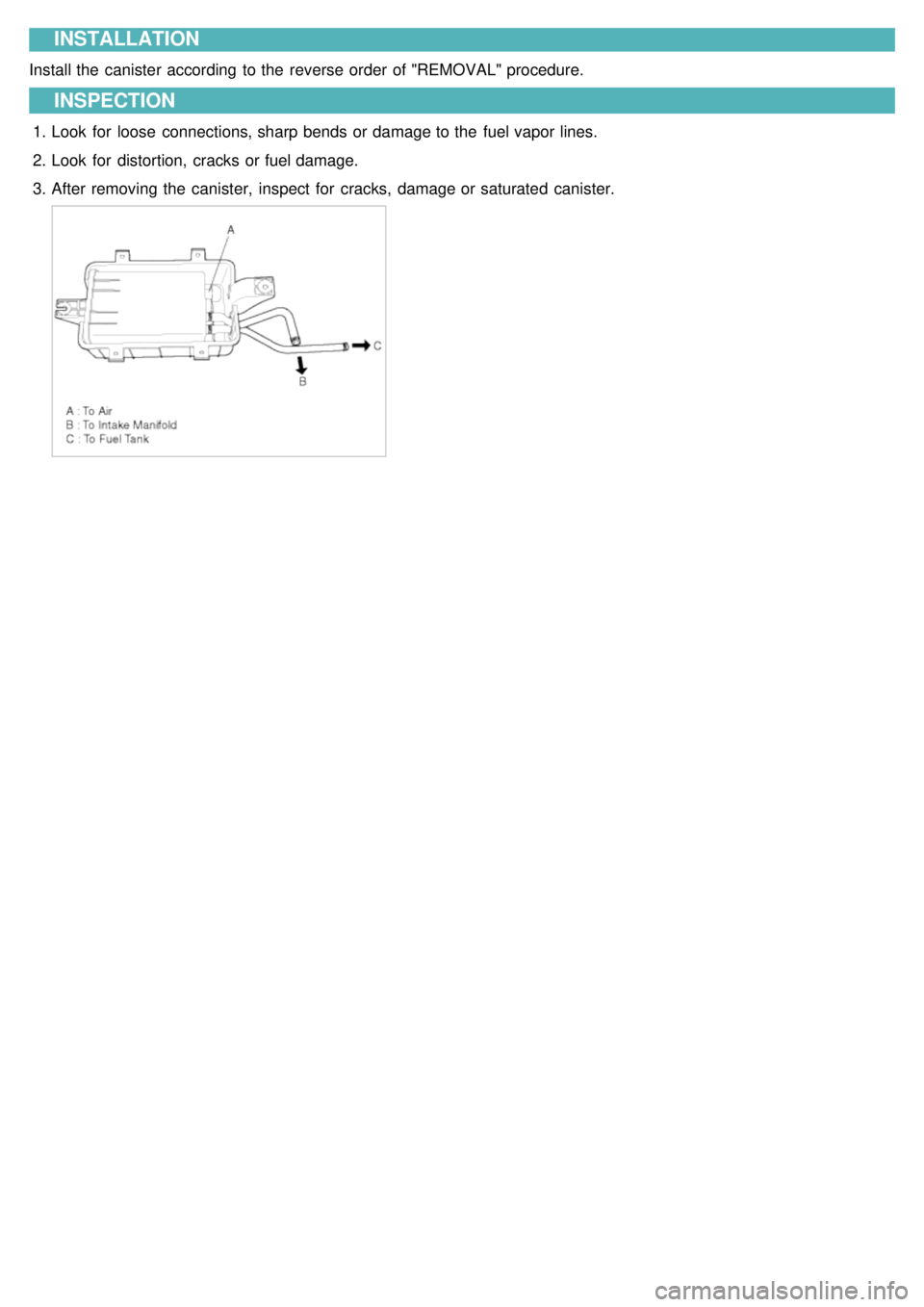
INSTALLATION
Install the canister according to the reverse order of "REMOVAL" procedure.
INSPECTION
1.Look for loose connections, sharp bends or damage to the fuel vapor lines.
2. Look for distortion, cracks or fuel damage.
3. After removing the canister, inspect for cracks, damage or saturated canister.
Page 210 of 1575

2007 > 2.7L V6 GASOLINE >
INSPECTION
When disconnecting the vacuum hose, make an identification mark on it so that it can be reconnected to its
original position.
1. Disconnect the vacuum hose from the solenoid valve.
2. Detach the harness connector.
3. Connect a vacuum pump to the nipple which is connected to intake manifold.
4. Apply vacuum and check when voltage is applied to the PCSV and when the voltage is discontinued.
Battery voltage Normal condition
When applied Vacuum is released
When discontinued Vacuum is maintained
5. Measure the resistance between the terminals of the solenoid valve.
PCSV coil resistance(Ω) :
14.0 ~ 18.0Ω at 20°C (68°F)
INSPECTION
FUNCTION AND OPERATION PRICIPLE
Purge Control Solenoid Valve (PCSV) is installed on the surge tank and controls the passage between the canister
and the intake manifold. It is a solenoid valve and is open when the PCM grounds the valve control line. When the
passage is open (PCSV ON), fuel vapors stored in the canister is transferred to the intake manifold.
SPECIFICATION
Item Specification
Coil Resistance (Ω) 14.0 ~ 18.0Ω at 20°C (68°F)
CIRCUIT DIAGRAM
Page 212 of 1575
Page 215 of 1575
2007 > 2.7L V6 GASOLINE >
DESCRIPTION
Modifications to the combustion chamber, intake manifold, camshaft and ignition system form the basic control system.
These items have been integrated into a highly effective system which controls exhaust emissions while maintaining
good driveability and fuel economy.
AIR/FUEL MIXTURE CONTROL SYSTEM [MULTIPORT FUEL INJECTION (MFI) SYSTEM]
This in turn allows the engine to produce exhaust gases of the proper composition to permit the use of a three way
catalyst. The three way catalyst is designed to convert the three pollutants (1) hydrocarbons (HC), (2) carbon
monoxide (CO), and (3) oxides of nitrogen (NOx) into harmless substances. There are two operating modes in the MFI
system.
1. Open Loop air/fuel ratio is controlled by information programmed into the ECM.
2. Closed Loop air/fuel ratio is adjusted by the ECM based on information supplied by the oxygen sensor.
Page 217 of 1575

2007 > 2.7L V6 GASOLINE >
DESCRIPTION
The CVVT (Continuously Variable Valve Timing) which is installed on the exhaust camshaft controls intake valve open
and close timing in order to improve engine performance.
The intake valve timing is optimized by CVVT system depending on engine rpm.
This CVVT system improves fuel efficiency and reduces NOx emissions at all levels of engine speed, vehicle speed,
and engine load by EGR effect because of valve over - lap optimization.
The CVVT changes the phase of the intake camshaft via oil pressure.
It changes the intake valve timing continuously.
OPERATION
The CVVT system makes continuous intake valve timing changes based on operating conditions.
Intake valve timing is optimized to allow the engine to produce maximum power.
Cam angle is advanced to obtain the EGR effect and reduce pumping loss. The intake valve is closed quickly to
reduce the entry of the air/fuel mixture into the intake port and improve the changing effect.
Reduces the cam advance at idle, stabilizes combustion, and reduces engine speed.
If a malfunction occurs, the CVVT system control is disabled and the valve timing is fixed at the fully retarded position.