Page 219 of 1575
Page 221 of 1575
2007 > 2.7L V6 GASOLINE >
SPECIAL SERVICE TOOLS
Tool
(Number and name) Illustration
Application
09353 - 24100
Fuel Pressure Gauge
Measuring the fuel line pressure
09353 - 38000
Fuel Pressure Gauge
Adapter
Connection between the delivery pipe and
fuel feed line
09353 - 24000
Fuel Pressure Gauge
Connector
Connection between Fuel Pressure Gauge
(09353- 24100) and Fuel Pressure Gauge
Adapter (09353- 38000)
Page 230 of 1575
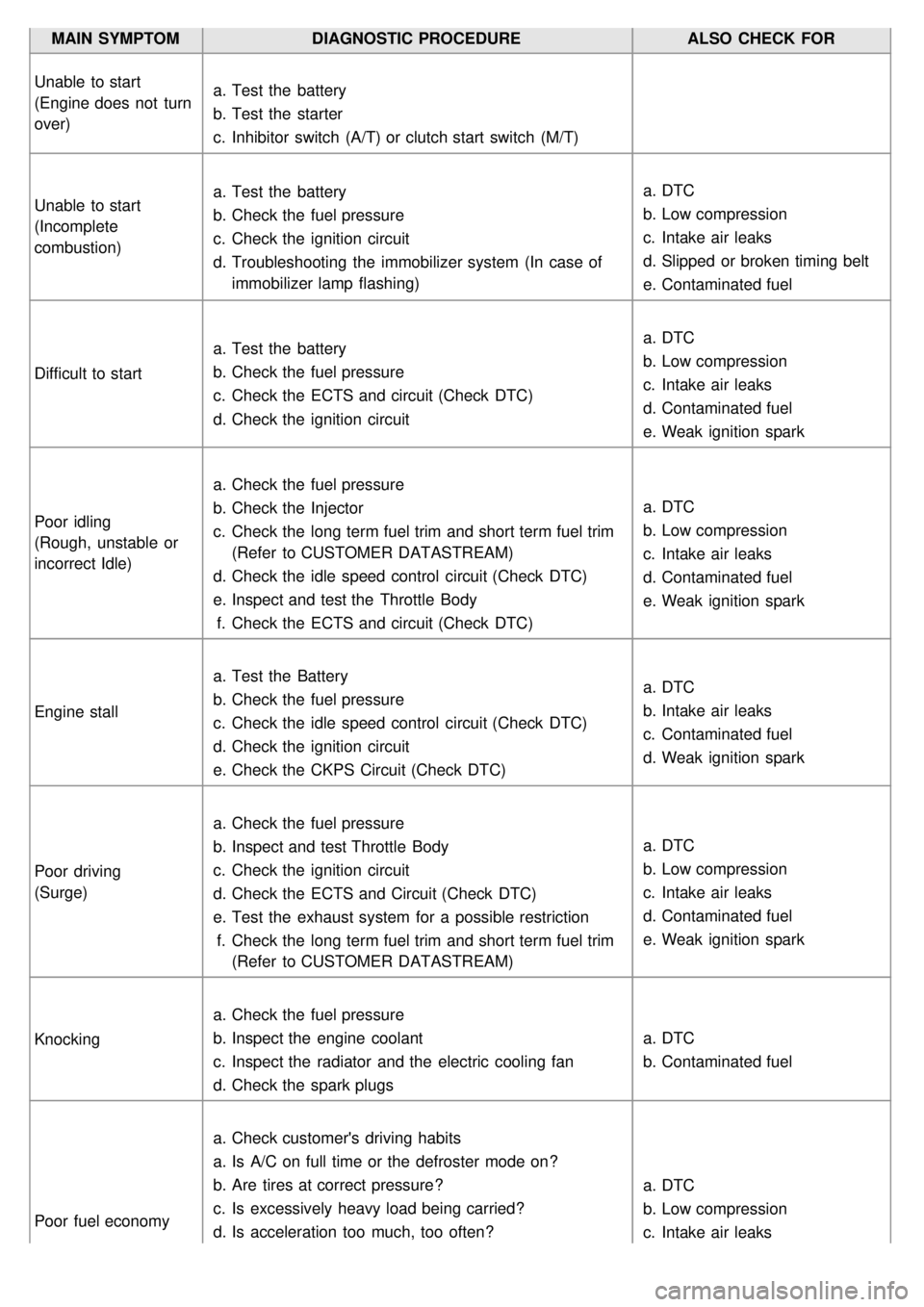
MAIN SYMPTOMDIAGNOSTIC PROCEDURE ALSO CHECK FOR
Unable to start
(Engine does not turn
over) a.
Test the battery
b. Test the starter
c. Inhibitor switch (A/T) or clutch start switch (M/T)
Unable to start
(Incomplete
combustion) a.
Test the battery
b. Check the fuel pressure
c. Check the ignition circuit
d. Troubleshooting the immobilizer system (In case of
immobilizer lamp flashing) a.
DTC
b. Low compression
c. Intake air leaks
d. Slipped or broken timing belt
e. Contaminated fuel
Difficult to start a.
Test the battery
b. Check the fuel pressure
c. Check the ECTS and circuit (Check DTC)
d. Check the ignition circuit a.
DTC
b. Low compression
c. Intake air leaks
d. Contaminated fuel
e. Weak ignition spark
Poor idling
(Rough, unstable or
incorrect Idle) a.
Check the fuel pressure
b. Check the Injector
c. Check the long term fuel trim and short term fuel trim
(Refer to CUSTOMER DATASTREAM)
d. Check the idle speed control circuit (Check DTC)
e. Inspect and test the Throttle Body
f. Check the ECTS and circuit (Check DTC) a.
DTC
b. Low compression
c. Intake air leaks
d. Contaminated fuel
e. Weak ignition spark
Engine stall a.
Test the Battery
b. Check the fuel pressure
c. Check the idle speed control circuit (Check DTC)
d. Check the ignition circuit
e. Check the CKPS Circuit (Check DTC) a.
DTC
b. Intake air leaks
c. Contaminated fuel
d. Weak ignition spark
Poor driving
(Surge) a.
Check the fuel pressure
b. Inspect and test Throttle Body
c. Check the ignition circuit
d. Check the ECTS and Circuit (Check DTC)
e. Test the exhaust system for a possible restriction
f. Check the long term fuel trim and short term fuel trim
(Refer to CUSTOMER DATASTREAM) a.
DTC
b. Low compression
c. Intake air leaks
d. Contaminated fuel
e. Weak ignition spark
Knocking a.
Check the fuel pressure
b. Inspect the engine coolant
c. Inspect the radiator and the electric cooling fan
d. Check the spark plugs a.
DTC
b. Contaminated fuel
Poor fuel economy a.
Check customer's driving habits
a. Is A/C on full time or the defroster mode on?
b. Are tires at correct pressure?
c. Is excessively heavy load being carried?
d. Is acceleration too much, too often? a.
DTC
b. Low compression
c. Intake air leaks
Page 231 of 1575
b.Check the fuel pressure
c. Check the injector
d. Test the exhaust system for a possible restriction
e. Check the ECTS and circuit d.
Contaminated fuel
e. Weak ignition spark
Hard to refuel
(Overflow during
refueling) a.
Test the canister close valve
b. Inspect the fuel filler hose/pipe
a. Pinched, kinked or blocked?
b. Filler hose is torn
c. Inspect the fuel tank vapor vent hose between the
EVAP. canister and air filter
d. Check the EVAP. canister a.
Malfunctioning gas station
filling nozzle (If this problem
occurs at a specific gas
station during refueling)
Page 232 of 1575
2007 > 2.7L V6 GASOLINE >
SPECIFICATIONS
FUEL DELIVERY SYSTEM
Items Specification
Fuel Tank Capacity80 lit. (21.1 U.S.gal., 17.6 Imp.gal.)
Fuel Filter (built in Fuel Pump
assembly) Type
High pressure type
Fuel Pressure Regulator (built in
Fuel Pump assembly) Regulated Fuel
Pressure 375 ~ 385 kPa(3.82 ~ 3.92 kgf/cm², 54.3 ~ 55.8 psi)
Fuel Pump Type
Electrical, in - tank type
Driven by Electric motor
SENSORS
MASS AIR FLOW SENSOR (MAFS)
�J Type: Hot - film type
�J Specification
Air Flow (kg/h) Frequency (Hz)
12.6 kg/h 2,617Hz
18.0 kg/h 2,958Hz
23.4 kg/h 3,241Hz
32.4 kg/h 3,653Hz
43.2 kg/h 4,024Hz
57.6 kg/h 4,399Hz
72.0 kg/h 4,704Hz
108.0 kg/h 5,329Hz
144.0 kg/h 5,897Hz
198.0 kg/h 6,553Hz
270.0 kg/h 7,240Hz
360.0 kg/h 7,957Hz
486.0 kg/h 8,738Hz
666.0 kg/h 9,644Hz
900.0 kg/h 10,590Hz
INTAKE AIR TEMPERATURE SENSOR (IATS)
�J Type: Thermistor type
�J Specification Temperature Resistance (kΩ)
°C °F
- 40 - 40100.87
- 20 -428.58
0 329.40
10 505.66
Page 237 of 1575
Heated oxygen sensor (Bank 2 / Sensor 2) installation3.5 ~ 4.534.3 ~ 44.1 25.3 ~ 32.6
Ignition coil installation bolt 1.0 ~ 1.29.8 ~ 11.8 7.2 ~ 8.7
Knock sensor [Bank 1] installation 1.9 ~ 2.418.6 ~ 23.5 13.7 ~ 17.4
Knock sensor [Bank 2] installation 1.9 ~ 2.418.6 ~ 23.5 13.7 ~ 17.4
Manifold absolute pressure sensor installation bolt 0.8 ~ 1.27.8 ~ 11.8 5.8 ~ 8.7
FUEL DELIVERY SYSTEM Item kgf·mN·mIbf·ft
Fuel tank band mounting nuts 4.0 ~ 5.539.2 ~ 53.9 28.9 ~ 39.8
Fuel pump assembly mounting bolts 0.2 ~ 0.32.0 ~ 2.91.4 ~ 2.2
Delivery pipe installation bolts 0.9 ~ 1.48.8 ~ 13.7 6.5 ~ 10.1
Accelerator pedal module installation bolts 1.3 ~ 1.612.8 ~ 15.7 9.4 ~ 11.6
Page 239 of 1575
2007 > 2.7L V6 GASOLINE >
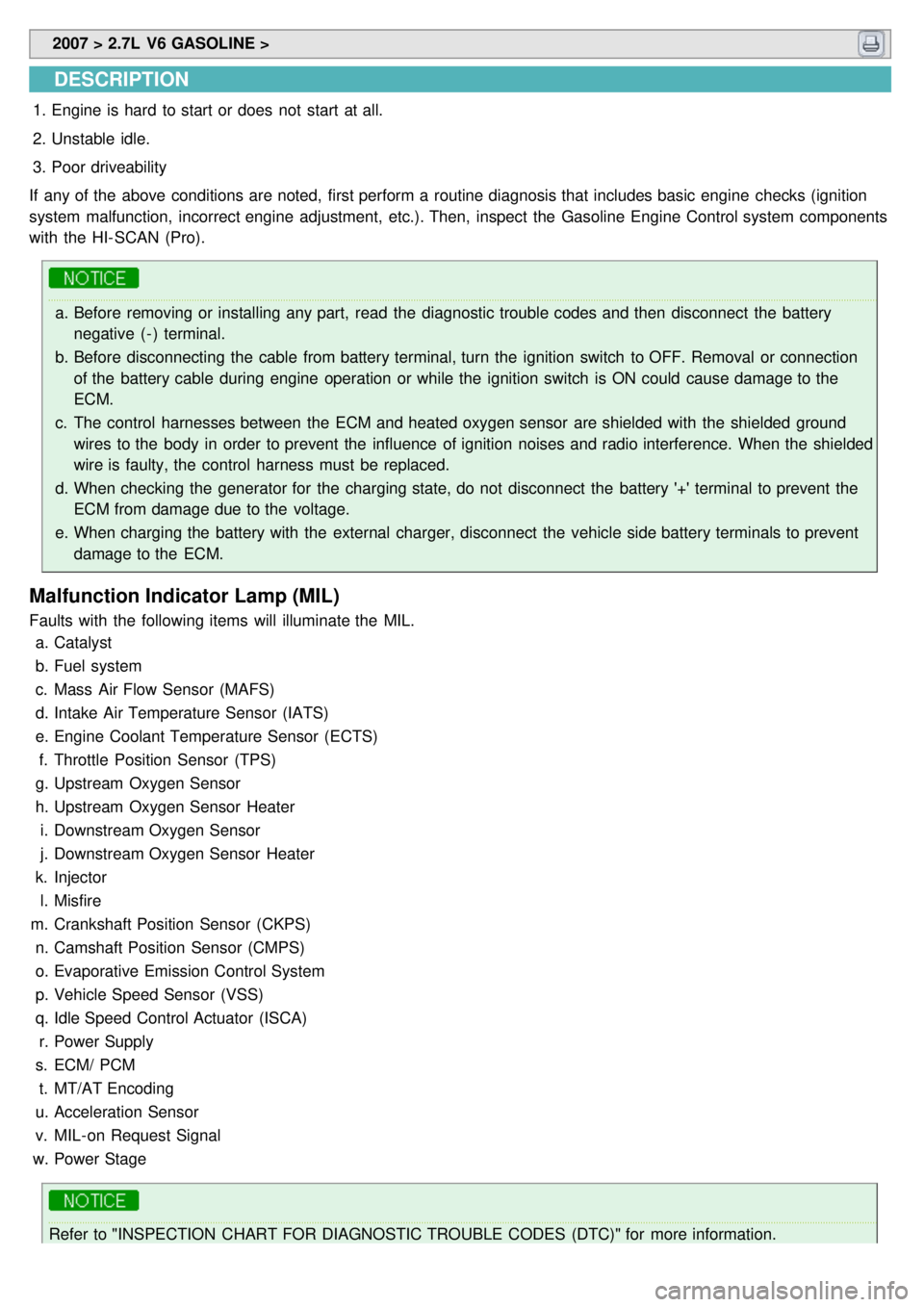
DESCRIPTION
1.Engine is hard to start or does not start at all.
2. Unstable idle.
3. Poor driveability
If any of the above conditions are noted, first perform a routine diagnosis that includes basic engine checks (ignition
system malfunction, incorrect engine adjustment, etc.). Then, inspect the Gasoline Engine Control system components
with the HI- SCAN (Pro).
a. Before removing or installing any part, read the diagnostic trouble codes and then disconnect the battery
negative ( - ) terminal.
b. Before disconnecting the cable from battery terminal, turn the ignition switch to OFF. Removal or connection
of the battery cable during engine operation or while the ignition switch is ON could cause damage to the
ECM.
c. The control harnesses between the ECM and heated oxygen sensor are shielded with the shielded ground
wires to the body in order to prevent the influence of ignition noises and radio interference. When the shielded
wire is faulty, the control harness must be replaced.
d. When checking the generator for the charging state, do not disconnect the battery '+' terminal to prevent the
ECM from damage due to the voltage.
e. When charging the battery with the external charger, disconnect the vehicle side battery terminals to prevent
damage to the ECM.
Malfunction Indicator Lamp (MIL)
Faults with the following items will illuminate the MIL.
a. Catalyst
b. Fuel system
c. Mass Air Flow Sensor (MAFS)
d. Intake Air Temperature Sensor (IATS)
e. Engine Coolant Temperature Sensor (ECTS)
f. Throttle Position Sensor (TPS)
g. Upstream Oxygen Sensor
h. Upstream Oxygen Sensor Heater
i. Downstream Oxygen Sensor
j. Downstream Oxygen Sensor Heater
k. Injector
l. Misfire
m. Crankshaft Position Sensor (CKPS)
n. Camshaft Position Sensor (CMPS)
o. Evaporative Emission Control System
p. Vehicle Speed Sensor (VSS)
q. Idle Speed Control Actuator (ISCA)
r. Power Supply
s. ECM/ PCM
t. MT/AT Encoding
u. Acceleration Sensor
v. MIL- on Request Signal
w. Power Stage
Refer to "INSPECTION CHART FOR DIAGNOSTIC TROUBLE CODES (DTC)" for more information.
Page 245 of 1575
23. Variable Intake Solenoid (VIS) #2 Valve (Intake
Manifold Side)24. Fuel Pump Relay
25. Main Relay
27. Wheel Speed Sensor (WSS)
28. Vehicle Speed Sensor (VSS)
31. A/C Pressure Transducer (APT)


![KIA CARNIVAL 2007 Workshop Manual Heated oxygen sensor (Bank 2 / Sensor 2) installation3.5 ~ 4.534.3 ~ 44.1 25.3 ~ 32.6
Ignition coil installation bolt 1.0 ~ 1.29.8 ~ 11.8 7.2 ~ 8.7
Knock sensor [Bank 1] installation 1.9](/manual-img/2/57045/w960_57045-236.png "KIA CARNIVAL 2007 Workshop Manual Heated oxygen sensor (Bank 2 / Sensor 2) installation3.5 ~ 4.534.3 ~ 44.1 25.3 ~ 32.6
Ignition coil installation bolt 1.0 ~ 1.29.8 ~ 11.8 7.2 ~ 8.7
Knock sensor [Bank 1] installation 1.9")
