2007 ISUZU KB P190 brake
[x] Cancel search: brakePage 1140 of 6020
6E-106 Engine Control System (4JH1)
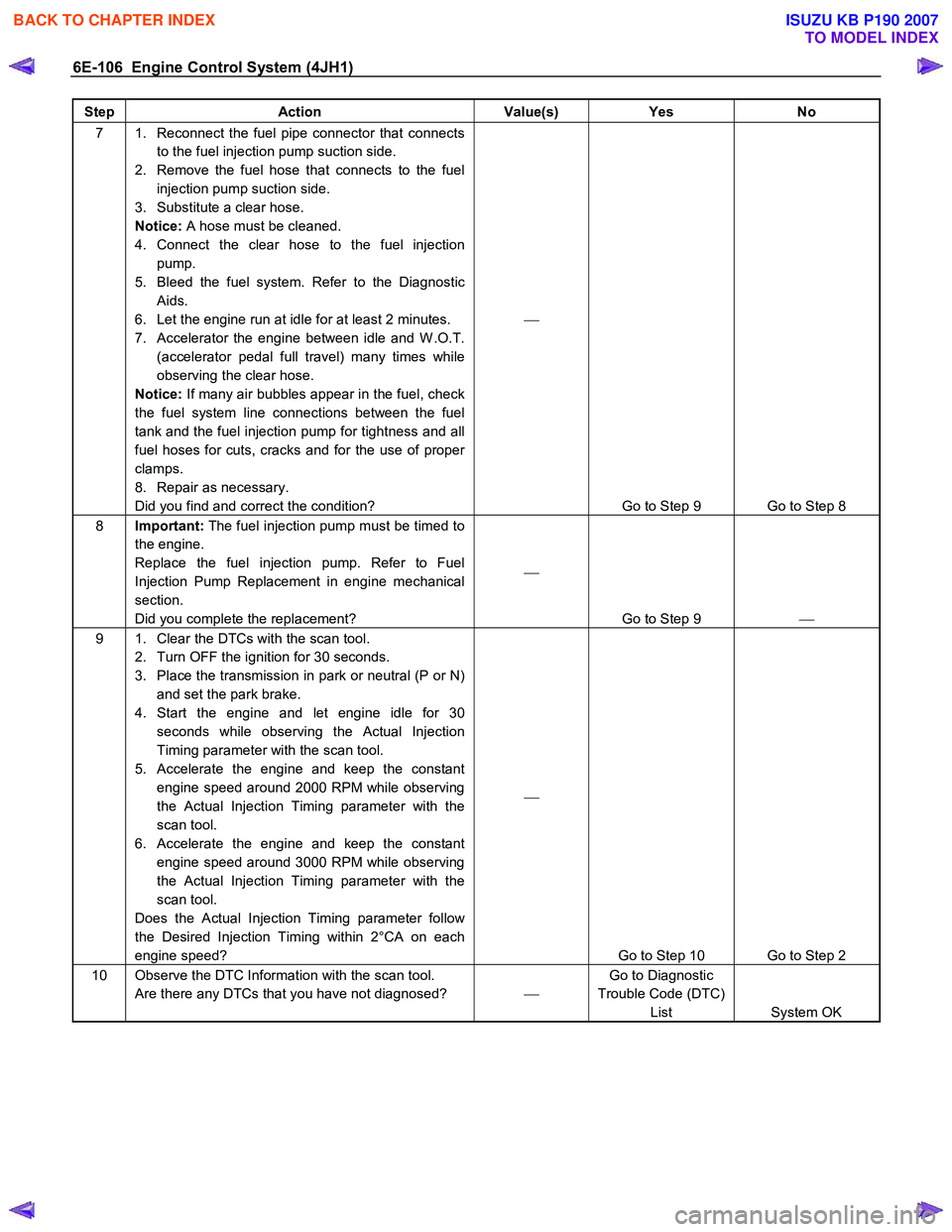
Step Action Value(s) Yes No
7 1. Reconnect the fuel pipe connector that connects
to the fuel injection pump suction side.
2. Remove the fuel hose that connects to the fuel injection pump suction side.
3. Substitute a clear hose.
Notice: A hose must be cleaned.
4. Connect the clear hose to the fuel injection pump.
5. Bleed the fuel system. Refer to the Diagnostic Aids.
6. Let the engine run at idle for at least 2 minutes.
7. Accelerator the engine between idle and W .O.T. (accelerator pedal full travel) many times while
observing the clear hose.
Notice: If many air bubbles appear in the fuel, check
the fuel system line connections between the fuel
tank and the fuel injection pump for tightness and all
fuel hoses for cuts, cracks and for the use of proper
clamps.
8. Repair as necessary.
Did you find and correct the condition?
Go to Step 9 Go to Step 8
8 Important: The fuel injection pump must be timed to
the engine.
Replace the fuel injection pump. Refer to Fuel
Injection Pump Replacement in engine mechanical
section.
Did you complete the replacement?
Go to Step 9
9 1. Clear the DTCs with the scan tool.
2. Turn OFF the ignition for 30 seconds.
3. Place the transmission in park or neutral (P or N) and set the park brake.
4. Start the engine and let engine idle for 30 seconds while observing the Actual Injection
Timing parameter with the scan tool.
5. Accelerate the engine and keep the constant engine speed around 2000 RPM while observing
the Actual Injection Timing parameter with the
scan tool.
6. Accelerate the engine and keep the constant engine speed around 3000 RPM while observing
the Actual Injection Timing parameter with the
scan tool.
Does the Actual Injection Timing parameter follow
the Desired Injection Timing within 2°CA on each
engine speed?
Go to Step 10 Go to Step 2
10 Observe the DTC Information with the scan tool. Are there any DTCs that you have not diagnosed? Go to Diagnostic
Trouble Code (DTC) List System OK
BACK TO CHAPTER INDEX
TO MODEL INDEX
ISUZU KB P190 2007
Page 1215 of 6020
Engine Control System (4JH1) 6E-181
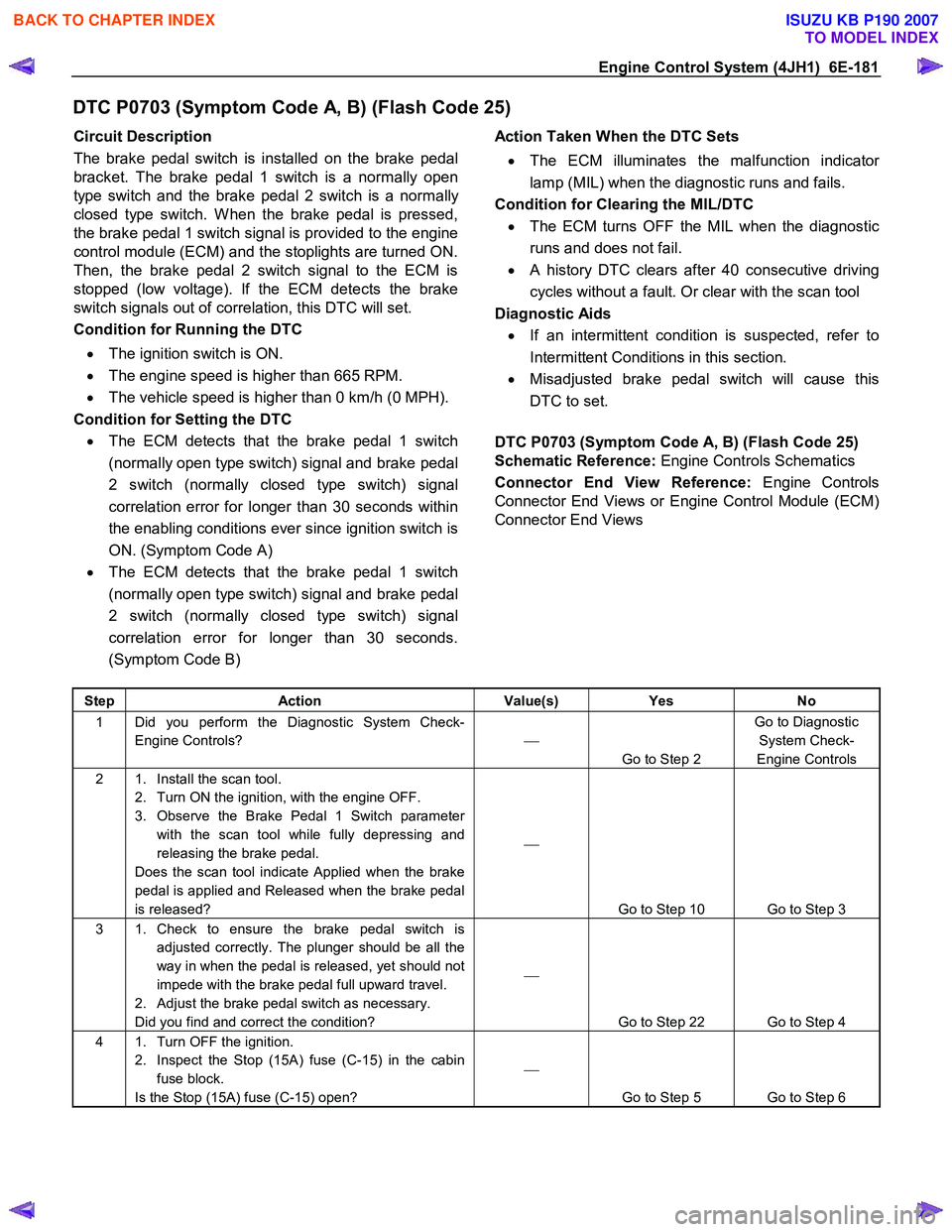
DTC P0703 (Symptom Code A, B) (Flash Code 25)
Circuit Description
The brake pedal switch is installed on the brake pedal
bracket. The brake pedal 1 switch is a normally open
type switch and the brake pedal 2 switch is a normally
closed type switch. W hen the brake pedal is pressed,
the brake pedal 1 switch signal is provided to the engine
control module (ECM) and the stoplights are turned ON.
Then, the brake pedal 2 switch signal to the ECM is
stopped (low voltage). If the ECM detects the brake
switch signals out of correlation, this DTC will set.
Condition for Running the DTC
• The ignition switch is ON.
• The engine speed is higher than 665 RPM.
• The vehicle speed is higher than 0 km/h (0 MPH).
Condition for Setting the DTC • The ECM detects that the brake pedal 1 switch
(normally open type switch) signal and brake pedal
2 switch (normally closed type switch) signal
correlation error for longer than 30 seconds within
the enabling conditions ever since ignition switch is
ON. (Symptom Code A)
• The ECM detects that the brake pedal 1 switch
(normally open type switch) signal and brake pedal
2 switch (normally closed type switch) signal
correlation error for longer than 30 seconds.
(Symptom Code B)
Action Taken When the DTC Sets
• The ECM illuminates the malfunction indicato
r
lamp (MIL) when the diagnostic runs and fails.
Condition for Clearing the MIL/DTC • The ECM turns OFF the MIL when the diagnostic
runs and does not fail.
• A history DTC clears after 40 consecutive driving
cycles without a fault. Or clear with the scan tool
Diagnostic Aids • If an intermittent condition is suspected, refer to
Intermittent Conditions in this section.
• Misadjusted brake pedal switch will cause this
DTC to set.
DTC P0703 (Symptom Code A, B) (Flash Code 25)
Schematic Reference: Engine Controls Schematics
Connector End View Reference: Engine Controls
Connector End Views or Engine Control Module (ECM)
Connector End Views
Step Action Value(s) Yes No
1 Did you perform the Diagnostic System Check-
Engine Controls?
Go to Step 2 Go to Diagnostic
System Check-
Engine Controls
2 1. Install the scan tool. 2. Turn ON the ignition, with the engine OFF.
3. Observe the Brake Pedal 1 Switch parameter with the scan tool while fully depressing and
releasing the brake pedal.
Does the scan tool indicate Applied when the brake
pedal is applied and Released when the brake pedal
is released?
Go to Step 10 Go to Step 3
3 1. Check to ensure the brake pedal switch is adjusted correctly. The plunger should be all the
way in when the pedal is released, yet should not
impede with the brake pedal full upward travel.
2. Adjust the brake pedal switch as necessary.
Did you find and correct the condition?
Go to Step 22 Go to Step 4
4 1. Turn OFF the ignition. 2. Inspect the Stop (15A) fuse (C-15) in the cabin fuse block.
Is the Stop (15A) fuse (C-15) open?
Go to Step 5 Go to Step 6
BACK TO CHAPTER INDEX
TO MODEL INDEX
ISUZU KB P190 2007
Page 1216 of 6020
6E-182 Engine Control System (4JH1)
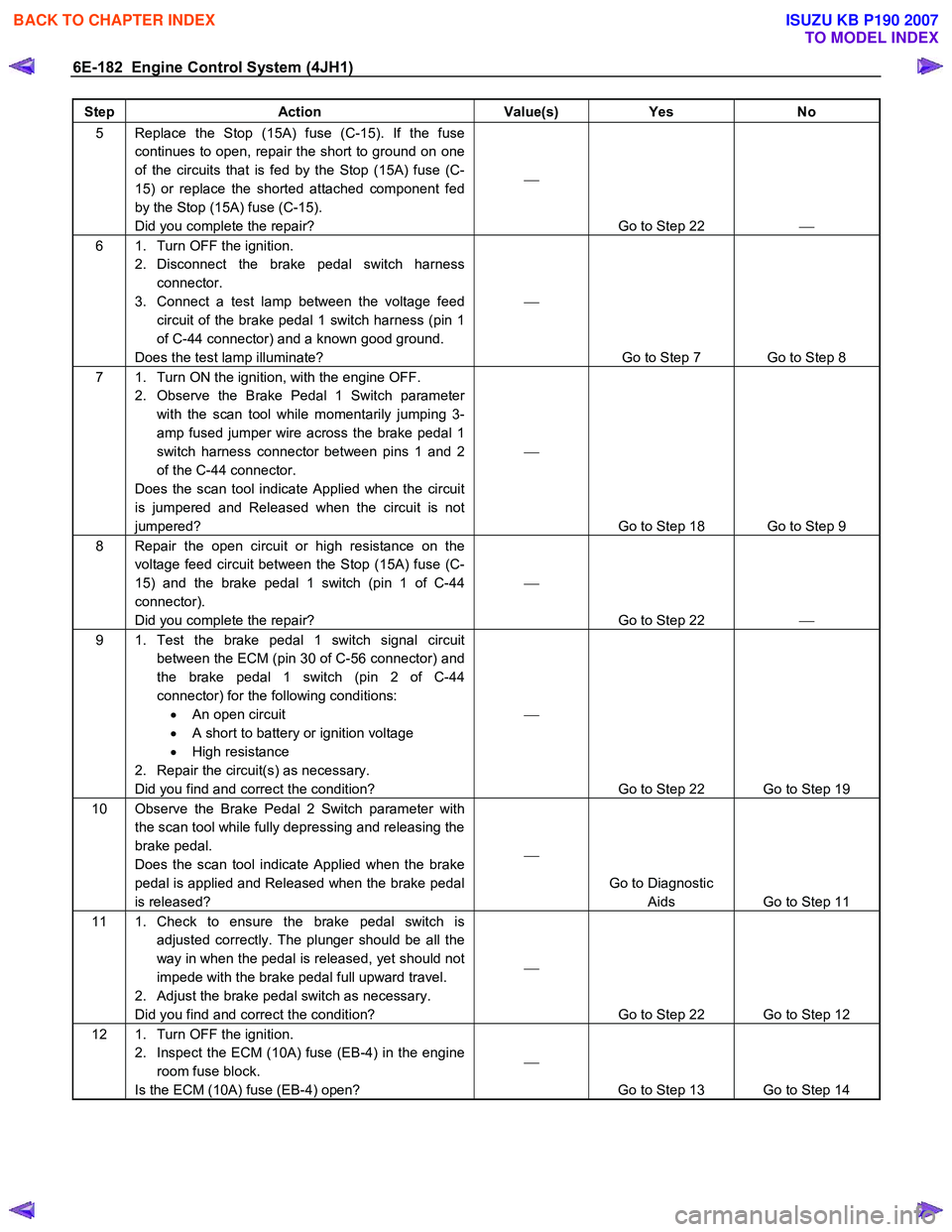
Step Action Value(s) Yes No
5 Replace the Stop (15A) fuse (C-15). If the fuse
continues to open, repair the short to ground on one
of the circuits that is fed by the Stop (15A) fuse (C-
15) or replace the shorted attached component fed
by the Stop (15A) fuse (C-15).
Did you complete the repair?
Go to Step 22
6 1. Turn OFF the ignition.
2. Disconnect the brake pedal switch harness connector.
3. Connect a test lamp between the voltage feed circuit of the brake pedal 1 switch harness (pin 1
of C-44 connector) and a known good ground.
Does the test lamp illuminate?
Go to Step 7 Go to Step 8
7 1. Turn ON the ignition, with the engine OFF. 2. Observe the Brake Pedal 1 Switch parameter with the scan tool while momentarily jumping 3-
amp fused jumper wire across the brake pedal 1
switch harness connector between pins 1 and 2
of the C-44 connector.
Does the scan tool indicate Applied when the circuit
is jumpered and Released when the circuit is not
jumpered?
Go to Step 18 Go to Step 9
8 Repair the open circuit or high resistance on the voltage feed circuit between the Stop (15A) fuse (C-
15) and the brake pedal 1 switch (pin 1 of C-44
connector).
Did you complete the repair?
Go to Step 22
9 1. Test the brake pedal 1 switch signal circuit
between the ECM (pin 30 of C-56 connector) and
the brake pedal 1 switch (pin 2 of C-44
connector) for the following conditions: • An open circuit
• A short to battery or ignition voltage
• High resistance
2. Repair the circuit(s) as necessary.
Did you find and correct the condition?
Go to Step 22 Go to Step 19
10 Observe the Brake Pedal 2 Switch parameter with the scan tool while fully depressing and releasing the
brake pedal.
Does the scan tool indicate Applied when the brake
pedal is applied and Released when the brake pedal
is released?
Go to Diagnostic Aids Go to Step 11
11 1. Check to ensure the brake pedal switch is
adjusted correctly. The plunger should be all the
way in when the pedal is released, yet should not
impede with the brake pedal full upward travel.
2. Adjust the brake pedal switch as necessary.
Did you find and correct the condition?
Go to Step 22 Go to Step 12
12 1. Turn OFF the ignition. 2. Inspect the ECM (10A) fuse (EB-4) in the engine room fuse block.
Is the ECM (10A) fuse (EB-4) open?
Go to Step 13 Go to Step 14
BACK TO CHAPTER INDEX
TO MODEL INDEX
ISUZU KB P190 2007
Page 1217 of 6020
Engine Control System (4JH1) 6E-183
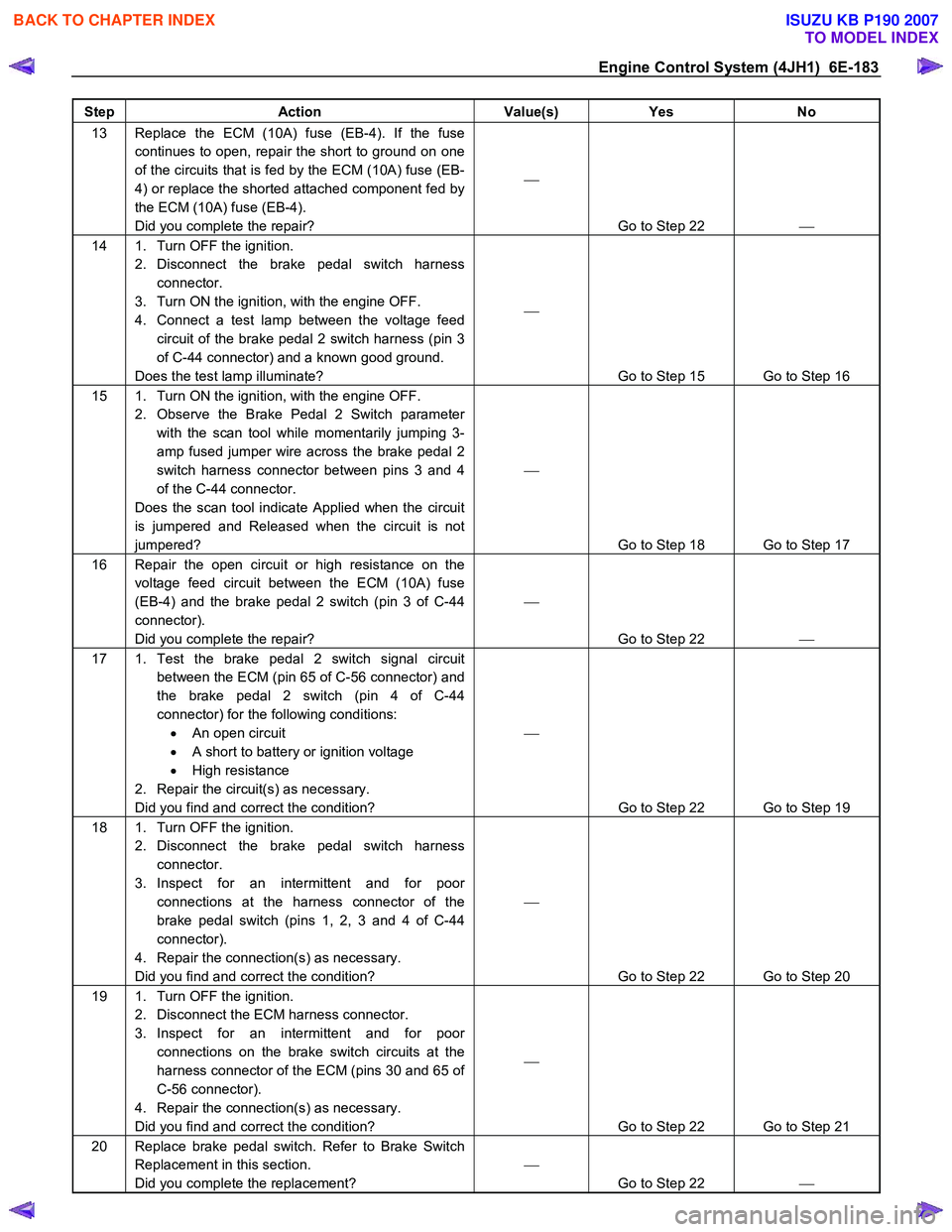
Step Action Value(s) Yes No
13 Replace the ECM (10A) fuse (EB-4). If the fuse
continues to open, repair the short to ground on one
of the circuits that is fed by the ECM (10A) fuse (EB-
4) or replace the shorted attached component fed by
the ECM (10A) fuse (EB-4).
Did you complete the repair?
Go to Step 22
14 1. Turn OFF the ignition.
2. Disconnect the brake pedal switch harness connector.
3. Turn ON the ignition, with the engine OFF.
4. Connect a test lamp between the voltage feed circuit of the brake pedal 2 switch harness (pin 3
of C-44 connector) and a known good ground.
Does the test lamp illuminate?
Go to Step 15 Go to Step 16
15 1. Turn ON the ignition, with the engine OFF. 2. Observe the Brake Pedal 2 Switch parameter with the scan tool while momentarily jumping 3-
amp fused jumper wire across the brake pedal 2
switch harness connector between pins 3 and 4
of the C-44 connector.
Does the scan tool indicate Applied when the circuit
is jumpered and Released when the circuit is not
jumpered?
Go to Step 18 Go to Step 17
16 Repair the open circuit or high resistance on the voltage feed circuit between the ECM (10A) fuse
(EB-4) and the brake pedal 2 switch (pin 3 of C-44
connector).
Did you complete the repair?
Go to Step 22
17 1. Test the brake pedal 2 switch signal circuit
between the ECM (pin 65 of C-56 connector) and
the brake pedal 2 switch (pin 4 of C-44
connector) for the following conditions: • An open circuit
• A short to battery or ignition voltage
• High resistance
2. Repair the circuit(s) as necessary.
Did you find and correct the condition?
Go to Step 22 Go to Step 19
18 1. Turn OFF the ignition. 2. Disconnect the brake pedal switch harness connector.
3. Inspect for an intermittent and for poor connections at the harness connector of the
brake pedal switch (pins 1, 2, 3 and 4 of C-44
connector).
4. Repair the connection(s) as necessary.
Did you find and correct the condition?
Go to Step 22 Go to Step 20
19 1. Turn OFF the ignition. 2. Disconnect the ECM harness connector.
3. Inspect for an intermittent and for poor connections on the brake switch circuits at the
harness connector of the ECM (pins 30 and 65 of
C-56 connector).
4. Repair the connection(s) as necessary.
Did you find and correct the condition?
Go to Step 22 Go to Step 21
20 Replace brake pedal switch. Refer to Brake Switch Replacement in this section.
Did you complete the replacement?
Go to Step 22
BACK TO CHAPTER INDEX
TO MODEL INDEX
ISUZU KB P190 2007
Page 1218 of 6020
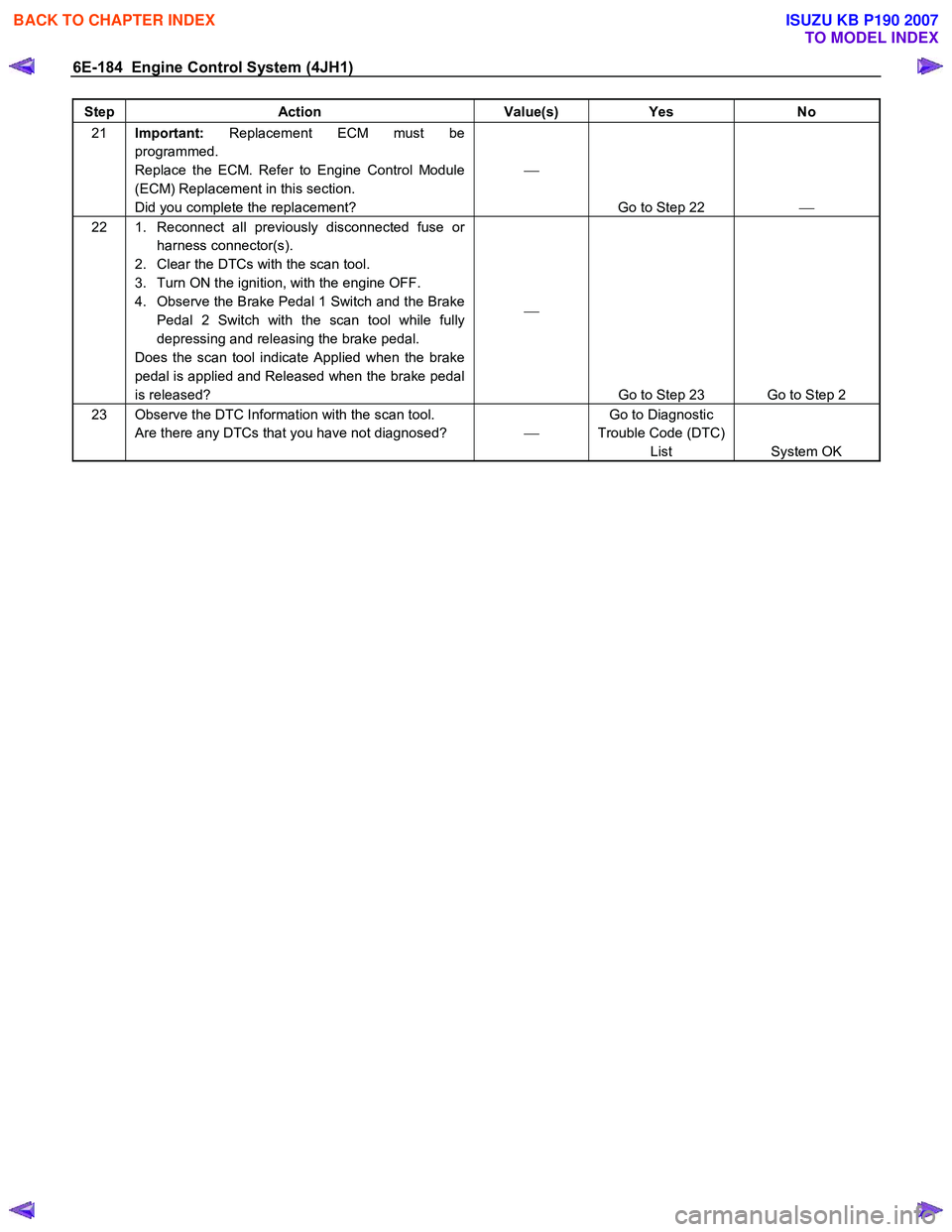
6E-184 Engine Control System (4JH1)
Step Action Value(s) Yes No
21 Important: Replacement ECM must be
programmed.
Replace the ECM. Refer to Engine Control Module
(ECM) Replacement in this section.
Did you complete the replacement?
Go to Step 22
22 1. Reconnect all previously disconnected fuse or
harness connector(s).
2. Clear the DTCs with the scan tool.
3. Turn ON the ignition, with the engine OFF.
4. Observe the Brake Pedal 1 Switch and the Brake Pedal 2 Switch with the scan tool while fully
depressing and releasing the brake pedal.
Does the scan tool indicate Applied when the brake
pedal is applied and Released when the brake pedal
is released?
Go to Step 23 Go to Step 2
23 Observe the DTC Information with the scan tool. Are there any DTCs that you have not diagnosed? Go to Diagnostic
Trouble Code (DTC) List System OK
BACK TO CHAPTER INDEX
TO MODEL INDEX
ISUZU KB P190 2007
Page 1231 of 6020
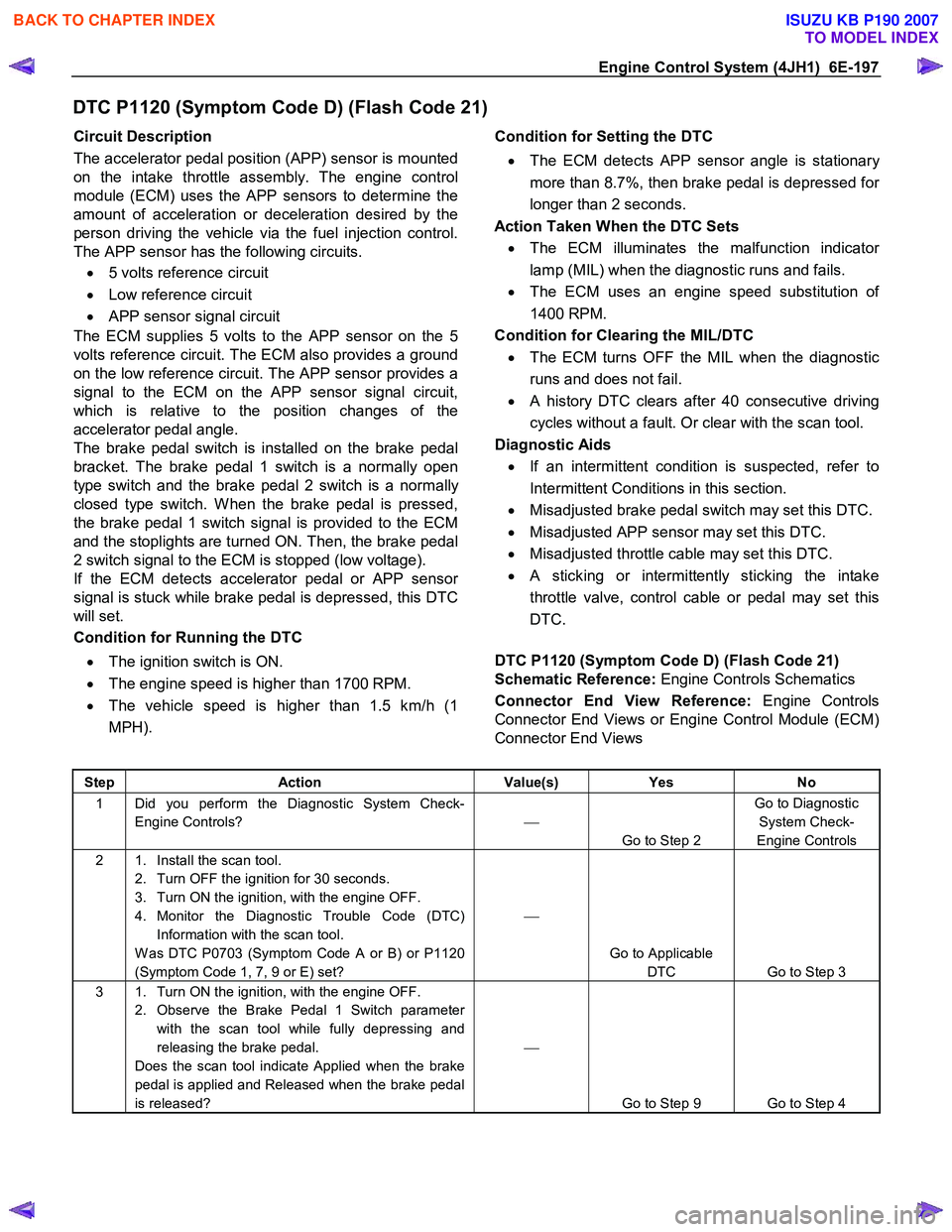
Engine Control System (4JH1) 6E-197
DTC P1120 (Symptom Code D) (Flash Code 21)
Circuit Description
The accelerator pedal position (APP) sensor is mounted
on the intake throttle assembly. The engine control
module (ECM) uses the APP sensors to determine the
amount of acceleration or deceleration desired by the
person driving the vehicle via the fuel injection control.
The APP sensor has the following circuits.
• 5 volts reference circuit
• Low reference circuit
• APP sensor signal circuit
The ECM supplies 5 volts to the APP sensor on the 5
volts reference circuit. The ECM also provides a ground
on the low reference circuit. The APP sensor provides a
signal to the ECM on the APP sensor signal circuit,
which is relative to the position changes of the
accelerator pedal angle.
The brake pedal switch is installed on the brake pedal
bracket. The brake pedal 1 switch is a normally open
type switch and the brake pedal 2 switch is a normally
closed type switch. W hen the brake pedal is pressed,
the brake pedal 1 switch signal is provided to the ECM
and the stoplights are turned ON. Then, the brake pedal
2 switch signal to the ECM is stopped (low voltage).
If the ECM detects accelerator pedal or APP senso
r
signal is stuck while brake pedal is depressed, this DTC
will set.
Condition for Running the DTC
• The ignition switch is ON.
• The engine speed is higher than 1700 RPM.
• The vehicle speed is higher than 1.5 km/h (1
MPH).
Condition for Setting the DTC
• The ECM detects APP sensor angle is stationar
y
more than 8.7%, then brake pedal is depressed fo
r
longer than 2 seconds.
Action Taken When the DTC Sets • The ECM illuminates the malfunction indicato
r
lamp (MIL) when the diagnostic runs and fails.
• The ECM uses an engine speed substitution o
f
1400 RPM.
Condition for Clearing the MIL/DTC • The ECM turns OFF the MIL when the diagnostic
runs and does not fail.
• A history DTC clears after 40 consecutive driving
cycles without a fault. Or clear with the scan tool.
Diagnostic Aids • If an intermittent condition is suspected, refer to
Intermittent Conditions in this section.
• Misadjusted brake pedal switch may set this DTC.
• Misadjusted APP sensor may set this DTC.
• Misadjusted throttle cable may set this DTC.
• A sticking or intermittently sticking the intake
throttle valve, control cable or pedal may set this
DTC.
DTC P1120 (Symptom Code D) (Flash Code 21)
Schematic Reference: Engine Controls Schematics
Connector End View Reference: Engine Controls
Connector End Views or Engine Control Module (ECM)
Connector End Views
Step Action Value(s) Yes No
1 Did you perform the Diagnostic System Check-
Engine Controls?
Go to Step 2 Go to Diagnostic
System Check-
Engine Controls
2 1. Install the scan tool. 2. Turn OFF the ignition for 30 seconds.
3. Turn ON the ignition, with the engine OFF.
4. Monitor the Diagnostic Trouble Code (DTC) Information with the scan tool.
W as DTC P0703 (Symptom Code A or B) or P1120
(Symptom Code 1, 7, 9 or E) set?
Go to Applicable DTC Go to Step 3
3 1. Turn ON the ignition, with the engine OFF. 2. Observe the Brake Pedal 1 Switch parameter with the scan tool while fully depressing and
releasing the brake pedal.
Does the scan tool indicate Applied when the brake
pedal is applied and Released when the brake pedal
is released?
Go to Step 9 Go to Step 4
BACK TO CHAPTER INDEX
TO MODEL INDEX
ISUZU KB P190 2007
Page 1232 of 6020
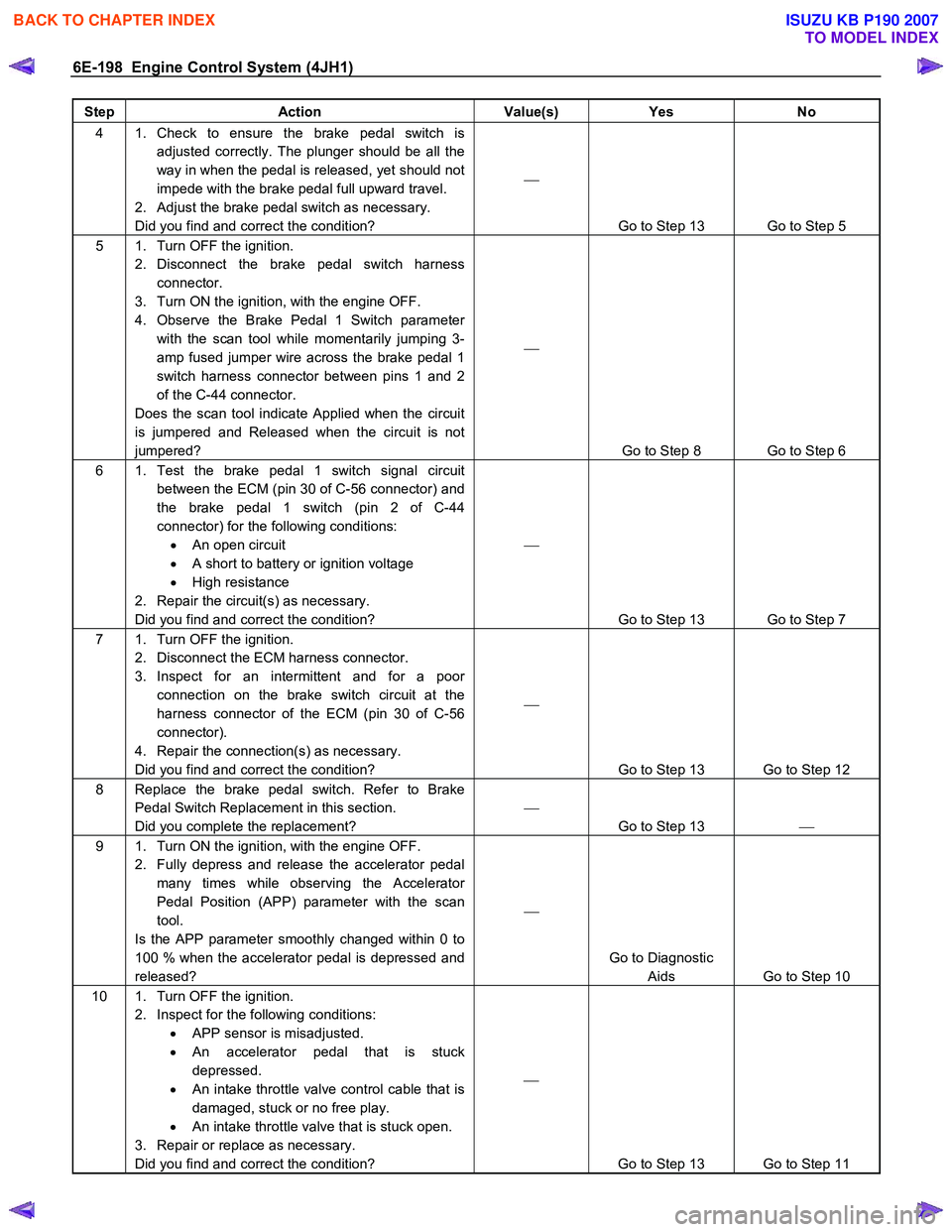
6E-198 Engine Control System (4JH1)
Step Action Value(s) Yes No
4 1. Check to ensure the brake pedal switch is
adjusted correctly. The plunger should be all the
way in when the pedal is released, yet should not
impede with the brake pedal full upward travel.
2. Adjust the brake pedal switch as necessary.
Did you find and correct the condition?
Go to Step 13 Go to Step 5
5 1. Turn OFF the ignition. 2. Disconnect the brake pedal switch harness connector.
3. Turn ON the ignition, with the engine OFF.
4. Observe the Brake Pedal 1 Switch parameter with the scan tool while momentarily jumping 3-
amp fused jumper wire across the brake pedal 1
switch harness connector between pins 1 and 2
of the C-44 connector.
Does the scan tool indicate Applied when the circuit
is jumpered and Released when the circuit is not
jumpered?
Go to Step 8 Go to Step 6
6 1. Test the brake pedal 1 switch signal circuit between the ECM (pin 30 of C-56 connector) and
the brake pedal 1 switch (pin 2 of C-44
connector) for the following conditions: • An open circuit
• A short to battery or ignition voltage
• High resistance
2. Repair the circuit(s) as necessary.
Did you find and correct the condition?
Go to Step 13 Go to Step 7
7 1. Turn OFF the ignition. 2. Disconnect the ECM harness connector.
3. Inspect for an intermittent and for a poor connection on the brake switch circuit at the
harness connector of the ECM (pin 30 of C-56
connector).
4. Repair the connection(s) as necessary.
Did you find and correct the condition?
Go to Step 13 Go to Step 12
8 Replace the brake pedal switch. Refer to Brake Pedal Switch Replacement in this section.
Did you complete the replacement?
Go to Step 13
9 1. Turn ON the ignition, with the engine OFF.
2. Fully depress and release the accelerator pedal many times while observing the Accelerator
Pedal Position (APP) parameter with the scan
tool.
Is the APP parameter smoothly changed within 0 to
100 % when the accelerator pedal is depressed and
released?
Go to Diagnostic Aids Go to Step 10
10 1. Turn OFF the ignition. 2. Inspect for the following conditions: • APP sensor is misadjusted.
• An accelerator pedal that is stuck
depressed.
• An intake throttle valve control cable that is
damaged, stuck or no free play.
• An intake throttle valve that is stuck open.
3. Repair or replace as necessary.
Did you find and correct the condition?
Go to Step 13 Go to Step 11
BACK TO CHAPTER INDEX
TO MODEL INDEX
ISUZU KB P190 2007
Page 1233 of 6020
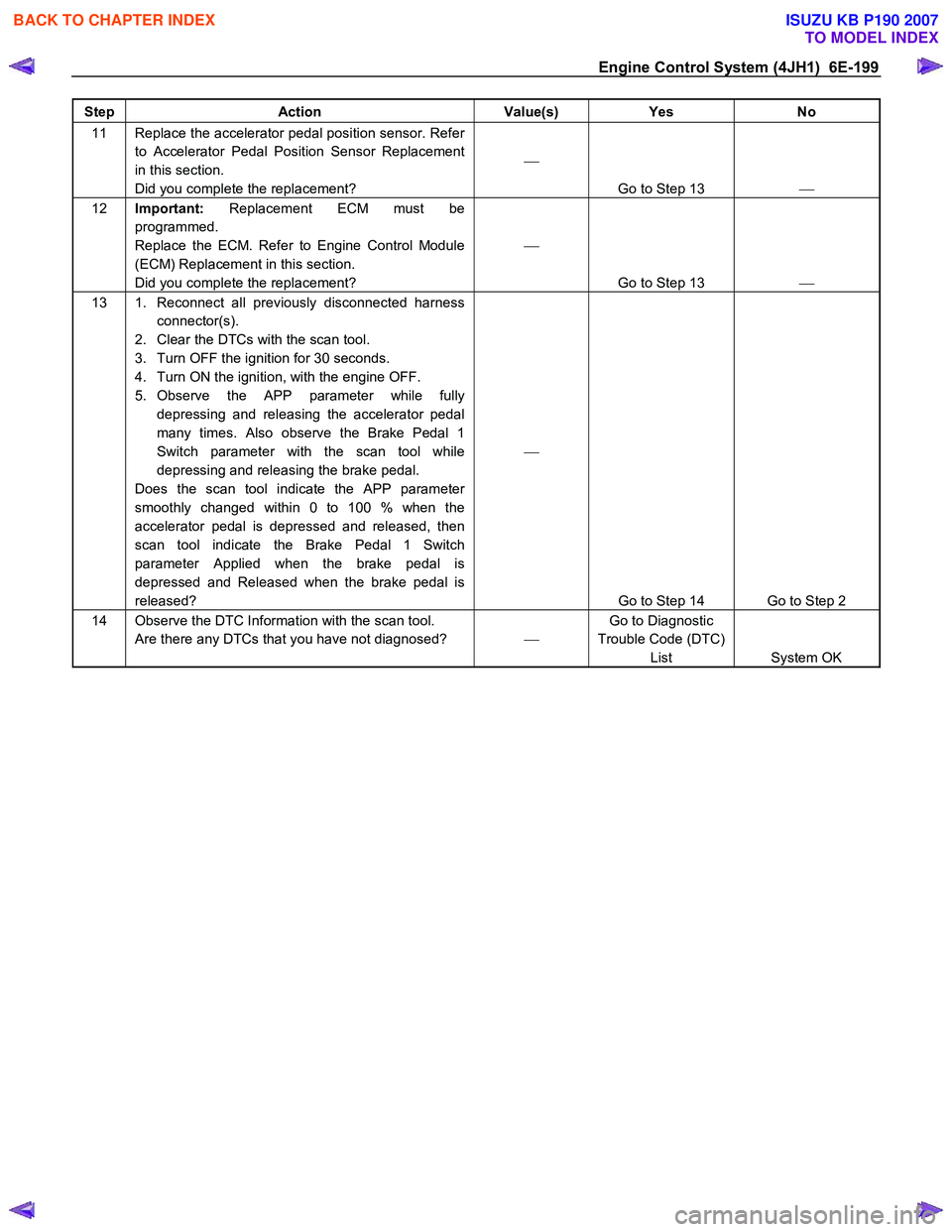
Engine Control System (4JH1) 6E-199
Step Action Value(s) Yes No
11 Replace the accelerator pedal position sensor. Refer
to Accelerator Pedal Position Sensor Replacement
in this section.
Did you complete the replacement?
Go to Step 13
12 Important: Replacement ECM must be
programmed.
Replace the ECM. Refer to Engine Control Module
(ECM) Replacement in this section.
Did you complete the replacement?
Go to Step 13
13 1. Reconnect all previously disconnected harness
connector(s).
2. Clear the DTCs with the scan tool.
3. Turn OFF the ignition for 30 seconds.
4. Turn ON the ignition, with the engine OFF.
5. Observe the APP parameter while fully depressing and releasing the accelerator pedal
many times. Also observe the Brake Pedal 1
Switch parameter with the scan tool while
depressing and releasing the brake pedal.
Does the scan tool indicate the APP parameter
smoothly changed within 0 to 100 % when the
accelerator pedal is depressed and released, then
scan tool indicate the Brake Pedal 1 Switch
parameter Applied when the brake pedal is
depressed and Released when the brake pedal is
released?
Go to Step 14 Go to Step 2
14 Observe the DTC Information with the scan tool. Are there any DTCs that you have not diagnosed? Go to Diagnostic
Trouble Code (DTC) List System OK
BACK TO CHAPTER INDEX
TO MODEL INDEX
ISUZU KB P190 2007