2007 ISUZU KB P190 brake
[x] Cancel search: brakePage 1072 of 6020
6E-38 Engine Control System (4JH1)
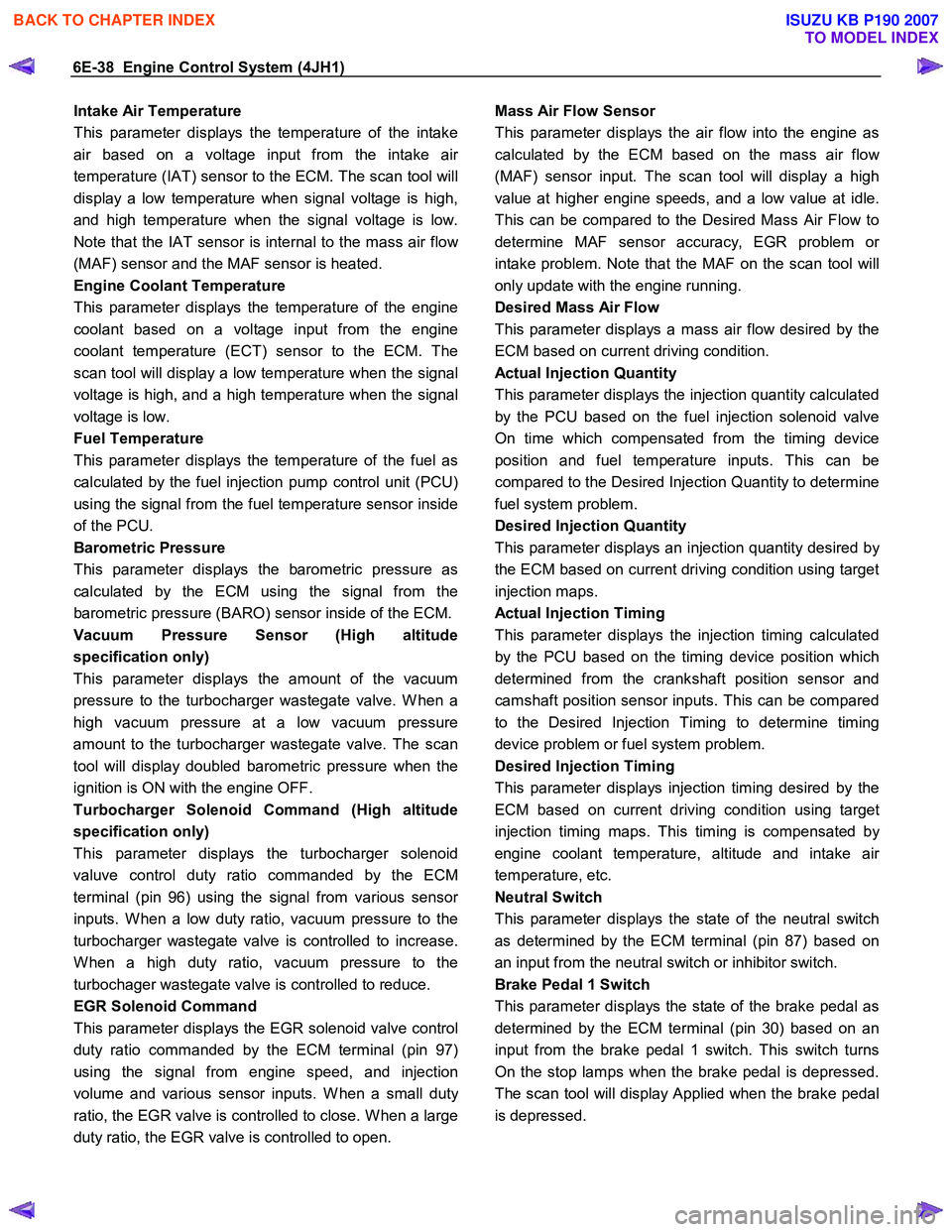
Intake Air Temperature
This parameter displays the temperature of the intake
air based on a voltage input from the intake ai
r
temperature (IAT) sensor to the ECM. The scan tool will
display a low temperature when signal voltage is high,
and high temperature when the signal voltage is low.
Note that the IAT sensor is internal to the mass air flo
w
(MAF) sensor and the MAF sensor is heated.
Engine Coolant Temperature
This parameter displays the temperature of the engine
coolant based on a voltage input from the engine
coolant temperature (ECT) sensor to the ECM. The
scan tool will display a low temperature when the signal
voltage is high, and a high temperature when the signal
voltage is low.
Fuel Temperature
This parameter displays the temperature of the fuel as
calculated by the fuel injection pump control unit (PCU)
using the signal from the fuel temperature sensor inside
of the PCU.
Barometric Pressure
This parameter displays the barometric pressure as
calculated by the ECM using the signal from the
barometric pressure (BARO) sensor inside of the ECM.
Vacuum Pressure Sensor (High altitude
specification only)
This parameter displays the amount of the vacuum
pressure to the turbocharger wastegate valve. W hen a
high vacuum pressure at a low vacuum pressure
amount to the turbocharger wastegate valve. The scan
tool will display doubled barometric pressure when the
ignition is ON with the engine OFF.
Turbocharger Solenoid Command (High altitude
specification only)
This parameter displays the turbocharger solenoid
valuve control duty ratio commanded by the ECM
terminal (pin 96) using the signal from various senso
r
inputs. W hen a low duty ratio, vacuum pressure to the
turbocharger wastegate valve is controlled to increase.
W hen a high duty ratio, vacuum pressure to the
turbochager wastegate valve is controlled to reduce.
EGR Solenoid Command
This parameter displays the EGR solenoid valve control
duty ratio commanded by the ECM terminal (pin 97)
using the signal from engine speed, and injection
volume and various sensor inputs. W hen a small dut
y
ratio, the EGR valve is controlled to close. W hen a large
duty ratio, the EGR valve is controlled to open.
Mass Air Flow Sensor
This parameter displays the air flow into the engine as
calculated by the ECM based on the mass air flo
w
(MAF) sensor input. The scan tool will display a high
value at higher engine speeds, and a low value at idle.
This can be compared to the Desired Mass Air Flow to
determine MAF sensor accuracy, EGR problem o
r
intake problem. Note that the MAF on the scan tool will
only update with the engine running.
Desired Mass Air Flow
This parameter displays a mass air flow desired by the
ECM based on current driving condition.
Actual Injection Quantity
This parameter displays the injection quantity calculated
by the PCU based on the fuel injection solenoid valve
On time which compensated from the timing device
position and fuel temperature inputs. This can be
compared to the Desired Injection Quantity to determine
fuel system problem.
Desired Injection Quantity
This parameter displays an injection quantity desired b
y
the ECM based on current driving condition using target
injection maps.
Actual Injection Timing
This parameter displays the injection timing calculated
by the PCU based on the timing device position which
determined from the crankshaft position sensor and
camshaft position sensor inputs. This can be compared
to the Desired Injection Timing to determine timing
device problem or fuel system problem.
Desired Injection Timing
This parameter displays injection timing desired by the
ECM based on current driving condition using target
injection timing maps. This timing is compensated b
y
engine coolant temperature, altitude and intake ai
r
temperature, etc.
Neutral Switch
This parameter displays the state of the neutral switch
as determined by the ECM terminal (pin 87) based on
an input from the neutral switch or inhibitor switch.
Brake Pedal 1 Switch
This parameter displays the state of the brake pedal as
determined by the ECM terminal (pin 30) based on an
input from the brake pedal 1 switch. This switch turns
On the stop lamps when the brake pedal is depressed.
The scan tool will display Applied when the brake pedal
is depressed.
BACK TO CHAPTER INDEX
TO MODEL INDEX
ISUZU KB P190 2007
Page 1073 of 6020
Engine Control System (4JH1) 6E-39
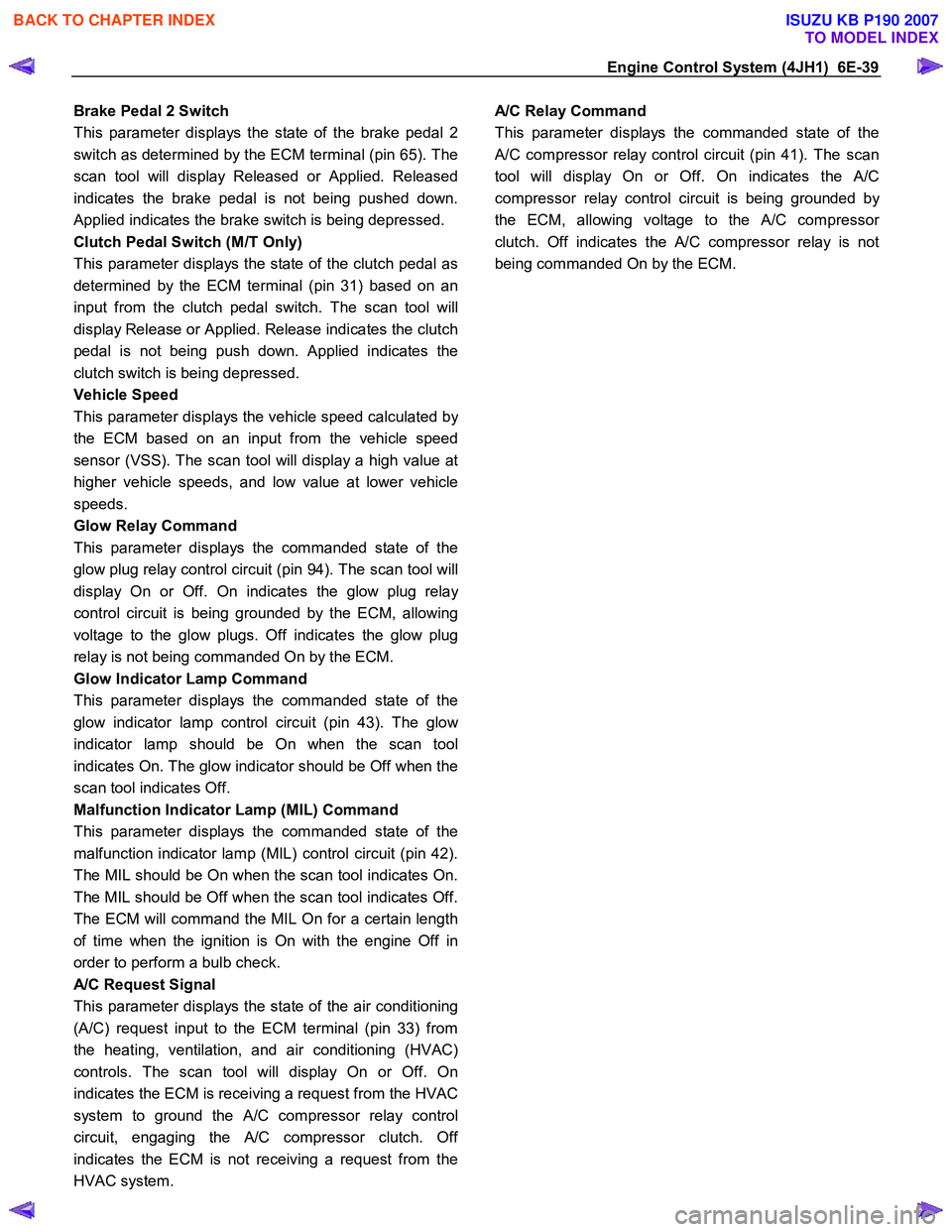
Brake Pedal 2 Switch
This parameter displays the state of the brake pedal 2
switch as determined by the ECM terminal (pin 65). The
scan tool will display Released or Applied. Released
indicates the brake pedal is not being pushed down.
Applied indicates the brake switch is being depressed.
Clutch Pedal Switch (M/T Only)
This parameter displays the state of the clutch pedal as
determined by the ECM terminal (pin 31) based on an
input from the clutch pedal switch. The scan tool will
display Release or Applied. Release indicates the clutch
pedal is not being push down. Applied indicates the
clutch switch is being depressed.
Vehicle Speed
This parameter displays the vehicle speed calculated b
y
the ECM based on an input from the vehicle speed
sensor (VSS). The scan tool will display a high value at
higher vehicle speeds, and low value at lower vehicle
speeds.
Glow Relay Command
This parameter displays the commanded state of the
glow plug relay control circuit (pin 94). The scan tool will
display On or Off. On indicates the glow plug rela
y
control circuit is being grounded by the ECM, allowing
voltage to the glow plugs. Off indicates the glow plug
relay is not being commanded On by the ECM.
Glow Indicator Lamp Command
This parameter displays the commanded state of the
glow indicator lamp control circuit (pin 43). The glo
w
indicator lamp should be On when the scan tool
indicates On. The glow indicator should be Off when the
scan tool indicates Off.
Malfunction Indicator Lamp (MIL) Command
This parameter displays the commanded state of the
malfunction indicator lamp (MIL) control circuit (pin 42).
The MIL should be On when the scan tool indicates On.
The MIL should be Off when the scan tool indicates Off.
The ECM will command the MIL On for a certain length
of time when the ignition is On with the engine Off in
order to perform a bulb check.
A/C Request Signal
This parameter displays the state of the air conditioning
(A/C) request input to the ECM terminal (pin 33) from
the heating, ventilation, and air conditioning (HVAC)
controls. The scan tool will display On or Off. On
indicates the ECM is receiving a request from the HVAC
system to ground the A/C compressor relay control
circuit, engaging the
A/C compressor clutch. Off
indicates the ECM is not receiving a request from the
HVAC system.
A/C Relay Command
This parameter displays the commanded state of the
A/C compressor relay control circuit (pin 41). The scan
tool will display On or Off. On indicates the
A/C
compressor relay control circuit is being grounded b
y
the ECM, allowing voltage to the A/C compressor
clutch. Off indicates the A/C compressor relay is not
being commanded On by the ECM.
BACK TO CHAPTER INDEX
TO MODEL INDEX
ISUZU KB P190 2007
Page 1076 of 6020
6E-42 Engine Control System (4JH1)
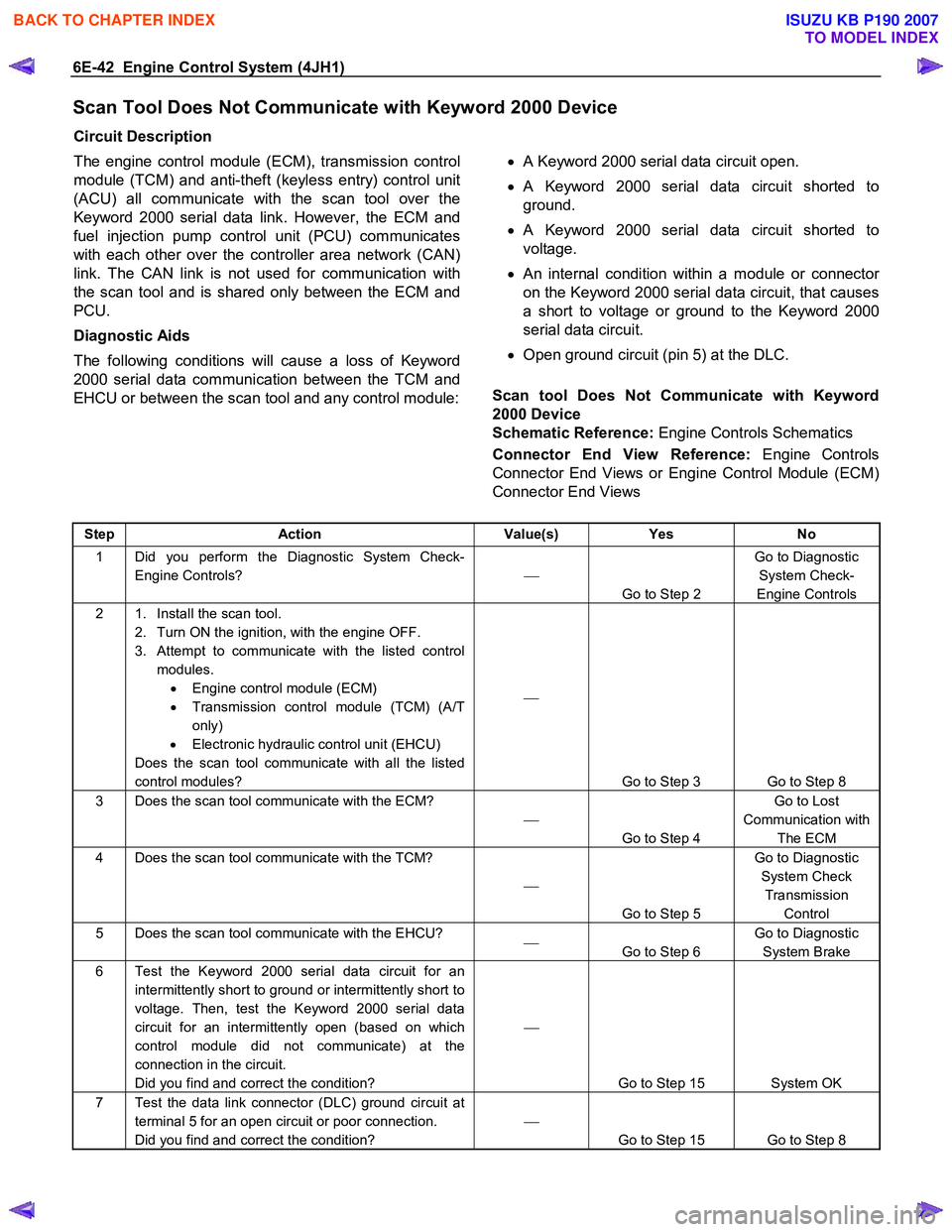
Scan Tool Does Not Communicate with Keyword 2000 Device
Circuit Description
The engine control module (ECM), transmission control
module (TCM) and anti-theft (keyless entry) control unit
(ACU) all communicate with the scan tool over the
Keyword 2000 serial data link. However, the ECM and
fuel injection pump control unit (PCU) communicates
with each other over the controller area network (CAN)
link. The CAN link is not used for communication with
the scan tool and is shared only between the ECM and
PCU.
Diagnostic Aids
The following conditions will cause a loss of Keyword
2000 serial data communication between the TCM and
EHCU or between the scan tool and any control module:
• A Keyword 2000 serial data circuit open.
• A Keyword 2000 serial data circuit shorted to
ground.
• A Keyword 2000 serial data circuit shorted to
voltage.
•
An internal condition within a module or connector
on the Keyword 2000 serial data circuit, that causes
a short to voltage or ground to the Keyword 2000
serial data circuit.
• Open ground circuit (pin 5) at the DLC.
Scan tool Does Not Communicate with Keyword
2000 Device
Schematic Reference: Engine Controls Schematics
Connector End View Reference: Engine Controls
Connector End Views or Engine Control Module (ECM)
Connector End Views
Step Action Value(s) Yes No
1 Did you perform the Diagnostic System Check-
Engine Controls?
Go to Step 2 Go to Diagnostic
System Check-
Engine Controls
2 1. Install the scan tool. 2. Turn ON the ignition, with the engine OFF.
3. Attempt to communicate with the listed control modules. • Engine control module (ECM)
• Transmission control module (TCM) (A/T
only)
• Electronic hydraulic control unit (EHCU)
Does the scan tool communicate with all the listed
control modules?
Go to Step 3 Go to Step 8
3 Does the scan tool communicate with the ECM?
Go to Step 4 Go to Lost
Communication with The ECM
4 Does the scan tool communicate with the TCM?
Go to Step 5 Go to Diagnostic
System Check Transmission Control
5 Does the scan tool communicate with the EHCU?
Go to Step 6 Go to Diagnostic
System Brake
6 Test the Keyword 2000 serial data circuit for an intermittently short to ground or intermittently short to
voltage. Then, test the Keyword 2000 serial data
circuit for an intermittently open (based on which
control module did not communicate) at the
connection in the circuit.
Did you find and correct the condition?
Go to Step 15 System OK
7 Test the data link connector (DLC) ground circuit at terminal 5 for an open circuit or poor connection.
Did you find and correct the condition?
Go to Step 15 Go to Step 8
BACK TO CHAPTER INDEX
TO MODEL INDEX
ISUZU KB P190 2007
Page 1077 of 6020
Engine Control System (4JH1) 6E-43
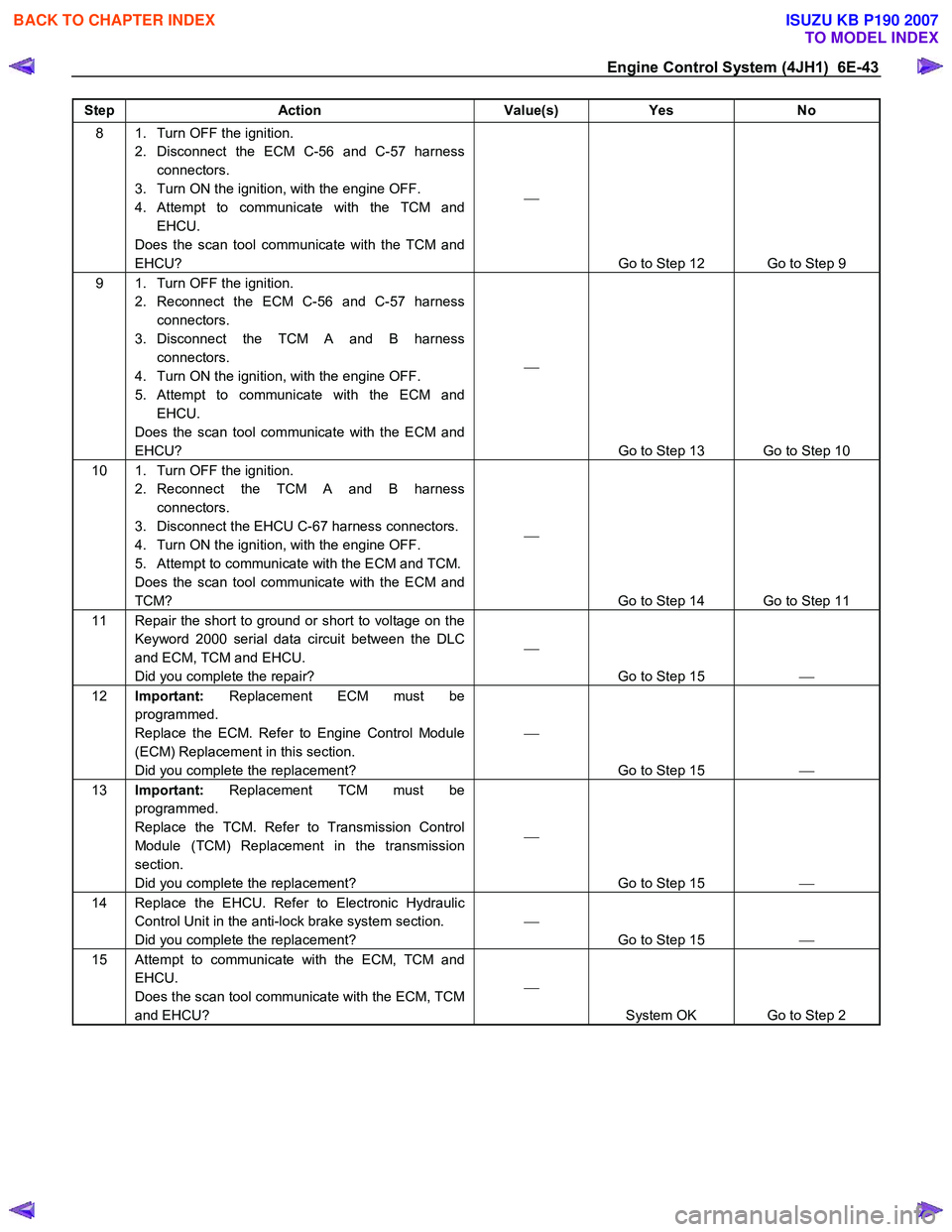
Step Action Value(s) Yes No
8 1. Turn OFF the ignition.
2. Disconnect the ECM C-56 and C-57 harness connectors.
3. Turn ON the ignition, with the engine OFF.
4. Attempt to communicate with the TCM and EHCU.
Does the scan tool communicate with the TCM and
EHCU?
Go to Step 12 Go to Step 9
9 1. Turn OFF the ignition. 2. Reconnect the ECM C-56 and C-57 harness connectors.
3. Disconnect the TCM A and B harness connectors.
4. Turn ON the ignition, with the engine OFF.
5. Attempt to communicate with the ECM and EHCU.
Does the scan tool communicate with the ECM and
EHCU?
Go to Step 13 Go to Step 10
10 1. Turn OFF the ignition. 2. Reconnect the TCM A and B harness connectors.
3. Disconnect the EHCU C-67 harness connectors.
4. Turn ON the ignition, with the engine OFF.
5. Attempt to communicate with the ECM and TCM.
Does the scan tool communicate with the ECM and
TCM?
Go to Step 14 Go to Step 11
11 Repair the short to ground or short to voltage on the Keyword 2000 serial data circuit between the DLC
and ECM, TCM and EHCU.
Did you complete the repair?
Go to Step 15
12 Important: Replacement ECM must be
programmed.
Replace the ECM. Refer to Engine Control Module
(ECM) Replacement in this section.
Did you complete the replacement?
Go to Step 15
13 Important: Replacement TCM must be
programmed.
Replace the TCM. Refer to Transmission Control
Module (TCM) Replacement in the transmission
section.
Did you complete the replacement?
Go to Step 15
14 Replace the EHCU. Refer to Electronic Hydraulic
Control Unit in the anti-lock brake system section.
Did you complete the replacement?
Go to Step 15
15 Attempt to communicate with the ECM, TCM and
EHCU.
Does the scan tool communicate with the ECM, TCM
and EHCU?
System OK Go to Step 2
BACK TO CHAPTER INDEX
TO MODEL INDEX
ISUZU KB P190 2007
Page 1093 of 6020
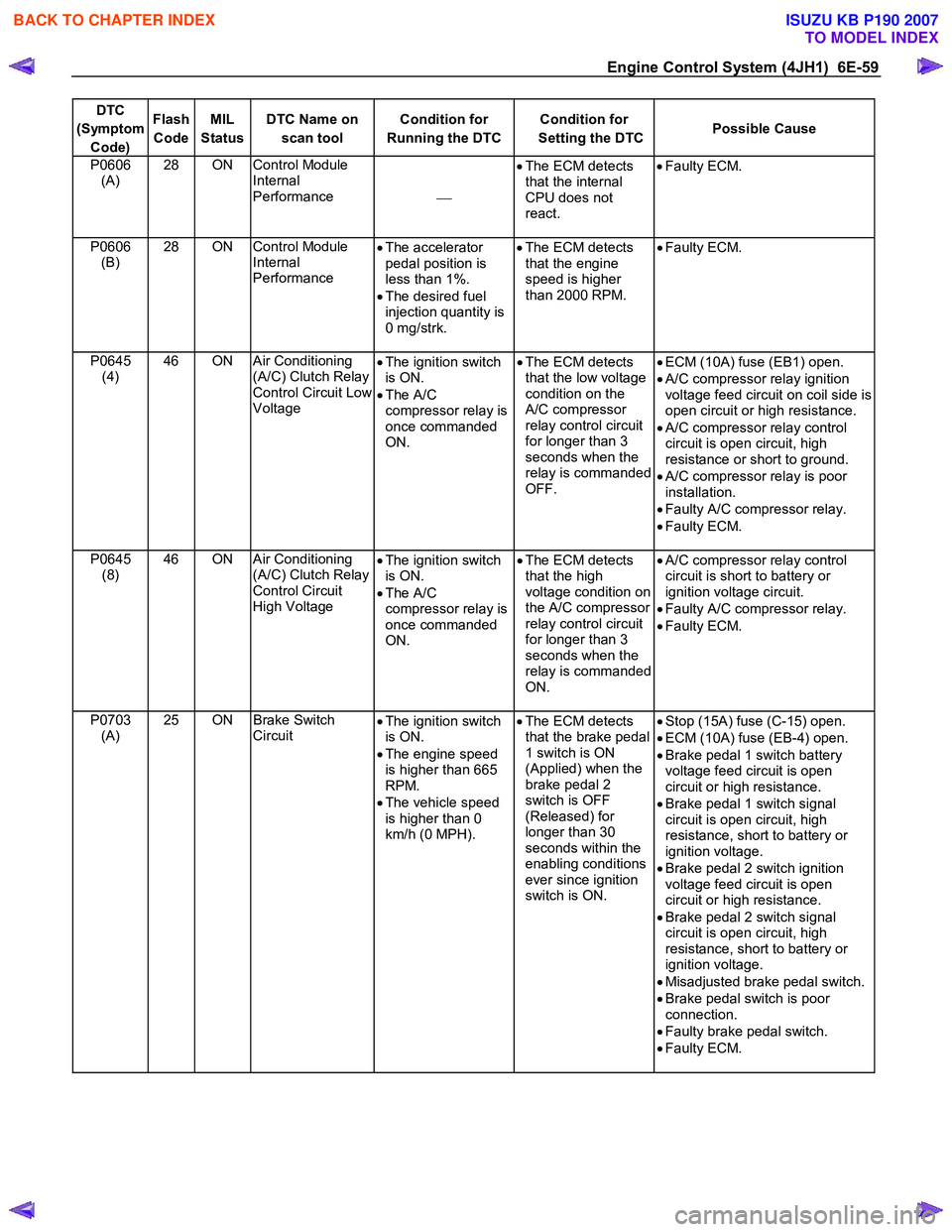
Engine Control System (4JH1) 6E-59
DTC
(Symptom Code) Flash
Code MIL
Status DTC Name on
scan tool Condition for
Running the DTC Condition for
Setting the DTC Possible Cause
P0606
(A) 28 ON Control Module
Internal
Performance
•
The ECM detects
that the internal
CPU does not
react.
•
Faulty ECM.
P0606
(B) 28 ON Control Module
Internal
Performance •
The accelerator
pedal position is
less than 1%.
• The desired fuel
injection quantity is
0 mg/strk.
•
The ECM detects
that the engine
speed is higher
than 2000 RPM. •
Faulty ECM.
P0645
(4) 46 ON Air Conditioning
(A/C) Clutch Relay
Control Circuit Low
Voltage •
The ignition switch
is ON.
• The A/C
compressor relay is
once commanded
ON. •
The ECM detects
that the low voltage
condition on the
A/C compressor
relay control circuit
for longer than 3
seconds when the
relay is commanded
OFF.
•
ECM (10A) fuse (EB1) open.
• A/C compressor relay ignition
voltage feed circuit on coil side is
open circuit or high resistance.
• A/C compressor relay control
circuit is open circuit, high
resistance or short to ground.
• A/C compressor relay is poor
installation.
• Faulty A/C compressor relay.
• Faulty ECM.
P0645 (8) 46 ON Air Conditioning
(A/C) Clutch Relay
Control Circuit
High Voltage •
The ignition switch
is ON.
• The A/C
compressor relay is
once commanded
ON. •
The ECM detects
that the high
voltage condition on
the A/C compressor
relay control circuit
for longer than 3
seconds when the
relay is commanded
ON.
•
A/C compressor relay control
circuit is short to battery or
ignition voltage circuit.
• Faulty A/C compressor relay.
• Faulty ECM.
P0703 (A) 25 ON Brake Switch
Circuit •
The ignition switch
is ON.
• The engine speed
is higher than 665
RPM.
• The vehicle speed
is higher than 0
km/h (0 MPH).
•
The ECM detects
that the brake pedal
1 switch is ON
(Applied) when the
brake pedal 2
switch is OFF
(Released) for
longer than 30
seconds within the
enabling conditions
ever since ignition
switch is ON. •
Stop (15A) fuse (C-15) open.
• ECM (10A) fuse (EB-4) open.
• Brake pedal 1 switch battery
voltage feed circuit is open
circuit or high resistance.
• Brake pedal 1 switch signal
circuit is open circuit, high
resistance, short to battery or
ignition voltage.
• Brake pedal 2 switch ignition
voltage feed circuit is open
circuit or high resistance.
• Brake pedal 2 switch signal
circuit is open circuit, high
resistance, short to battery or
ignition voltage.
• Misadjusted brake pedal switch.
• Brake pedal switch is poor
connection.
• Faulty brake pedal switch.
• Faulty ECM.
BACK TO CHAPTER INDEX
TO MODEL INDEX
ISUZU KB P190 2007
Page 1094 of 6020
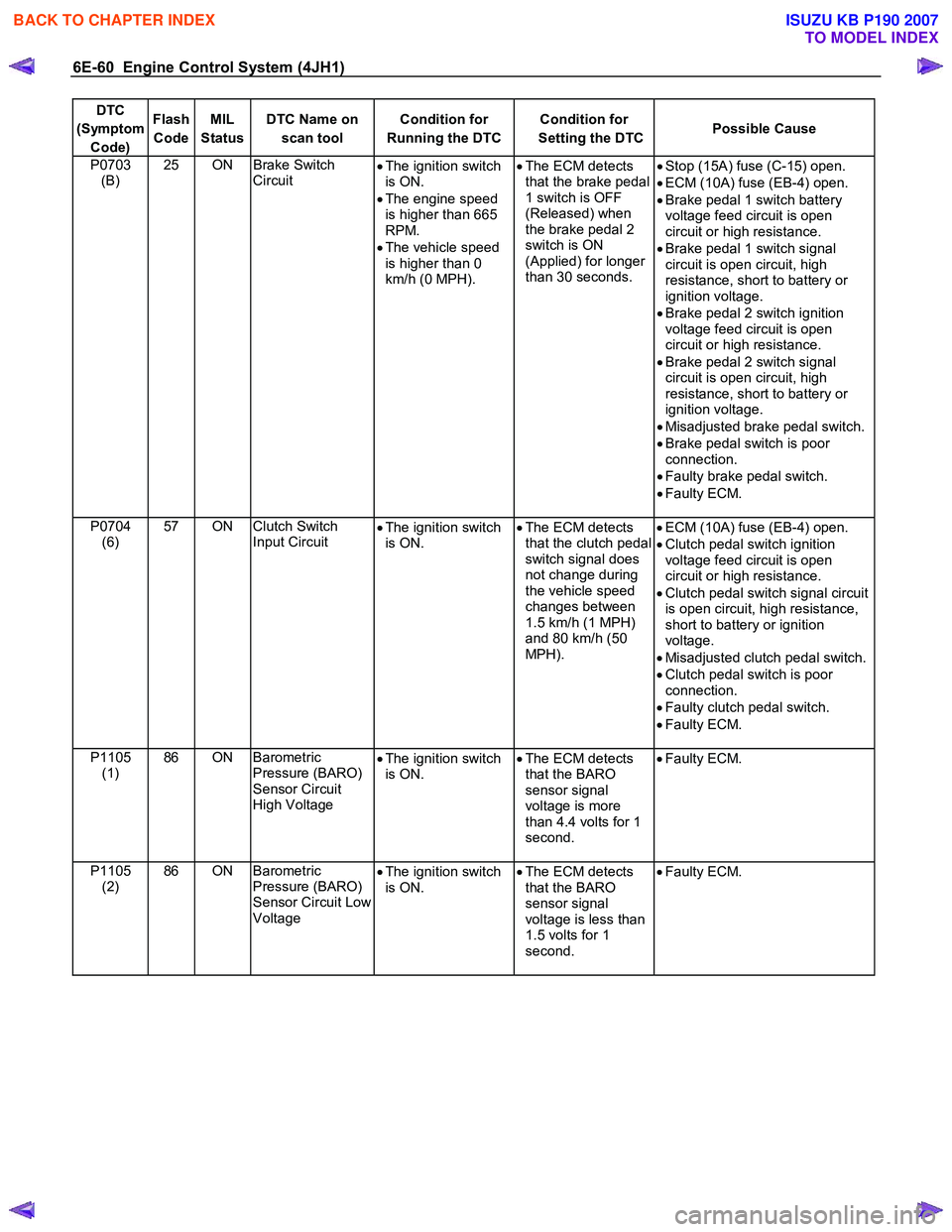
6E-60 Engine Control System (4JH1)
DTC
(Symptom Code) Flash
Code MIL
Status DTC Name on
scan tool Condition for
Running the DTC Condition for
Setting the DTC Possible Cause
P0703
(B) 25 ON Brake Switch
Circuit •
The ignition switch
is ON.
• The engine speed
is higher than 665
RPM.
• The vehicle speed
is higher than 0
km/h (0 MPH).
•
The ECM detects
that the brake pedal
1 switch is OFF
(Released) when
the brake pedal 2
switch is ON
(Applied) for longer
than 30 seconds. •
Stop (15A) fuse (C-15) open.
• ECM (10A) fuse (EB-4) open.
• Brake pedal 1 switch battery
voltage feed circuit is open
circuit or high resistance.
• Brake pedal 1 switch signal
circuit is open circuit, high
resistance, short to battery or
ignition voltage.
• Brake pedal 2 switch ignition
voltage feed circuit is open
circuit or high resistance.
• Brake pedal 2 switch signal
circuit is open circuit, high
resistance, short to battery or
ignition voltage.
• Misadjusted brake pedal switch.
• Brake pedal switch is poor
connection.
• Faulty brake pedal switch.
• Faulty ECM.
P0704 (6) 57 ON Clutch Switch
Input Circuit •
The ignition switch
is ON.
•
The ECM detects
that the clutch pedal
switch signal does
not change during
the vehicle speed
changes between
1.5 km/h (1 MPH)
and 80 km/h (50
MPH).
•
ECM (10A) fuse (EB-4) open.
• Clutch pedal switch ignition
voltage feed circuit is open
circuit or high resistance.
• Clutch pedal switch signal circuit
is open circuit, high resistance,
short to battery or ignition
voltage.
• Misadjusted clutch pedal switch.
• Clutch pedal switch is poor
connection.
• Faulty clutch pedal switch.
• Faulty ECM.
P1105 (1) 86 ON Barometric
Pressure (BARO)
Sensor Circuit
High Voltage
•
The ignition switch
is ON.
•
The ECM detects
that the BARO
sensor signal
voltage is more
than 4.4 volts for 1
second.
•
Faulty ECM.
P1105
(2) 86 ON Barometric
Pressure (BARO)
Sensor Circuit Low
Voltage
•
The ignition switch
is ON.
•
The ECM detects
that the BARO
sensor signal
voltage is less than
1.5 volts for 1
second.
•
Faulty ECM.
BACK TO CHAPTER INDEX
TO MODEL INDEX
ISUZU KB P190 2007
Page 1095 of 6020
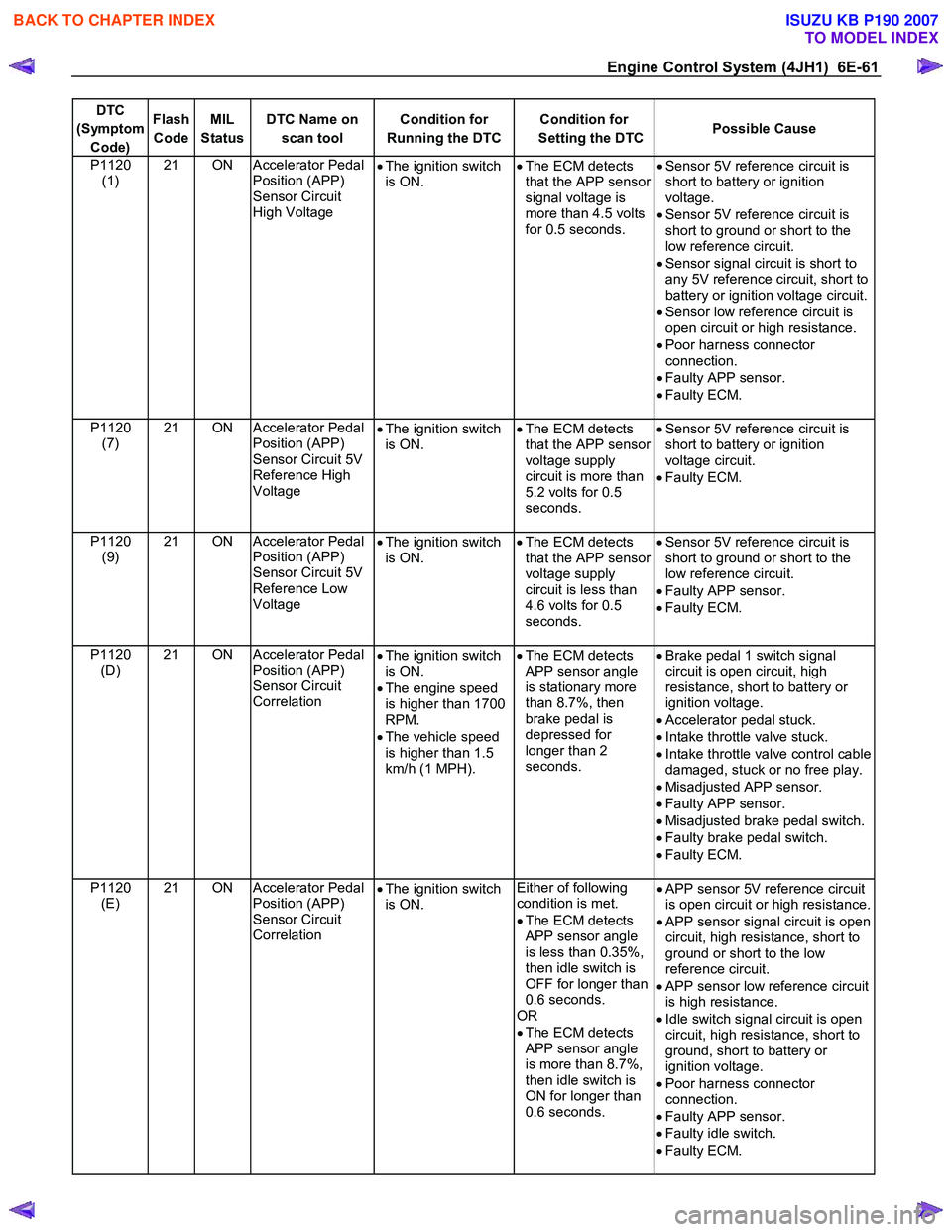
Engine Control System (4JH1) 6E-61
DTC
(Symptom Code) Flash
Code MIL
Status DTC Name on
scan tool Condition for
Running the DTC Condition for
Setting the DTC Possible Cause
P1120
(1) 21 ON Accelerator Pedal
Position (APP)
Sensor Circuit
High Voltage •
The ignition switch
is ON.
•
The ECM detects
that the APP sensor
signal voltage is
more than 4.5 volts
for 0.5 seconds. •
Sensor 5V reference circuit is
short to battery or ignition
voltage.
• Sensor 5V reference circuit is
short to ground or short to the
low reference circuit.
• Sensor signal circuit is short to
any 5V reference circuit, short to
battery or ignition voltage circuit.
• Sensor low reference circuit is
open circuit or high resistance.
• Poor harness connector
connection.
• Faulty APP sensor.
• Faulty ECM.
P1120 (7) 21 ON Accelerator Pedal
Position (APP)
Sensor Circuit 5V
Reference High
Voltage
•
The ignition switch
is ON.
•
The ECM detects
that the APP sensor
voltage supply
circuit is more than
5.2 volts for 0.5
seconds.
•
Sensor 5V reference circuit is
short to battery or ignition
voltage circuit.
• Faulty ECM.
P1120 (9) 21 ON Accelerator Pedal
Position (APP)
Sensor Circuit 5V
Reference Low
Voltage
•
The ignition switch
is ON.
•
The ECM detects
that the APP sensor
voltage supply
circuit is less than
4.6 volts for 0.5
seconds.
•
Sensor 5V reference circuit is
short to ground or short to the
low reference circuit.
• Faulty APP sensor.
• Faulty ECM.
P1120 (D) 21 ON
Accelerator Pedal
Position (APP)
Sensor Circuit
Correlation •
The ignition switch
is ON.
• The engine speed
is higher than 1700
RPM.
• The vehicle speed
is higher than 1.5
km/h (1 MPH).
•
The ECM detects
APP sensor angle
is stationary more
than 8.7%, then
brake pedal is
depressed for
longer than 2
seconds.
•
Brake pedal 1 switch signal
circuit is open circuit, high
resistance, short to battery or
ignition voltage.
• Accelerator pedal stuck.
• Intake throttle valve stuck.
• Intake throttle valve control cable
damaged, stuck or no free play.
• Misadjusted APP sensor.
• Faulty APP sensor.
• Misadjusted brake pedal switch.
• Faulty brake pedal switch.
• Faulty ECM.
P1120 (E) 21 ON Accelerator Pedal
Position (APP)
Sensor Circuit
Correlation •
The ignition switch
is ON. Either of following
condition is met.
• The ECM detects
APP sensor angle
is less than 0.35%,
then idle switch is
OFF for longer than
0.6 seconds.
OR
• The ECM detects
APP sensor angle
is more than 8.7%,
then idle switch is
ON for longer than
0.6 seconds.
•
APP sensor 5V reference circuit
is open circuit or high resistance.
•
APP sensor signal circuit is open
circuit, high resistance, short to
ground or short to the low
reference circuit.
• APP sensor low reference circuit
is high resistance.
• Idle switch signal circuit is open
circuit, high resistance, short to
ground, short to battery or
ignition voltage.
• Poor harness connector
connection.
• Faulty APP sensor.
• Faulty idle switch.
• Faulty ECM.
BACK TO CHAPTER INDEX
TO MODEL INDEX
ISUZU KB P190 2007
Page 1138 of 6020
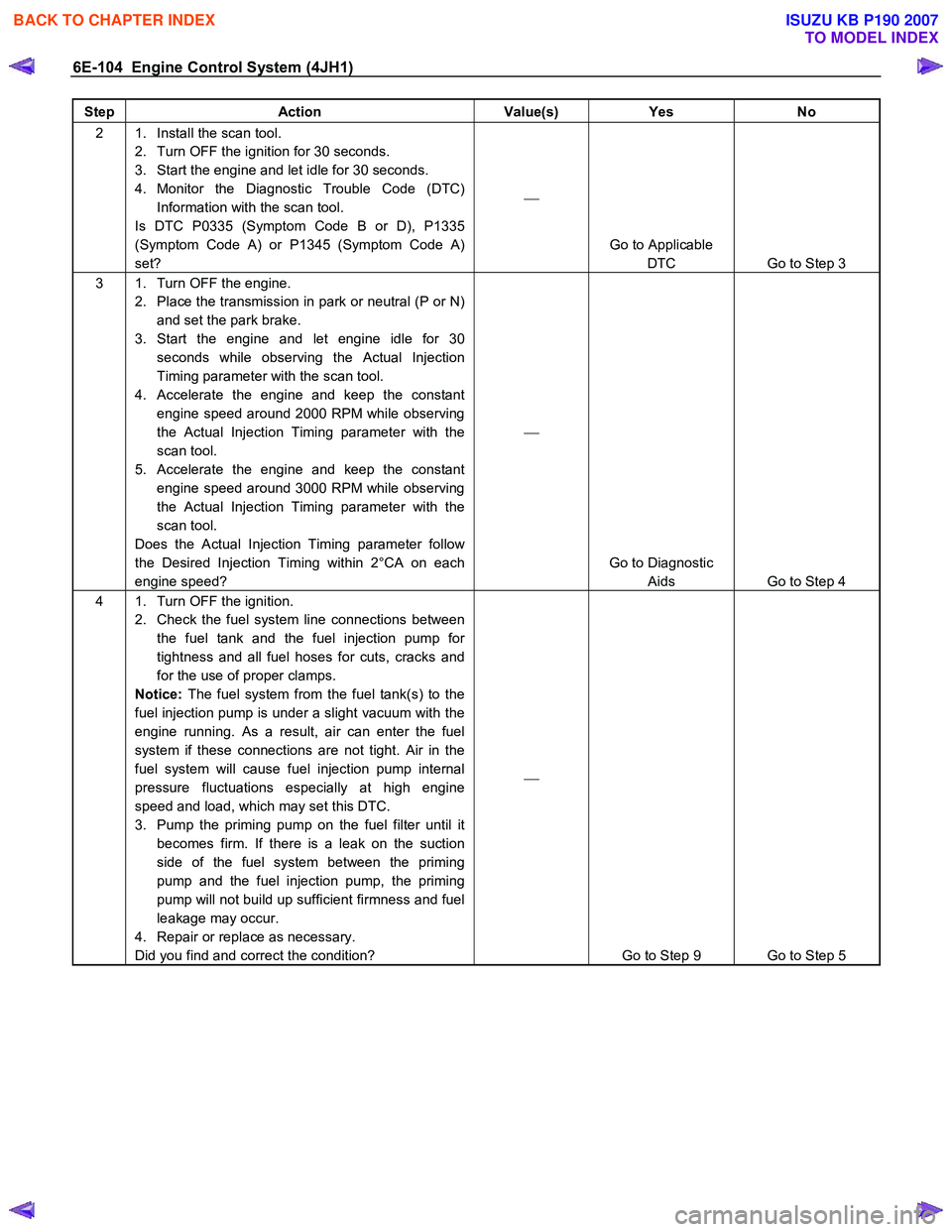
6E-104 Engine Control System (4JH1)
Step Action Value(s) Yes No
2 1. Install the scan tool.
2. Turn OFF the ignition for 30 seconds.
3. Start the engine and let idle for 30 seconds.
4. Monitor the Diagnostic Trouble Code (DTC) Information with the scan tool.
Is DTC P0335 (Symptom Code B or D), P1335
(Symptom Code A) or P1345 (Symptom Code A)
set?
Go to Applicable DTC Go to Step 3
3 1. Turn OFF the engine. 2. Place the transmission in park or neutral (P or N) and set the park brake.
3. Start the engine and let engine idle for 30 seconds while observing the Actual Injection
Timing parameter with the scan tool.
4. Accelerate the engine and keep the constant engine speed around 2000 RPM while observing
the Actual Injection Timing parameter with the
scan tool.
5. Accelerate the engine and keep the constant engine speed around 3000 RPM while observing
the Actual Injection Timing parameter with the
scan tool.
Does the Actual Injection Timing parameter follow
the Desired Injection Timing within 2°CA on each
engine speed?
Go to Diagnostic Aids Go to Step 4
4 1. Turn OFF the ignition. 2. Check the fuel system line connections between the fuel tank and the fuel injection pump for
tightness and all fuel hoses for cuts, cracks and
for the use of proper clamps.
Notice: The fuel system from the fuel tank(s) to the
fuel injection pump is under a slight vacuum with the
engine running. As a result, air can enter the fuel
system if these connections are not tight. Air in the
fuel system will cause fuel injection pump internal
pressure fluctuations especially at high engine
speed and load, which may set this DTC.
3. Pump the priming pump on the fuel filter until it becomes firm. If there is a leak on the suction
side of the fuel system between the priming
pump and the fuel injection pump, the priming
pump will not build up sufficient firmness and fuel
leakage may occur.
4. Repair or replace as necessary.
Did you find and correct the condition?
Go to Step 9 Go to Step 5
BACK TO CHAPTER INDEX
TO MODEL INDEX
ISUZU KB P190 2007