Page 231 of 331

Your vehicle has been designed
primarily f or use on pavement. But
its higher ground clearance and f our-
wheel drive VTM-4 system allow you
to occasionally travel on unpaved
roads and surf aces. Your vehicle is
not designed f or trailblazing,
mountain climbing, or other
challenging off-road activities.If you decide to drive on unpaved
roads, you will f ind that it requires
somewhat dif f erent driving skills.
Your vehicle will also handle
somewhat dif f erently than it does on
pavement. Be sure to pay extra
attention to the precautions and tips
in this section, and get acquainted
with your vehicle bef ore leaving the
pavement.
General Inf ormation
Of f -Highway Driving Guidelines
Driving
227
Improperly operating this
vehicle on or off-pavement can
cause an accident or rollover in
which you and your passengers
could be seriously injured or
killed.
Follow all instructions and
guidelines in this owner’s
manual.
Keep your speed low, and
don’t drive faster than
conditions permit.
Page 233 of 331

Forbettertractiononallsurfaces,
accelerate slowly and gradually build
up speed. If you try to start too fast
on wet soil, mud, snow, or ice, you
might not have enough traction to
get underway, and you may dig
yourself a hole. Starting with the
shif t lever in second (2) gear will
help you have a smoother start on
snow or ice.
Keep in mind that you will usually
need more time and distance to
brake to a stop on unpaved surf aces.
Avoid hard braking. Do not ‘‘pump’’
the brakes; let the anti-lock braking
system pump them f or you.Your vehicle is not equipped with
undercarriage guards to protect key
components, so take care to avoid
rocks, tree stumps, and other
obstacles in your path.
Because your vehicle has a higher
center of gravity than a conventional
passenger vehicle, driving a wheel
over a tall object, or allowing a wheel
to drop into a deep hole, can cause
your vehicle to tip or roll over.
If you can’t clearly see all conditions
or obstacles on a slope, walk the
slope bef ore you drive on it. If you
have any doubt whether or not you
can saf ely drive on the slope, don’t
do it. Find another route.
If you are driving up a hill and f ind
that you cannot continue,
. Your vehicle could roll
over. Slowly back down the hill,
f ollowing the same route you took up
the hill.
do not try to
turn around
A ccelerating and Braking A voiding ObstaclesDriving on Slopes
Of f -Highway Driving Guidelines
Driving
229
Page 234 of 331

The banks and surface under the
water provide good traction. The
water may hide hazards such as
rocks, holes, or mud.
Before
driving through water, stop,
get out if necessary, and make sure
that:
If you decide it is safe to drive
through water, choose a suitable
speed, and proceed without shifting,
changing speed s, stopping, or
shutting off the engine.
Do not try to cross water at high
speeds, as this may cause severe
damage to the cooling system or
result in loss of control.
After driving through water, test
your brakes. If they got wet, gently
‘‘pump’’ them while driving slowly
until they operate normally.
If the water is deeper than the wheel
hubs, some additional service may
be required. This service is not
covered by your warranties.
The
water is not flowing too fast.
Deep rushing water can sweep you
downstream. Even very shallow
rushingwatercanwashthe
ground from under your tires and
cause you to lose traction and
possibly roll over.
The
ban ks are sloped so you can
drive out.
The
water is not deep enough to
cover your wheel hubs, axles, or
exhaust pipe. You could stall and
not be able to restart your engine.
The water can also damage
important vehicle components. If
you get stuck, and cannot get
unstuck with the VTM-4 system,
engage the VTM-4 Lock (see page
), and carefully try to go in the
direction (forward or reverse) that
you think will get you unstuck. Do
notspinthetiresathighspeeds.It
will not help you get out and may
cause damage to the transmission or
VTM-4 system.
If you are still unable to free yourself,
your vehicle is equipped with front
and rear tow hooks designed f or this
purpose (see page ). 297
203
If You Get Stuck
Crossing a Stream
Of f -Highway Driving Guidelines
230
Page 237 of 331

This section explains why it is
important to keep your vehicle well
maintained and how to follow basic
maintenance safety precautions.
If you have the skills and tools to
perform more complex maintenance
tasks on your vehicle, you may want
to purchase the service manual. See
page f or inf ormation on how to
obtain a copy, or see your dealer. This section also includes
instructions on how to read the
maintenance minder messages on
the information display, a
maintenance record, and instructions
for simple maintenance tasks you
may want to take care of yourself. ......................
Maintenance Saf ety .234
....................
Maintenance Minder .235
....................
Maintenance Record .243
..............................
Fluid Locations .245
........................
Adding Engine Oil .246
Changing the Engine Oil and
...........................................
Filter .247
..............................
Engine Coolant .249
....................
Windshield Washers .250
....
Automatic Transmission Fluid .251
.................
Rear Dif f erential Fluid .252
.............
Transf er Assembly Fluid .253
....................................
Brake Fluid .253
....................
Power Steering Fluid .254
....................................
Timing Belt .254
.............................................
Lights .255
................
Cleaning the Seat Belts .261
.....................................
Floor Mats .261
..................
Dust and Pollen Filter .262
.................................
Wiper Blades .262
...........................................
Wheels .264
...............................................
Tires .265
...................
Checking the Battery .270
.............................
Vehicle Storage .272
315
Maintenance
Maint enance
233
Page 258 of 331

�µ�µ
The timing belt should be replaced
at the intervals shown in the
maintenance minder schedule.
Replace the belt at 60,000 miles (U.S.)
or 100,000 km (Canada) if you
regularly drive your vehicle in one or
more of these conditions:
Remove the cover, then check the
level on the side of the reservoir
when the engine is cold.
The f luid should be between the
UPPER LEVEL and LOWER LEVEL.
If not, add power steering f luid to the
UPPER LEVEL mark, and put the
cover back in place. Pour the f luid slowly and caref ully so
you do not spill any. Clean up any
spill immediately; it could damage
components in the engine
compartment.
A low power steering f luid level can
indicate a leak in the system. Check
the f luid level f requently, and have
the system inspected as soon as
possible. Always use Honda Power Steering
Fluid. You may use another power
steering f luid as an emergency
replacement, but have the power
steering system f lushed and ref illed
with Honda PSF as soon as possible.
In very high temperatures
(over 110°F, 43°C).
In very low temperatures
(under 20°F, 29°C).
Towing a trailer.
Timing Belt
Power Steering Fluid
Power Steering Fluid, Timing Belt
254
UPPER LEVEL
LOWER LEVEL
COVER
Turning the steering wheel to f ull lef t
or right lock and holding it there can
damage the power steering pump.
Page 260 of 331

Install the new bulb into the hole,
making sure the tabs are in their
slots. Pivot the hold-down wire
back in place, and clip the end into
the slot.
Install the rubber weather seal
over the back of the headlight
assembly.Makesureitisright
side up.To change the passenger’s side
bulb, start the engine, turn the
steering wheel all the way to the
lef t, and turn of f the engine. To
change the driver’s side bulb, turn
the steering wheel to the right.
Use a f lat-tipped screwdriver to
remove the two holding clips f rom
the inner f ender, and pull the inner
f ender cover back.Remove the socket from the
headlight assembly by turning it
one-quarter turn counterclockwise.
Pull the bulb straight out of its
socket. Push the new bulb straight
into the socket until it bottoms.
Push the electrical connector onto
the new bulb. Make sure it is
connected securely. Turn on the
headlights to test the new bulb.
4.
5.
6.
1.
2.3.
4.
Lights
Replacing a Front T urn Signal/
Hazard/Parking L ight Bulb
256
HOLDING CLIPS
Page 268 of 331
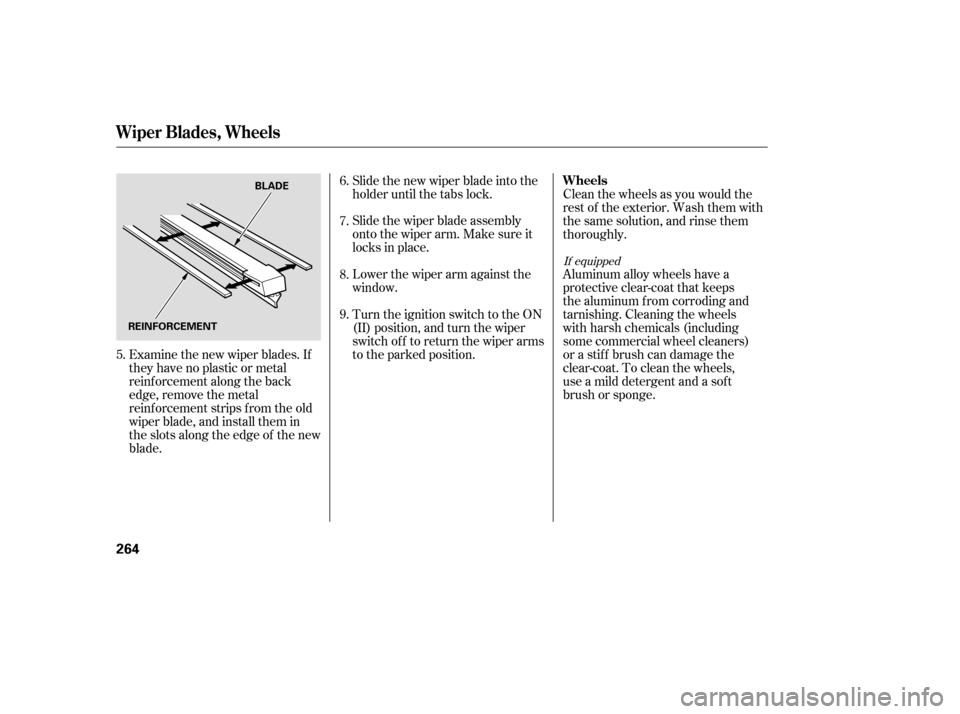
Examine the new wiper blades. If
they have no plastic or metal
reinf orcement along the back
edge, remove the metal
reinf orcement strips f rom the old
wiper blade, and install them in
the slots along the edge of the new
blade.Slide the new wiper blade into the
holder until the tabs lock.
Slide the wiper blade assembly
onto the wiper arm. Make sure it
locks in place.
Lower the wiper arm against the
window.
Turn the ignition switch to the ON
(II) position, and turn the wiper
switch of f to return the wiper arms
to the parked position.
Aluminum alloy wheels have a
protective clear-coat that keeps
the aluminum f rom corroding and
tarnishing. Cleaning the wheels
with harsh chemicals (including
some commercial wheel cleaners)
or a stif f brush can damage the
clear-coat. To clean the wheels,
use a mild detergent and a sof t
brush or sponge. Clean the wheels as you would the
rest of the exterior. Wash them with
thesamesolution,andrinsethem
thoroughly.
6.
7.
5. 8.
9.
If equipped
Wheels
Wiper Blades, Wheels
264
BLADE
REINFORCEMENT
Page 271 of 331
In addition to proper inf lation,
correct wheel alignment helps to
decrease tire wear. If you f ind a tire
is worn unevenly, have your dealer
check the wheel alignment.
Have your dealer check the tires if
you f eel a consistent vibration while
driving. A tire should always be
rebalanced if it is removed f rom the
wheel. When you have new tires
installed, make sure they are
balanced. This increases riding
comf ort and tire lif e. For best results,
have the installer perform a dynamic
balance.
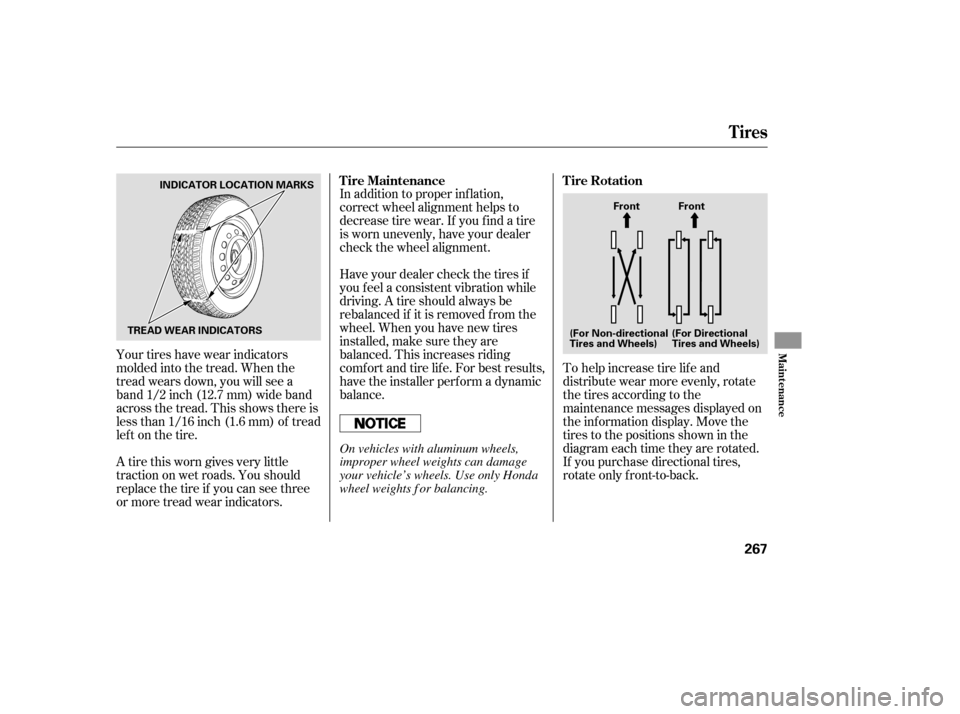
Your tires have wear indicators
molded into the tread. When the
tread wears down, you will see a
band 1/2 inch (12.7 mm) wide band
across the tread. This shows there is
less than 1/16 inch (1.6 mm) of tread
lef t on the tire.
A tire this worn gives very little
traction on wet roads. You should
replace the tire if you can see three
or more tread wear indicators. To help increase tire lif e and
distribute wear more evenly, rotate
the tires according to the
maintenance messages displayed on
the information display. Move the
tires to the positions shown in the
diagram each time they are rotated.
If you purchase directional tires,
rotate only front-to-back.
T ire Maintenance T ire Rotation
Tires
Maint enance
267
Front
(For Non-directional
Tires and Wheels) Front
(For Directional
Tires and Wheels)
TREAD WEAR INDICATORS INDICATOR LOCATION MARKS
On vehicles with aluminum wheels,
improper wheel weights can damage
your vehicle’s wheels. Use only Honda
wheel weights f or balancing.