2007 FORD FIESTA catalytic converter
[x] Cancel search: catalytic converterPage 819 of 1226

Fuel Charging and Controls - 2.OL
303-04B-1 I Duratec-HE (M14) 303-04B-11
DIAGNOSIS AND TESTING
Symptom Possible Sources
Action
Fuel injector(s). INSPECT the fuel injectors.
CLEAN the fuel injectors or
INSTALL a new set of injectors
as required only after the
checks have been carried out.
Fuel rail fuel pressure sensor. Carry out a full engine
diagnosis using the guided
diagnostic menu in WDS.
Catalytic converter blocked. REMOVE and visually
INSPECT the catalytic
converter as necessary.
REFER to: Catalytic Converter
- 1.8L Duratec-HE (M14)/2.OL
Duratec-HE (M14) (309-00,
Removal and Installation).
Low cylinder compression. TEST the engine cylinder
compression.
Engine starts but immediately
stops Air cleaner element blocked. INSTALL
a new air cleaner
element.
CKP sensor.
Carry out a full engine
diagnosis using the guided
diagnostic menu in WDS.
CMP sensor. Carry out a full engine
diagnosis using the guided
diagnostic menu in WDS.
PCM. Carry out a full engine
diagnosis using the guided
diagnostic menu in WDS.
Low fuel system pressure.
Check the fuel system pres-
sure.
REFER to: Fuel System Pres-
sure Check (31
0-OOA,
General Procedures).
Fuel system
restriction
I
--
INSPECT the fuel system.
INSTALL new components as
necessary. TEST the system
for normal operation.
I Fuel filter blocked. I INSTALL a new fuel filter. I
Poor idling Air cleaner
element blocked. INSTALL a new air cleaner
element.
2006.0 Fiesta 1212006 GI 65371 en
procarmanuals.com
Page 823 of 1226

Fuel Charging and Controls - 2.OL
303-04B-15 Duratec-HE (M14) 303-04B-15
DIAGNOSIS AND TESTING
Symptom Possible Sources Action
Catalytic converter
blocked. REMOVE and visually
INSPECT the catalytic
converter for damage.
INSTALL a new catalytic
converter as necessary.
REFER to: Catalytic Converter
- 1.8L Duratec-HE (M14)12.OL
Duratec-HE (M14) (309-00,
Removal and Installation).
Black smoke at idle
Air cleaner element blocked.
acceleration INSTALL a new air cleaner
element as necessary.
--
Fuel injectors. INSPECT the fuel injectors.
CLEAN the fuel injectors or
INSTALL a new set of injectors
as required only after the
checks have been carried out.
ECT sensor. Carry out a full engine
diagnosis using the guided
diagnostic menu in WDS.
Fuel rail fuel pressure sensor.
Carry out a full engine
diagnosis using the guided
diagnostic menu in WDS.
Catalytic converter blocked.
REMOVE and visually
INSPECT the catalytic
converter for damage.
INSTALL a new catalytic
converter as necessary.
REFER to: Catalytic Converter
- 1.8L Duratec-HE (M14)12.OL
Duratec-HE (M14) (309-00,
Removal and Installation).
I Incorrect valve timing. I CHECK the valve timing. I
2006.0 Fiesta 1212006 GI 65371 en
Air cleaner element blocked. INSTALL a new air cleaner
element as necessary.
procarmanuals.com
Page 824 of 1226

Fuel Charging and Controls - 2.OL
303-04B-16 Duratec-HE (M14) 303-04B-16
DIAGNOSIS AND TESTING
Symptom Possible Sources Action
Incorrect or contaminated fuel. CHECK for signs of contamina-).-
tion such as strange odors from, .,,
,
the fuel tank.
If contaminated fuel is found,
DRAIN the complete fuel
system. FLUSH the fuel system
through with clean gasoline.
REFER to: Fuel Tank Draining
(31
0-OOA, General Proced-
ures).
INSTALL a new fuel filter.
INSPECT the fuel injectors.
CLEAN the fuel injectors or
INSTALL a new set of injectors
as required only after the
checks have been carried out.
INSTALL a new fuel rail.
REFER to: Fuel
Injection
Supply Manifold (303-04C,
Removal and Installation).
REFER to: Engine Emission
Control (303-08 Engine Emission Control
- 2.OL
Duratec-HE (M14), Diagnosis .
and Testing). I
CKP sensor. Carry out a full engine
diagnosis using the guided
diagnostic menu in WDS.
KS. Carry out a full engine
diagnosis using the guided
diagnostic menu in WDS.
INSPECT the fuel injectors.
CLEAN the fuel injectors or
l NSTALL a new set of injectors
as required only after the
checks have been carried out.
Catalytic converter blocked.
Fuel
rail fuel pressure sensor.
REMOVE and visually
INSPECT the catalytic
converter for damage.
INSTALL a new catalytic
converter as necessary.
Carry out a full engine
diagnosis using the guided
diagnostic menu in WDS.
REFER to: Catalytic Converter
I
- 1.8L Duratec-HE (M14)/2.OL
Duratec-H E (M14) (309-00,
Removal and Installation).
2006.0 Fiesta 1212006 GI 65371 en
procarmanuals.com
Page 825 of 1226

Fuel Charging and Controls - 2.OL
303-04B-17 Duratec-HE (M14) 303-04B-17 - --
DIAGNOSIS AND TESTING ~
EGR valve sticking open.
Symptom
Possible Sources Action
REFER to: Engine Emission
Control (303-08 Engine
Emission Control
- 2.OL
Duratec-H E (M14), Diagnosis
and Testing).
Black
smoke at cruising speeds
ECT sensor. Carry out a full engine
diagnosis using the guided
diagnostic menu in WDS.
. Air cleaner element blocked.
Fuel injectors. INSTALL a new air cleaner
element.
INSPECT the fuel injectors.
CLEAN the fuel injectors or
INSTALL a new set of injectors
as required only after the
checks have been carried out.
Fuel rail fuel pressure sensor.
Carry out a full engine
diagnosis using the guided
diagnostic menu in WDS.
Catalytic converter blocked.
REMOVE and visually
INSPECT the catalytic
converter for damage.
INSTALL a new catalytic
converter as necessary.
REFER to: Catalytic Converter
- 1.8L Duratec-HE (M14)/2.OL
Duratec-HE (M 14) (309-00,
Removal and Installation).
Blue smoke Engine burning oil. CARRY OUT a controlled oil
consumption test over
I000 km
(600 miles). CONFIRM that the
oil consumption is less than 0.1
litre per 1000 km (600 miles).
2006.0 Fiesta 1212006 GI 65371 en
procarmanuals.com
Page 939 of 1226

303-1 4-1 5 Electronic Engine Controls 303-1 4-1 5
DIAGNOSIS AND TESTING
Monitors
The purpose of the monitors is to continuously
check the operation of the emission related sensors
and actuators. It then establishes if they are
operating within specified tolerances. All monitors
carry out their functions in such a way as to be
unnoticeable by the driver of the vehicle. Each one
is carried out under specific conditions of load,
speed and engine temperature. The Comprehensive Component Monitor, Combustion
Misfire Monitor and
AirIFuel Ratio Monitor operate
continuously. The remaining monitors are only
invoked under certain operating conditions. On
diesel variants, all of the monitors operate under
normal driving conditions: There are no monitors
which intervene and cause special operating
modes to enable the monitors to work. Some diesel
monitors are non-continuous. This means that in
a drive cycle, monitoring is done as and when
suitable driving conditions exist and potential faults
are accumulated and compared with acceptance
criteria. Examples of this type are the turbocharger
boost pressure and exhaust gas recirculation
(EGR) monitors on vehicles with common rail fuel
injection.
( Comprehensive Component Monitor (CCM)
When the CCM detects a component operating out
of tolerance, it sets a Diagnostic Trouble Code
(DTC), which is stored in the EEPROM. If the same
concern is confirmed during the next trip the MIL
will be switched on. The CCM monitors many
components, sub-systems and signals. The
following is a list of those that can effect emissions
depending on application:
Electronic Ignition (El) System.
Crankshaft Position (CKP) Sensor.
Ignition Coil.
Electronic Throttle Control Unit.
Camshaft Position (CMP) Sensor.
Air Conditioning
(AIC) Clutch.
Idle Air Control (IAC) Valve.
Mass Air Flow (MAF) Sensor.
Manifold Absolute Pressure (MAP) Sensor.
Intake Air Temperature (IAT) Sensor.
Engine Coolant Temperature (ECT) Sensor.
Cylinder Head Temperature (CHT) Sensor.
Heated Oxygen Sensor
(H02S).
Catalyst Monitor Sensor.
Charge Air Temperature Sensor.
Knock Sensor (KS).
Throttle Position (TP) Sensor.
Vehicle Speed Sensor (VSS).
Boost Pressure Sensor.
Cam-Crank Phasing Sensor.
EEPROM.
High Pressure Fuel Injection Pump.
Exhaust Gas Recirculation (EGR) Valve Monitor.
Fuel Injectors.
Turbocharger.
Combustion Noise Monitor.
Barometric Pressure (BARO) Sensor.
Combustion Misfire Monitor (All except vehicles
with diesel engine)
The combustion misfire monitor operates independently of the others, and can detect misfires
caused by the ignition system, fuel system or
mechanical engine components. As each cylinder
fires, a characteristic crankshaft acceleration is
produced. The monitor detects irregularities in the
acceleration pattern using the crankshaft position (CKP) sensor, thus detecting the misfire. It can
also detect which cylinder has misfired.
Combustion misfires can be categorized as follows:
Type
A: These can cause catalytic converter
damage due to excessive internal temperatures.
If a certain number of misfires occur over a
pre-determined number of engine revolutions, the
MIL will be switched on to alert the driver of the
concern.
Type B: These can lead to an increase in emissions
to a point above the EOBD threshold. If the misfire
is detected during a second trip, over a,
pre-determined number of engine revolutions, the
MIL will be switched on. If the misfire does not
occur over the next three trips, the MIL will be
extinguished
AirIFuel Ratio (AFR) Monitor (All except vehicles
with diesel engine)
The H02S fitted before the catalytic converter
(upstream) measures the oxygen content of the
exhaust gas and the variations in it. This then
enables the PCM to adjust the opening times of
the fuel injectors to maintain the correct AFR. This
is known as Short Term Fuel Trim (STFT). If the
same variation is registered a pre-determined
number of times, a permanent correction factor is
applied. This is known as Long Term Fuel Trim
(LTFT), which is stored in the EEPROM. When the
correction factors exceed pre-determined limits a
DTC will be set in the EEPROM. If a concern is
2006.0 Fiesta 1212006 G384566en
procarmanuals.com
Page 940 of 1226

Electronic Engine Controls
DIAGNOSIS AND TESTING
detected in either the STFT or LTFT, and it is still
present on a second trip, the MIL will be switched
on.
Heated Oxygen Sensor (H02S) Monitor (All except
vehicles with diesel engine)
This monitors the operation of the pre (upstream)
and post (downstream) catalytic converter
H02S
sensors. It will detect deviations in airlfuel ratios
(AFR) and sensor faults.
The
H02S will cause emission increase when its
response time increases too much. To diagnose
a sensor a period is measured and the number of
leanlrich transitions are counted. The sum of valid
periods is then calculated. To avoid
non-representative measurements, the period is
valid only if the
H02S has been below a low
threshold and above a high threshold between 2
consecutive leanlrich transitions.
A failure is
declared when the sum of the measured periods
exceeds the sum of the corresponding limit (held
within the PCM) and the MIL is illuminated.
Catalytic Converter Efficiency Monitor (All except
vehicles with diesel engine)
The efficiency of a catalytic converter is measured
by its ability to store and later release oxygen to
convert harmful gases. The efficiency is reduced
if the converter becomes contaminated as it ages,
and at high gas flow rates, because the exhaust
gas does not remain in the converter long enough
to complete the conversion process. switches
over or until the end of a delay. If this
delay expires or the sensor does not switch, the
sensor is treated as failed.
Combustion Noise Monitor (Vehicles with common
rail fuel injection)
In diesel variants, the Combustion Noise Monitor
is used to trim the fuel injection pulse lengths. Each
fuel injector has an associated set of correction
data that is determined during a production end of
line test. The Combustion Noise Monitor is used
to determine how the fuel injector characteristic
changes from this initial calibration over the life of
the fuel injector.
EGR Monitor (Vehicles with diesel engine)
The functionality of the EGR system is checked by
comparing either the MAP sensor output or EGR
valve lift potentiometer output (depending upon
application) with expected values.
Diagnostic Requirements
Vehicles equipped with EOBD, can be diagnosed
using the WDS. In order for the EOBD system to
be invoked, a number of criteria must be met. After
any repair, which could affect emissions, a trip must
be carried out on the vehicle, to make sure that
engine management system operates correctly.
Malfunction Indicator Lamp (MIL)
The MIL is located in the instrument cluster and is
fitted to alert the driver to the fact that an abnormal
This monitor checks for the oxygen storage condition
has developed in the engine management
capacity (OSC) of the catalytic converter. During system,
that is having an adverse effect on
a controlled period, the catalyst monitor sensor emissions.
In cases of misfires which are likely to
signal is analyzed to evaluate the OSC of the cause
catalytic converter damage, it is switched
catalyst. It represents the quantity of oxygen that on immediately.
With all other faults it will illuminate
is really used for the oxidation-reduction reaction continuously
from the second trip after the condition
by the catalytic converter If a fault has occurred occurred.
Under normal operation it should
with the catalyst monitor sensor during the catalyst illuminate
at key-on and go out almost as soon as
diagnosis, a sensor diagnosis is carried out. During the
engine is started.
the controlled diagnosis phase, the catalyst monitor
Diagnostic Trouble Codes (DTCs) sensor activity is measured and is compared to the
OSC of the catalyst. If this activity is high (low The
DTCs given
by the PCM are standardized,
0SC)theMILwillbeilluminated.Ifthroughoutthe whichmeansthatgenericscantoolscanread
controlled phase, repeated several times, the results from
all vehicles.
downstream sensor output has not moved, the
closed loop mode is delayed in order to test the
sensor. If the catalyst monitor sensor is set to rich,
the injection time is forced to lean and conversely
if the downstream sensor is set to lean, the
injection time is forced to rich until the sensor
2006.0 Fiesta 1212006 G384566en
procarmanuals.com
Page 963 of 1226

Automatic TransmissionlTransaxle -
Vehicles With: 4-Speed Automatic
Transmission
(AW81-40)
SPECIFICATIONS
Lubricants, Fluids, Sealers and Adhesives
A WARN1NG:Refer to the Material Safety
Data Sheets for the Automatic Transmis-
sion Fluid E-AW. Failure to follow this
instruction may result in personal injury.
Certain Transmission and Power Steering
fluids supplied to Ford contain additives
which may cause skin irritation or other
skin reactions after contact.
Automatic transmission fluid
Grease
Capacities
Specif icat
ions
WSS-M2C 924-A
WSD-MI C
230-A
For additional information, refer to: Health
and Safety Precautions
(1 00-00 General
Information, Description and Operation).
See
- Transmission Fluids. Automatic transmission fluid
(including cooler and tubes)
I Transaxle to engine flange retaining bolts I 47 I 35 I - I
Litres
5.75
Torque Specifications
I Engine ground cable to transaxle retaining nut I 25 I 18 I - I
I Torque converter retaining nuts I 27 I 20 I - I
lb-in Item
I Starter motor retaining bolts I 47 I 35 I - I
,I Engine and transaxle rear mount retaining bolt I 80 I 59 I - I
Nm
I Lower arm to the wheel knuckle I 48 I 35 I - I
I b-ft
I tie-rod end to the wheel knuckle I 48 I 35 I - I
I Exhaust flexible pipe to catalytic converter I 44 I 32 I - I
I Engine support insulator bolts I 48 I 35 I - I
IGnition switch to starter motor solenoid cable I 7 I - I 62 I
I Battery to starter motor solenoid cable I 12 I 9 I - I
-I indicator tube to transaxle retaining bolt I 25 I 18 I - I
I Selector lever cable bracket retaining bolts I 20 I 15 I - I - -
I Ground cable to transaxle retaining bolt
I Engine rear mount outer retaining nuts
I Engine rear mount center retaining nut I 90 I 66 I - I
I Battery tray retaining bolts I 25 I 18 I - I
I Strut and spring assembly top mount nuts I 25 I 18 I - I - -
Transaxle drain plug
Vehicle speed sensor (VSS) heat shield retaining
1 nut
Turbine
shaft speed (TSS) sensor retaining bolt
Vehicle speed sensor (VSS) retaining stud bolt
2006.0 Fiesta 1212006 G371496en
17
5
13 13 -
-
10
44
-
procarmanuals.com
Page 1025 of 1226
Automatic Transmission/Transaxle -
Vehicles With: 4-Speed Automatic
Transmission (AW81-40)
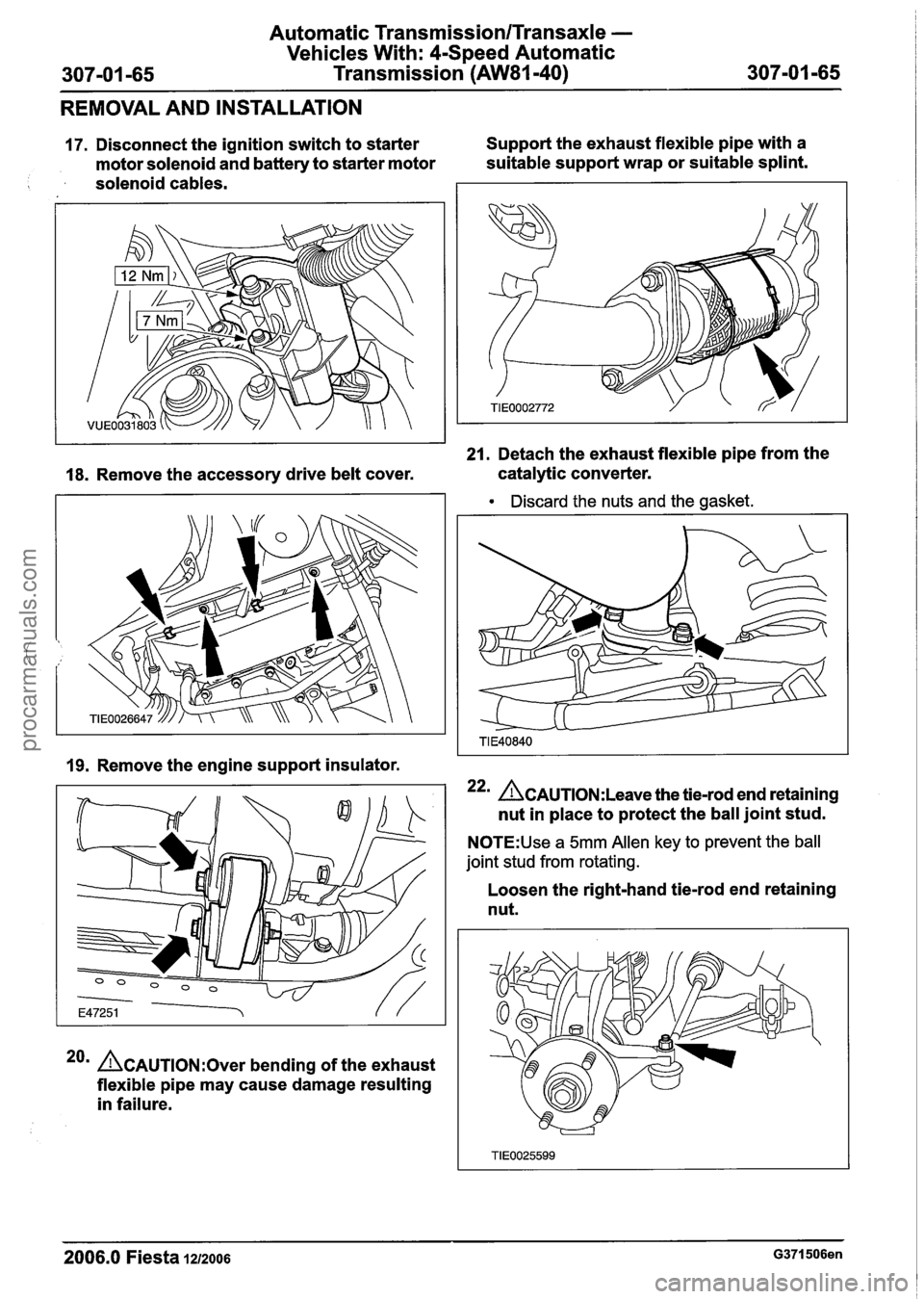
REMOVAL AND INSTALLATION
17. Disconnect the ignition switch to starter Support
the exhaust flexible pipe with a
motor solenoid and battery to starter motor suitable
support wrap or suitable splint.
solenoid cables.
21. Detach the exhaust flexible pipe from the
18. Remove the accessory drive belt cover. catalytic
converter.
Discard the nuts and the gasket.
19. Remove the engine support insulator.
22m &AUTION:L~~~~ the tie-rod end retaining
nut in place to protect the ball joint stud.
N0TE:Use a 5mm Allen key to prevent the ball
joint stud from rotating.
20m ACAUTION:~~~~ bending of the exhaust
flexible pipe may cause damage resulting
in failure. Loosen
the right-hand tie-rod end retaining
nut.
2006.0 Fiesta 1212006 G371506en
procarmanuals.com