Page 4 of 2000
ENGINE - 2AZ-FE ENGINE
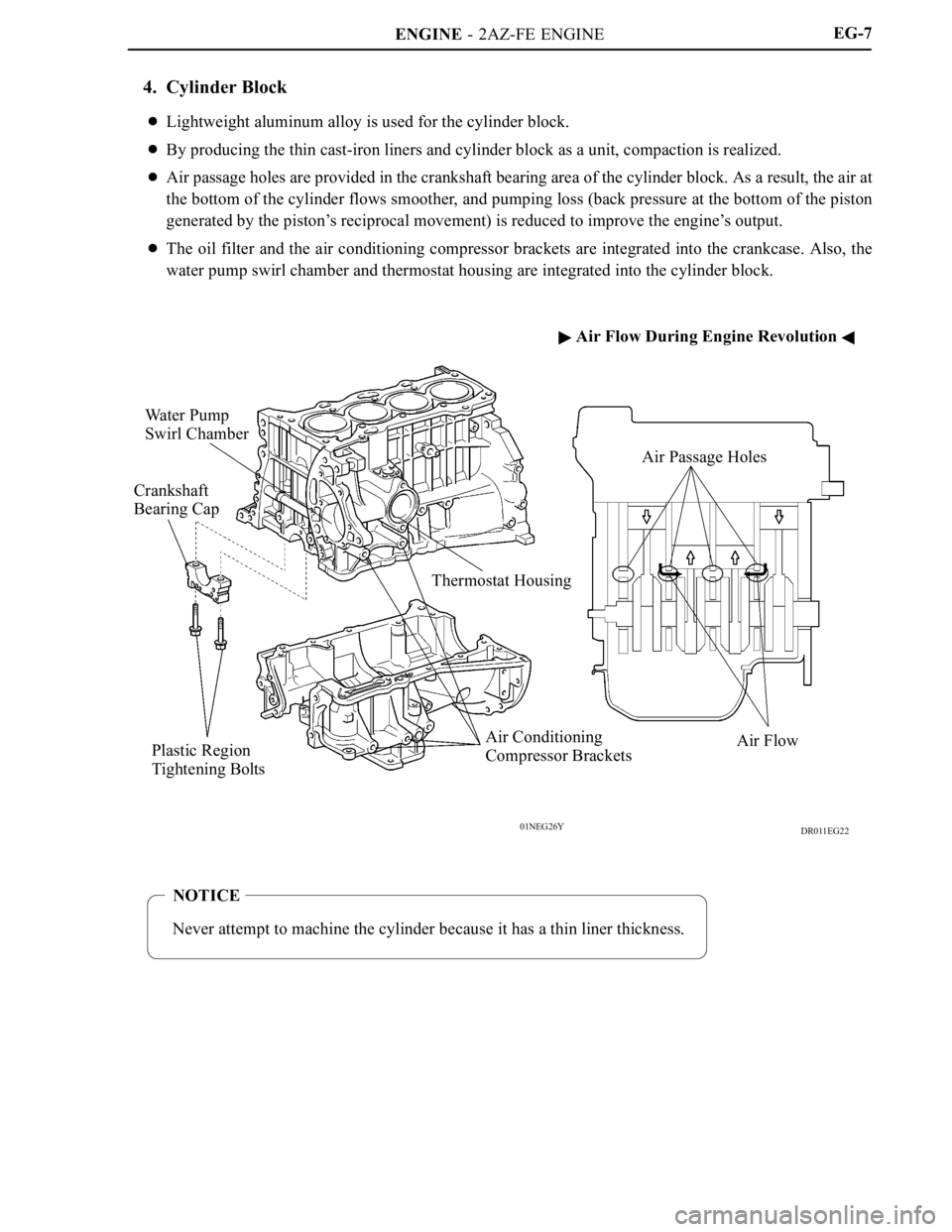
DR011EG22 01NEG26Y
Air Flow During Engine Revolution
Wa t e r P u m p
Swirl Chamber
Crankshaft
Bearing Cap
Plastic Region
Tightening BoltsThermostat Housing
Air Conditioning
Compressor BracketsAir Passage Holes
Air Flow
NOTICE
Never attempt to machine the cylinder because it has a thin liner thickness.
EG-7
4. Cylinder Block
Lightweight aluminum alloy is used for the cylinder block.
By producing the thin cast-iron liners and cylinder block as a unit, compaction is realized.
Air passage holes are provided in the crankshaft bearing area of the cylinder block. As a result, the air at
the bottom of the cylinder flows smoother, and pumping loss (back pressure at the bottom of the piston
generated by the piston’s reciprocal movement) is reduced to improve the engine’s output.
The oil filter and the air conditioning compressor brackets are integrated into the crankcase. Also, the
water pump swirl chamber and thermostat housing are integrated into the cylinder block.
Page 6 of 2000
ENGINE - 2AZ-FE ENGINE
01MEG01Y
Taper Squish Shape : Resin Coating
240EG45
Plastic Region Tightening BoltsEG-9
5. Piston
The piston is made of aluminum alloy and skirt area is made compact and lightweight.
The piston head portion uses a taper squish shape to improve the fuel combustion efficiency.
The piston skirt has been coated with resin to reduce the friction loss.
6. Connecting Rod
The connecting rods and caps are made of
high-strength steel for weight reduction.
Nut-less type plastic region tightening bolts are
used on the connecting rod for a lighter design.
The connecting rod bearings are reduced in
width to reduce friction.
Page 73 of 2000

ENGINE - 2GR-FE ENGINE
285EG14
Knock Pin
Plastic Region
Tightening Bolts
285EG15
Balance Weight
Engine
Front
No. 1 Journal
No. 2 Journal
No. 3 JournalNo. 4 JournalEG-77
6. Connecting Rod and Connecting Rod Bearing
Connecting rods that have been forged for high strength are used for weight reduction.
Knock pins are used at the mating surfaces of the bearing caps of the connecting rod to minimize the
shifting of the bearing caps during assembly.
The connecting rods and caps are made of high-strength steel for weight reduction.
Nutless-type plastic region tightening bolts are used on the connecting rods for a lighter design.
An aluminum bearing is used for the connecting rod bearings.
The connecting rod bearings are reduced in width to reduce friction.
7. Crankshaft
A crankshaft made of forged steel, which excels in rigidity and wear resistance, is used.
The crankshaft has 4 journals and 5 balance weights.
All pin and journal fillets are IH-finished to maintain adequate strength.
Page 74 of 2000
ENGINE - 2GR-FE ENGINE
285EG81
Plastic Region
Tightening Bolts
Crankshaft
Bearing CapSeal WasherUpper Main Bearing
Oil Grooved
Micro-grooved
Lower Main Bearing
285EG80
Torsional Damper
Rubber EG-78
8. Crankshaft Bearing and Crankshaft Bearing Cap
The crankshaft bearing is made of aluminum alloy.
As the connecting rod bearings, the lining surface of the crankshaft bearings is micro-grooved to realize
an optimal amount of oil clearance. As a result, cold-engine cranking performance is improved and engine
vibration is reduced.
The upper main bearing has an oil groove around its inside circumference.
The crankshaft bearing caps are tightened using 4 plastic region tightening bolts for each journal. In
addition, each cap is tightened laterally to improve its reliability.
9. Crankshaft Pulley
The rigidity of the crankshaft pulley with its
built-in torsional damper rubber reduces noise.
Page 76 of 2000

ENGINE - 2GR-FE ENGINE
285EG18
Secondary
Timing
ChainExhaust Camshaft Intake CamshaftsExhaust Camshaft
Roller Rocker Arm
Va l v e S p r i n g
Retainer
Va l v e S p r i n g
Hydraulic
Lash Adjuster
Va l v e G u i d e
Bush Va l v e S p r i n g
Sheet
Va l v e
Secondary Timing
Chain Primary
Timing
Chain EG-80
VA LV E M E C H A N I S M
1. General
Each cylinder of this engine has 2 intake valves and 2 exhaust valves. Intake and exhaust efficiency is
increased due to the larger total port areas.
This engine uses roller rocker arms with built-in needle bearings. This reduces the friction that occurs
between the cams and the areas (roller rocker arms) that push the valves down, thus improving fuel
economy.
A hydraulic lash adjuster, which maintains a constant zero valve clearance through the use of oil pressure
and spring force, is used.
The intake camshafts are driven by the crankshaft via the primary timing chain. The exhaust camshafts
are driven by the intake camshaft of the respective bank via the secondary timing chain.
This engine uses a Dual VVT-i (Variable Valve Timing-intelligent) system which controls the intake and
exhaust camshafts to provide optimal valve timing according to driving conditions. With this adoption,
lower fuel consumption, higher engine performance, and fewer exhaust emissions have been achieved.
For details of Dual VVT-i control, see page EG-120.
Page 181 of 2000
SERVICE SPECIFICATIONS – DIFFERENTIALSS–75
SS
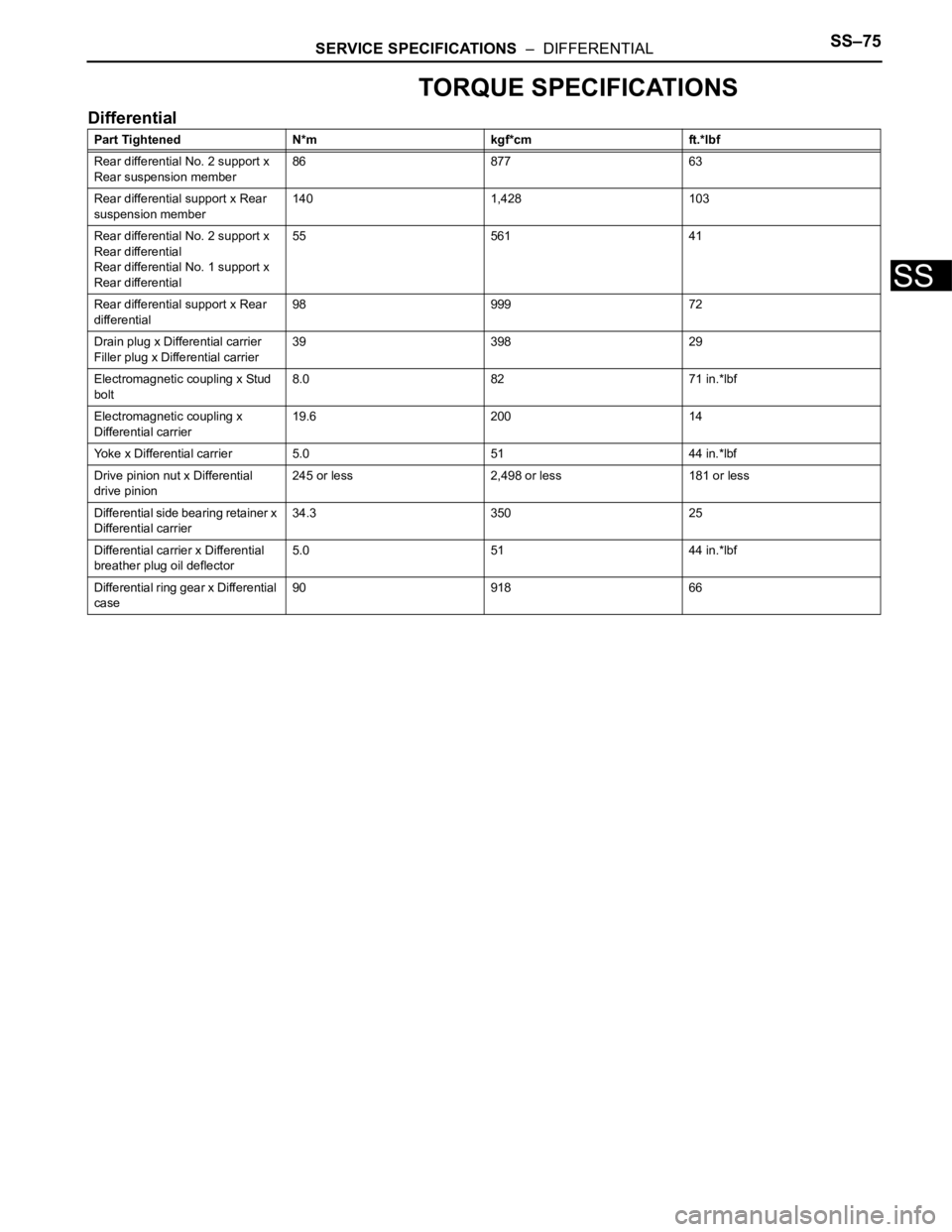
TORQUE SPECIFICATIONS
Differential
Part Tightened N*m kgf*cm ft.*lbf
Rear differential No. 2 support x
Rear suspension member86 877 63
Rear differential support x Rear
suspension member140 1,428 103
Rear differential No. 2 support x
Rear differential
Rear differential No. 1 support x
Rear differential55 561 41
Rear differential support x Rear
differential98 999 72
Drain plug x Differential carrier
Filler plug x Differential carrier39 398 29
Electromagnetic coupling x Stud
bolt8.0 82 71 in.*lbf
Electromagnetic coupling x
Differential carrier19.6 200 14
Yoke x Differential carrier 5.0 51 44 in.*lbf
Drive pinion nut x Differential
drive pinion245 or less 2,498 or less 181 or less
Differential side bearing retainer x
Differential carrier34.3 350 25
Differential carrier x Differential
breather plug oil deflector5.0 51 44 in.*lbf
Differential ring gear x Differential
case90 918 66
Page 199 of 2000
EM–242GR-FE ENGINE MECHANICAL – ENGINE ASSEMBLY
EM
(b) 4WD:
Disconnect the control cable (see page AX-154).
31. REMOVE FRONT EXHAUST PIPE ASSEMBLY (See
page EX-3)
32. REMOVE CENTER EXHAUST PIPE ASSEMBLY (See
page EX-2)
33. REMOVE PROPELLER WITH CENTER BEARING
SHAFT ASSEMBLY (See page PR-3)
34. REMOVE FRONT WHEELS
35. REMOVE FRONT AXLE HUB NUT LH
(a) Remove the hub nut (see page AH-8).
36. REMOVE FRONT AXLE HUB NUT RH
(a) Remove the hub nut (see page AH-8).
37. DISCONNECT FRONT STABILIZER LINK ASSEMBLY
LH (See page SP-30)
38. DISCONNECT FRONT STABILIZER LINK ASSEMBLY
RH (See page SP-30)
39. DISCONNECT STEERING INTERMEDIATE SHAFT
(See page PS-44)
40. DISCONNECT TIE ROD END SUB-ASSEMBLY RH
(See page PS-42)
41. DISCONNECT TIE ROD END SUB-ASSEMBLY LH
(See page PS-42)
42. REMOVE FRONT DRIVE SHAFT LH
(a) 2WD:
Remove the drive shaft (see page DS-10).
(b) 4WD:
Remove the drive shaft (see page DS-43).
43. REMOVE FRONT DRIVE SHAFT RH
(a) 2WD:
Remove the drive shaft (see page DS-10).
(b) 4WD:
Remove the drive shaft (see page DS-43).
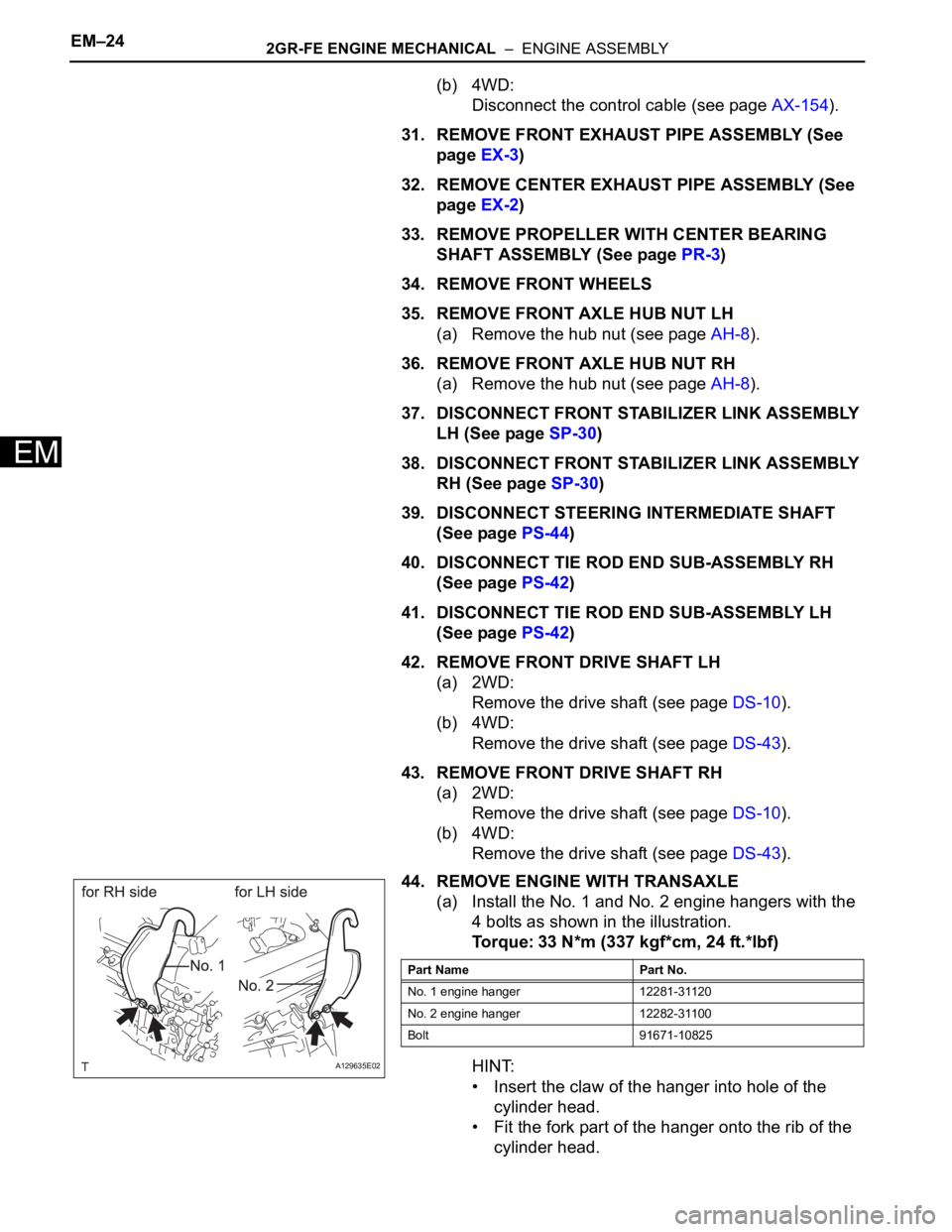
44. REMOVE ENGINE WITH TRANSAXLE
(a) Install the No. 1 and No. 2 engine hangers with the
4 bolts as shown in the illustration.
Torque: 33 N*m (337 kgf*cm, 24 ft.*lbf)
HINT:
• Insert the claw of the hanger into hole of the
cylinder head.
• Fit the fork part of the hanger onto the rib of the
cylinder head.
A129635E02
Part Name Part No.
No. 1 engine hanger 12281-31120
No. 2 engine hanger 12282-31100
Bolt 91671-10825
Page 204 of 2000
2GR-FE ENGINE MECHANICAL – ENGINE ASSEMBLYEM–29
EM
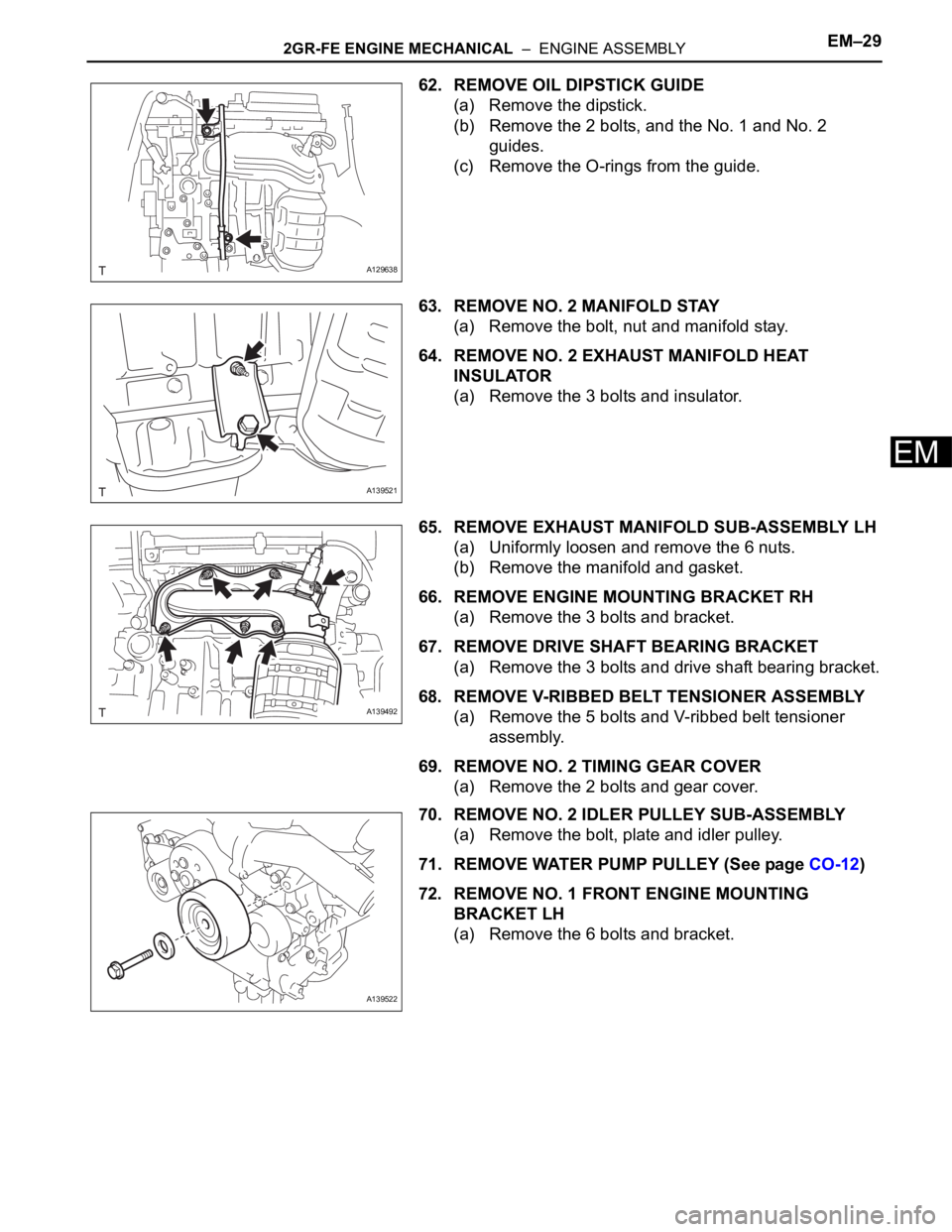
62. REMOVE OIL DIPSTICK GUIDE
(a) Remove the dipstick.
(b) Remove the 2 bolts, and the No. 1 and No. 2
guides.
(c) Remove the O-rings from the guide.
63. REMOVE NO. 2 MANIFOLD STAY
(a) Remove the bolt, nut and manifold stay.
64. REMOVE NO. 2 EXHAUST MANIFOLD HEAT
INSULATOR
(a) Remove the 3 bolts and insulator.
65. REMOVE EXHAUST MANIFOLD SUB-ASSEMBLY LH
(a) Uniformly loosen and remove the 6 nuts.
(b) Remove the manifold and gasket.
66. REMOVE ENGINE MOUNTING BRACKET RH
(a) Remove the 3 bolts and bracket.
67. REMOVE DRIVE SHAFT BEARING BRACKET
(a) Remove the 3 bolts and drive shaft bearing bracket.
68. REMOVE V-RIBBED BELT TENSIONER ASSEMBLY
(a) Remove the 5 bolts and V-ribbed belt tensioner
assembly.
69. REMOVE NO. 2 TIMING GEAR COVER
(a) Remove the 2 bolts and gear cover.
70. REMOVE NO. 2 IDLER PULLEY SUB-ASSEMBLY
(a) Remove the bolt, plate and idler pulley.
71. REMOVE WATER PUMP PULLEY (See page CO-12)
72. REMOVE NO. 1 FRONT ENGINE MOUNTING
BRACKET LH
(a) Remove the 6 bolts and bracket.
A129638
A139521
A139492
A139522