Page 85 of 2000

ENGINE - 2GR-FE ENGINE
285EG29
Timing Chain Cover
Wa t e r P u m p G a s k e t
Wa t e r P u m pVolute ChambersFrom Water Inlet Housing
Rotor
View from Back Side
Cross SectionEG-89
Engine Coolant Specifications
Engine
Ty p e
TOYOTA genuine Super Long Life Coolant
(SLLC) or similar high quality ethylene glycol
based non-silicate, non-amine, non-nitrite and
non-borate coolant with long-life hybrid
organic acid technology (coolant with
long-life hybrid organic acid technology is a
combination of low phosphates and organic
acids.) Do not use plain water alone.
Engine
CoolantColorPink
Capacity
Except Towing
Package Models8.9 Liters (9.4 US qts, 7.8 Imp. qts)
CapacityTowing Package
Models9.2 Liters (9.7 US qts, 8.1 Imp. qts)
Maintenance IntervalsFirst Time100,000 miles (160,000 km)Maintenance IntervalsSubsequentEvery 50,000 miles (80,000 km)
SLLC is pre-mixed (the U.S.A. models: 50 % coolant and 50 % deionized water, the Canada. models: 55
% coolant and 45 % deionized water), so no dilution is needed when SLLC in the vehicle is added or
replaced.
If LLC is mixed with SLLC, the interval for LLC (every 25,000 miles (USA), 32,000 km (CANADA) or
24 months whichever comes first) should be used.
2. Water Pump
The water pump has two volute chambers, and circulates coolant uniformly to the left and right banks of the
cylinder block.
Page 118 of 2000

ENGINE - 2GR-FE ENGINE
271EG93
Timing RotorHousingLock PinSprocket
Intake Camshaft
Vane (Fixed on Intake Camshaft)
Oil Pressure
In Operation At a Stop
Lock Pin
281EG47
Housing
Advanced Angle Assist SpringVane (Fixed on Exhaust Camshaft)Lock PinExhaust Camshaft Sprocket EG-122
Construction
1) VVT-i Controller
This controller consists of the housing driven by the timing chain and the vane coupled with the intake
and exhaust camshafts.
The intake side uses a VVT-i controller with 3 vanes, and the exhaust side uses one with 4 vanes.
When the engine stops, the intake side VVT-i controller is locked on the most retarded angle side by
the lock pin, and the exhaust side VVT-i controller is locked on the most advanced angle side. This
ensures excellent engine startability.
The oil pressure sent from the advance or retard side path at the intake and exhaust camshaft causes
rotation in the VVT-i controller vane circumferential direction to vary the intake valve timing
continuously.
An advanced angle assist spring is provided on the exhaust side VVT-i controller. This helps to apply
torque in the advanced angle direction so that the vane lock pin securely engages with the housing
when the engine stops.
Intake Side VVT-i Controller
Exhaust Side VVT-i Controller
Page 133 of 2000

CHASSIS - 4WD SYSTEM CH-66
4WD SYSTEM
DESCRIPTION
The 4WD system of the ’06 RAV4 uses an active torque control 4WD system.
It is a compact, lightweight, and high performance 4WD system that optimally controls the torque
distribution to the front and rear wheels through the electric control coupling in the rear differential.
ACTIVE TORQUE CONTROL 4WD SYSTEM
1. General
Based on information provided by various sensors, the 4WD ECU controls the amperage that is applied
to the electric control coupling, in order to transmit drive torque to the rear wheels when needed, and in
the amount needed. The following describes the features of the active torque control 4WD system.
Traction performance
Realizes stable start-off and acceleration performance
Driving stability performanceRealizes stable cornering performance
Fuel economyRealizes better fuel economy by transmitting drive torque to the rear
wheels when needed, in the amount needed.
A four-wheel drive lock switch has been provided. This enables the driver to select between the AUTO
and LOCK modes by operating the switch. The system optimally controls the torque distribution to the
front and rear wheels in the respective modes.
Mode
Four-wheel Drive
Lock Switch and
Indicator Light
Outline
AUTOOFF
Optimally distributes drive torque to the front and rear wheels.
Ensures optimal start-off performance during a start-off, based on
information provided by various sensors.
Suppresses the tight corner braking phenomenon* during low-speed
cornering.
Reduces the amount of torque distribution to the rear wheels and
improves fuel economy when the system judges that the vehicle is
traveling steadily.
Disengages the 4WD during braking deceleration.
LOCKON
Distributes the maximum torque limit to the rear wheels.
Distributes the maximum torque limit to the rear wheels during
start-off.
Distributes optimal torque during low-speed cornering.
Disengages the 4WD during braking deceleration.
Disengages the LOCK mode and transfers to the AUTO mode when
the vehicle speed exceeds 40 km / h (25 mph).
*: Tight corner braking phenomenon: a condition in which the brakes are applied due to a rotational difference
between the front and rear wheels, such as during low-speed cornering in the 4WD mode.
The 4WD ECU effects cooperative control with the skid control ECU, in order to control the drive torque
distribution to the front and rear wheels in accordance with information received from the skid control
ECU. These controls ensure a smooth acceleration and driving stability.
Page 134 of 2000
CHASSIS - 4WD SYSTEM
01MCH09Y
Electric Control Coupling
4WD ECU
Four-wheel Drive
Lock Switch
4WD LOCK
Indicator Light
4WD Warning
LightECM
Skid Control ECU
Main Body ECU
Ya w R a t e &
Deceleration Sensor
Steering Angle
SensorThrottle Position Sensor
Crankshaft Position Sensor
Park / Neutral Position
Switch
Speed Sensors
Stop Light Switch
Ambient Temperature
Sensor
Parking Brake Switch
CANH,
CANLCH-67
2. System Diagram
Page 135 of 2000
CHASSIS - 4WD SYSTEM
01NCH36Y
Skid Control ECU
Electric Control Coupling
ECM Ambient Temperature
Sensor
Main Body ECUSteering Angle
Sensor
Four-wheel Drive
Lock Switch
4WD ECU
Parking Brake
Switch Stop Light Switch
Yaw Rate & Deceleration
Sensor DLC3 CH-68
3. Layout of Main Components
Page 136 of 2000

CHASSIS - 4WD SYSTEMCH-69
4. Function of Main Components
ComponentFunction
Combination
4WD LOCK
Indicator LightIlluminates to inform the driver of the 4WD LOCK mode control.Combination
Meter4WD
Warning LightIlluminates to warn the driver of a malfunction in the 4WD system.
Speed Sensor (4)Detects the wheel speed of each 4 wheel.
Steering Angle SensorDetects the direction and angle of the steering wheel.
Yaw Rate & Deceleration SensorDetects the vehicle’s longitudinal and lateral acceleration.
Crankshaft Position SensorDetects the engine speed and outputs it to the ECM.
Accelerator Pedal Position SensorDetects the accelerator pedal position and outputs it to the ECM.
Throttle Position SensorDetects the throttle valve position and outputs it to the ECM.
Park / Neutral Position SwitchDetects the neutral position of the transaxle and outputs it to the
ECM.
Stop Light SwitchDetects the brake pedal depressing signal.
Parking Brake SwitchDetects when the parking brake lever is pulled up.
Four-wheel Drive Lock SwitchSwitches between the AUTO and LOCK modes.
4WD ECU
Controls the amperage that is applied to the electromagnetic
solenoid of the electric control coupling based on the signals
provided by the sensors in order to optimally distribute drive torque
in accordance with driving conditions.
ECMOutputs signals such as the shift position signal, throttle position
signal, and crankshaft position signal to the 4WD ECU.
Skid Control ECUOutputs signals such as the vehicle speed signal and deceleration
signal to the 4WD ECU.
Electric Control CouplingDistributes drive torque in accordance with the amperage applied
by the 4WD ECU.
Page 137 of 2000

CHASSIS - 4WD SYSTEM
01NCH38Y
Torque Distribution
to Rear WheelsTorque Distribution
to Rear Wheels
Straightline Driving Low-Speed Cornering
01NCH39Y
Torque Distribution
to Rear WheelsTorque Distribution
to Rear Wheels
Steady Driving Straightline Acceleration
NOTICE
In the LOCK mode after the four-wheel drive lock switch is pressed, the system starts control upon
judging that the vehicle is operating in a stable manner. During this judgment, the 4WD LOCK
indicator light blinks.
CH-70
5. System Operation
Auto Mode
1) Starting Off
The system ensures start-off performance by optimally distributing the entire drive torque, which is
transmitted by the engine, to the front and rear wheels.
To prevent the tight corner braking phenomenon from occurring during low-speed cornering, the
system reduces the amount of torque distribution to the rear wheels.
2) Normal Driving
During normal driving, when the system judges that the vehicle is traveling steadily, it reduces the
amount of torque distribution to the rear wheels. This allows the vehicle to operate in conditions
similar to front-wheel-drive, which improves fuel economy.
To ensure excellent acceleration performance during straightline acceleration and excellent driving
stability during cornering, the system controls the amount of torque distribution to the rear wheels.
Lock Mode
When the vehicle is in a situation that poses difficulty for it to pull itself out, such as sand, the driver can
switch to LOCK mode by operating the four-wheel drive lock switch. Thus, this mode effects optimal
control in accordance with the driving conditions and transmits as much drive torque as possible to the rear
wheels, in a mode that is similar to the locked 4WD mode.
Page 169 of 2000
IN–24INTRODUCTION – REPAIR INSTRUCTION
IN
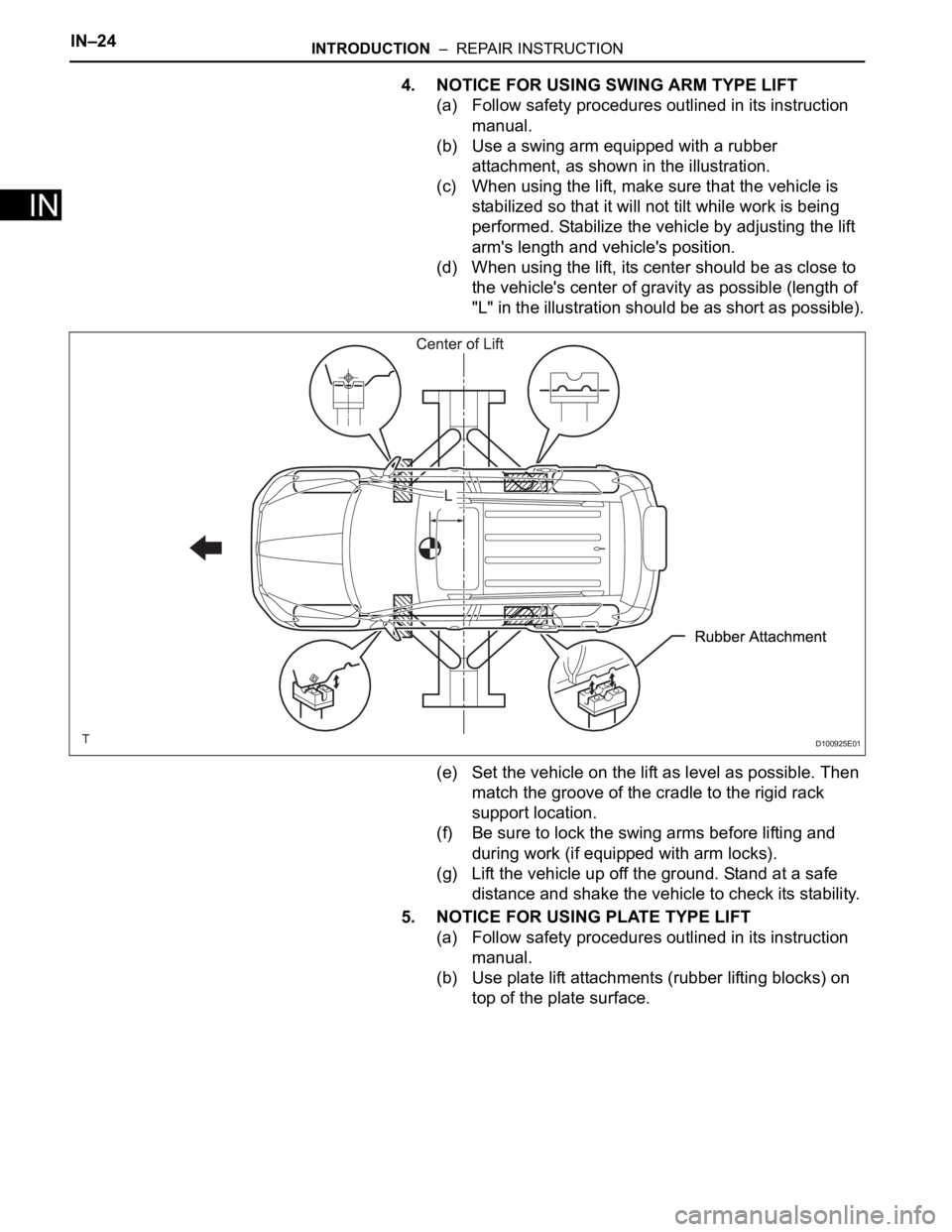
4. NOTICE FOR USING SWING ARM TYPE LIFT
(a) Follow safety procedures outlined in its instruction
manual.
(b) Use a swing arm equipped with a rubber
attachment, as shown in the illustration.
(c) When using the lift, make sure that the vehicle is
stabilized so that it will not tilt while work is being
performed. Stabilize the vehicle by adjusting the lift
arm's length and vehicle's position.
(d) When using the lift, its center should be as close to
the vehicle's center of gravity as possible (length of
"L" in the illustration should be as short as possible).
(e) Set the vehicle on the lift as level as possible. Then
match the groove of the cradle to the rigid rack
support location.
(f) Be sure to lock the swing arms before lifting and
during work (if equipped with arm locks).
(g) Lift the vehicle up off the ground. Stand at a safe
distance and shake the vehicle to check its stability.
5. NOTICE FOR USING PLATE TYPE LIFT
(a) Follow safety procedures outlined in its instruction
manual.
(b) Use plate lift attachments (rubber lifting blocks) on
top of the plate surface.
D100925E01