Page 47 of 2000

ENGINE - 2AZ-FE ENGINE
169EG36
HousingLock Pin
Intake Camshaft
Vane (Fixed on Intake Camshaft)
Oil Pressure
At a Stop In Operation
Lock Pin
221EG17
To VVT-i Controller
(Advance Side)To V V T- i C o n t r o l l e r
(Retard Side)
Sleeve
Spring
Drain
Oil PressureDrain
Spool ValveCoil
Plunger EG-50
Construction
1) VVT-i Controller
This controller consists of the housing driven by the timing chain and the vane fixed on the intake
camshaft.
The oil pressure sent from the advance or retard side path at the intake camshaft causes rotation in the
VVT-i controller vane circumferential direction to vary the intake valve timing continuously.
When the engine is stopped, the intake camshaft will be in the most retarded state to ensure startability.
When hydraulic pressure is not applied to the VVT-i controller immediately after the engine has been
started, the lock pin locks the movement of the VVT-i controller to prevent a knocking noise.
2) Camshaft Timing Oil Control Valve
This camshaft timing oil control valve controls the spool valve position in accordance with the duty-cycle
control from the ECM. This allows hydraulic pressure to be applied to the VVT-i controller advance or
retard sides. When the engine is stopped, the camshaft timing oil control valve is in the most retarded
state.
Page 67 of 2000

ENGINE - 2GR-FE ENGINEEG-71
FEATURES OF 2GR-FE ENGINE
The 2GR-FE engine has achieved the following performance through the use of the items listed below.
(1) High performance and reliability
(2) Low noise and vibration
(3) Lightweight and compact design
(4) Good serviceability
(5) Clean emission and fuel economy
Item
(1)(2)(3)(4)(5)
A steel laminate type cylinder head gasket is used.
An upright intake port is used.
EngineA taper squish shape is used for combustion chamber.Engine
ProperA cylinder block made of aluminum alloy is used.Proper
The skirt portion of the piston is applied with resin to
reduce friction.
An oil pan No. 1 made of aluminum alloy is used.
The Dual VVT-i (Variable Valve Timing-intelligent)
system is used.
Va l v e
Mh i
Hydraulic lash adjusters are used.
MechanismTiming chains and chain tensioners are used.
Roller rocker arms are used.
Lubrication
SystemAn oil filter with a replaceable element is used.
Cooling SystemThe TOYOTA Genuine SLLC (Super Long Life Coolant)Cooling SystemThe TOYOTA Genuine SLLC (Super Long Life Coolant)
is used for the engine coolant.
The linkless-type throttle body is used.
Intake andThe intake air chamber made of plastic is used.Intake and
Exhaust
S
A stainless steel exhaust manifold is used.
SystemAn ultra thin-wall, high-cell density ceramic type TWC
(Three-Way Catalytic converter) is used.
The fuel delivery pipe made of plastic is used.
Fuel SystemA compact 12-hole type injector is used.Fuel SystemQuick connectors are used to connect the fuel hose with
the fuel pipe.
Ignition System
The DIS (Direct Ignition System) makes ignition timing
adjustment unnecessary.
Ignition System
The long-reach type spark plugs are used.
(Continued)
Page 71 of 2000
ENGINE - 2GR-FE ENGINE
285EG10 285EG09
60
Knock Sensor Bosses
36.6 mm
(1.441 in.)
105.5 mm
(4.15 in.)
View from Top Side
285EG11
Wa t e r P a s s a g eEG-75
4. Cylinder Block
The cylinder block is made of aluminum alloy, so it is lightweight.
The cylinder block has a bank angle of 60, a bank offset of 36.6 mm (1.441 in.) and a bore pitch of 105.5
mm (4.15 in.), resulting in a compact block in its length and width even for its displacement.
Installation bosses of the two knock sensors are located on the inside of left and right banks.
A water passage has been provided between the cylinder bores. By allowing the engine coolant to flow
between the cylinder bores, this construction enables the temperature of the cylinder walls to be kept
uniform.
Page 72 of 2000

ENGINE - 2GR-FE ENGINE
285EG12
Liner
Cylinder
Block
Irregularly shaped
outer casting
surface of liner A
A
A - A Cross Section
285EG13
Front MarkResin CoatingTaper Squish Shape
Alumite
Coating EG-76
A compact block has been achieved by producing the thin cast-iron liners and cylinder block as a unit. It
is not possible to bore the block with this liner.
The liners are the spiny-type, which have been manufactured so that their casting exteriors form large
irregular surfaces in order to enhance the adhesion between the liners and the aluminum cylinder block.
The enhanced adhesion helps improve heat dissipation, resulting in a lower overall temperature and heat
deformation of the cylinder bores.
5. Piston
The piston is made of aluminum alloy.
The piston head portion uses a taper squish shape to accomplish fuel combustion efficiency.
The piston skirt is coated with resin to reduce the friction loss.
The groove of the top ring is coated with alumite to ensure wear resistance.
By increasing the machining precision of the cylinder bore diameter, the outer diameter of the piston is
made into one size.
Page 75 of 2000
ENGINE - 2GR-FE ENGINE
285EG16
Oil Pan No. 1
Oil Filter Case Oil Pan No. 2EG-79
10. Oil Pan
The oil pan No. 1 is made of aluminum alloy.
The oil pan No. 2 is made of steel.
The oil pan No. 1 is secured to the cylinder block and the transmission housing and is increasing rigidity.
The oil filter case is integrated with the oil pan No. 1.
Page 81 of 2000
ENGINE - 2GR-FE ENGINE
285EG77
Main Oil Hole
Cylinder Head
(for Left Bank)
Oil
Filter
Exhaust
Camshaft
Timing OCV*
Intake
Camshaft
Timing OCV*
Oil
PumpExhaust
VVT-i
Controller
Intake
VVT-i
Controller
Relief
Va l v e
Cylinder Head
(for Right Bank)
Exhaust
Camshaft
Timing OCV*
Intake
Camshaft
Timing OCV*
Exhaust
VVT-i
Controller
Intake
VVT-i
Controller
Secondary
Chain
TensionerPrimary
Chain
Tensioner
Secondary
Chain
Tensioner
Cylinder
Block
Crankshaft
Journal
Crankshaft
Pins
Connecting
Rods
Cylinder Head
(for Left Bank)
Oil
Jets
Intake
Camshaft
Journal
Exhaust
Camshaft
Journal
Lash
Adjuster
Cylinder Head
(for Right Bank)
Intake
Camshaft
Journal
Exhaust
Camshaft
Journal
Lash
Adjuster
Oil PanEG-85
Oil Circuit
*: Oil Control Valve
Page 82 of 2000
ENGINE - 2GR-FE ENGINE
285EG24
Timing Chain Cover
Oil Pump
Housing
Oil Pump Rotors
(Cycloid Rotor)Crankshaft
To Cylinder
Block
From Oil
Filter
To
Oil FilterFrom
Oil Strainer
Oil passage in the oil pump
285EG25
Oil Jet Cross Section
Oil JetsCheck
Va l v eEngine Oil EG-86
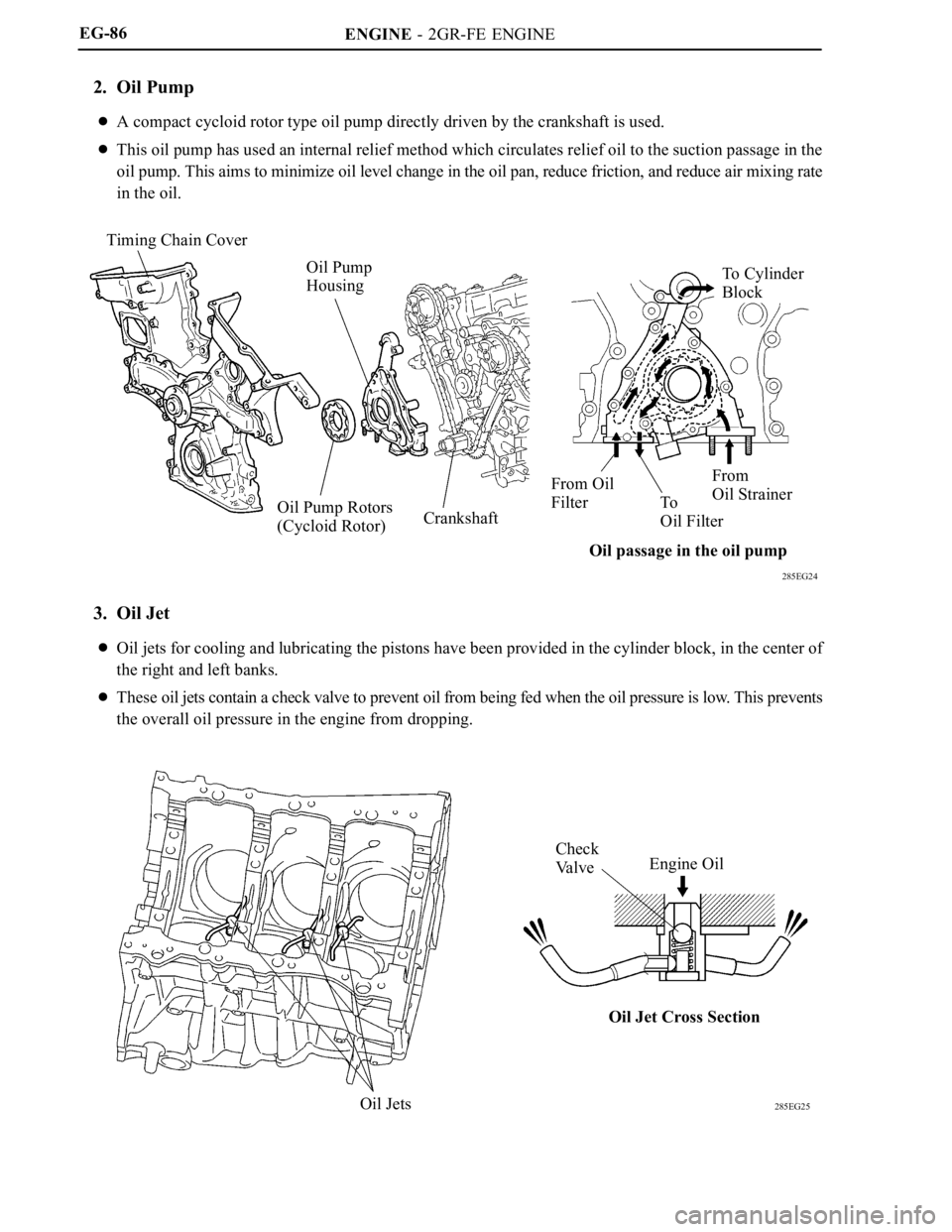
2. Oil Pump
A compact cycloid rotor type oil pump directly driven by the crankshaft is used.
This oil pump has used an internal relief method which circulates relief oil to the suction passage in the
oil pump. This aims to minimize oil level change in the oil pan, reduce friction, and reduce air mixing rate
in the oil.
3. Oil Jet
Oil jets for cooling and lubricating the pistons have been provided in the cylinder block, in the center of
the right and left banks.
These oil jets contain a check valve to prevent oil from being fed when the oil pressure is low. This prevents
the overall oil pressure in the engine from dropping.
Page 84 of 2000
ENGINE - 2GR-FE ENGINE
285EG27
Air Bleeder PlugTo Throttle Body
From Throttle Body
To H e a t e r
From Heater
To Radiator
From Radiator Thermostat
Opening Temperature:
80 - 84
C (176 - 183F)
01MEG35Y
ThermostatBypass Pipe
Heater Return Pipe
Air Bleeder Plug
Cylinder Head
Cylinder Block
Wa t e r P u m p
Radiator
Throttle
Body
Heater
Reservoir
Ta n k
EG-88
COOLING SYSTEM
1. General
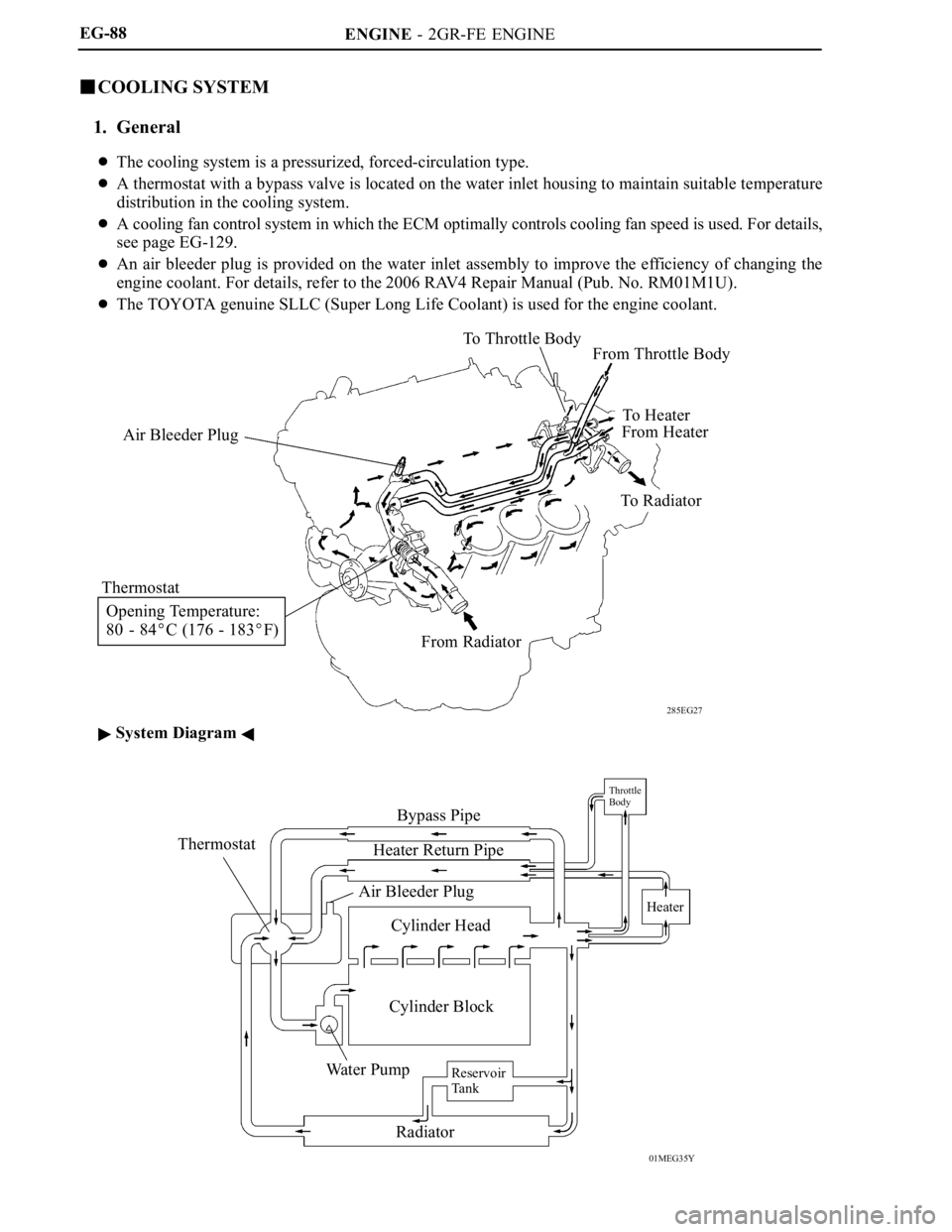
The cooling system is a pressurized, forced-circulation type.
A thermostat with a bypass valve is located on the water inlet housing to maintain suitable temperature
distribution in the cooling system.
A cooling fan control system in which the ECM optimally controls cooling fan speed is used. For details,
see page EG-129.
An air bleeder plug is provided on the water inlet assembly to improve the efficiency of changing the
engine coolant. For details, refer to the 2006 RAV4 Repair Manual (Pub. No. RM01M1U).
The TOYOTA genuine SLLC (Super Long Life Coolant) is used for the engine coolant.
System Diagram