2006 SUZUKI SX4 PPL
[x] Cancel search: PPLPage 730 of 1556
Downloaded from www.Manualslib.com manuals search engine 5A-82 Automatic Transmission/Transaxle:
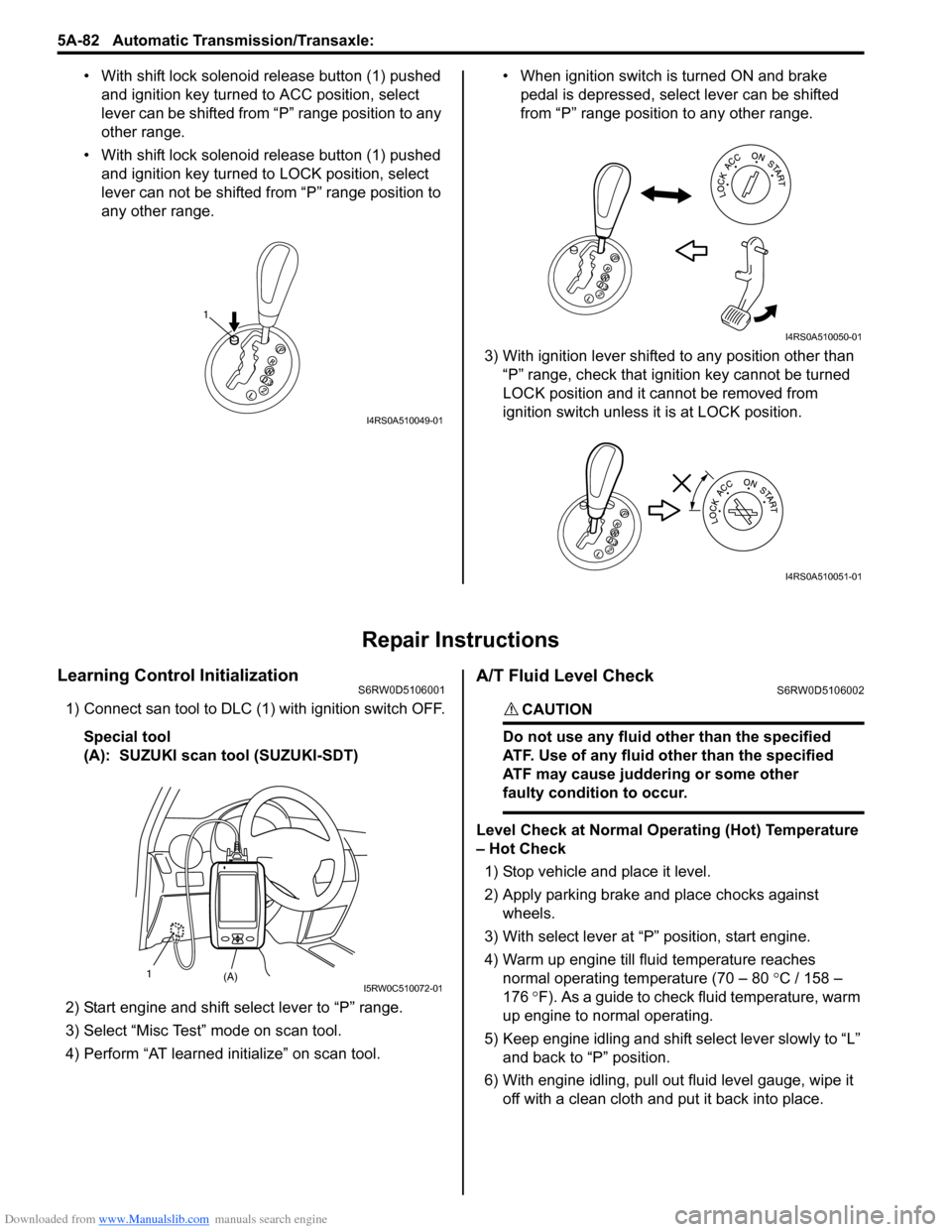
• With shift lock solenoid release button (1) pushed
and ignition key turned to ACC position, select
lever can be shifted from “P” range position to any
other range.
• With shift lock solenoid release button (1) pushed
and ignition key turned to LOCK position, select
lever can not be shifted from “P” range position to
any other range.• When ignition switch is turned ON and brake
pedal is depressed, select lever can be shifted
from “P” range position to any other range.
3) With ignition lever shifted to any position other than
“P” range, check that ignition key cannot be turned
LOCK position and it cannot be removed from
ignition switch unless it is at LOCK position.
Repair Instructions
Learning Control InitializationS6RW0D5106001
1) Connect san tool to DLC (1) with ignition switch OFF.
Special tool
(A): SUZUKI scan tool (SUZUKI-SDT)
2) Start engine and shift select lever to “P” range.
3) Select “Misc Test” mode on scan tool.
4) Perform “AT learned initialize” on scan tool.
A/T Fluid Level CheckS6RW0D5106002
CAUTION!
Do not use any fluid other than the specified
ATF. Use of any fluid other than the specified
ATF may cause juddering or some other
faulty condition to occur.
Level Check at Normal Operating (Hot) Temperature
– Hot Check
1) Stop vehicle and place it level.
2) Apply parking brake and place chocks against
wheels.
3) With select lever at “P” position, start engine.
4) Warm up engine till fluid temperature reaches
normal operating temperature (70 – 80 °C / 158 –
176 °F). As a guide to check fluid temperature, warm
up engine to normal operating.
5) Keep engine idling and shift select lever slowly to “L”
and back to “P” position.
6) With engine idling, pull out fluid level gauge, wipe it
off with a clean cloth and put it back into place.
1
I4RS0A510049-01
I4RS0A510050-01
I4RS0A510051-01
(A) 1I5RW0C510072-01
Page 734 of 1556

Downloaded from www.Manualslib.com manuals search engine 5A-86 Automatic Transmission/Transaxle:
Select Cable ComponentsS6RW0D5106006
Select Cable Removal and InstallationS6RW0D5106007
Removal
1) Remove console box referring to “Console Box
Components in Section 9H”.
2) Disconnect select cable from select lever and then
detach from bracket.
3) Remove clip and disconnect select cable from
manual select lever.
4) Remove select cable retainer from dash panel.
Installation
Install select cable by reversing removal procedure.
The important steps in installation are as follows.
• Apply grease to pin and cable joint.
• Tighten bolts to specified torque referring to “Select
Cable Components”.• Adjusting procedure is as follows. Refer to “Select
Cable Adjustment”.Select Cable AdjustmentS6RW0D5106008
1) Shift manual shift lever to “N” range (transmission
range sensor “N” range).
(a)
(b)
(c)
6
7A
112
[B]
[B] [A]
[A]
34
5
9
8
101
A
I5RW0C510031-01
[A]: View [A] 5. Clip 11. Radiator inlet hose
[B]: View [B] 6. Manual select lever pin
: Apply lithium grease 99000-25011 to all around pin (0.15 g):23 N⋅m (2.0 kgf-m, 17.0 lb-ft)
1. Select lever assembly 7. Select lever pin
: Apply lithium grease 99000-25011 to all around pin (0.15 g):6.5 N⋅m (0.65 kgf-m, 5.0 lb-ft)
2. Select cable 8. Adjuster case : 13 N⋅m (1.3 kgf-m, 9.5 lb-ft)
3. Cable bracket 9. Lock
4. Manual select lever 10. P/S control module
“P”“R”“N”
“D”
“2”
“L”
I2RH0B510040-01
Page 735 of 1556

Downloaded from www.Manualslib.com manuals search engine Automatic Transmission/Transaxle: 5A-87
2) Remove adjuster (cable end) from select lever pin of
select lever assembly.
3) Remove adjuster (cable end) from select lever pin of
select lever assembly.
4) Release lock plate (1) which restrict moving of cable
end holder (2).
5) Push cable end holder (1) out from eye-end (2) using
an appropriate tool (3) to disengage cable.
6) Shift select lever to “N” position.
7) Apply grease to select lever pin and install adjuster
(cable end) to it.
: Grease 99000–25011 (SUZUKI Super Grease
A)
8) With both select lever and transmission range
sensor kept each “N” position, drive cable end holder
(1) in until it locks cable.
9) Slide lock plate (2) to secure cable end holder in
position.
10) After select cable was installed, check for the
following.
• Push vehicle with select lever shifted to “P” range.
Vehicle should not move.
• Vehicle can not be driven in “N” range.• Vehicle can be driven in “D”, “3”, “2” and “L”
ranges.
• Vehicle can be backed in “R” range.
Key Interlock Cable Removal and InstallationS6RW0D5106026
NOTE
Don’t bend interlock cable excessively when
removing and installing it, or system will not
operate correctly.
Removal
1) If the vehicle is equipped with air bag system,
disconnect negative cable at battery and disable air
bag system, referring to “Disabling Air Bag System in
Section 8B”.
2) Remove steering column cover.
3) Turn ignition switch to ACC position.
4) Pull out key interlock cable (1) from key cylinder
cover (2) while pressing checkhook with slotted
screwdriver (3) or the like.
5) Turn ignition switch to LOCK position.
6) Remove console box referring to “Console Box
Components in Section 9H”.
7) Detach cable end (1) from interlock cam (2) while
pressing claws (3) of interlock cam boss.
At this time, be careful not to cause damage to its
claws.
Detach cable casing cap (4) from bracket (5) while
pressing checkhook.
8) Remove interlock cable.
I2RH01510046-01
I2RH01510047-01
I3RM0B510037-01
2
13I5RW0C510045-01
4
5 3 12
4
I5RW0C510046-01
Page 738 of 1556

Downloaded from www.Manualslib.com manuals search engine 5A-90 Automatic Transmission/Transaxle:
3) Check that engine starts in “N” and “P” ranges but it
doesn’t start in “D”, “2”, “L” or “R” range. Also, check
that back-up lamp lights in “R” range.
If faulty condition cannot be corrected by adjustment,
disconnect transmission range sensor connector
and check that continuity exists as shown by moving
manual select lever.
Output Shaft Speed Sensor (VSS) Removal and
Installation
S6RW0D5106010
Removal
1) Disconnect negative cable at battery.
2) Disconnect output shaft speed sensor connector (2).
3) Remove output shaft speed sensor (VSS) (1) by
removing its bolt.
Installation
1) Apply A/T fluid to output shaft speed sensor O-ring.
2) Install output shaft speed sensor (VSS) (1) to A/T
case and tighten bolt to specified torque.
Tightening torque
Output shaft speed sensor (VSS) bolt (a): 13
N·m (1.3 kgf-m, 9.5 lb-ft)3) Connect output shaft speed sensor connector (2) to
output shaft speed sensor (VSS) (1).
4) Connect negative cable to battery.
Output Shaft Speed Sensor (VSS) InspectionS6RW0D5106011
1) Connect positive cable of 12 volt battery to “A”
terminal of sensor and ground cable to “C” terminal.
Then using voltmeter, check voltage between “B”
terminal and “C” terminal with output shaft speed
sensor (VSS) driven gear rotated.
If measured voltage (pulse signal) is not as
specified, replace sensor.
Output shaft speed sensor (VSS) output voltage
Pulse signal of alternating 0 – 1 V and 10 – 14 V
2) Check output shaft speed sensor (VSS) driven gear
(1) for wear.
Replace if necessary.
1 2
3
4
5
9
87
6
1
P
R
N
D
2
LTerminal No.
Sensor Position
23456789
I3RH0A510038-01
12I5RW0C510032-01
(a)
12
I5RW0C510033-01
I2RH0B510045-01
I2RH0B510046-01
Page 739 of 1556

Downloaded from www.Manualslib.com manuals search engine Automatic Transmission/Transaxle: 5A-91
Input Shaft Speed Sensor Removal and
Installation
S6RW0D5106012
Removal
1) Disconnect negative cable at battery.
2) Disconnect input shaft speed sensor connector (2).
3) Remove input shaft speed sensor (1) by removing its
bolt.
Installation
1) Apply A/T fluid to input shaft speed sensor O-ring.
2) Install input shaft speed sensor (1) to A/T case and
tighten bolt to specified torque.
Tightening torque
Input shaft speed sensor bolt (a): 5.5 N·m (0.55
kgf-m, 4.0 lb-ft)
3) Connect input shaft speed sensor connector (2) to
input shaft speed sensor (1).
4) Connect negative cable to battery.
Input Shaft Speed Sensor InspectionS6RW0D5106013
1) Disconnect negative cable at battery.
2) Disconnect input shaft speed sensor connector (2).
3) Check resistance between input shaft speed sensor
(1) terminals.
Input shaft speed sensor resistance
Standard: 560 – 680 Ω at 20 °C (68 °F)
Transmission Fluid Temperature Sensor
Removal and Installation
S6RW0D5106014
Removal
1) Disconnect negative cable at battery.
2) Lift up vehicle.
3) Remove left side engine under cover.
4) With engine is cool, remove drain plug and drain A/T
fluid.
5) Install drain plug. Refer to “A/T Fluid Change”.
6) Remove A/T oil pan.
7) Remove oil strainer assembly.
8) Remove valve body assembly referring to
“Automatic Transaxle Unit Disassembly”.
CAUTION!
When pulling valve body harness out of
transaxle case, take care not to damage
transmission fluid temperature sensor at
narrow exit of case.
Careless sensor treatment might cause
sensor malfunction.
9) Remove valve body harness (1).
12
I5RW0C510034-01
12
(a)I5RW0C510035-01
12I5RW0C510036-01
I2RH0B510050-01
Page 744 of 1556

Downloaded from www.Manualslib.com manuals search engine 5A-96 Automatic Transmission/Transaxle:
10) Remove valve body assembly referring to
“Automatic Transaxle Unit Disassembly”.
11) Remove pressure control solenoid valve and TCC
pressure control solenoid valve referring to “Valve
Body Assembly Disassembly and Reassembly”.
Installation
Reverse removal procedure to install pressure control
solenoid valve and valve body assembly noting the
following points.
• For detail of pressure control solenoid valve and TCC
pressure control solenoid valve installation, refer to
“Valve Body Assembly Disassembly and
Reassembly”.
• For detail of valve body assembly installation, refer to
“Automatic Transaxle Unit Assembly”.
• For detail of installing wire harness for solenoid valves
and sensor, refer to “Automatic Transaxle Unit
Assembly”. Use new O-rings.
• For detail of A/T oil pan and oil strainer assembly
installation, refer to “Automatic Transaxle Unit
Assembly”. Use new oil pan gasket.
• Pour A/T fluid and check fluid level according to
procedure described in “A/T Fluid Change”.
• Check for fluid leakage after warming up A/T.
Pressure Control Solenoid Valves InspectionS6RW0D5106020
CAUTION!
• Be very careful as dust etc. does enter
when pressure control solenoid valves are
inspected.
Resistance Check
Measure resistance between pressure control solenoid
valves (Pressure control solenoid and TCC pressure
control solenoid) (1) terminals.
Pressure control solenoid valve and TCC pressure
control solenoid valve resistance
Standard: 5.0 – 5.6 Ω at 20 °C (68 °F)Operation Check
Check pressure control solenoid valves (Pressure
control solenoid and TCC pressure control solenoid)
operation in the either manner of the following.
Using regulated DC power supply
1) Connect pressure control solenoid valve (1) with
regulated DC power supply (2) as shown in figure.
2) Turn regulated DC power supply switch ON and
increase voltage of power supply keeping current
within 1.0 A.
3) Check for gradual movement of valve (3) in the
direction of arrow “A” as voltage is increased.
4) Check movement of valve (3) in the direction of
arrow “B” as voltage is decreased.
5) Turn power supply switch OFF.
CAUTION!
Do not pass current 1.0 A or more, or
pressure control solenoid is burned out.
Not using regulated DC power supply
1) Connect pressure control solenoid valve (1) to
battery (2) setting 21 W bulb (4) on the way as
shown in figure.
2) Check for movement of valve (3) in the direction of
arrow “A”.
3) Disconnect pressure control solenoid valve (1) from
battery (2) and check movement of valve (3) in the
direction of arrow “B” as shown in figure.
CAUTION!
Set 21 W bulb on the way, or pressure control
solenoid valve is burned out.
1
I2RH01510071-01
I2RH0B510064-01
Page 746 of 1556

Downloaded from www.Manualslib.com manuals search engine 5A-98 Automatic Transmission/Transaxle:
Differential Side Oil Seal ReplacementS6RW0D5106023
1) Lift up vehicle and drain automatic transaxle fluid.
2) Remove drive shaft assembly and center shaft
referring to “Front Drive Shaft Assembly Removal
and Installation in Section 3A”.
3) Remove differential side oil seal (1) by using special
tool.
Special tool
(A): 09913–50121
4) Apply grease to new differential side oil seal lips.
: Grease 99000–25030 (SUZUKI Super Grease C)
5) Install new differential side oil seals (1) by using
special tool.
Special tool
(A): 09913–75510
(B): 09913–75810
Differential side oil seal installing depth
Right side “a”: 13.2 – 14.2 mm (0.52 – 0.56 in.)
Left side “b”: 3.8 – 4.8 mm (0.15 – 0.19 in.)
6) Insert drive shaft assembly and center shaft referring
to “Front Drive Shaft Assembly Removal and
Installation in Section 3A”.
7) Pour A/T fluid referring to “A/T Fluid Change”.
A/T Fluid Cooler Hoses ReplacementS6RW0D5106027
The rubber hoses for the A/T fluid cooler should be
checked at specified interval. If replacing them, be sure
to note the following.
• to replace clamps at the same time
• to insert hose as far as its limit mark
• to clamp clamps securely
[A]: Right side [B]: Left side
(A)
1I5RW0A520006-02
“a” “b”
(B)[B] [A]
1
(A)
I5RW0C510042-01
1. Inlet hose (Outlet from A/T fluid cooler)
2. Outlet hose (Inlet to A/T fluid cooler)
2
1I5RW0C510049-01
Page 748 of 1556

Downloaded from www.Manualslib.com manuals search engine 5A-100 Automatic Transmission/Transaxle:
Automatic Transaxle Unit Dismounting and
Remounting
S6RW0D5106029
Dismounting
1) Take down transaxle with engine. For its procedure,
refer to “Engine Assembly Removal and Installation
in Section 1D”.
2) Remove transaxle housing lower plate (1).
3) Remove drive plate to torque converter bolts (1)
engage flat head rod or the like (2) with drive plate
ring gear.4) Remove starting motor.
5) Remove bolts and nut fastening engine and
transaxle, then detach transaxle from engine.WARNING!
Be sure to keep transaxle with torque
converter horizontal or facing up throughout
the work. Should it be tilted with torque
converter down, converter may fall off and
cause personal injury.
NOTE
When detaching transaxle from engine, move
it in parallel with crankshaft and use care so
as not to apply excessive force to drive plate
and torque converter.
1
I5RW0C510051-01
1
2I5RW0C510052-01
I5RW0C510053-01