2006 SUZUKI SX4 PPL
[x] Cancel search: PPLPage 634 of 1556
Downloaded from www.Manualslib.com manuals search engine 4E-29 ABS:
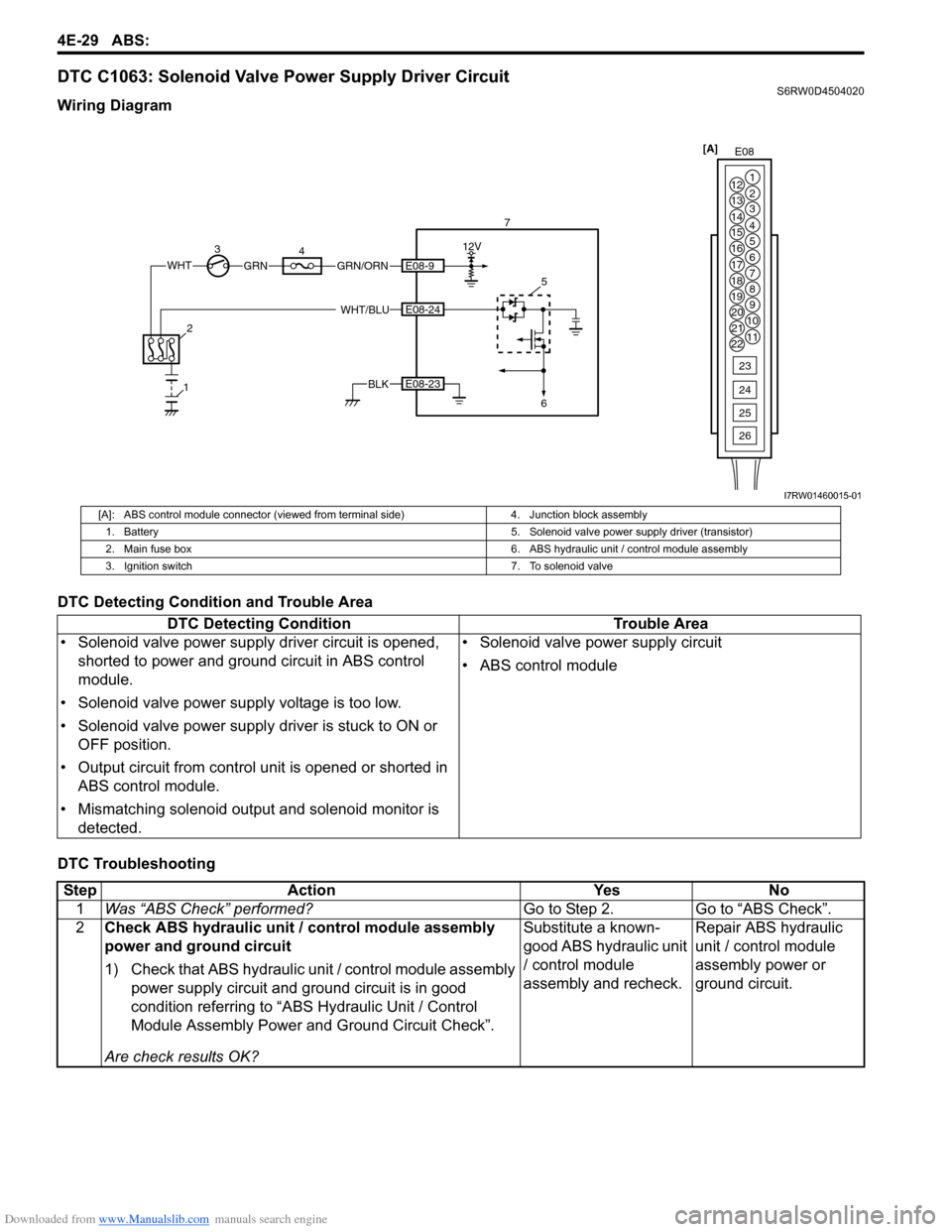
DTC C1063: Solenoid Valve Power Supply Driver CircuitS6RW0D4504020
Wiring Diagram
DTC Detecting Condition and Trouble Area
DTC Troubleshooting
E08 [A]
1
2
3
4
5
6
7 12
13
14
15
16
17
18
19
20
21
228
9
10
11
23
24
25
26
WHTGRN 34 7
E08-23BLK12V
E08-9GRN/ORN
2
1
WHT/BLU5E08-24
6
I7RW01460015-01
[A]: ABS control module connector (viewed from terminal side) 4. Junction block assembly
1. Battery5. Solenoid valve power supply driver (transistor)
2. Main fuse box 6. ABS hydraulic unit / control module assembly
3. Ignition switch 7. To solenoid valve
DTC Detecting Condition Trouble Area
• Solenoid valve power supply driver circuit is opened,
shorted to power and ground circuit in ABS control
module.
• Solenoid valve power supply voltage is too low.
• Solenoid valve power supply driver is stuck to ON or
OFF position.
• Output circuit from control unit is opened or shorted in
ABS control module.
• Mismatching solenoid output and solenoid monitor is
detected.• Solenoid valve power supply circuit
• ABS control module
Step Action Yes No
1Was “ABS Check” performed?Go to Step 2. Go to “ABS Check”.
2Check ABS hydraulic unit / control module assembly
power and ground circuit
1) Check that ABS hydraulic unit / control module assembly
power supply circuit and ground circuit is in good
condition referring to “ABS Hydraulic Unit / Control
Module Assembly Power and Ground Circuit Check”.
Are check results OK?Substitute a known-
good ABS hydraulic unit
/ control module
assembly and recheck.Repair ABS hydraulic
unit / control module
assembly power or
ground circuit.
Page 635 of 1556

Downloaded from www.Manualslib.com manuals search engine ABS: 4E-30
DTC C1071: Control Module Internal DefectS6RW0D4504021
DTC Detecting Condition and Trouble Area
DTC Troubleshooting
ABS Hydraulic Unit / Control Module Assembly Power and Ground Circuit CheckS6RW0D4504022
Wiring Diagram
Circuit Description
When the ignition switch is turned ON, power supply is supplied to ABS control module. And, power supply is supplied
to pump motor and solenoid valve in other line by the switching function in ABS control module. DTC Detecting Condition Trouble Area
ABS control module internal defect is detected. • ABS control module
Step Action Yes No
1Was “ABS Check” performed?Go to Step 2. Go to “ABS Check”.
2Check ABS hydraulic unit / control module assembly
power and ground circuit
1) Check that ABS hydraulic unit / control module assembly
power supply circuit and ground circuit is in good
condition referring to “ABS Hydraulic Unit / Control
Module Assembly Power and Ground Circuit Check”.
Are check results OK?Substitute a known-
good ABS hydraulic unit
/ control module
assembly and recheck.Repair ABS hydraulic
unit / control module
assembly power or
ground circuit.
E08 [A]
1
2
3
4
5
6
7 12
13
14
15
16
17
18
19
20
21
228
9
10
11
23
24
25
26
WHTGRN
35
6
7
84
E08-23BLK
12V
E08-25
E08-24
E08-9
WHT/RED
WHT/BLU
GRN/ORN
2
1
12V
I6RW0C450004-01
[A]: ABS control module connector (viewed from terminal side) 5. ABS hydraulic unit / control module assembly
1. Battery6. To pump motor driver
2. Main fuse box 7. Solenoid valve power supply driver
3. Ignition switch 8. To solenoid valve
4. Junction block assembly
Page 636 of 1556

Downloaded from www.Manualslib.com manuals search engine 4E-31 ABS:
Troubleshooting
Repair Instructions
ABS Hydraulic Unit Operation CheckS6RW0D4506001
1) Check that basic brake system other than ABS is in
good condition.
2) Check that battery voltage is 11 V or more.
3) Hoist vehicle.
4) Set transmission to neutral (P range for A/T) and
release parking brake.
5) Turn each wheel gradually by hand to check if brake
dragging occurs. If it does, correct.
6) Connect SUZUKI scan tool to data link connector
(DLC) (1) with ignition switch OFF.
Special tool
(A): SUZUKI scan tool Step Action Yes No
1Check fuse
Are main fuses and circuit fuses for ABS in good condition?Go to Step 2. Replace fuse and check
for short circuit to
ground.
2Check ABS control module power supply circuit
1) Turn ignition switch to OFF position.
2) Disconnect ABS control module connector.
3) Check for proper connection to ABS control module
connector at terminals “E08-9”, “E08-23”, “E08-24”, and
“E08-25”.
4) If OK, then turn ignition switch to ON position and
measure voltage between terminal “E08-9” and vehicle
body ground.
Is it 10 – 14 V?Go to Step 3. “GRN/ORN” circuit
open.
3Pump motor and solenoid valve power supply circuit
1) Turn ignition switch to OFF position.
2) Measure voltage between each terminal of “E08-24”,
“E08-25” and vehicle body ground.
Are they 10 – 14 V?Go to Step 4. “WHT/BLU” and/or
“WHT/RED” circuit
open.
4Check ABS hydraulic unit / control module assembly
ground circuit
1) Measure resistance between terminal “E08-23” and
vehicle body ground.
Is resistance less than 2
Ω?ABS hydraulic unit /
control module
assembly power and
ground circuits are in
good condition.“BLK” circuit open or
high resistance.
(A)
1
I5RW0A450007-01
Page 639 of 1556

Downloaded from www.Manualslib.com manuals search engine ABS: 4E-34
Installation
1) Install hydraulic unit / control module assembly by
reversing removal procedure noting the following.
Install ABS hydraulic unit / control module assembly
bracket bolt as follows.
a) Tighten bracket bolt (1) and (2) by hand.
b) Then tighten bracket bolt to specified torque.
Tightening order (1) → (2)
Tightening torque
Brake pipe flare nut (a): 16 N·m (1.6 kgf-m, 11.5
lb-ft)
ABS hydraulic unit / control module assembly
bolt (b): 9 N·m (0.9 kgf-m, 6.5 lb-ft)
ABS hydraulic unit / control module assembly
bracket bolt (c): 26 N·m (2.6 kgf-m, 19.0 lb-ft)2) Bleed air from brake system referring to “Air
Bleeding of Brake System in Section 4A”.
3) Check each installed part for fluid leakage and
perform “ABS Hydraulic Unit Operation Check”.
NOTE
For new ABS hydraulic unit / control module
assembly, if “ABS Hydraulic Unit Operation
Check” has not been performed, ABS
warning light may flash when ignition switch
is turned ON position.
Accordingly preform “ABS Hydraulic Unit
Operation Check” to stop flashing of ABS
warning light.
Front and Rear Wheel Speed Sensor On-Vehicle
Inspection
S6RW0D4506005
Output Voltage Inspection
1) Disconnect negative (–) cable from battery.
2) Hoist vehicle a little.
3) Disconnect wheel speed sensor connector.
4) Set up measuring device as shown in figure, the
resistance to 115 Ω and the power supply voltage to
12 V.
CAUTION!
Incorrect voltage and/or wrong connection
cause damage to wheel speed sensor.
I6RW0C450011-01
1. Wheel speed sensor connector 4. “BLK” wire terminal
2. Resistance (115Ω) 5. Power supply (12 V)
3. “WHT” wire terminal
V
41
3
2
5
I5JB0A450026-03
Page 649 of 1556

Downloaded from www.Manualslib.com manuals search engine Automatic Transmission/Transaxle: 5A-1
Transmission / Transaxle
Automatic Transmission/Transaxle
Precautions
Precautions in Diagnosing TroubleS6RW0D5100001
• Do not disconnect couplers from TCM, battery cable
from battery, TCM ground wire harness from engine or
main fuse before checking the diagnostic information
(DTC, freeze frame data, etc.) stored in TCM memory.
Such disconnection will clear memorized information
in TCM memory.
• Diagnostic information stored in TCM memory can be
cleared as well as checked by using SUZUKI scan
tool or CAN communication OBD generic scan tool.
Before using scan tool, read its Operator’s
(Instruction) Manual carefully to have good
understanding as to what functions are available and
how to use it.
It is indistinguishable which module turns on MIL
because not only ECM but also TCM turns on MIL.
Therefore, check both ECM and TCM for DTC when
MIL lights on.
When checking TCM for DTC, keep in mind that DTC
is displayed on the scan tool as follows depending on
the scan tool used.
– SUZUKI scan tool displays DTC detected by TCM.
– CAN communication OBD generic scan tool
displays DTC detected by each of ECM and TCM
simultaneously.
• Be sure to read “Precautions for Electrical Circuit
Service in Section 00” before inspection and observe
what is written there.
• TCM replacement
– When substituting a known-good TCM, check that
all relays and actuators have resistance of
specified value.
Neglecting this check may result in damage to good
TCM.
• Communication of ECM, BCM, combination meter,
keyless start control module (if equipped), ABS
control module, 4WD control module (if equipped),
TCM and DLC, is established by CAN (Controller
Area Network). (For more detail of CAN
communication for ECM, refer to “CAN
Communication System Description”). Therefore,
handle CAN communication line with care referring to
“Precaution for CAN Communication System in
Section 00”.
Precautions for Disassembly and ReassemblyS6RW0D5100002
When repairing automatic transaxle, it is necessary to
conduct the on-vehicle test to investigate where the
cause of the trouble lies first.
Then whether overhaul should be done or not is
determined. If the transaxle is disassembled without
such preliminary procedure, not only the cause of the
trouble would be unknown, but also a secondary trouble
may occur and often time would be wasted.
As the automatic transaxle consists of high precision
component, the following cautions should be strictly
observed when handling its parts in disassembly and
reassembly.
• Disassembling valve body assembly is prohibited
essentially. However, a few parts can be
disassembled. When disassembling valve body
component parts, confirm whether their parts are
allowed to disassemble or not referring to “Valve Body
Assembly Disassembly and Reassembly”.
• When component part of forward clutch, direct clutch,
2nd brake and/or O/D and 2nd coast brake, namely
clutch disc, brake disc, retaining plate and/or
separator plate, have been replaced, all learned
contents, which have been stored in TCM memory by
executing learning control, should be initialized
referring to “Learning Control Initialization”.
• Make sure to wash dirt off from the transaxle so that
no such dirt will enter the transaxle during
dismounting and remounting.
• Select a clean place free from dust and dirt for
overhauling.
• Place a rubber mat on the work bench to protect parts
from damage.
• Work gloves or shop cloth should not be used. (Use a
nylon cloth or a paper towel.)
• When separating the case joint, do not pry with a
screwdriver or such but tap with a plastic hammer
lightly.
• Make sure to wash dirt off from the transaxle so that
no such dirt will enter the transaxle during
disassembly and reassembly.
• Wash the disassembled parts in ATF (Automatic
Transaxle Fluid) or kerosene (using care not to allow
ATF or kerosene to get on your face, etc.) and confirm
that each fluid passage is not clogged by blowing air
into it. But use kerosene to wash the discs, resin
washers and rubber parts.
• Replace each gasket, oil seal and O-ring with a new
one.
• Apply ATF to sliding or rotating parts before
reassembly.
Page 650 of 1556

Downloaded from www.Manualslib.com manuals search engine 5A-2 Automatic Transmission/Transaxle:
CAUTION!
• Keep component parts in group for each
subassembly and avoid mixing them up.
• Clean all parts with cleaning solvent
thoroughly and air dry them.
• Use kerosene or automatic transaxle fluid
as cleaning solvent.
• Do not use wiping cloths or rags to clean
or dry parts.
• All oil passages should be blown out and
checked to make sure that they are not
obstructed.
• Keep face and eyes away from solvent
spray while air blowing parts.
• Check mating surface for irregularities and
remove them, if any, and clean it again.
• Soak new clutch discs and brake discs in
transaxle fluid for at least 2 hours before
assembly.
• Replace all gaskets and O-ring with new
ones.
• Apply automatic transaxle fluid to all O-
rings.
• When installing seal ring, be careful so that
it is not expanded excessively, extruded or
caught.
• Replace oil seals that are removed and
apply grease to their lips.
• Before installing, be sure to apply
automatic transaxle fluid to sliding, rolling
and thrusting surface of all component
part. Also after installation, make sure to
check each part for proper operation.
• Always use torque wrench when
tightening bolts.
• A new discs should be soaked in ATF at least 2 hours
before use.Part Inspection and Correction Table
Part Inspect for Correction
Casted part,
machined partSmall flaw, burr Remove with oil
stone.
Deep or grooved
flawReplace part.
Clogged fluid
passageClean with air or
wire.
Flaw on installing
surface, residual
gasketRemove with oil
stone or replace
part.
Crack Replace part.
Bearing Unsmooth rotation Replace.
Streak, pitting, flaw,
crackReplace.
Bushing, thrust
washerFlaw, burr, wear,
burningReplace.
Oil seal, gasket Flawed or
hardened seal ringReplace.
Worn seal ring on
its periphery or sideReplace.
Piston seal ring, oil
seal, gasket, etc.Replace.
Gear Flaw, burr Replace.
Worn gear tooth Replace.
Splined part Burr, flaw, torsion Correct with oil
stone or replace.
Snap ring Wear, flaw,
distortionReplace.
No interference Replace.
Thread Burr Replace.
Damage Replace.
Spring Settling, sign of
burningReplace.
Friction plate Wear, burning,
distortion,
damaged clawReplace.
Separator
plate, retaining
plateWear, burning,
distortion,
damaged clawReplace.
Sealing
surface (where
lip contacts)Flaw, rough
surface, stepped
wear, foreign
materialReplace.
Page 651 of 1556

Downloaded from www.Manualslib.com manuals search engine Automatic Transmission/Transaxle: 5A-3
General Description
A/T DescriptionS6RW0D5101001
This automatic transaxle is electronic control full automatic transaxle with forward 3-speed plus overdrive (O/D) and
reverse 1-speed.
The torque converter is a 3-element, 1-step and 2-phase type and is equipped with an automatically controlled lock-up
mechanism.
The gear change device consists of a ravigneau type planetary gear unit, 3 multiple disc type clutches, 3 multiple disc
type brakes and 2 one-way clutches.
The hydraulic pressure control device consists of a valve body assembly, pressure control solenoid valve (linear
solenoid), 2 shift solenoid valves, TCC solenoid valve (TCC pressure control solenoid valve) (linear solenoid) and a
timing solenoid valve. Optimum line pressure complying with engine torque is produced by the pressure control
solenoid valve in dependence upon control signal from transmission control module (TCM). This makes it possible to
control the line pressure with high accuracy in accordance with the engine power and running conditions to achieve
smooth shifting characteristics and high efficiency.
A clutch-to-clutch control system is provided for shifting between 3rd gear and 4th gear. This clutch-to-clutch control
system is made to function optimally, so that hydraulic pressure controls such as shown below are conducted.
• When upshifting from 3rd gear to 4th gear, to adjust the drain hydraulic pressure at releasing the forward clutch, a
timing solenoid valve is used to switch a hydraulic passage with an orifice to another during shifting.
• When downshifting from 4th gear to 3rd gear, to adjust the line pressure applied to the forward clutch at engaging
the forward clutch, a timing solenoid valve is used to switch a hydraulic passage with an orifice to another during
shifting.
• When upshifting from 3rd gear to 4th gear with engine throttle opened, to optimize the line pressure applied to the
forward clutch at releasing the forward clutch, the learning control is processed to compensate the switching timing
of the timing solenoid at every shifting.
• When downshifting from 4th gear to 3rd gear with engine throttle opened, to optimize the line pressure applied to
the forward clutch at engaging the forward clutch, the learning control is processed to compensate the line pressure
at every shifting.
Employing the ravigneau type planetary gear unit and this clutch-to-clutch control system greatly simplifies the
construction to make possible a lightweight and compact transaxle.
A line pressure learning control is conducted to provide optimum shifting time at every upshifting with engine throttle
opened. If long upshifting time is detected, the subsequent line pressure applied during upshifting is intensified. On the
contrary, if short upshifting time is detected, the subsequent line pressure applied during upshifting is weakened.
Page 658 of 1556

Downloaded from www.Manualslib.com manuals search engine 5A-10 Automatic Transmission/Transaxle:
Schematic and Routing Diagram
Transmission Control Module (TCM) Wiring DiagramS6RW0D5102001
12V
12V
12V
IG1
118
9
10
P
R
N
D
2
L12
2.5V
5V
12V
5V
12V
12V
12V
WHT
BLK
BLK
BLK
BLK
PPLBLK/WHT
BLK/ORN
IG11
RED/BLK
YEL/BLKYEL/BLU
LT GRN/BLK
+BB
WHT/RED
14
20 15
16
17
19
12V18
1 2
3
132126
24 27
28
29
30
65
16 15 14 13 12 1143
24 23 212210 9 8 721
19 20 18 17 C06
17 16
26 2515 14 65 342
13 12
23 22 2411 10 9
21 20 1987
18 1 C07
[A]
22
25
YELYEL/GRN
WHT
P
N
BRN LT/GRN
ORN
BLK/YEL
BLU/BLK
GRY
LT GRN/BLKWHT/BLU
WHT/BLK
C06-11
C06-12
C06-16
C06-15
C06-14
C06-4
C06-2
C06-1
C06-23C06-6 C06-24C06-5
C06-3
RED
GRN GRN/ORNPNK/BLK
GRN/YEL
LT GRN/BLKC07-6
C07-16
C07-23 C07-25
C07-20
C07-1
C07-8
C07-7
C07-19
C07-18
4IG11 23
C07-9
YEL
RED
WHTBLU35 34
3637
5REDWHT
7
WHT
RED
33
4
6
C06-7C06-17WHT
REDREDWHT
WHT
12V12V
WHTRED
WHTREDREDWHT
31
32
RED
WHTRED[B]
[C]
I6RW0D510003-02
1. TCM 15. Shift solenoid valve-A (No.1) 29. “ST SIG” fuse
2. Input shaft speed sensor 16. Shift solenoid valve-B (No.2) 30. “ST” fuse
3. Output shaft speed sensor / VSS 17. Timing solenoid valve 31. MIL
4. ECM 18. TCC solenoid valve 32. Transmission warning light (non-Euro-OBD model)
5. Combination meter 19. Pressure control solenoid valve 33. ABS control module
6. BCM 20. A/T 34. To Data link connector
7. 4WD control module (if equipped) 21. A/T relay 35. To BCM
8. “3” position switch 22. Inhibitor switch (including transmission range
sensor)36. Junction connector
9. Shift lock solenoid 23. Starter motor relay 37. Keyless start control module (if equipped)
10. Brake light switch 24. Ignition switch [A]: Terminal arrangement of TCM connector (viewed
from harness side)
11. Transmission range sensor 25. Starter motor [B]: Junction block with BCM model
12. Backup lamp 26. “DOME” fuse [C]: Junction block without BCM model
13. Data link connector (DLC) 27. “AT” fuse
14. Transmission fluid temperature sensor 28. “IG1 SIG” fuse