2006 SUZUKI SX4 MAIN
[x] Cancel search: MAINPage 514 of 1556

Downloaded from www.Manualslib.com manuals search engine 3B-17 Differential:
DTC C1240: 4WD Control Module Power Supply Circuit MalfunctionS6RW0D3204015
Wiring Diagram
DTC Detecting Condition and Trouble Area
DTC Confirmation Procedure
1) Clear DTC using scan tool.
2) Turn ignition switch to ON position for 10 seconds.
3) Check DTC.
Troubleshooting
[A]: 4WD control module connector “G26” (viewed from harness side) 3. “4WD” fuse
1. 4WD control module 4. Main fuse box
2. “IG COIL” fuse
DTC detecting condition Trouble area
4WD control module power supply voltage is out of specification. 4WD control module power supply circuit
5V
5V
G26-12
G26-11
G26-10BLK
WHT/RED
RED/BLK
1
2
3
4
YEL
1 2 3
4 5
6 7 8 9 10 11
12
13
14 15 16
17 18 19
20
21 22
23
24 25 26
[A]
I7RW01320005-01
Step Action Yes No
1Was “4WD control system check” performed?Go to Step 2. Go to “4WD Control
System Check”.
24WD control module power circuit check
1) Disconnect 4WD control module connector with ignition
switch OFF.
2) Check for proper connection to “G26” terminal of 4WD
control module connector.
3) If connection is OK, measure voltage between “G26-11”
terminal of 4WD control module connector and vehicle
body ground with ignition switch ON.
Is it 10 – 14 V?Poor “G26-11”
connection or
intermittent trouble.
Check for intermittent
referring to “Intermittent
and Poor Connection
Inspection in Section
00”. If wire and
connections are OK,
substitute a known-
good 4WD control
module and recheck.“4WD” fuse blown,
“WHT/RED” or “YEL”
wire is circuit open or
circuit short.
Page 566 of 1556
Downloaded from www.Manualslib.com manuals search engine 3D-1 Propeller Shafts:
Driveline / Axle
Propeller Shafts
Precautions
Propeller Shaft CautionS6RW0D3400001
CAUTION!
• All propeller shaft fasteners are an important attaching part in that it could affect the performance of
vital parts and systems, and/or could result in major repair expense. They must be replaced with one
of the same part number or with an equivalent part if replacement becomes necessary. Do not use a
replacement part of lesser quality or substitute design. Torque values must be used as specified
during reassembly to assure proper retention of this part.
• Never attempt to heat, quench or straighten any propeller shaft part. Replace it with a new part, or
damage to the part may result.
General Description
Propeller Shaft ConstructionS6RW0D3401001
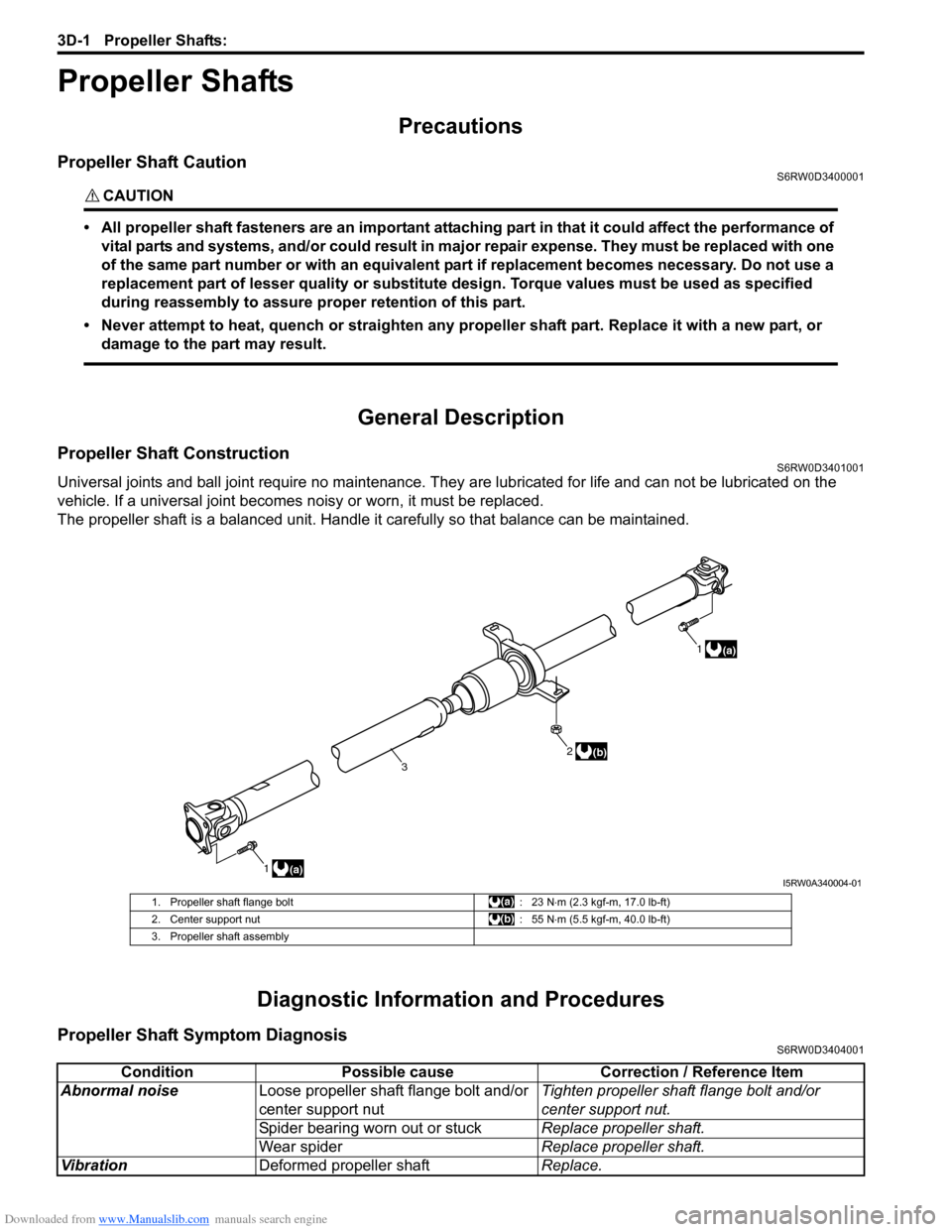
Universal joints and ball joint require no maintenance. They are lubricated for life and can not be lubricated on the
vehicle. If a universal joint becomes noisy or worn, it must be replaced.
The propeller shaft is a balanced unit. Handle it carefully so that balance can be maintained.
Diagnostic Information and Procedures
Propeller Shaft Symptom DiagnosisS6RW0D3404001
1(a)1
(a)
2
3(b)
I5RW0A340004-01
1. Propeller shaft flange bolt : 23 N⋅m (2.3 kgf-m, 17.0 lb-ft)
2. Center support nut : 55 N⋅m (5.5 kgf-m, 40.0 lb-ft)
3. Propeller shaft assembly
Condition Possible cause Correction / Reference Item
Abnormal noiseLoose propeller shaft flange bolt and/or
center support nutTighten propeller shaft flange bolt and/or
center support nut.
Spider bearing worn out or stuckReplace propeller shaft.
Wear spiderReplace propeller shaft.
VibrationDeformed propeller shaftReplace.
Page 575 of 1556

Downloaded from www.Manualslib.com manuals search engine Brake Control System and Diagnosis: 4A-4
Rear Brake Hose / Pipe ConstructionS6RW0D4101003
Diagnostic Information and Procedures
Brakes Diagnosis NoteS6RW0D4104001
Road Testing Brakes
Brakes should be tested on dry, clean, smooth and
reasonably level roadway which is not crowned. Road
test brakes by making brake applications with both light
and heavy pedal forces at various speeds to determine if
the vehicle stops evenly and effectively. Also drive
vehicle to see if it leads to one side or the other without
brake application. If it does, check the tire pressure, front
wheel alignment and front suspension attachments for
looseness. See diagnosis table for other causes.
Brake Fluid Leaks
Check the master cylinder fluid levels. While a slight
drop in reservoir level does result from normal lining
wear, an abnormally low level indicates a leak in the
system. In such a case, check the entire brake system
for leakage. If even a slight evidence of leakage is noted,
the cause should be corrected or defective parts should
be replaced.Substandard or Contaminated Brake Fluid
Improper brake fluid, mineral oil or water in the fluid may
cause the brake fluid to boil or the rubber components
(piston cups and brake hoses) in the hydraulic system to
deteriorate.
If the above fluid is included in the system, replace the
master cylinder assembly and other rubber components
(hoses). The master cylinder assembly is disassemble
parts to maintain the performance.
The system must be flushed if there is any doubt as to
the grade of fluid in the system or if fluid has been used
which contained parts that have been subjected to
contaminated fluid.
I6RW0D410001-01
1. To left rear brake hose 5. Left rear brake hose to left brake
2. To right rear brake hose 6. Right rear brake hose to right brake
3. Left rear brake hose : 16 N⋅m (1.6 kgf-m, 12.0 lb-ft)
4. Right rear brake hose
Page 578 of 1556

Downloaded from www.Manualslib.com manuals search engine 4A-7 Brake Control System and Diagnosis:
Repair Instructions
Brake Pedal ComponentsS6RW0D4106018
CAUTION!
If equipped Brake Pedal Foot Protection
System, never disassemble brake pedal
assembly. Disassemble will spoil its original
function. If faulty condition is found, replace
it with new one.
Brake Pedal Free Height InspectionS6RW0D4106001
1) Check brake pedal free height. If it is not within
specification, check and adjust following item 2) and
6).
Brake pedal free height “a” from carpet
111 – 131 mm (4.4 – 5.1 in.)
2) Check measurement between booster mounting
surface and center of clevis pin hole. When booster
push rod clevis has been reinstalled, it is important
that the measurement is adjusted (refer to “Brake
Booster Inspection”).
3) Check brake light switch position. Adjust it if it is out
of specification.
4) Check pedal for dent.
5) Check brake booster for installation.6) Check brake booster push rod for length.
Brake Pedal Play InspectionS6RW0D4106002
Pedal play should be within the following specification. If
out of specification, check brake light switch for proper
installation position and adjust if necessary.
Also check pedal shaft bolt and booster clevis pin
installation for looseness and replace if defective.
Brake pedal play
“a”
: 1 – 8 mm (0.04 – 0.31 in.)
Excessive Pedal Travel InspectionS6RW0D4106003
1) Start engine.
2) Depress brake pedal a few times.
3) With brake pedal depressed with approximately 300
N (30 kg, 66 lbs) load, measure brake pedal to wall
(dash panel silencer) clearance “a”. If clearance is
out of specification, possible causes are as follows.
If clearance “a” is less than specification, the most
possible cause is that air is in lines or brake fluid
leakage.
Should clearance “a” remain less than specification
even after bleeding of system, other possible but
infrequent cause is malfunction of booster push rod
length out of adjustment.
• Bleed brake system. Refer to “Air Bleeding of
Brake System”.
Brake pedal arm to wall clearance
“a”
When pedal is depressed at 300 N (30 kg, 66 lbs)
: Over 40 mm (1.57 in.)
[A]: A/T model : 13 N⋅m (1.3 kgf-m, 9.5 lb-ft)
1. Brake pedal : 23 N⋅m (2.3 kgf-m, 16.5 lb-ft)
2. Brake pedal bracket
I6RW0C410004-01
I6RW0C410005-01
“a”I3RH0A410010-01
I6RW0C410006-01
Page 581 of 1556

Downloaded from www.Manualslib.com manuals search engine Brake Control System and Diagnosis: 4A-10
• Check to make sure that flexible hose doesn’t contact
any part of suspension, both in extreme right and
extreme left turn conditions. If it does at any point,
remove and correct. Fill and maintain brake fluid level
in reservoir.
• Bleed brake system. Refer to “Air Bleeding of Brake
System”.
• Perform brake test and check installed part for fluid
leakage.
Rear Brake Hose / Pipe Removal and
Installation
S6RW0D4106008
CAUTION!
Do not allow brake fluid to get on painted
surfaces. Painted surfaces will be damaged
by brake fluid, flush it with water immediately
if any fluid is spilled.
Removal
1) Raise and support vehicle properly. Remove tire and
wheel.
2) Clean dirt and foreign material from both flexible
hose end and pipe end fittings.
3) Drain brake fluid in reservoir.
4) Remove brake flexible hose or pipe.
Installation
Reverse brake flexible hose removal procedure, noting
the following.
• Install clamps and tighten nuts referring to “Rear
Brake Hose / Pipe Construction”.
• Fill and maintain brake fluid level in reservoir.
• Bleed brake system. Refer to “Air Bleeding of Brake
System”.
• Perform brake test and check each installed part for
fluid leakage.
• When installing hose, make sure that it has no twist or
kink.
Brake Hose and Pipe InspectionS6RW0D4106009
Hose
The brake hose assembly should be checked for road
hazard damage, for cracks and chafing of outer cover,
for leaks and blisters. A light and mirror may be needed
for an adequate inspection. If any above conditions are
observed on brake hose, it is necessary to replace it.
Pipe
Inspect the pipe for damage, cracks, dents and
corrosion. If any defect is found, replace it.
2. Location mark
3. Outside of vehicle
4. Inside of vehicle
I7RW01410007-02
I5RW0A410007-01
Page 589 of 1556

Downloaded from www.Manualslib.com manuals search engine Front Brakes: 4B-2
Front Disc Brake Pad On-Vehicle InspectionS6RW0D4206002
Inspect pad linings (1) periodically according to
maintenance schedule whenever wheels are removed
(for tire rotation or other reason). Take a look through
each end and inspection hole of caliper and check lining
thickness of outside and inside pads.
If lining is worn and its thickness (“a” in figure) is less
than limit, all pads must be replaced at the same time.
Front brake pad thickness “a” (lining thickness)
Standard: 10 mm (0.39 in.)
Limit: 2 mm (0.08 in.)
Front Disc Brake Pad Removal and InstallationS6RW0D4206003
NOTE
When replacing brake pad, replace it on the
right and left.
Removal
1) Hoist vehicle and remove front wheel.
2) Remove caliper pin bolts (1).
3) Remove caliper (1) from caliper carrier (2).
NOTE
Hang removed caliper (1) with a wire hook (4)
or the like so as to prevent brake hose from
bending and twisting excessively or being
pulled.
Don’t operate brake pedal with brake pads
removed.
4) Remove brake pads (3).
5) Remove brake pad spring (1) as show in figure.
Installation
1) Apply small amount of pad grease “a” (included in
spare parts) to pad spring and set brake pad spring
as shown in figure.
2) Set brake pad springs (1), and install brake pads (2)
and shim (4).
NOTE
Install the brake pad with wear indicator (3) to
the vehicle center side of front right brake
pad.
I7RW01420009-01
1
I7RW01420003-01
42
3
1
I7RW01420010-01
1
I7RW01420014-01
"a"
I7RW01420011-01
I7RW01420012-01
Page 607 of 1556

Downloaded from www.Manualslib.com manuals search engine ABS: 4E-2
General Description
ABS DescriptionS6RW0D4501001
The ABS (Antilock Brake System) controls the fluid
pressure applied to the wheel cylinder of each brake
from the master cylinder so that each wheel is not locked
even when hard braking is applied.
This ABS has also the following function.
While braking is applied, but before ABS control
becomes effective, braking force is distributed between
the front and rear so as to prevent the rear wheels from
being locked too early for better stability of the vehicle.
The main component parts of this ABS include the
following parts in addition to those of the conventional
brake system.
• Wheel speed sensor which senses revolution speed
of each wheel and outputs its signal.
Rear wheel speed sensor of 4WD vehicle is
integrated in rear wheel hub assembly and supplied
as rear wheel hub assembly part.
Front wheel speed sensor and rear wheel speed
sensor of 2WD model are separated from wheel hub
assembly and supplied as spare parts.
• ABS warning light which lights to inform abnormality
when system fails to operate properly.• ABS hydraulic unit / control module assembly is
incorporated ABS control module, ABS hydraulic unit
(actuator assembly), solenoid valve power supply
driver (transistor), solenoid valve driver (transistor),
pump motor driver (transistor).
– ABS control module which sends operation signal
to ABS hydraulic unit to control fluid pressure
applied to each wheel cylinder based on signal
from each wheel speed sensor so as to prevent
wheel from locking.
– ABS hydraulic unit which operates according to
signal from ABS control module to control fluid
pressure applied to wheel cylinder of each 4
wheels.
– Solenoid valve power supply driver (transistor)
which supplies power to solenoid valve in ABS
hydraulic unit.
– Solenoid valve driver (transistor) which controls
each solenoid valves in ABS hydraulic unit.
– Pump motor driver (transistor) which supplies
power to pump motor in ABS hydraulic unit.
• G sensor which detects body deceleration speed for
4WD model.
This ABS is equipped with Electronic Brake force
Distribution (EBD) system that controls a fluid pressure
of rear wheels to best condition, which is the same
function as that of proportioning valve, by the signal from
wheel sensor independently of change of load due to
load capacity and so on. And if the EBD system fails to
operate properly, the brake warning light lights to inform
abnormality.
Page 611 of 1556

Downloaded from www.Manualslib.com manuals search engine ABS: 4E-6
17+BB
18BLU
WHT12VGRN/ORN 34
30E08-9
RED
WHT 1226
WHT/RED
12V
E08-7
19GRN
GRN
E08-16
12V
5
76
21REDRED/BLK
12V
BLKWHTE08-22 E08-11
23BLKWHTLT GRN/BLKLT GRN
12V
E08-10 E08-21
E08-23
E08-26
E08-1E08-12
24BLKWHT
12V
YELBRNE08-19 E08-20
27
1 2
RED/BLK
WHTRED
WHTRED
WHTRED9
E08-2E08-13WHT
E08-6
RED
9
9
11
9
9
9
REDWHT
WHTRED
12VE08-25
M
BLK
BLK
WHT/BLUWHT/RED
WHT/BLUE08-24
WHT
E08 [A]
1
2
3
4
5
6
7 12
13
14
15
16
17
18
19
20
21
228
9
10
11
23
24
25
26
GRN/WHT
22
12V
BLKWHTWHTWHT/BLKE08-17 E08-18
GRN/ORN28
2033
31
29
25
15
32
GRN/YELE08-3GRN/BLK
8
12V
12V
13
14RED/BLK
RED/BLU
WHTRED6
16
10
BLK [B]
I6RW0D450001-02
[A]: Junction block with BCM 10. G sensor (4WD model) 22. Right-front wheel speed sensor
[B]: Junction block without BCM 11. 4WD control module 23. Left-rear wheel speed sensor
[C]: Terminal arrangement of ABS control module
connector (viewed from terminal side)12. BCM 24. Right-rear wheel speed sensor
1. Battery 13. Brake fluid level switch 25. ABS hydraulic unit / control module assembly
2. Main fuse box 14. Parking brake switch 26. Brake light switch
3. Ignition switch 15. CAN junction connector 27. Brake light
4. Junction block assembly 16. Keyless start control module 28. To ECM and shift lock relay (A/T model)
5. Combination meter 17. Data link connector (DLC) 29. Pump motor driver (transistor)
6. ABS warning light 18. To BCM, 4WD control module, P/S control
module, HVAC control module (auto A/C
model) and SDM30. Pump motor
7. EBD warning light (brake warning light)19. ECM 31. Solenoid valve power supply driver
8. Light driver module 20. TCM (A/T model) 32. Solenoid valve
9. CAN driver 21. Left-front wheel speed sensor 33. Solenoid valve driver (transistor)